Rook earrings sit in one of the trickiest spots on the ear, so buying the wrong shape or metal is easy and expensive. The piercing runs through the antihelix, the raised fold above the tragus, on the ridge between the inner and outer conch. Unlike most ear piercings, the jewelry enters and exits the same side rather than passing front to back. That single anatomical quirk decides which pieces fit, how a fresh channel heals, and why a curved barbell is the only sensible starter. Get the gauge, length, and material right and the rest of the decision is styling.
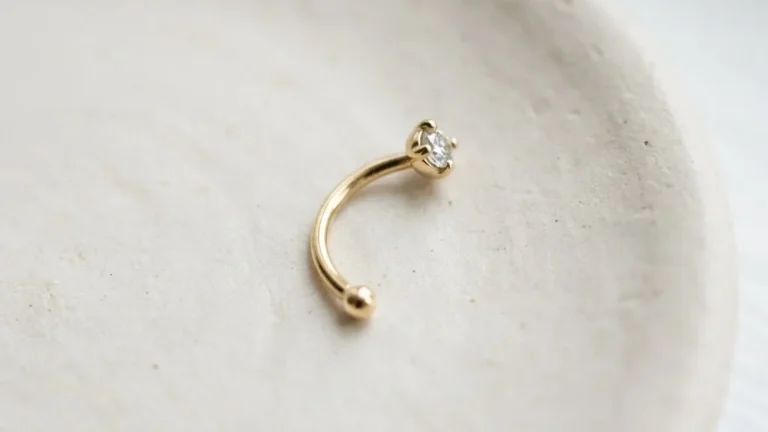
Quick answer: Rook earrings should start as a 16G (1.2mm) internally threaded curved barbell, usually 6mm to 8mm long, in implant-grade titanium meeting ASTM F136 or F67. Expect roughly 6 months of primary healing and up to 12 to 18 months for full maturity. Only after the channel is fully healed should you swap in a hinged ring, clicker, or captive bead ring. Hoop inner diameters of 5mm to 8mm suit most anatomy, with 6mm a comfortable common starting point.
What a Rook Piercing Is and Where the Jewelry Sits
A rook piercing passes through the antihelix, the curved ridge of cartilage above the tragus and between the inner and outer conch. The jewelry enters and exits on the same side of that fold, which sets it apart from lobe or helix piercings that run cleanly front to back. Because the bar sits in dense, folded cartilage, the pressure and healing behavior differ from softer tissue. Not every ear has a rook ridge pronounced enough to hold jewelry well, which is why a piercer assesses the fold before marking anything. Anatomy, not fashion, dictates whether the placement is even possible.
- Location: the antihelix fold, on the ridge above the tragus.
- Path: enters and exits the same side, not front to back.
- Tissue: thick cartilage, which affects fit and healing.
- Screening: a piercer confirms the ridge is prominent enough.
If you are still comparing ear projects, the placement sits near several cartilage neighbors. Our triple helix cartilage piercing placement guide covers a stackable outer-ear option, while the ear piercing pain chart by placement gives context for how the rook compares against softer spots.
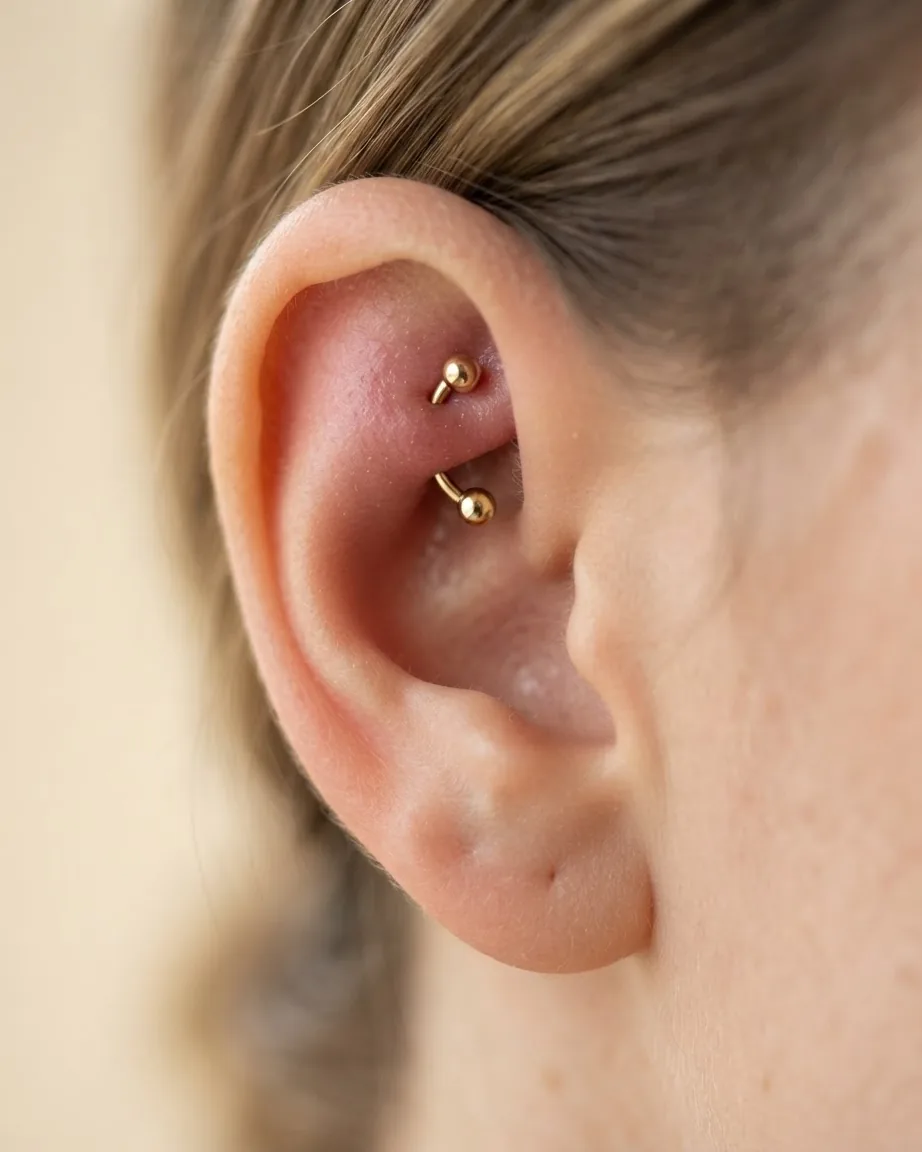
Rook Earring Sizing: The Exact Gauge, Length, and Diameter
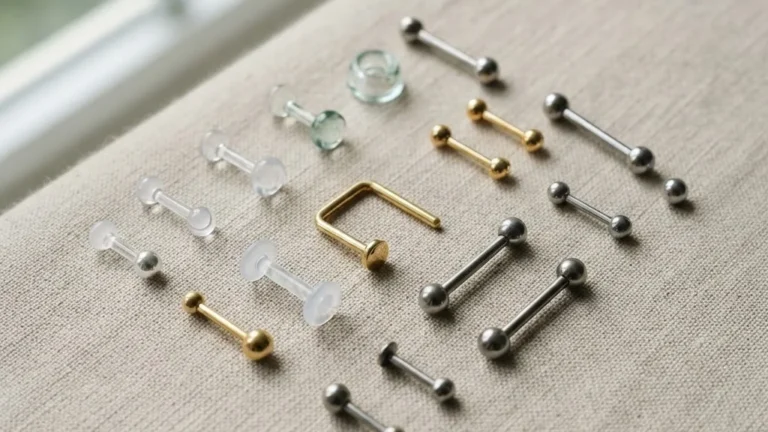
Sizing is where most shoppers go wrong, because product pages rarely publish numbers. The standard rook gauge is 16G, which equals 1.2mm, though 18G at 1.0mm also appears. Curved barbell length typically runs 6mm to 8mm, stretching up to 10mm for thick cartilage. When you move to a healed-piercing hoop, inner diameter usually sits between 5mm and 8mm, with 6mm a common comfortable start. Decorative ends land around 3mm to 5mm. These are starting references, not prescriptions: your piercer measures your fold, and higher placements generally call for a larger hoop diameter.
A quick reference table for the common measurements:
| Element | Common size | Range |
|---|---|---|
| Gauge | 16G (1.2mm) | 18G (1.0mm) also used |
| Curved barbell length | 6mm to 8mm | up to 10mm thick cartilage |
| Hoop inner diameter | 6mm | 5mm to 8mm |
| Ball or end | 3mm to 5mm | style dependent |
Two practical notes. First, a barbell that is too tight restricts circulation and traps normal secretions, while one too long catches and drags on the healing channel. Second, gauge matters for stability: jewelry that is too thin can be treated by the body like a splinter, which drives migration or rejection. The Association of Professional Piercers stresses that both size and gauge must suit your individual anatomy, not a generic default.
Because the rook uses the same curved-barbell logic as its dedicated jewelry, the deeper mechanical breakdown lives in our rook piercing jewelry barbell and material guide, which walks through length math for swollen versus settled tissue. Understanding the difference between these dimensions prevents the common issue of jewelry shifting or becoming uncomfortable after initial swelling subsides.
When selecting your first piece, prioritize a piece with a slightly longer barbell to account for immediate post-piercing swelling. An experienced piercer will select the length based on your specific tissue thickness to allow for this expansion.
Best Metals for Rook Earrings and What the Standards Mean
Metal choice is the highest-stakes decision for rook earrings because the jewelry lives inside a wound for months. The Association of Professional Piercers lists implant-grade titanium as an acceptable initial material, specifically Ti-6Al-4V ELI meeting ASTM F136 and commercially pure titanium meeting ASTM F67. That F136 alloy is roughly 90 percent titanium, 6 percent aluminum, and 4 percent vanadium, with nickel held below 0.05 percent. Other defensible options include niobium, medical-grade PTFE, and solid nickel-free 14k or 18k gold. The phrase “surgical steel,” by contrast, is an unregulated marketing term unless it names a real grade.
Here is what the alphabet soup actually refers to:
- ASTM International publishes the alloy specs: F136 and F67 for titanium, F138 for implant steel, and F2384 for niobium.
- ISO, the International Organization for Standardization, mirrors them: ISO 5832-3 for titanium and ISO 5832-1 for steel.
- ELI means Extra Low Interstitial, the cleaner grade of the Ti-6Al-4V alloy used for implants.
- Reputable makers such as Anatometal, Industrial Strength, and NeoMetal supply APP-aligned implant-grade pieces.
The proof that separates a trustworthy retailer from a marketing claim is the mill test certificate, a document that ties a batch of metal to its ASTM or ISO grade. The APP guidance on jewelry for initial piercings recommends asking your piercer to see those certificates, noting that their presence signals sourcing from reputable manufacturers. A page that says “titanium” without a grade, or “hypoallergenic” without a nickel figure, is asserting rather than proving.
Steel deserves a specific caution. Only a few grades qualify as biocompatible, notably steel that is ASTM F138 compliant or ISO 5832-1 compliant. Generic “316L surgical stainless” that names no standard offers no such assurance, which is why titanium is the safer default for anyone unsure of their nickel status. If you are weighing metal choices for a different placement, the same grade logic applies in our diamond nose piercing safe metal guide.
For individuals with known metal sensitivities, even “nickel-free” is sometimes insufficient if the manufacturing process allowed contamination. Always prioritize companies that explicitly provide nickel release data based on standardized testing. Mill certificates are not just for professionals; they are your assurance that the alloy in your ear is consistent with your safety requirements.
Nickel, Allergy Risk, and the Legal Release Limits
Nickel is the single biggest reason a rook earring turns red, itchy, and slow to heal. Nickel sensitization affects roughly 10 to 20 percent of the population and is higher in women, with more than 10 percent of women under 30 sensitized. Once you are sensitized, the reaction is lasting, so prevention through low-release metal is the only reliable strategy for a piece worn continuously against pierced tissue.
The law sets hard numbers. In the European Union, REACH Annex XVII Entry 27, administered by the European Chemicals Agency (ECHA), caps nickel release at less than 0.2 micrograms per square centimeter per week for posts inserted into pierced parts, and less than 0.5 micrograms per square centimeter per week for articles in prolonged skin contact. Compliance is verified with EN 1811, the reference test method updated as EN 1811:2023, which immerses jewelry in artificial sweat at pH 6.5 and 30 degrees Celsius for seven days, then measures dissolved nickel by mass spectrometry.
China mirrors those thresholds under GB 28480-2012, setting the same 0.2 micrograms per square centimeter per week for body piercing and 0.5 for prolonged skin contact. The Nickel Institute publishes the sensitization reference data behind these limits. The American Academy of Dermatology explains in its guidance on avoiding nickel exposure that choosing jewelry carefully is the primary defense once a rash appears, and clinical dermatology bodies describe nickel allergy as an immune reaction that recurs on every contact.
For a fresh rook piercing, the practical takeaway is simple: implant-grade titanium sits far below these release limits, which is precisely why the APP puts it first for initial jewelry. If nickel worries you across the board, the same reasoning drives the recommendations in our flat-back stud jewelry standard guide. Understanding that nickel-release is a measurable quantity rather than a binary quality helps you bypass marketing fluff.
Troubleshooting persistent irritation starts by identifying the metal composition. If you purchased jewelry from an outlet that failed to provide a mill certificate or a nickel-release certification, the metal is the first variable to swap. Replacing unidentified steel with ASTM F136 titanium often resolves symptoms within days if the reaction was indeed nickel-based.
Rook Piercing Pain and Realistic Healing Timeline
The rook hurts more than a lobe and more than many outer-ear piercings, because the needle passes through thick, folded cartilage rather than soft tissue. Pain is subjective and brief, but the healing that follows is the part that tests patience. Primary healing takes roughly 6 months, and full maturity runs 12 to 18 months, though many retail guides quote a 6 to 12 month window. “Healed” is not the same as “comfortable.” Until the channel is fully closed and stable, the piercing remains vulnerable to trauma every time you sleep on it or catch it.
What the timeline means in practice:
- Weeks 0 to 8: tenderness, some swelling, and clear or straw-colored crusting are normal.
- Around 6 months: primary healing; the surface feels settled but the interior is not done.
- 12 to 18 months: full healing, after which jewelry changes are lower risk.
Do not judge readiness to change jewelry by how it looks. A rook that seems fine at three months can react badly to an early swap, because the cartilage channel is still fragile. The safest rule is to wait for full healing and let a piercer confirm it before switching from the starter curved barbell to a ring. For a broader comparison of how placements rank against each other, the pain context in our earlier chart puts the rook in perspective against softer spots.
Consider the lifestyle impact of a fresh rook. Because of the location on the antihelix, you must be hyper-aware of hair styling, hats, and headphones. A snagged hoop or a bar caught in a towel will restart the inflammatory cycle. Those who sleep on their side should use a travel pillow to keep the ear suspended in the center, preventing pressure. Even after the piercing seems healed, persistent irritation often stems from pressure rather than materials or infection.
For those worried about the initial intensity, focus on the professional assessment. A skilled piercer uses a needle optimized for the specific density of your cartilage. While pain is universal to the procedure, the recovery is largely in your hands. Adhering to the 12-month rule for ring transition is the single most effective way to ensure long-term stability.
Aftercare That Protects a Rook Piercing
Aftercare for a rook is mostly restraint. Clean with sterile saline, leave the jewelry alone, and resist the urge to twist or rotate it, which only reopens micro-tears in healing tissue. Avoid switching jewelry until the piercing is fully healed, and adjust your sleep position so you are not pressing the fold into a pillow all night. The goal is a calm, undisturbed channel; every unnecessary touch, product, or movement slows the process. Most complications trace back to over-cleaning, early jewelry changes, or trauma rather than to any exotic problem.
Learn to tell irritation from infection. Normal healing produces mild tenderness, faint pinkness, and light crusting. Warning signs that warrant a professional include spreading heat, increasing pain after the first weeks, thick colored discharge, or a fever. When in doubt, a qualified piercer or clinician should look at it, since some doctors have limited piercing-specific training. Skip harsh antiseptics and ointments unless a professional directs otherwise, because they can trap moisture and irritate the wound. For managing the initial appointment, our guide to numbing cream for piercings explains why many piercers are cautious about it.
Consistency is your best cleaning ally. Use a sterile saline spray twice daily. Avoid homemade salt solutions, as they rarely maintain the correct concentration and are frequently contaminated by household bacteria. If you notice persistent swelling after the first month, evaluate your daily routine. Are you accidentally touching the jewelry with unwashed hands, or has your hair been consistently tangling in the bar? Simple, subtle changes in behavior often solve the most stubborn irritation.
If you encounter crusting, do not pick or scrape it off. This is a common mistake that causes secondary damage to the delicate tissue. Instead, allow the warm water in your shower to soften the crusts, letting them rinse away naturally. Over-cleansing can actually dry out the skin, leading to increased irritation and flaking. The best aftercare routine is one that leaves the wound alone as much as possible.
Styling Rook Earrings Once You Are Healed
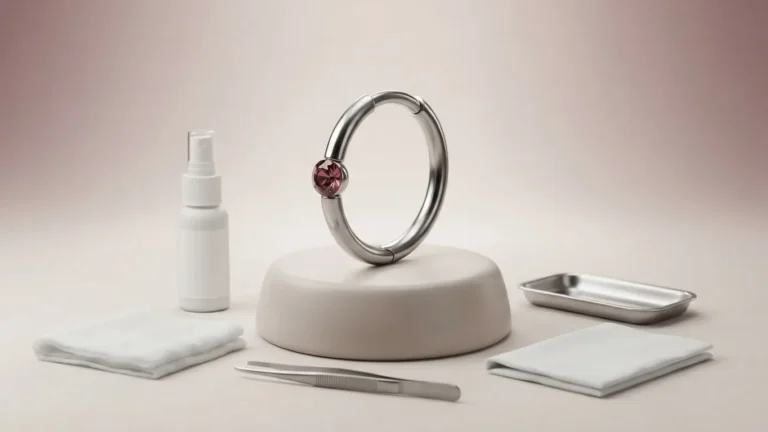
Once fully healed, the rook becomes one of the most versatile anchor points for a curated ear. The starter curved barbell can give way to a hinged ring, seamless ring, captive bead ring, or a small hoop or huggie, each changing the piercing’s whole character. End options run from plain beads to gemstones, charms, and shaped fittings, so a single healed rook can read minimalist one week and ornate the next. The fold’s central position lets it tie together the piercings around it rather than competing with them.
Common pairings that read well together:
- Rook plus daith for a layered inner-ear look.
- Rook plus helix and lobe for a vertical stack.
- Rook plus tragus and conch for a filled-in curated ear.
Balance matters more than quantity. A single well-chosen rook gem can carry an ear stack, while too many competing hoops flatten the effect. Match metals across the ear so titanium reads against titanium and gold against gold, which keeps the palette coherent. If you are building around a ring rather than a stud, our daith jewelry ring and gauge guide pairs naturally with rook styling, and beginners assembling a first setup can start with the at-home ear piercing starter kit overview for context on tools and limits.
Consider the visual weight of your jewelry when pairing. A heavy, ornate gold charm in the rook can overwhelm a delicate, thin hoop in the tragus. Experimenting with different textures, such as polished gold versus textured stone settings, adds depth to your ear stack without requiring additional piercings. A well-curated rook becomes the focal point, pulling the eye toward the center of the ear rather than the edges.
Even if you prefer a minimalist aesthetic, the variety of rook jewelry allows for significant change. A simple, thin, high-polish hoop is a classic office-appropriate choice, while a clicker with tiny inset crystals provides instant evening glamour. Because the rook is tucked into the antihelix, you get to choose how much of the jewelry is visible, allowing for a subtle sparkle that reveals itself only when you move your head. This hidden-in-plain-sight quality makes the rook a favorite for subtle personalization.
Frequently Asked Questions
What gauge and length are rook earrings?
The standard rook gauge is 16G, which equals 1.2mm, though some piercers use 18G at 1.0mm. A starter curved barbell is usually 6mm to 8mm long, extending up to 10mm for thick cartilage. Healed-piercing hoops typically run 5mm to 8mm in inner diameter. Your piercer measures your exact fold, since anatomy decides the final fit.
Is titanium the best metal for a rook piercing?
Titanium is the safest default. The Association of Professional Piercers lists implant-grade titanium meeting ASTM F136 or F67 as acceptable for initial piercings, and it sits well below EU nickel-release limits. It suits sensitive skin, resists corrosion, and can be anodized for color safely. Solid nickel-free 14k gold and niobium are also defensible choices for healed piercings.
How long does a rook piercing take to heal?
Primary healing takes roughly 6 months, and full maturity runs 12 to 18 months, though many retail guides cite 6 to 12 months. Surface calm does not mean the channel is done, since the interior heals slower than the exterior. Wait for full healing, confirmed by a piercer, before swapping the starter barbell for a ring.
Why do people react to cheap rook earrings?
The usual culprit is nickel. Sensitization affects roughly 10 to 20 percent of people, higher in women. Low-quality pieces labeled only “surgical steel,” with no ASTM grade, can release nickel above the EU limit of 0.2 micrograms per square centimeter per week. Choosing certified implant-grade metal prevents most reactions.
Can I change my rook jewelry myself?
Not until it is fully healed, and even then carefully. The rook enters and exits the same side of the antihelix fold, so the angle makes self-insertion awkward and easy to botch. Changing too early reopens the channel and invites irritation or infection. For a first change, have a piercer do it or supervise, and use only implant-grade jewelry.
Does a rook piercing hurt more than other ear piercings?
Generally yes. Because the needle passes through thick cartilage in the antihelix rather than soft lobe tissue, the rook rates higher than a lobe and many outer-ear piercings. The sensation is sharp but brief. Pain tolerance is individual, so a spot that feels intense for one person is manageable for another. The longer healing period is usually the harder part.