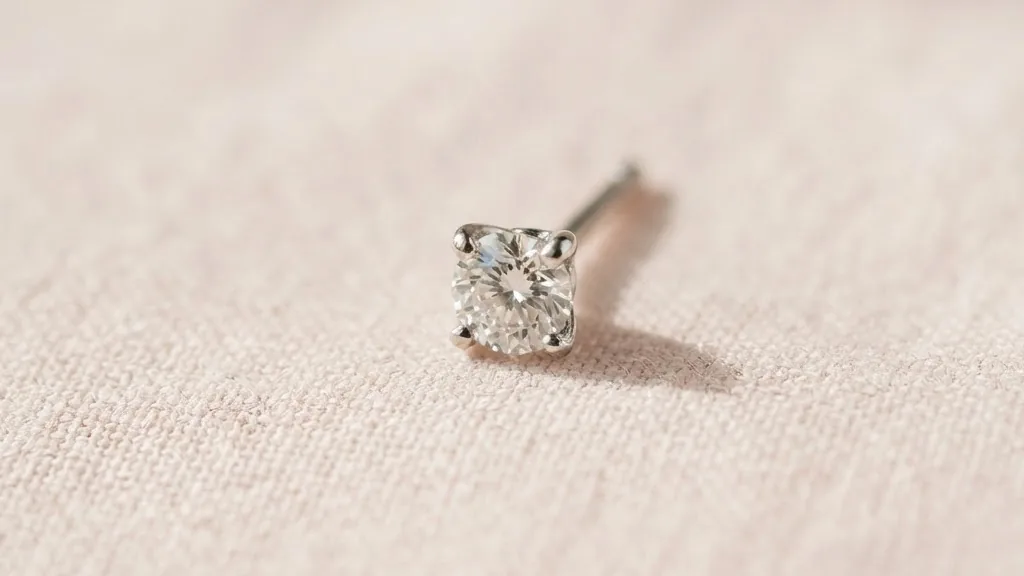
A diamond nose piercing is really two decisions wearing one name: the piercing itself, almost always through the soft outer nostril, and the small diamond stud that eventually sits in it. The stone can be a genuine mined or lab-grown diamond, or a simulant like cubic zirconia or moissanite that looks similar for a fraction of the price. Getting either one right starts with understanding that the sparkle and the safety are separate problems.
Most people who search for this want a shopping answer, and that is fair. But a nostril is a wound before it is a jewelry display, and the metal touching it during healing matters far more than the stone sitting on top. The goal here is to help you choose a stud that is both good-looking and safe for your skin, and to know when it is actually time to put a diamond in it.
The healing timelines, gauge sizes, metal standards, and price ranges below were checked against the Association of Professional Piercers, Mayo Clinic, the American Academy of Dermatology, and current jewelry pricing.
Quick answer: Heal a new nostril piercing for about 2 to 4 months in implant-grade titanium or 14k-plus gold, not in a diamond. Once it is fully healed, you can switch to a diamond nose stud, ideally 20 gauge (0.8 mm) to match your piercing. A genuine diamond stud in gold typically runs $80 to $500 or more, a moissanite version about $30 to $120, and a cubic zirconia one roughly $10 to $40. Whatever the stone, keep the metal nickel-free and buy from a reputable piercer or jeweler.
What a diamond nose piercing actually is
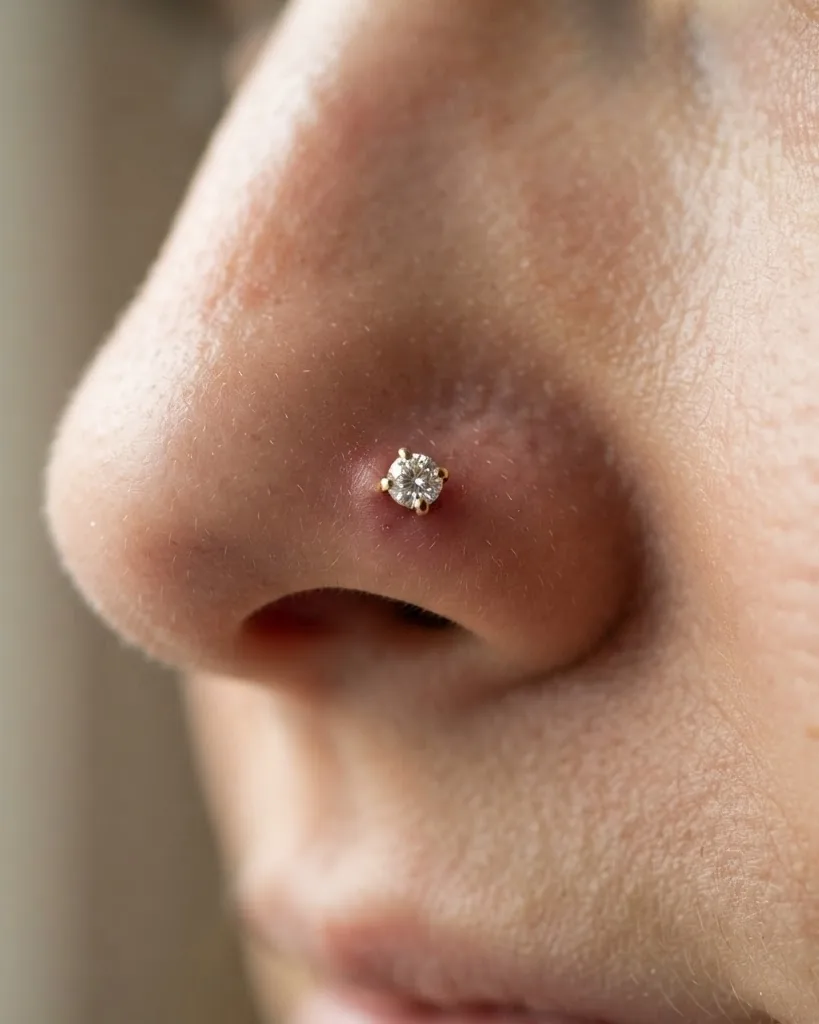
The piercing part is standard. The overwhelming majority of nose studs sit in the nostril, through the fleshy crease where the wing of the nose meets the cheek. That spot is chosen for a reason: it is easy to pierce cleanly, the jewelry sits flat, and a small front-facing stone reads as a diamond rather than getting lost. High-nostril placements and septum piercings exist, but a classic diamond stud is a nostril piece, and that is what this guide assumes.
What makes it a “diamond” piercing is simply the front of the jewelry: a faceted stone, prong-set or bezel-set into the visible end of a post that passes through your nostril. The stone can be a real diamond or a simulant, and the back of the post keeps it in place. Because the piercing and the jewelry are separable, you are free to heal in one piece of jewelry and wear a completely different diamond stud later. If you are still deciding which side or style suits your face, our guide to the best nose piercing for your nose shape walks through placement before you ever think about the stone.
One honest caveat up front: a diamond is not the smart choice for a brand-new piercing. Reputable piercers start you in plain, biocompatible jewelry and treat the diamond as an upgrade you earn once the tissue has settled.
Jewelry styles that can hold a diamond
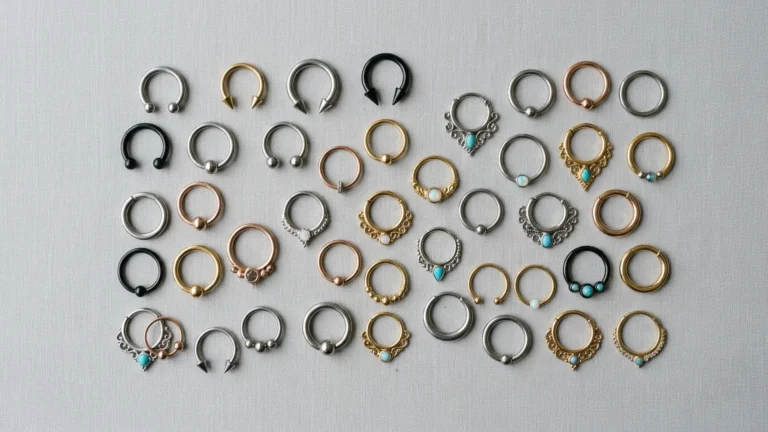
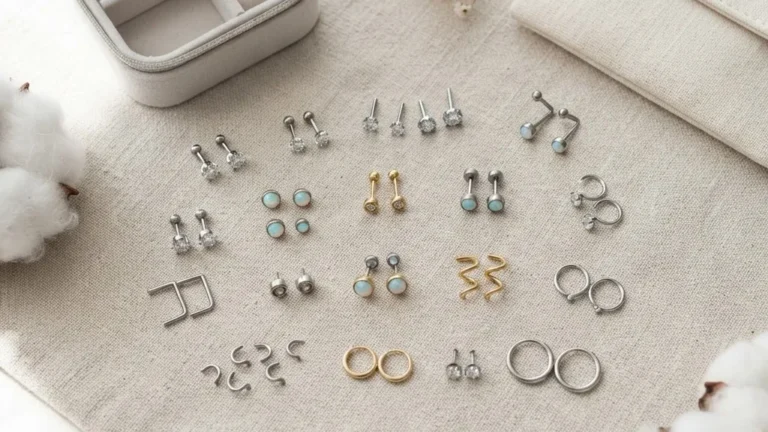
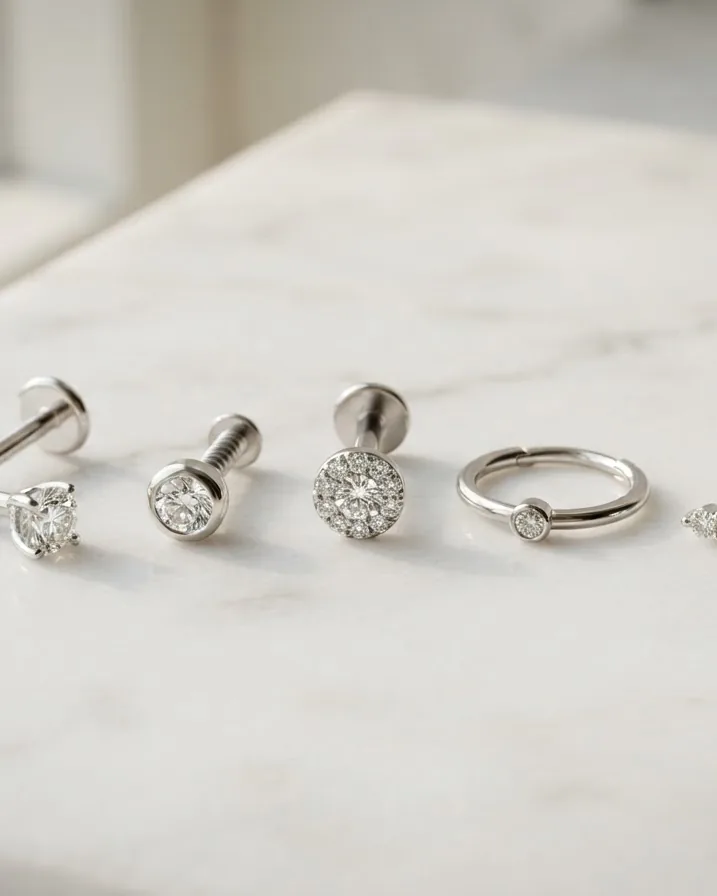
Nose studs come in a handful of back designs, and the stone on the front can be set into most of them. The difference between styles is how the jewelry stays in your nose and how easy it is to insert or remove without damaging a still-tender piercing. Here are the front-facing styles you will actually shop for:
- Nose bone: a straight post with a small fixed ball or flare on the back end that holds it in. Simple to wear once healed, but the flare has to push through the piercing, so it is not ideal for a fresh one.
- Nostril screw: a post with a curved, corkscrew-shaped tail that twists into place and resists getting bumped out. Secure, but fiddly to insert the first few times.
- L-shape (L-bend): a post pre-bent into an L so the short arm tucks against the inside of the nostril. A good middle ground between security and easy insertion.
- Threadless (push-pin): a smooth post and a stone-topped pin that press-fits together with slight tension. This is the style many professional piercers prefer because it is gentle on tissue and easy to change.
- Threaded stud: the stone end screws onto the post. Common and secure, though the threads can be slightly rough on a healing channel.
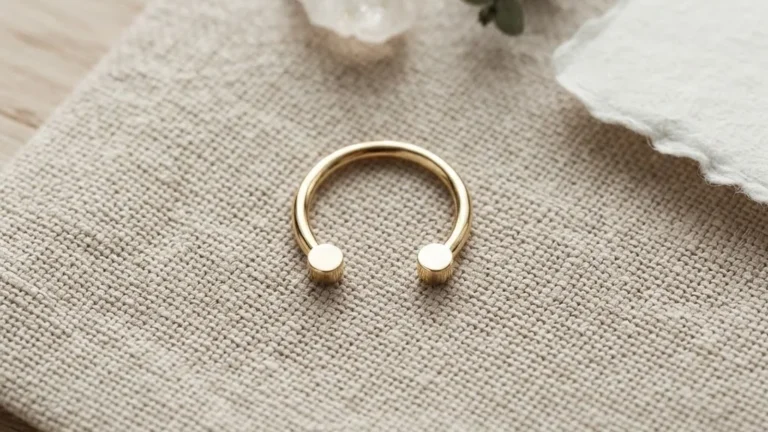
- Hoop or clicker: a ring rather than a stud, sometimes set with tiny stones. A different look than a solitaire diamond, and usually a thicker gauge.
For a diamond you plan to wear daily, a threadless or L-shape stud in a secure back is the practical pick: enough grip that you will not lose the stone, gentle enough that you are not sawing at the piercing every time you change it. Whatever the style, the stone should sit close to the skin so it does not catch on clothing or a towel.
Diamond quality on a very small stud
A nose stud is tiny, so the usual diamond math changes scale. Nose-stud stones generally run from about 1 mm to 3 mm across the top, which works out to roughly 0.005 carat at the small end and around 0.10 carat at 3 mm. That is a fraction of an engagement-ring stone, and at these sizes clarity flaws and faint color are almost invisible to the naked eye. Spending up for a flawless, colorless grade on a 1.5 mm stone is mostly wasted money; cut quality, which drives how much it actually sparkles, is where your attention belongs.
The setting matters as much as the stone. The two common choices are prong and bezel. A prong (or claw) setting lifts the stone on little metal arms, letting in more light for extra sparkle, but those arms can snag on fabric and collect debris near a piercing. A bezel setting wraps a thin metal rim all the way around the stone, sitting flush and snag-free, which is the safer, lower-maintenance choice for something living on the edge of your nostril. In short, prong for maximum fire versus bezel for durability and peace of mind.
| Stone size (diameter) | Approx. carat weight | Look on a nostril |
|---|---|---|
| 1.0 mm | ~0.005 ct | Barely-there pinpoint sparkle |
| 1.5 mm | ~0.015 ct | Subtle, most popular everyday size |
| 2.0 mm | ~0.03 ct | Clearly visible, still understated |
| 2.5 mm | ~0.05 ct | Noticeable statement stud |
| 3.0 mm | ~0.10 ct | Bold; can look heavy on a small nose |
If you are unsure, most people are happiest in the 1.5 mm to 2 mm range: big enough to catch light, small enough to look like part of your face rather than a spotlight on it.
Real diamond versus cubic zirconia versus moissanite
This is the comparison that decides your budget, and the three stones behave differently over years of daily wear. Hardness is measured on the Mohs scale, where a diamond sits at the top at 10, moissanite at 9.25, and cubic zirconia around 8 to 8.5. That ranking predicts how each holds up: a diamond shrugs off scratches indefinitely, moissanite stays crisp for a very long time, and cubic zirconia slowly abrades, clouds, and loses its polish, which is why CZ studs are best treated as replaceable.
They also sparkle differently. Moissanite throws more colored “fire” than a diamond and can look faintly rainbow or warm in bright light, which some people love and others find obviously not-a-diamond. Cubic zirconia mimics a diamond well when brand new but goes dull as it wears and picks up soap film and skin oils. A real diamond is the most understated of the three in a good way: white, bright, and stable for life.
Cost is the honest tradeoff. At tiny nose-stud sizes, a cubic zirconia stud commonly runs about $10 to $40, a moissanite stud roughly $30 to $120, and a genuine diamond stud set in gold anywhere from about $80 to $500 or more depending on the stone and metal. Lab-grown diamonds are real diamonds, chemically identical to mined ones, and usually cost noticeably less, which makes them a strong value for a piece this small. For scale, a full one-carat loose moissanite can retail near $400 while a one-carat CZ might be $10 to $40, but you are buying a sliver of that, so the real gap between the three is smaller than headline ring prices suggest. A diamond also holds resale value in a way a simulant never will.
Metals and your skin: the part that actually matters
Here is where a jewelry decision becomes a health decision, and it is the section to read twice. The stone sits on the surface, but the post lives inside a healing or healed wound, so the metal is what your body reacts to. The Association of Professional Piercers sets a clear standard for what belongs in a piercing, and it is worth following even after you are healed.
For initial and sensitive piercings, the APP recommends implant-grade titanium (ASTM F-136, the Ti6Al4V ELI alloy, or commercially pure ASTM F-67), solid 14k or higher gold that is nickel- and cadmium-free, along with platinum and niobium. These materials are biocompatible and effectively nickel-free, with implant-grade titanium held below 0.05 percent nickel. You can read the full material standard from the Association of Professional Piercers before you buy anything. Surgical steel, even the ASTM F-138 grade, contains nickel and is a poorer choice for anyone whose skin is reactive or whose piercing is not fully healed.
Nickel is the reason this matters so much. It is the single most common cause of allergic contact dermatitis, and the American Academy of Dermatology reports that more than 18 percent of people in North America are allergic to it. A reaction shows up as itching, redness, swelling, and sometimes weeping around the site, usually 12 to 48 hours after exposure, and sensitivity can develop suddenly even after years of wearing a metal without trouble. Do not lean on the word “hypoallergenic” to protect you either: the U.S. Food and Drug Administration has no legal standard for that term, so a piece labeled hypoallergenic can still contain nickel. The dependable move is to buy jewelry whose exact material is named and certified, not just described with a marketing word.
If you have a known nickel allergy, that pushes you toward implant-grade titanium for the post and either titanium, platinum, or high-karat solid gold around the stone. A diamond set in solid 14k or 18k gold is a safe long-term choice; a diamond glued into cheap plated metal is not, no matter how real the stone is.
Gauge and fit, so the jewelry sits right
Gauge is the thickness of the post, and nose jewelry uses a slightly confusing numbering where a higher number means a thinner post. For nostril studs, 20 gauge, which is about 0.8 mm, is the most common size, while 18 gauge, around 1.0 mm, is thicker and shows up more often in hoops and clickers. Your piercer chooses the gauge when they pierce you, and your future jewelry should match it.
The one rule that trips people up: do not buy a thinner stud than your piercing. A 20 gauge diamond dropped into an 18 gauge hole will wobble, sit crooked, and can let the channel shrink unevenly. If you want to go thinner or thicker later, that is a conversation with a piercer, not a solo experiment. Post length matters too, since a stud that is too long slides around and one that is too short presses into the tissue. If needle nerves are holding you back from getting pierced properly, our notes on numbing cream for piercings and on the piercing gun versus needle question are worth a look, because a clean needle piercing at the right gauge is the foundation everything else sits on.
When you can switch to a diamond stud, plus aftercare
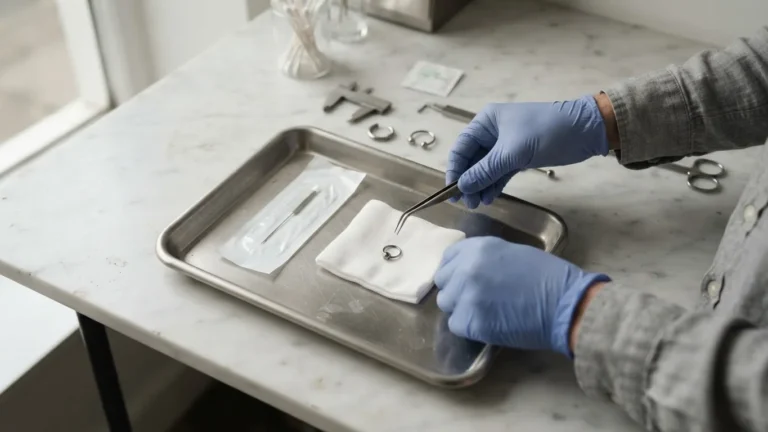
Timing is the most common mistake with a diamond nose piercing. A nostril generally heals externally in about 2 to 4 months, but the channel keeps stabilizing internally for up to six months, and that is the window where the wrong jewelry causes irritation bumps, prolonged swelling, and infection. The safe sequence is to heal in plain implant-grade titanium, then upgrade to your diamond only once the piercing is calm: no tenderness, no discharge, no swelling, and comfortable to touch. The first jewelry change is best done by your piercer, who can swap it without tearing the fresh channel.
Good aftercare is what gets you to that upgrade on schedule. Mayo Clinic advises cleaning a new piercing with a saline or gentle soap-and-water solution and avoiding hydrogen peroxide, iodine, and other harsh products that damage healing skin; you can review its full piercing care guidance for the details. A simple, boring routine beats a complicated one every time:
- Step 1 – Wash your hands thoroughly before touching the piercing or the jewelry, every single time.
- Step 2 – Clean the site twice a day with sterile 0.9 percent saline, letting it soak briefly to soften any crust.
- Step 3 – Gently pat the area dry with a clean paper towel; skip cloth towels, which harbor bacteria and snag jewelry.
- Step 4 – Leave the jewelry in and do not twist or rotate it, which only tears healing tissue.
- Step 5 – Once swelling has fully settled, have your piercer check the fit and switch you into your diamond stud.
Know the difference between healing and infection. Slight redness, mild swelling, and a whitish-yellow crust are normal early on. Warning signs are not: throbbing pain, thick yellow or green pus with a bad smell, heat radiating from the area, spreading redness or red streaks, or a fever all point to infection. If you see those, contact a doctor promptly, and do not yank the jewelry out on your own, since removing it can trap the infection under the skin. When in doubt, a reputable piercer or a clinician is the right call, not the internet.
Buying a diamond nose stud without getting burned
Once you are healed and shopping for the real upgrade, a few habits keep you from overpaying or buying something unsafe. First, decide real versus simulant honestly based on budget and how much you care about resale, then buy the metal to match: solid 14k or 18k gold, platinum, or implant-grade titanium, never plated base metal that will flake and expose nickel. Second, if you want a genuine diamond, ask whether it is mined or lab-grown and request the stone’s basic specs; for a stud this small you do not need a full certificate, but a seller who cannot tell you the material and origin is a seller to skip.
Third, check the back and the setting. A secure threadless or screw back keeps a small, expensive stone from vanishing down a drain, and a bezel setting protects it from knocks. Fourth, buy from a reputable body-jewelry specialist or a professional piercer rather than a fashion-accessory bin, because they stock named materials and correct gauges. To see where a nostril diamond sits among other placements, our overview of common piercing types puts it in context. Spend on cut, metal, and a secure back, and the stone can stay modest without anyone noticing.
Frequently asked questions
Can I get a diamond stud right when I get pierced?
It is not recommended. A fresh nostril is a wound that swells and needs a plain, biocompatible starter, usually implant-grade titanium, in a slightly longer post to allow for swelling. Wait until the piercing is fully healed, generally 2 to 4 months and up to six months internally, then have your piercer switch you into a diamond. Starting with a diamond risks irritation, bumps, and a longer heal.
How do I tell a real diamond from cubic zirconia in a nose stud?
At nose-stud sizes it is genuinely hard by eye, but there are clues. Cubic zirconia throws more colored flashes and dulls over months, while a diamond stays bright and white. Real diamonds and moissanite score 10 and 9.25 on the Mohs hardness scale versus 8 to 8.5 for cubic zirconia, so CZ scratches and clouds first. Price is the biggest tell: a “diamond” stud selling for a few dollars is a simulant. A jeweler can test the stone if you need certainty.
What metal is safest for a diamond nose piercing?
Implant-grade titanium (ASTM F-136) and solid 14k or higher gold that is nickel- and cadmium-free are the safest choices, along with platinum and niobium, per the Association of Professional Piercers. Avoid surgical steel if your skin is reactive, since it contains nickel, and ignore vague “hypoallergenic” labels, which the FDA does not regulate. A diamond set in solid gold or titanium is a safe long-term piece.
What gauge is a diamond nose stud?
Most nostril studs are 20 gauge, about 0.8 mm thick, which is the standard piercers use. Some hoops and clickers run at 18 gauge, roughly 1.0 mm. Match new jewelry to the gauge you were pierced at; putting a thinner stud in a thicker hole makes it wobble and sit crooked. To change gauge, see a piercer rather than forcing a mismatched post.
How much does a diamond nose piercing cost?
The piercing service itself is usually modest, often in the $30 to $80 range plus starter jewelry, depending on the studio. The diamond stud is the variable: a cubic zirconia version runs about $10 to $40, moissanite roughly $30 to $120, and a genuine diamond in gold from about $80 to $500 or more. Lab-grown diamonds cost less than mined stones for the same look.
What are the signs my nose piercing is infected?
Normal healing brings mild redness, slight swelling, and a light crust. Infection looks different: throbbing pain, thick yellow or green foul-smelling pus, warmth, spreading redness or red streaks, and fever. If those appear, see a doctor and leave the jewelry in, because removing it can seal the infection under the skin. Prompt medical care matters more than any home remedy here.
The bottom line
A diamond nose piercing is worth doing carefully because the piece is small and the wound is real. Heal first in implant-grade titanium or solid 14k-plus gold, follow a simple saline routine, and give a nostril the 2 to 4 months it needs before upgrading. When you buy the diamond, match the 20 gauge post, choose a secure back and a bezel or well-made prong setting, and decide real versus moissanite versus cubic zirconia based on budget and how long you want it to last. Spend on safe, named metal and good cut rather than raw stone size, lean on a reputable professional piercer for the fit, and a modest, well-set diamond will look like it belongs for years.