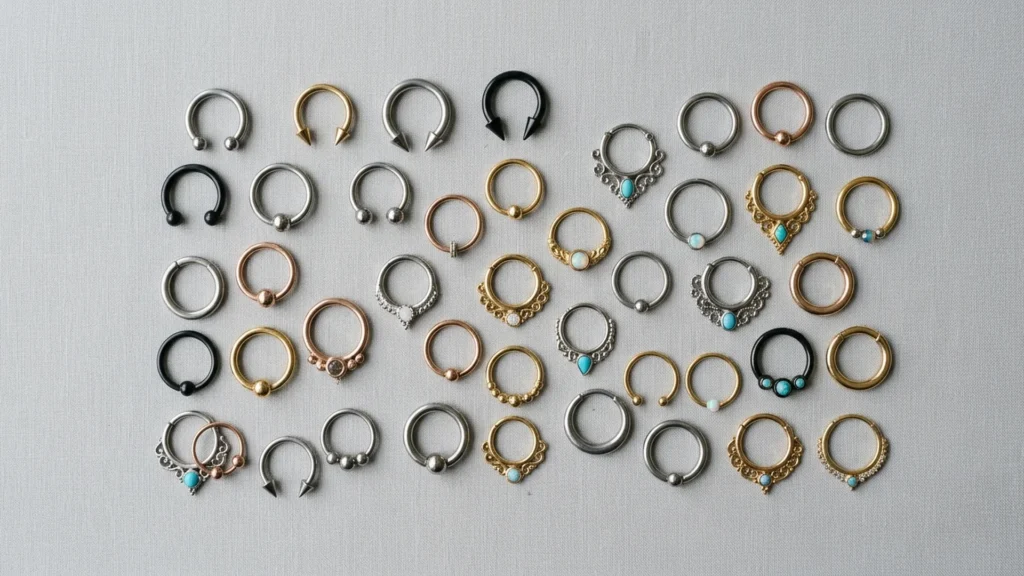
Septum jewelry is where a lot of people discover that a piercing is only half the decision. The other half, the part that determines whether you love your septum every single day, is the ring itself. I have fitted hundreds of septum pieces, and the conversations almost always go the same way: someone walks in certain they want a chunky horseshoe, tries on a slim clicker, and walks out with something they never would have picked from a photo. The ring changes everything.
This guide is the one I wish every client read before shopping. It covers the real styles of septum rings and what each one is actually like to wear, the materials that are safe versus the ones that cause problems, how gauge and diameter work so you order a ring that fits, and the honest practical details, like flipping your septum up, dealing with the smell people are too embarrassed to ask about, and knowing when your piercing is ready for a switch. Whether you have a fresh septum or you have worn one for years, the goal is to help you choose jewelry that looks right, feels right, and keeps your piercing healthy.
First, a Quick Word on the Septum Piercing Itself
A septum piercing does not actually go through the hard cartilage wall down the center of your nose. A skilled piercer threads the needle through the thin strip of soft tissue just below that cartilage, a spot piercers call the sweet spot or the columella. When it is placed in the sweet spot, the piercing is more comfortable and heals more predictably than people fear. When it is placed too high, into actual cartilage, it hurts more and heals worse. This is the single biggest reason to choose a piercer who knows septum anatomy. If you want the anatomical background, the overview of the septum piercing covers the structure and history in neutral detail.
Healing typically runs two to four months for the initial settling, with full maturation taking longer. During that healing window your jewelry options are limited, which matters for everything that follows. If you are still weighing whether the septum suits your face, our guide to nose types and nose piercings is a good companion to this one.
The Main Styles of Septum Rings
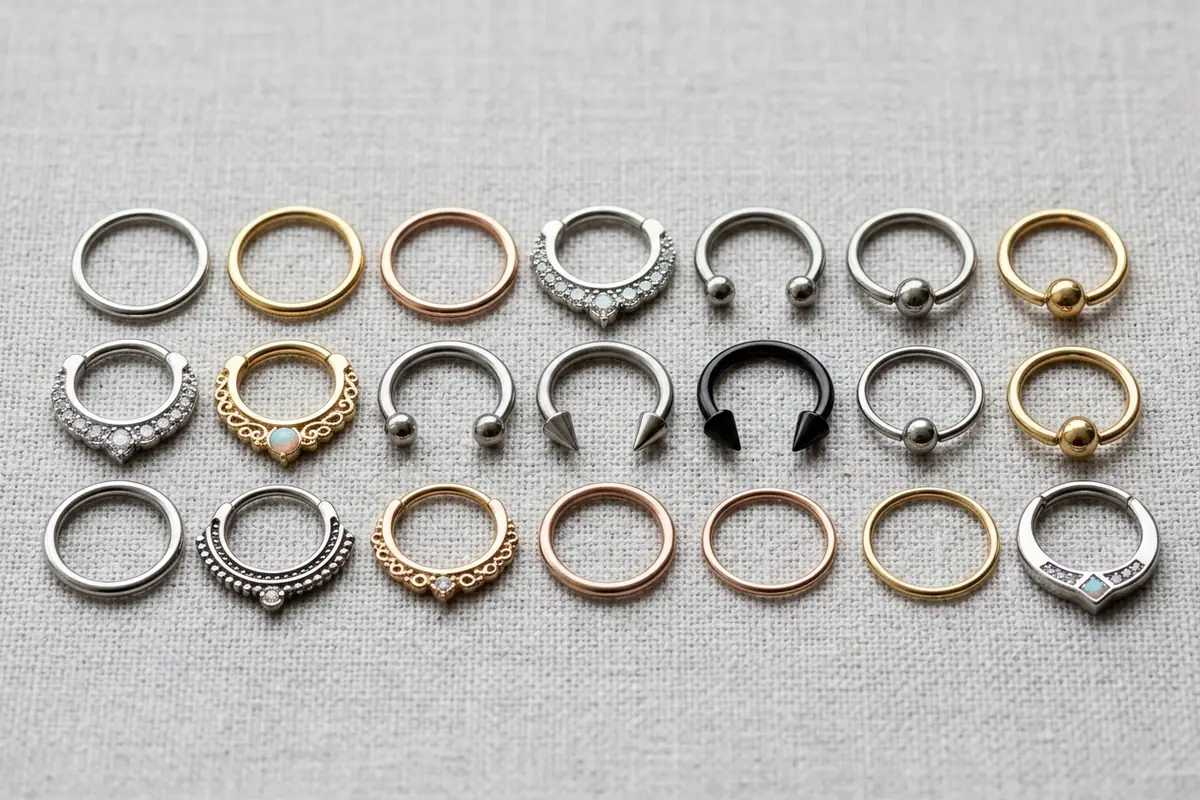
Septum jewelry comes in more shapes than newcomers expect, and each has a distinct personality. Here is what each style is genuinely like to wear.
Circular Barbell (Horseshoe)
The classic. A horseshoe is an open circular barbell with a ball or cone screwed onto each end. It is the most recognizable septum look, it is easy to flip up and hide, and the removable ends let you change your look without changing the whole ring. The trade-off is that the threaded ends can occasionally loosen, so check them now and then. The horseshoe is the everyday staple for good reason.
Septum Clicker
A clicker is a decorative hinged ring that snaps shut with a satisfying click. This is the style for ornamentation: clickers carry the most elaborate designs, from simple bands to gem-set crescents and chains. They are easy to put in and take out once your piercing is healed, and they sit elegantly. They are not, however, the right choice for a fresh piercing, because the decorative front is bulkier and less forgiving while you heal.
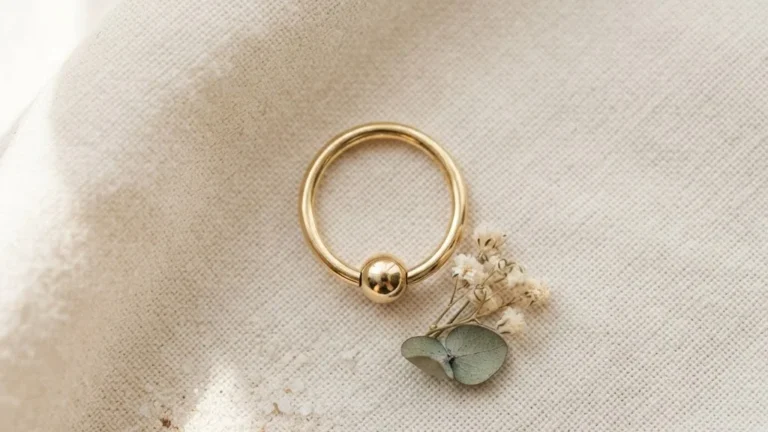
Captive Bead Ring
A captive bead ring, or CBR, is a continuous ring held closed by a single bead under tension. It gives a clean, seamless hoop look and is sturdy and low-profile. The bead can be fiddly to remove without the right grip, which is why many people have a piercer or a pair of ring-opening pliers handle the swap. CBRs are versatile and durable for everyday wear.
Seamless and Segment Rings
A seamless ring is a simple unbroken-looking hoop you twist open; a segment ring has a small removable piece that creates a flawless closed circle. Both give the most minimalist, jewelry-store-clean look. Seamless rings are best on healed piercings, since twisting them open and closed near fresh tissue is risky.
Septum Retainer
A retainer is the practical hero of this category. It is a clear or skin-toned piece, often glass or a simple staple shape, designed to keep the piercing open while staying nearly invisible. If you have a job, a sport, or a family event where visible jewelry is not an option, a glass retainer lets you keep your piercing without it showing. Glass is the better retainer material; some flexible plastic retainers are fine short-term but are not ideal for long wear.
Pincher and Tusk
For people who stretch their septum, pinchers (curved, tapering pieces) and tusks become options at larger sizes. These are a stretched-piercing look and are not relevant to a standard, unstretched septum.
Materials: What Is Safe and What to Avoid
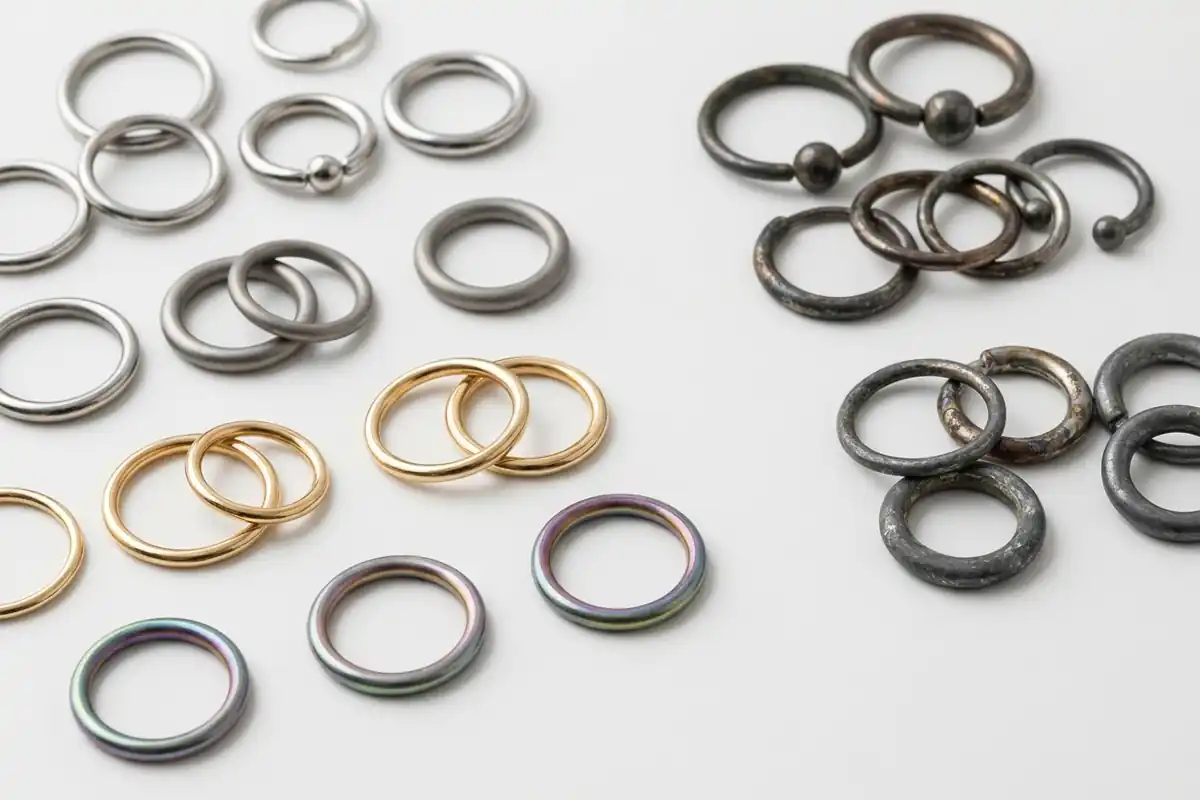
Material is not an aesthetic footnote. It is a health decision, especially for a piercing that sits inside your nose against mucous membrane. The wrong metal causes irritation, prolongs healing, and can trigger an allergic reaction that drags on for weeks.
Here is the honest hierarchy.
- Implant-grade titanium is the best all-around choice and the one I recommend for almost everyone, especially fresh piercings and sensitive skin. It is hypoallergenic, contains no free nickel, is lightweight, and can be anodized into colors without coating it in anything that wears off.
- Implant-grade steel (316L or 316LVM) is widely used and safe for many people, but it does contain nickel. If you know you react to nickel in jewelry or watch backs, skip steel and go titanium.
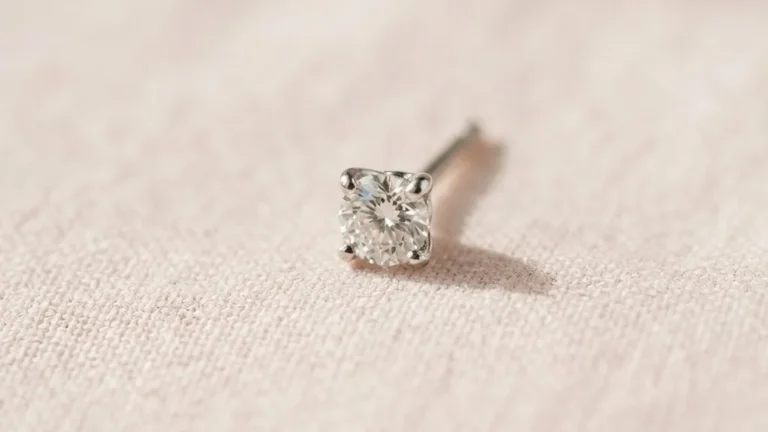
- Solid 14-karat gold or higher is safe and beautiful for healed piercings. The key word is solid. Avoid gold-plated and gold-filled septum rings, because the thin gold layer wears through and exposes whatever base metal sits underneath.
- Niobium is another inert, hypoallergenic option, similar in safety to titanium and also available anodized.
- Glass is excellent for retainers and is body-safe and inert.
What to avoid: anything plated, sterling silver in a fresh piercing (it tarnishes and can irritate), and the mystery-metal costume jewelry sold cheaply online with no material listed. If a listing does not clearly state the metal, treat that as a no. The Association of Professional Piercers publishes standards for safe initial jewelry that are the reference every quality studio works from.
Sizes: Gauge and Diameter Explained
Buying a septum ring online goes wrong most often because of sizing, so let me make this simple. Two numbers matter: gauge and diameter.
Gauge is the thickness of the ring’s bar. Counterintuitively, a smaller gauge number means a thicker ring. Most septum piercings are done at 16 gauge (about 1.2 millimeters) or 14 gauge (about 1.6 millimeters), with 16 gauge being the most common starting point. Some people stretch from 16 to 14 over time. An 18 gauge (about 1.0 millimeter) is thinner and more delicate, used for some nostril work but less common for the septum.
Diameter is the width of the ring across its inside. For a snug, modern look that sits close to the nose, an 8-millimeter diameter is the most popular. A 10-millimeter sits a touch lower and roomier, which some people prefer for flipping up easily or for a slightly more dramatic hang. Smaller than 8 millimeters can sit very tight; larger than 10 starts to look and feel oversized for most noses.
The crucial rule: match your new ring’s gauge to your existing piercing. If your piercing was done at 16 gauge, a 14-gauge ring will not fit without stretching, and forcing it irritates the channel. When in doubt, your piercer can measure your jewelry in seconds. The table below summarizes the standard sizing so you can shop with confidence.
| Size term | Common value | What it means |
|---|---|---|
| Gauge (most common) | 16g (about 1.2 mm) | Standard starting thickness for a septum |
| Gauge (stretched/heavier) | 14g (about 1.6 mm) | Thicker; common after stretching from 16g |
| Gauge (delicate) | 18g (about 1.0 mm) | Thinner; less common for septum |
| Diameter (snug, popular) | 8 mm | Sits close to the nose; the most chosen size |
| Diameter (roomier) | 10 mm | Hangs slightly lower; easier to flip up |
| Golden rule | Match your piercing | New ring gauge must equal your current gauge |
The Practical Stuff Nobody Tells You
Flipping Your Septum Up
One of the septum’s best features is that a horseshoe or many rings can be flipped up inside the nostrils to hide it almost completely. This is genuinely useful for work, interviews, or relatives who would not approve. A word of caution for fresh piercings, though: do not flip a healing septum up and down constantly. The movement irritates new tissue and is a common cause of bumps. Once healed, flip away.
The Smell Question
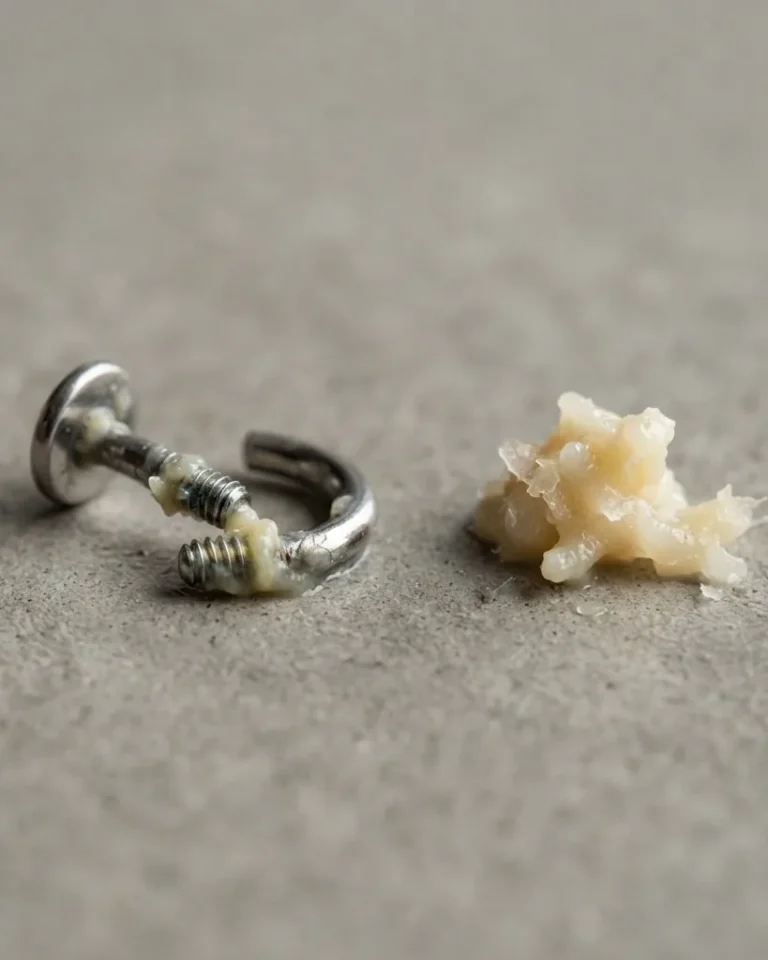
People are embarrassed to ask, so I will say it plainly: a healed septum piercing can develop a distinctive smell, sometimes called body-jewelry odor or, more bluntly, septum funk. It is caused by a normal buildup of dead skin cells, oils, and bacteria around the jewelry, exactly like the smell some people notice from old earrings. It is not a sign of infection on its own. The fix is hygiene: clean the jewelry and the area gently, and clean the ring itself when you remove it. Switching to titanium often reduces it, because cheaper porous metals hold odor more. If the smell comes with pain, redness, swelling, or discharge, that is different and points toward irritation or infection.
When Can You Change Your Septum Ring
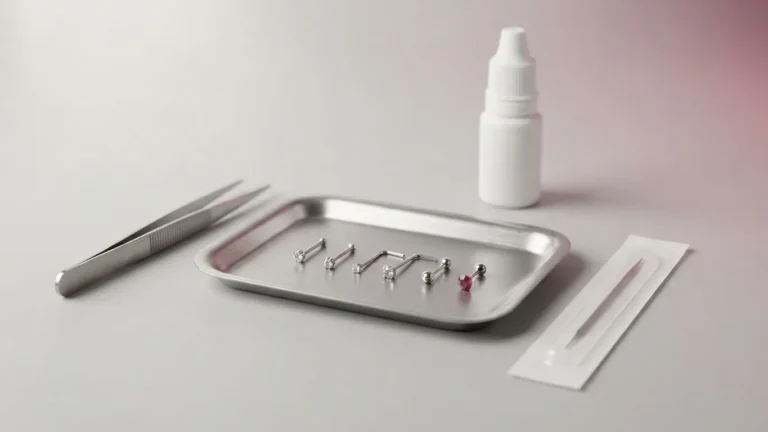
Wait until your piercing is healed before the first jewelry change, generally a couple of months at minimum, and ideally confirmed by your piercer. Changing too early is the leading cause of irritation, and a septum is awkward to re-insert jewelry into if it starts to close. For the very first change, having a piercer do it is money well spent.
How to Clean a Septum Ring Without Causing a Problem
Most septum issues I see are not infections. They are irritation from doing too much, or from cleaning the wrong way. The routine that actually works is boring, and that is the point. While your piercing is healing, do a saline soak or spray twice a day using sterile wound-wash saline, the kind that lists sodium chloride and water and nothing else. Soak a clean piece of gauze, hold it against the area for a minute or two to soften any crust, then let it dry. That is the whole job. You do not need to rotate the jewelry, you do not need to scrub, and you absolutely do not need rubbing alcohol, hydrogen peroxide, tea tree oil, or harsh antibacterial soaps, all of which dry out and inflame the delicate tissue inside the nose.
For a healed septum, cleaning becomes more about the ring than the piercing. Every few weeks, when you swap or simply want to freshen up, remove the ring and clean it. Warm water with a drop of gentle soap, a soft brush for any seam or hinge, a thorough rinse, and a complete dry before it goes back in. This is where the smell problem usually lives, and a clean ring solves most of it. If you wear a clicker with gem settings, be gentle around the stones and dry the setting fully so moisture does not sit behind it. Titanium and solid gold tolerate this routine for years; plated pieces do not, which is another reason to skip them.
One habit worth building: wash your hands before you touch the jewelry, every single time. The septum sits in a spot your fingers find constantly out of nervous habit, and dirty hands on a healing piercing are the fastest route to a bump. If you catch yourself fiddling, that is the urge to break, not the cleaning routine to add to.
Matching a Septum Ring to Your Face and Style
Beyond health and fit, there is the simple question of what looks good on you, and it is more individual than the internet suggests. A few honest observations from fitting septum jewelry on a lot of different faces. A thin, slim ring reads as delicate and modern, and it suits people who want the piercing to whisper rather than shout; it also pairs cleanly with other minimal piercings. A thicker horseshoe or a wider clicker makes a statement and balances stronger features well, but on a very petite nose it can overwhelm. Diameter matters here too: an 8-millimeter ring hugs the septum and looks tidy, while a 10-millimeter hangs a touch lower and gives that classic, slightly bohemian drop.
Gold tones tend to warm up the face and feel dressy, while titanium in silver or a dark anodized finish reads cooler and more contemporary. If you wear a lot of ear jewelry, matching your septum metal to your most-worn earrings ties a look together; a coordinated curation of ear and nose pieces almost always looks more deliberate than a mix of mismatched metals. None of this is a rule. The best septum ring is the one you forget you are wearing until you catch your reflection and like it. Try a few styles on at the studio before you commit to an expensive piece, because, as I said at the start, jewelry behaves differently on a real face than it does in a product photo.
Choosing Your First Septum Ring
For a fresh piercing, your piercer will usually start you in a plain titanium horseshoe or a simple clicker at the gauge they pierced you with. That is the right call: simple, smooth, body-safe, and easy to clean. Save the elaborate gem-set clickers and slim seamless rings for once you are healed. When you do start shopping for that statement piece, buy from a studio or retailer that lists implant-grade materials and exact sizing, not a fast-fashion site selling unmarked metal.
Healing well is partly about not disturbing the piercing and partly about supporting your body. The same steady habits that help any tissue repair, including good sleep, hydration, and balanced meals, quietly help a piercing settle. If you are the type who likes to lean into a nourishing routine during a healing stretch, plenty of people keep things easy with a pot of something warm and comforting, like a batch of chicken soups, or a few wholesome healthy pasta dinners to keep the week simple. It is not a substitute for aftercare, but feeling well makes everything easier.
A septum ring is one of the most expressive, flexible pieces of jewelry you can own. It hides when you need it to, transforms with a single swap, and frames the face in a way few other piercings do. Choose implant-grade material, match your gauge, start simple, and give your piercing the time it needs, and your septum will be a piece you reach for happily for years. If you are still mapping out where else you might want jewelry, our overview of the types of ear piercings pairs naturally with a septum for a coordinated look.
Frequently Asked Questions
What gauge are most septum rings?
Most septum piercings and rings are 16 gauge, which is about 1.2 millimeters thick, or 14 gauge at about 1.6 millimeters. Sixteen gauge is the most common starting point in the United States. Always match a new ring to the gauge your piercing was done at, because going thicker requires stretching and forcing a too-large ring irritates the channel.
What is the best material for a septum ring?
Implant-grade titanium is the best all-around choice. It is hypoallergenic, contains no free nickel, is lightweight, and is ideal for fresh piercings and sensitive skin. Implant-grade steel is fine for many people but contains nickel, and solid 14-karat or higher gold is safe for healed piercings. Avoid anything gold-plated, sterling silver in a fresh piercing, and unmarked mystery metals.
Why does my septum piercing smell?
A healed septum can develop a normal odor from a buildup of dead skin cells, natural oils, and bacteria around the jewelry, similar to the smell of old earrings. On its own it is not a sign of infection. Gently clean the area and the ring, and switching to titanium often reduces it. If the smell comes with pain, redness, swelling, or discharge, treat it as possible irritation or infection and see your piercer.
When can I change my septum ring?
Wait until the piercing has healed, which is generally a couple of months at minimum and ideally confirmed by your piercer. Changing jewelry too early is the most common cause of irritation and bumps, and a septum can be awkward to re-insert if it starts to tighten. For your very first change, it is worth having a piercer do it for you.