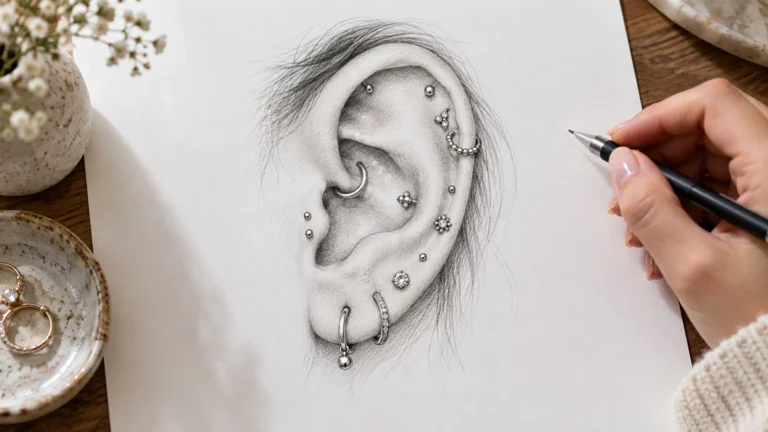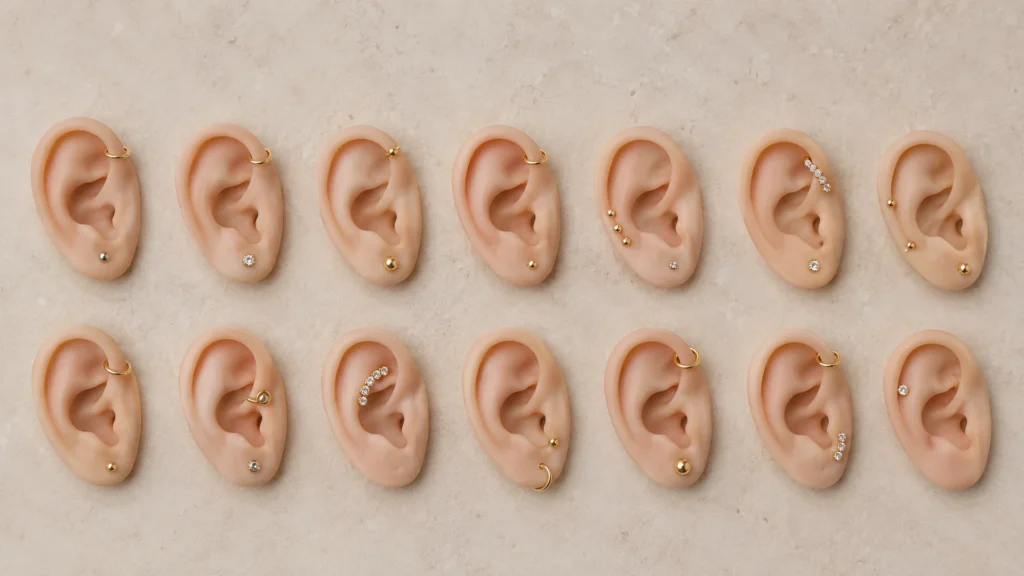
Types of ear piercings fall into a surprisingly large family, from the simple lobe everyone knows to a dozen named cartilage spots with their own looks, pain levels, and healing quirks. If you have ever stared at an ear piercing chart and wondered what separates a helix from a conch, or where a rook actually sits, this guide names every common placement, shows you where it goes, and tells you what each one is like to get and to heal. By the end you will be able to read any ear and point to each piercing by name, and plan a curated ear that actually fits your anatomy.
The ear is roughly divided into the soft lobe at the bottom and the firmer cartilage that makes up the rest. That single distinction drives almost everything: lobe piercings are quick and easy to heal, while cartilage piercings take longer and ask for more patience. We will work from the bottom of the ear upward and outside in, so the names start to make spatial sense rather than feeling like a random list.
Lobe piercings: the foundation
The lobe is the soft, fleshy bottom of the ear, and it is where most people start. Lobe piercings are the least painful and the fastest to heal, usually settling in about 6 to 8 weeks, because the lobe is soft tissue with good blood flow rather than cartilage.
A standard lobe piercing sits in the middle of the fleshy pad. A second or third lobe piercing stacks above the first, climbing toward the cartilage, and lets you build a graduated row of studs or hoops. A transverse lobe is a less common placement where a barbell runs horizontally through the lobe so a bead shows at each end. Because lobes heal quickly and forgive a lot, they are the friendliest place to experiment with multiples and mismatched jewelry.
Outer cartilage piercings: the rim of the ear
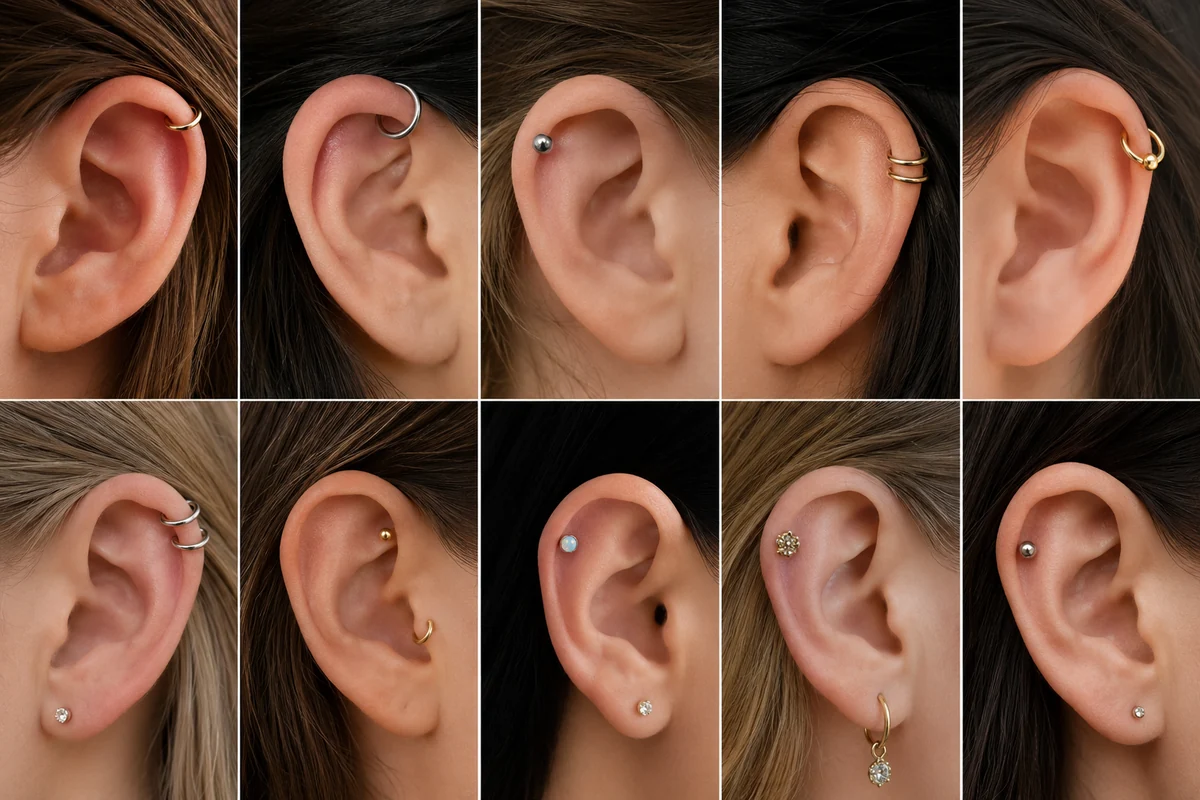
Move up from the lobe and you reach the helix, the curved outer rim that frames the top of the ear. This is the busiest neighborhood on the ear for piercings, and it is mostly cartilage from here up, which means a 6 to 12 month healing window for everything in this group.
A helix piercing goes through the upper outer rim and is the most popular cartilage piercing by name. A forward helix sits at the front of the rim, near the face, just above the tragus, and is often done as a pair or trio. A flat piercing (sometimes called a flat helix) sits on the broad flat plane of cartilage just inside the rim rather than on the thin edge, which makes it a great canvas for a decorative stud. The helix is the most common starting point for anyone moving past the lobe, and like every cartilage spot it rewards the patient, saline-first routine we walk through for sensitive placements.
An auricle piercing sits on the outer rim between the helix and the lobe, on the side of the ear. An industrial is not one piercing but two, usually a forward helix and a regular helix, joined by a single straight barbell that crosses the top of the ear; it makes a bold statement and asks you to heal two cartilage wounds at once on one bar.
Inner cartilage piercings: the ridges and shell
The middle of the ear holds the more sculptural spots, the ones that read as serious ear-piercing knowledge when you can name them.
A tragus piercing goes through the small flap of cartilage that sticks out in front of the ear canal. A conch piercing goes through the large, shell-shaped bowl in the center of the ear; an inner conch sits in the deeper hollow, an outer conch nearer the rim. A rook piercing passes through the inner cartilage ridge in the upper ear, above the daith. A daith piercing goes through the small fold of cartilage just above the ear canal, hugging the opening. A snug, or anti-helix, sits on the inner vertical ridge of cartilage about halfway down the ear and is one of the more demanding to heal. An anti-tragus sits on the small ridge of cartilage just above the lobe, opposite the tragus.
Connected and decorative placements
A few placements link two holes or sit in unusual spots. An orbital uses a single ring threaded through two nearby piercings, often on the lobe or the helix. An industrial (described above) is the classic connected piece. These look striking but mean healing more than one channel, so most piercers suggest you build up to them rather than starting there.
An ear piercing chart you can actually use
The table below maps each common placement to its location, rough pain level on a 1 to 10 scale, and typical healing time. Pain is personal and these are averages, so treat them as a starting point, not a verdict.
| Piercing | Where it sits | Pain (1-10) | Typical healing |
|---|---|---|---|
| Standard lobe | Soft fleshy bottom of the ear | 2-3 | 6-8 weeks |
| Upper lobe | Above the standard lobe | 2-3 | 6-8 weeks |
| Helix | Upper outer rim (cartilage) | 4-6 | 6-12 months |
| Forward helix | Front of the rim near the face | 4-6 | 6-12 months |
| Flat | Flat cartilage inside the rim | 4-6 | 6-12 months |
| Tragus | Flap in front of the ear canal | 4-6 | 6-12 months |
| Conch | Shell-shaped center of the ear | 5-7 | 6-12 months |
| Rook | Inner ridge in the upper ear | 6-7 | 6-12 months |
| Daith | Fold above the ear canal | 5-7 | 6-12 months |
| Snug (anti-helix) | Inner ridge, midway down | 7-8 | 6-12 months or longer |
| Anti-tragus | Ridge just above the lobe | 6-7 | 6-12 months |
| Industrial | Two cartilage holes on one bar | 6-8 | 6-12 months or longer |
One number on that chart deserves a closer look: the gulf between a lobe healing in weeks and cartilage healing in months. The reason is blood flow. Your lobe is soft tissue laced with small vessels that ferry healing cells to the wound quickly, so it closes fast. Cartilage is mostly a dense, gristly matrix with very little direct blood supply, so it rebuilds slowly and stays vulnerable far longer than it looks. That is why a cartilage piercing can feel fine at week six and still be only halfway healed inside, and why the gentle, consistent care described in our saline cleaning routine for cartilage piercings matters so much more here than on a lobe. Reading the chart with that in mind keeps you from declaring victory too early.
It also helps to read the pain column honestly. The numbers are averages from a lot of people, but your own experience depends on your anatomy, your nerves on the day, and how steady your piercer is. A snug listed at 7 to 8 is genuinely intense for most people, while a flat at 4 to 6 is a brief sharp pinch and over in a second. Use the chart to set expectations and to compare spots against each other, not to talk yourself into or out of a piercing you actually want.
How much do ear piercings cost?
In the United States, a lobe piercing often runs in the rough range of 20 to 40 dollars, while a cartilage piercing like a helix, tragus, or conch typically lands somewhere around 30 to 70 dollars for the service. Connected piercings like an industrial can cost more because two holes are involved. Jewelry is usually quoted separately, and implant-grade titanium or solid gold pieces can add anywhere from about 20 to 60 dollars or more. A reputable studio with an autoclave and single-use needles is worth the price; tipping your piercer, commonly around 20 percent, is customary. Prices vary widely by city and studio, so ask for a full quote, jewelry included, before you commit.
How ear piercings are done (and why the method matters)
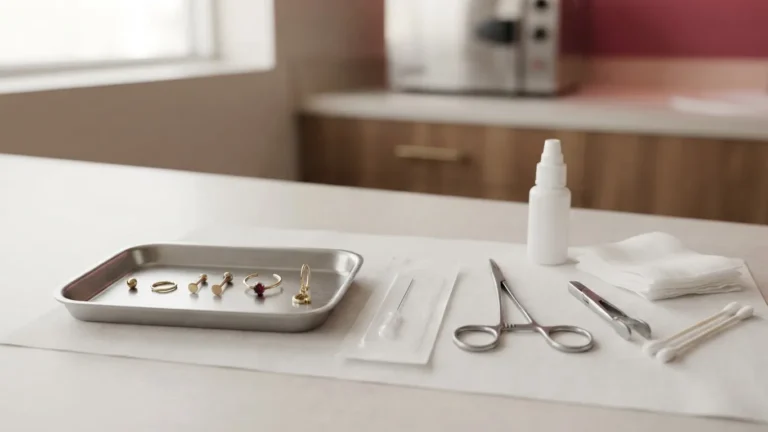
Any cartilage piercing should be done with a sterile, single-use hollow needle, never a piercing gun. A needle removes a clean core of tissue and lets the piercer control the angle, while a gun forces blunt jewelry through cartilage, crushing tissue and raising the risk of complications, and it cannot be fully sterilized between clients. The Association of Professional Piercers advises against guns on cartilage and sets the standard for safe studios; you can read their guidance in the APP aftercare and safety resources. A good studio uses needles, an autoclave, single-use supplies, and gloves, and will gladly show you their setup.
Choosing your first ear piercing (or your next)
If this is your first piercing beyond a standard lobe, the friendliest cartilage starts are usually a helix or a flat, because they are easy to reach, easy to clean, and forgiving to heal. Spots like the snug, rook, and industrial are more demanding and reward some experience and a strong piercer. Beyond pain and healing, three things should guide your choice.
- Your anatomy. Not every ear suits every piercing. A daith, rook, or snug depends on having the right ridge or fold to pierce. A good piercer will tell you honestly if a spot will not work well on your ear, which saves you a rejected or migrating piercing later.
- How you live. If you sleep on one side, take calls with your ear pressed to a phone, or wear in-ear headphones constantly, an outer-rim spot away from the pressure point heals more easily than one in the line of fire.
- The look you want. A curated ear is planned, not accidental. Deciding the overall arrangement first lets your piercer space new holes so future hoops and clusters sit evenly.
Building a curated ear
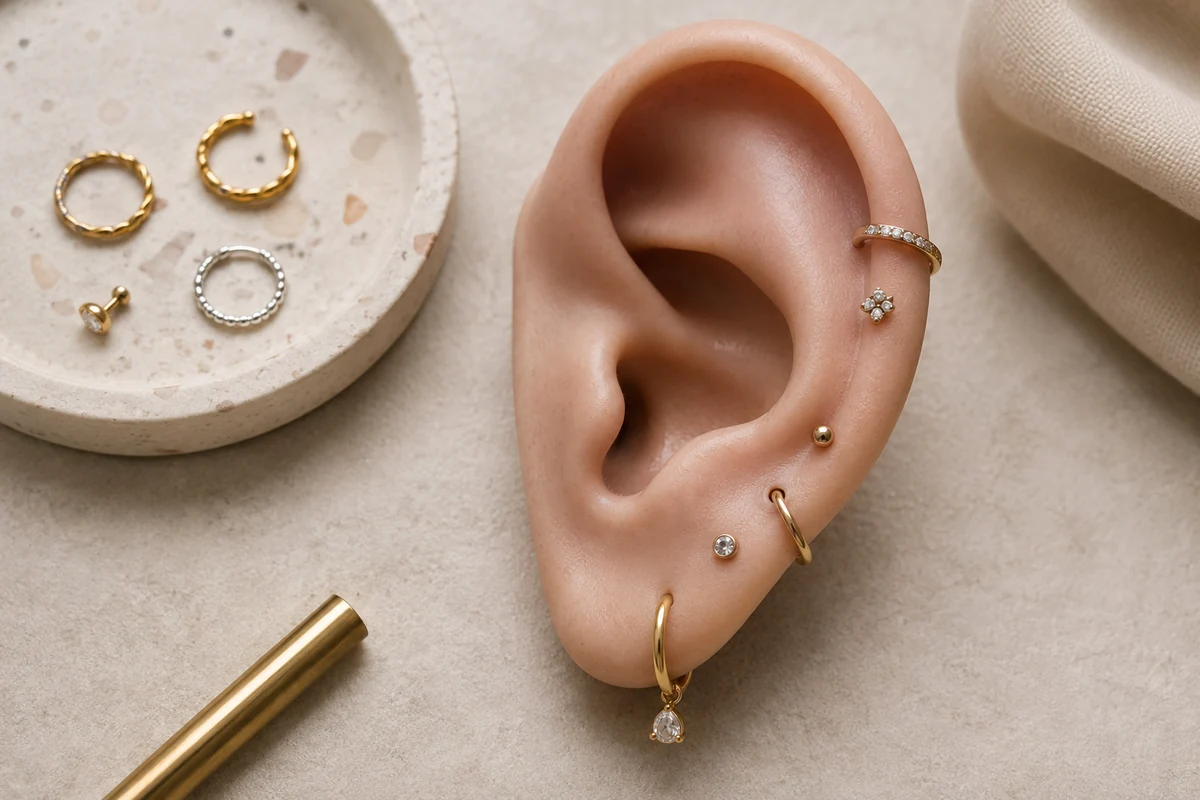
A curated ear is a deliberate arrangement of several piercings designed to look like a single composition. The trick is to plan it before you start, even if you add the piercings over months or years. Map where the studs, hoops, and any connecting pieces will go, and let healing dictate the pace: it is wiser to heal one or two piercings at a time than to pierce five cartilage spots in one sitting and ask your ear to recover from all of them at once. Mixing metals is fine once everything is healed, but during healing, stick to implant-grade titanium or solid gold in every fresh hole.
Aftercare basics across every placement
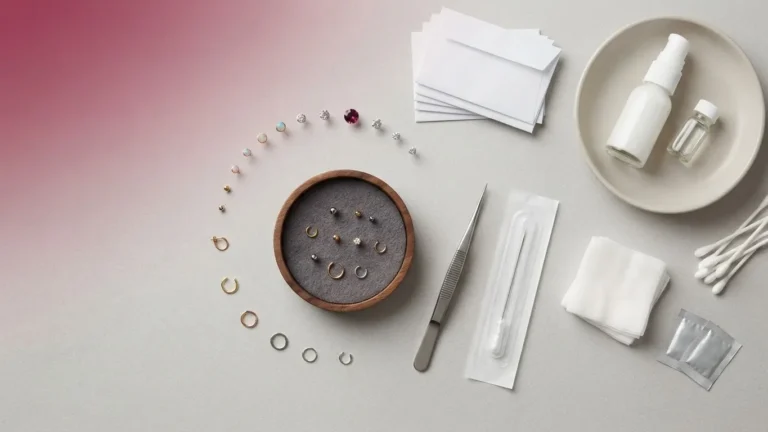
Whatever you pick, the aftercare rules are nearly identical, which is good news. Wash your hands before touching anywhere near a fresh piercing. Clean it twice a day with sterile saline (a 0.9 percent sodium-chloride wound wash), either sprayed on or applied with saline-soaked gauze, then pat dry with clean disposable paper. Do not rotate or twist the jewelry, do not over-clean, and skip alcohol, hydrogen peroxide, and antibacterial ointments, all of which damage healing tissue. Our walkthrough of sterile saline cleaning for cartilage covers the exact method, the buy-versus-DIY decision, and how often to do it.
Cartilage heals slowly because it has limited blood flow, so plan for months, not weeks, and keep up the routine until your piercer confirms a piercing is healed, not just until it stops hurting. A small irritation bump near a fresh cartilage piercing is common and usually responds to removing the cause and sticking to plain saline; a firmer, growing scar may be a keloid, which the American Academy of Dermatology explains in its overview of keloids.
Jewelry materials that suit every ear placement
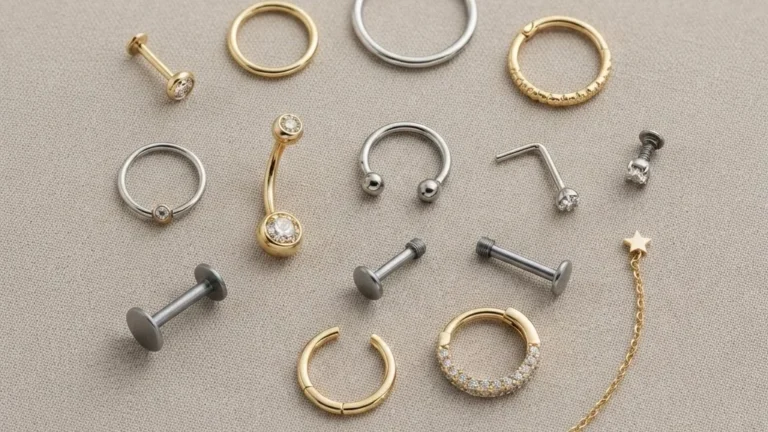
No matter which spot you choose, the metal you heal with is not a detail to leave to chance. For any fresh piercing, lobe or cartilage, stick to implant-grade titanium (ASTM F-136) or solid 14k or higher gold. Titanium is the default for good reason: it is biocompatible, light, and rarely reactive, which matters when a healing wound is in constant contact with it for months. Solid gold is a fine alternative if it is genuinely solid and not plated. What you want to avoid in a fresh hole is cheap “surgical steel” of unknown grade, nickel-containing alloys, and anything plated, because plating wears and exposes reactive metal to the wound. Nickel in particular is a common allergen, and a reaction to it during healing can look a lot like a problem with the piercing itself when the real culprit is the jewelry.
The shape matters too. Most piercers start cartilage placements with a flat-back labret stud because the flat disc sits comfortably against the ear and the small front piece stays out of trouble. Hoops, rings, and decorative clusters look great, but they belong on a healed ear, not a fresh one, because a ring on a new piercing moves, snags, and pressures the channel. Once everything is healed and your piercer clears it, you can mix metals, add hoops, and build the curated look you planned, swapping pieces as the mood strikes.
Lifestyle, swimming, and protecting a new piercing
A few everyday habits make or break the healing of any ear piercing. Avoid swimming in pools, lakes, hot tubs, and the ocean while a piercing is healing, because that water carries bacteria your cartilage is slow to clear. Be gentle pulling shirts, hats, and masks over your head, since the rim and the higher placements catch easily. Keep hair and hair products off a fresh piercing, and give it a saline rinse after styling. If you sleep on one side or take a lot of calls, favor a placement away from that pressure point, or train yourself to sleep on the other side, because nighttime pressure is one of the most common causes of irritation bumps. None of this is complicated, but it is the difference between a piercing that heals smoothly and one that stalls for months.
When to see a professional
Normal early healing includes mild redness right at the hole, light swelling that settles, tenderness, and clear or whitish crusties. Warning signs that call for action include spreading redness or heat, increasing swelling after the first week, throbbing or worsening pain, thick yellow or green pus, bleeding, or feeling feverish or unwell. If you see those, do not remove the jewelry yourself, which can trap an infection; keep up gentle saline and get help. A trusted piercer handles irritation, but a suspected infection is a medical issue. The Cleveland Clinic’s guide to an infected ear piercing explains when to see a doctor, and cartilage infections sometimes need prescription treatment.
Bottom line
The types of ear piercings come down to two zones: the quick-healing lobe and the slow-healing cartilage that covers the rest of the ear. Learn the named spots (helix, forward helix, flat, tragus, conch, rook, daith, snug, anti-tragus, industrial, orbital) and you can read any ear and plan your own. Start with a placement that suits your anatomy and your habits, go to a reputable studio that uses needles and an autoclave, heal with implant-grade titanium or gold, and clean twice a day with saline. Respect the cartilage timeline and the genuine warning signs, and you can build the ear you want one well-healed piercing at a time.
Frequently Asked Questions
What are the main types of ear piercings?
The main types of ear piercings are the lobe (standard, upper, transverse) and the cartilage placements: helix, forward helix, flat, auricle, tragus, conch, rook, daith, snug (anti-helix), anti-tragus, plus connected styles like industrial and orbital. Lobe piercings heal fastest; cartilage ones take 6 to 12 months.
Which ear piercing hurts the least?
A standard lobe piercing hurts the least, usually around a 2 to 3 out of 10, because the lobe is soft tissue with good blood flow. Cartilage piercings sit higher, roughly 4 to 8 depending on the spot, with the snug and industrial among the more intense. Pain tolerance varies from person to person.
How long do ear piercings take to heal?
A lobe piercing usually heals in about 6 to 8 weeks, while cartilage piercings such as the helix, tragus, conch, or rook take roughly 6 to 12 months, sometimes longer. Cartilage heals slowly because it has limited blood flow, so keep up saline care until your piercer confirms it is fully healed.
How many ear piercings can I get at once?
That depends on your anatomy, your pain tolerance, and your piercer’s judgment. Many people get one or two at a sitting; piercing several cartilage spots at once means healing all of them simultaneously, which is harder on the ear. For a curated ear, it is usually wiser to add piercings gradually.
What is the difference between a helix and a conch piercing?
A helix piercing goes through the upper outer rim of the ear, while a conch piercing goes through the large shell-shaped bowl in the center. The helix sits on the thin edge; the conch sits in the broad middle and often takes a larger stud or a hoop that hugs the rim.
Should I use a piercing gun for cartilage?
No. Piercing guns crush cartilage with blunt force, raise the risk of complications, and cannot be fully sterilized between clients. The Association of Professional Piercers advises against guns on cartilage. Choose a studio that uses a sterile, single-use needle for any ear piercing beyond a basic lobe.