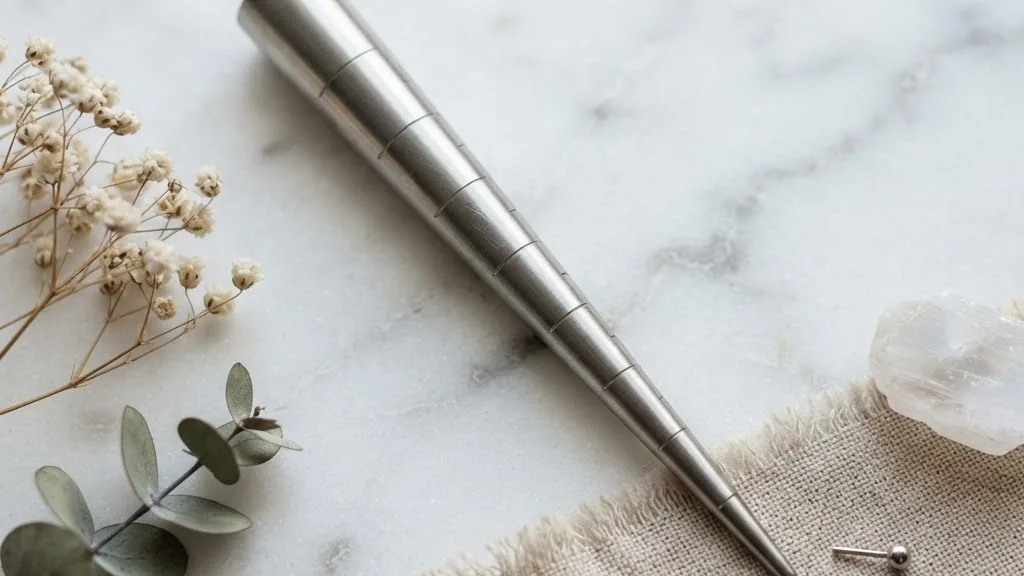
Standard nose piercing gauge sits at 18G or 20G for most fresh nostril work, and that one line answers what brings the majority of people here. The confusion starts right after. Gauge numbers run backwards from every other measurement you know, the word standard hides a lot of studio-to-studio variation, and the gauge you were pierced at is not always the gauge you should be wearing once the swelling is gone.
This guide treats the question the way a good piercer would at the counter. You get the numbers, the anatomy that explains them, a full conversion chart, and the material-safety layer that most sizing pages skip. If you also want the aesthetic side of stud selection, the companion breakdown on choosing a safe nose stud and stone pairs cleanly with the sizing math below.
Quick answer: the standard nose piercing gauge for a new nostril is 18G (about 1.0 mm) or 20G (about 0.8 mm), picked by your piercer based on your tissue and the look you want. Septum piercings usually start at 16G (about 1.2 mm). Structural placements like the bridge, rhino, and nasallang typically run at 14G (about 1.6 mm) for support. A lower gauge number means a thicker bar. Match new-piercing metal to an implant-grade standard, and plan for a possible downsize once the first swelling settles down.
How Nose Gauge Numbers Run Backwards
Gauge measures the thickness of the jewelry bar, and it runs on the American Wire Gauge (AWG) system, where a higher number means a thinner post. That inverse logic is the single biggest source of confusion for anyone buying nose jewelry. A 20G stud is thinner than an 18G stud, which is thinner again than a 16G. Read it like shotgun bores or knitting needles rather than shoe sizes. The sizes relevant to the nose sit in a tight band: 22G at the delicate end, then 20G, 18G, 16G, and 14G for the heaviest structural work. Every step down the number is a real jump in metal. Moving from 20G at roughly 0.8 mm to 18G at roughly 1.0 mm is a genuine increase in bar diameter, and your healed channel is shaped to hold one specific thickness, not a range.
Why does a backwards scale exist at all? American Wire Gauge began as a way to describe drawn metal wire, counting how many times it was pulled through progressively smaller dies. More draws, thinner wire, higher number. Body jewelry inherited the scale wholesale.
Two things fall out of this that you can rely on:
- A smaller gauge number is always the thicker, sturdier piece.
- You cannot eyeball a gauge number against a millimeter figure. You need the chart further down.
Standard Nose Piercing Gauge by Placement
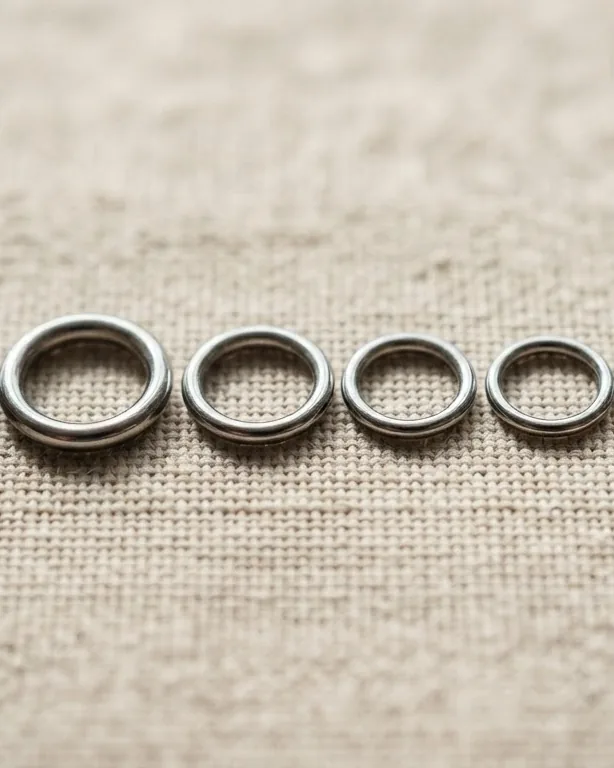
The right nose gauge changes with placement, because each spot passes through a different amount and type of tissue. A fresh nostril is most commonly pierced at 18G or 20G. A high nostril, sitting up on the crease where the skin runs a little tougher, is typically done at 18G. A septum, when placed through the thin sweet spot below the cartilage, is most commonly started at 16G, and piercers often move to 14G for clients who plan to stretch it later. The structural piercings that anchor across the bridge of the nose, along with rhino and nasallang placements, are typically performed at 14G because a thicker bar resists migration through a demanding channel. None of this is a legal standard. It reflects common professional practice, which is why two reputable studios can disagree by a gauge and both be correct.
Here is the placement map at a glance:
| Placement | Common starting gauge | Approx. bar (mm) |
|---|---|---|
| Nostril | 18G or 20G | 1.0 mm or 0.8 mm |
| High nostril | 18G | 1.0 mm |
| Septum | 16G (14G to stretch) | 1.2 mm (1.6 mm) |
| Bridge / rhino / nasallang | 14G | 1.6 mm |
Anatomy drives the choice inside those numbers. A thin, mobile nostril rim often reads better and heals more predictably with a 20G stud, since the thinner post displaces less tissue. A thicker or more active nostril, or a client who tends to knock jewelry, is where an 18G earns its place by being harder to bend and pull. The septum is different again. The reason 16G is the floor there, and why so many piercers reach straight for it, is that a heavier bar seats securely and gives you room to stretch cleanly later without re-piercing.
Placement also drives healing pace, which feeds back into gauge and jewelry choices during recovery. If you are weighing a septum, the timeline detail in how long septum piercings take to heal is worth reading alongside this sizing chart, because gauge and healing window are not independent decisions.
Gauge-to-Millimeter Conversion Chart for the Nose
A gauge-to-millimeter conversion chart is what you need the moment you buy from an international retailer, because much of the world lists jewelry in millimeters only. The nose-relevant range runs from 22G through 14G. In the round terms a piercer uses at the counter, 22G is about 0.6 mm, 20G is about 0.8 mm, 18G is about 1.0 mm, 16G is about 1.2 mm, and 14G is about 1.6 mm. The precise figures sit slightly off those clean numbers, which matters when a listing quotes an exact decimal. A 20G bar is 0.812 mm precise, not a tidy 0.8, and an 18G bar is 1.024 mm rather than exactly 1.0. So when a hoop is sold as 1.2 mm with no gauge label, that is 16G. When it says 1.0 mm, that is 18G. Learn these five conversions and you can shop any catalogue anywhere.
| Gauge (AWG) | Rounded mm | Precise mm | Typical nose use |
|---|---|---|---|
| 22G | 0.6 mm | 0.644 mm | Delicate healed studs |
| 20G | 0.8 mm | 0.812 mm | Nostril |
| 18G | 1.0 mm | 1.024 mm | Nostril, high nostril |
| 16G | 1.2 mm | 1.291 mm | Septum |
| 14G | 1.6 mm | 1.628 mm | Bridge, rhino, nasallang, stretched septum |
The gap between rounded and precise numbers is small, but it is real. A retailer who quotes 1.29 mm is being exact about a 16G bar; a retailer who quotes a flat 1.2 mm is rounding the same size. Both describe the same piece. Treat the rounded column as your shopping shorthand and the precise column as the tiebreaker when a listing gives you a decimal you do not recognize.
Initial Piercing Gauge vs Healed, Downsized Jewelry
Initial jewelry and healed jewelry are two separate fittings, and treating them as one is where a lot of new piercings quietly go wrong. When a piercer sets you up, they choose a post length with room for swelling, so the bar can look slightly long in the first weeks. That extra length is deliberate. It keeps the jewelry from pressing into tissue that puffs up as it heals. Once the swelling settles, that same long post starts to move, snag, and slow healing, which is why many piercers recommend a downsize. The downsize swaps the initial post for a shorter one that fits the settled channel, usually keeping the same gauge. Timing is individual, but the window many piercers discuss lands around the 4 to 8 week mark, once swelling has clearly gone down. Gauge normally stays constant through this. What changes is length, and sometimes the jewelry style.
Two timeframes are worth holding in mind here, both given as ranges rather than fixed schedules. Nostril piercings are frequently described as needing roughly 2 to 4 months for initial healing, with full maturation potentially longer. The downsizing conversation, again, is commonly framed around 4 to 8 weeks post-piercing, not as a rule but as a checkpoint to reassess.
Before you downsize, run through a short checklist:
- Visible swelling has clearly gone down and stayed down.
- There is no fresh crusting, heat, or discharge suggesting active irritation.
- You are letting a piercer make the swap, not forcing a shorter or thinner bar yourself.
One warning that belongs here: do not drop a thinner gauge into a channel that was pierced thicker. A 20G stud slid into an 18G hole leaves the jewelry loose and the tissue unsupported, which invites exactly the trauma the next section covers. Downsizing means shorter, not thinner.
Matching Jewelry Style to the Right Gauge
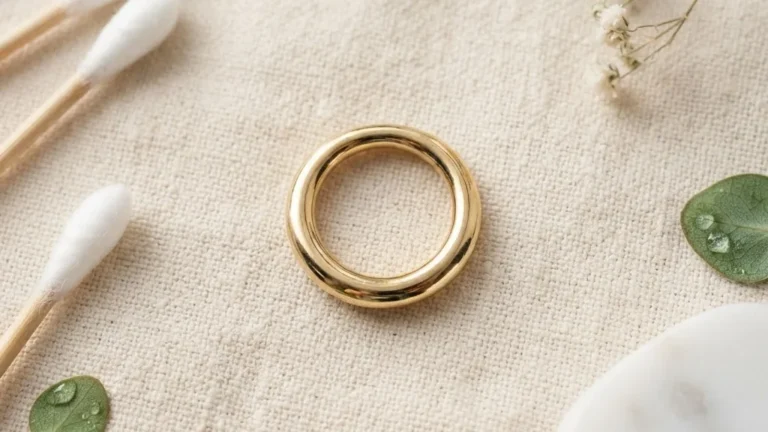
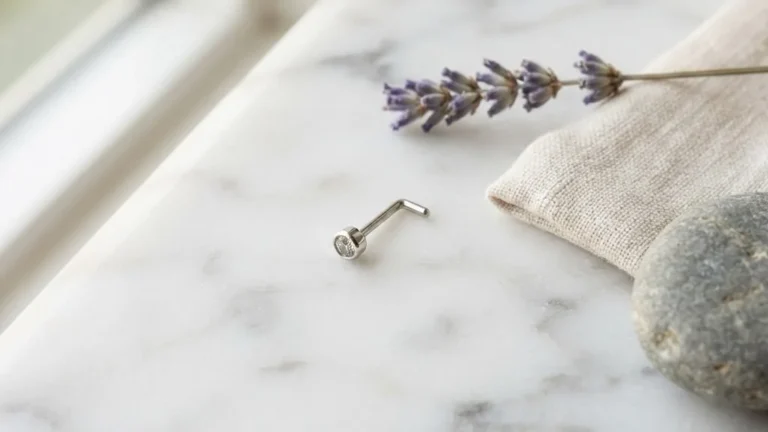
Jewelry style and gauge have to match, because each design seats in the piercing differently and each has its own gauge conventions. An L-shaped stud and a nostril screw both hold a nostril from the inside, but they bend and load the channel in their own ways, so buying the wrong gauge leaves them either loose or unable to seat. A labret-style post threads flat against the inside of the nostril and depends on a snug gauge fit to stay put. Rings behave differently again: a seamless ring, a captive bead ring, and a clicker all measure by inner diameter as well as gauge, so a mismatch there shows up as a hoop that gaps or crowds the piercing. The septum, when a ring is not wanted, often takes a circular barbell sized to the same 16G it was pierced at.
The style shortlist for the nose breaks down like this:
- L-shaped studs and nostril screws: internal nostril fittings, gauge must match the channel.
- Labret-style posts: flat backing, popular for healed nostrils, gauge-sensitive fit.
- Seamless rings and captive bead rings: measured by gauge and inner diameter together.
- Clickers and circular barbells: common in septums, usually 16G to match placement.
Ring dimensions deserve their own note. Typical healed nostril hoop inner diameters commonly range from 7 mm to 9 mm on average adult anatomy, with smaller sizes around 6 mm or larger sizes of 10 mm or more used depending on nostril size and the fit you want. Standard nose-stud post lengths, meaning the portion sitting inside the channel, commonly range from about 6 mm (1/4 inch) to 8 mm (5/16 inch), depending on tissue thickness and swelling stage. Get the gauge right first, then dial in diameter or length.
Material Standards and Nickel Rules at Thin Gauges
Material safety is where thin gauge and cheap metal collide, and it is the part most sizing pages leave out. Thinner-gauge jewelry is disproportionately sold in non-implant-grade alloys, which is exactly the metal that regulatory limits exist to control. The Association of Professional Piercers (APP), the leading nonprofit body-piercing authority in North America, recommends a short list of materials for initial piercings: implant-grade titanium meeting ASTM F136, implant-grade stainless steel meeting ASTM F138, niobium, and solid 14k or higher gold. Against that list, generically labeled “surgical steel” and plated jewelry are the marketing terms to distrust, because neither phrase guarantees the specification an initial piercing needs. When a bar is both very thin and very cheap, the odds that it skips the implant-grade standard climb, and your nose is the part paying for it.
It helps to know which body governs what:
- ASTM International publishes the metallurgical standards themselves. ASTM F136 covers wrought Ti-6Al-4V ELI titanium alloy for surgical implants; ASTM F138 covers 18Cr-14Ni-2.5Mo stainless steel for surgical implants. “Implant-grade” means a piece meets one of these, not that a listing simply used the word.
- The ISO 10993 series sets the international framework for biological evaluation of medical devices, which is the backdrop for any biocompatibility claim on body jewelry.
- The EU REACH Regulation, Annex XVII, Entry 27, often called the Nickel Directive, sets a nickel-release limit of 0.2 micrograms per square centimeter per week for post assemblies inserted into pierced parts of the body during healing, and a separate 0.5 micrograms per square centimeter per week limit for other prolonged skin-contact items.
Those nickel figures matter because nickel contact sensitivity is commonly estimated at roughly 10 percent to 15 percent of the general population in dermatological literature. A thin, nickel-releasing bar sitting in a healing wound is the textbook trigger. For the regulatory and biocompatibility framing at a higher level, the U.S. Food and Drug Administration (FDA) is the reference point in the United States, and its material guidance sits at the FDA. Practitioner sizing and aftercare standards live with the Association of Professional Piercers, and dermatology-side guidance on nickel allergy and contact reactions is published by the American Academy of Dermatology. The Centers for Disease Control and Prevention (CDC) adds the infection-control context that piercing hygiene rests on. The practical takeaway is blunt: verify the standard code, not the adjective.
Gauge Mistakes That Damage a Piercing
The wrong gauge does specific, nameable damage, and most of it traces back to jewelry that is too thin for its channel. The classic failure is the cheese-wire or cheese-cutter effect, where a bar thin enough to act like a blade slowly cuts through healing or healed tissue as it moves. Embedding is the mirror problem, where a fitting that is too short or too tight sinks into swollen tissue. Migration and outright rejection happen when a piercing decides a bar does not belong, drifting it toward the surface, and thin structural placements are the most exposed to this. On top of those, hypertrophic scarring and, for keloid-prone skin, keloid growth can follow repeated irritation. Gauge is not a cosmetic afterthought here. It is the mechanical factor that decides whether tissue is supported or sawed.
The high-risk moves worth avoiding:
- Forcing a thinner bar into a thicker channel, which unloads the tissue and starts the cheese-wire process.
- Choosing a structural piercing like the bridge in too thin a gauge, raising migration and rejection odds.
- Ignoring early irritation on nickel-releasing metal, which feeds scarring in the 10 percent to 15 percent of people who are nickel-sensitive.
When a reaction looks like infection rather than ordinary healing, a general medical source such as the Mayo Clinic is the right place to check the warning signs before deciding between a piercer and a doctor.
How to Measure Your Current Gauge at Home
Measuring an existing piece is straightforward once you know the two tools that give an honest reading. The cleanest option is a gauge wheel, a metal disc with labeled slots you slide the bar into until you find the snug fit, which reads the gauge directly. A digital caliper is the alternative: measure the bar thickness in millimeters, then match it against the conversion chart above, so 1.0 mm reads as 18G and 1.2 mm as 16G. Guessing by eye does not work, because the differences between 20G, 18G, and 16G are fractions of a millimeter. If you have neither tool and the jewelry is in a healing piercing, the safest move is to bring the piece to a piercer, who can size it and check the fit in one visit rather than risk an incompatible reorder.
Why “Standard” Gauge Varies by Country and Studio
Standard is a soft word in this trade, and it is worth taking it literally. Gauge norms reflect common professional practice, not a codified legal mandate, and they can differ by country and by individual studio. A nostril described as 18G standard in one shop may be a 20G house default in another, and both are defensible calls shaped by local convention, the piercer’s training, and the client’s anatomy. This is why an international jewelry order can arrive fitting differently than expected even when the gauge number matches: the surrounding house style around length, diameter, and threading varies too. The practical rule for cross-border shoppers is to size from your own healed jewelry or a piercer’s measurement, then confirm the retailer lists in the same units, rather than trusting that standard means the same thing everywhere. When in doubt, measure, do not assume.
Frequently Asked Questions
Is 18G or 20G more standard for a nostril?
Both are standard nose piercing gauge choices for a nostril, and neither is universally correct. Piercers pick between 18G at about 1.0 mm and 20G at about 0.8 mm based on your tissue thickness, the jewelry you want, and studio convention. Thinner 20G suits a delicate rim; sturdier 18G resists bending. Ask your piercer which fits your anatomy.
What happens if I put thinner jewelry into a piercing done at a thicker gauge?
The thinner bar sits loose in a channel shaped for a thicker one, leaving tissue unsupported. That gap invites the cheese-wire effect, where a too-thin bar can cut through tissue as it moves, plus migration and irritation. Downsizing should shorten post length, not reduce gauge. Keep the gauge your piercing was performed at unless a piercer advises otherwise.
Do thinner gauges hurt less or heal faster?
A thinner gauge displaces slightly less tissue, so it may feel marginally gentler going in, but there is no reliable claim in sizing guidance that it heals faster. Healing is driven more by placement, aftercare, and material quality than by the fraction of a millimeter between 20G and 18G. Nostril healing is commonly described as 2 to 4 months regardless.
What gauge is standard for a septum piercing?
Septum piercings are most commonly started at 16G, about 1.2 mm, because a heavier bar seats securely through the thin sweet spot below the cartilage. Piercers frequently choose 14G, about 1.6 mm, for clients who plan to stretch later. Placed correctly through that thin spot, industry sources often cite septum healing near 6 to 8 weeks.
How do I measure the gauge of jewelry I already own?
Use a gauge wheel, sliding the bar into slots until one fits snugly to read the gauge directly, or a digital caliper to measure thickness in millimeters and match it to the chart. So 0.8 mm is 20G, 1.0 mm is 18G, 1.2 mm is 16G. If unsure, a piercer can size the piece and confirm the fit.
Is “surgical steel” safe for a fresh nose piercing?
Unqualified “surgical steel” is a marketing phrase, not a guaranteed specification, so it is a red flag for a fresh piercing. The Association of Professional Piercers recommends implant-grade stainless steel meeting ASTM F138, along with ASTM F136 titanium, niobium, or solid 14k-plus gold. Ask for the standard code, because vague labels can hide nickel-releasing alloys that trigger reactions.
The Short Version
Nose gauge is a small set of numbers doing a large amount of work. Nostrils run 18G or 20G, high nostrils 18G, septums 16G with 14G for stretching, and structural placements 14G, all as common practice rather than law. The chart converts those to millimeters so an international order lands right, and the material standards from ASTM International, the EU REACH nickel limits, and the Association of Professional Piercers keep a thin bar from becoming a health problem.
Buy the correct gauge first, then sort length and diameter, and let a piercer handle any downsize around the 4 to 8 week mark. Aftercare is the other half of the equation, and if water is part of your routine, read when you can swim after a fresh piercing before you dive back in, because a healing channel and a pool are a poor match.