The honest septum piercing healing time is about 2 to 3 months for the initial phase when the piercing sits in the soft sweet spot, with full tissue maturation taking closer to 6 to 12 months. A septum placed through cartilage instead runs longer, often 4 to 8 months. Those two numbers, surface healing and full maturation, are the ones most pages blur together, and knowing the difference is what keeps a healthy piercing from being disturbed too early.
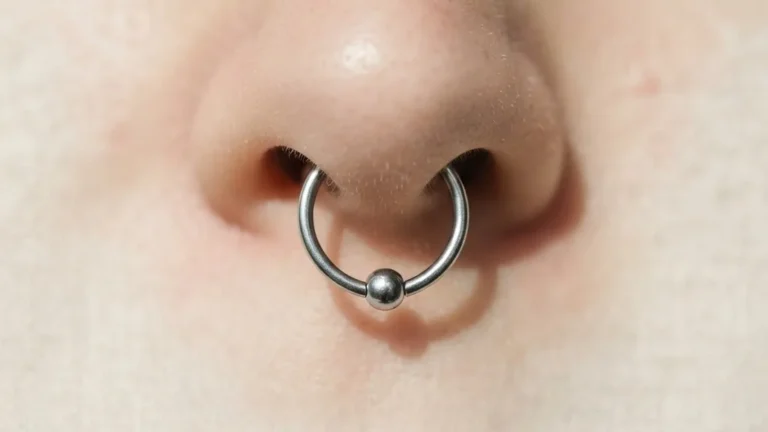
A septum piercing passes through the thin flexible tissue at the front of the nasal septum, just below the harder cartilage, in the narrow gap between the nostrils. When a skilled piercer finds that soft channel, the piercing tends to settle quickly and stay comfortable. When the placement drifts into the firmer cartilage, healing slows and irritation is more likely. That single anatomical detail explains most of the variation people see in how long recovery takes.
This guide walks through the full timeline stage by stage, the factors that speed healing up or drag it out, an aftercare routine that follows what professional piercers actually recommend in 2026, and the specific warning signs that mean it is time to call a professional rather than wait it out.
Every healing window, gauge size, and aftercare step below is checked against guidance from the Association of Professional Piercers and Mayo Clinic, plus current studio practice.
Quick answer: Expect roughly 2 to 3 months of initial healing for a well-placed septum piercing, and 6 to 12 months for the internal tissue to fully toughen. A piercing set through cartilage rather than the sweet spot can take 4 to 8 months, sometimes longer. Do not swap the jewelry on a fixed date; wait at least 8 to 12 weeks and let your piercer confirm it is healed in person. Clean it only with sterile saline that lists 0.9 percent sodium chloride as its single ingredient, keep your hands off it, and watch for hot, spreading redness or thick green pus, which point to infection.
What “healed” actually means for a septum
Healing is not a single moment, and treating it as one is where most trouble starts. A piercing has two clocks running at once: the surface, which calms down and looks settled within the first couple of months, and the internal channel, called the fistula, which is the tube of new skin your body builds through the wound. That channel keeps thickening and strengthening long after the outside looks fine.
For a septum, the surface clock usually reads 2 to 3 months. By then the swelling is gone, discharge has stopped, and the jewelry moves without soreness. The internal clock reads much longer, commonly 6 to 12 months, before the fistula is mature enough to trust fully. During that gap the piercing is fragile in a way you cannot see, which is exactly why professional piercers push back on changing jewelry or leaving it out early. An empty channel that has not matured can shrink or close in hours.
The practical takeaway is patience. A septum that feels healed at ten weeks is doing well, but it is not finished. Keeping up gentle aftercare and leaving the original jewelry in until a piercer clears it is what carries the piercing across that invisible line from looking healed to actually being healed. For context on how nasal timelines compare with the ear, our breakdown of how long ear piercings take to heal shows just how much placement and tissue type change the calendar.
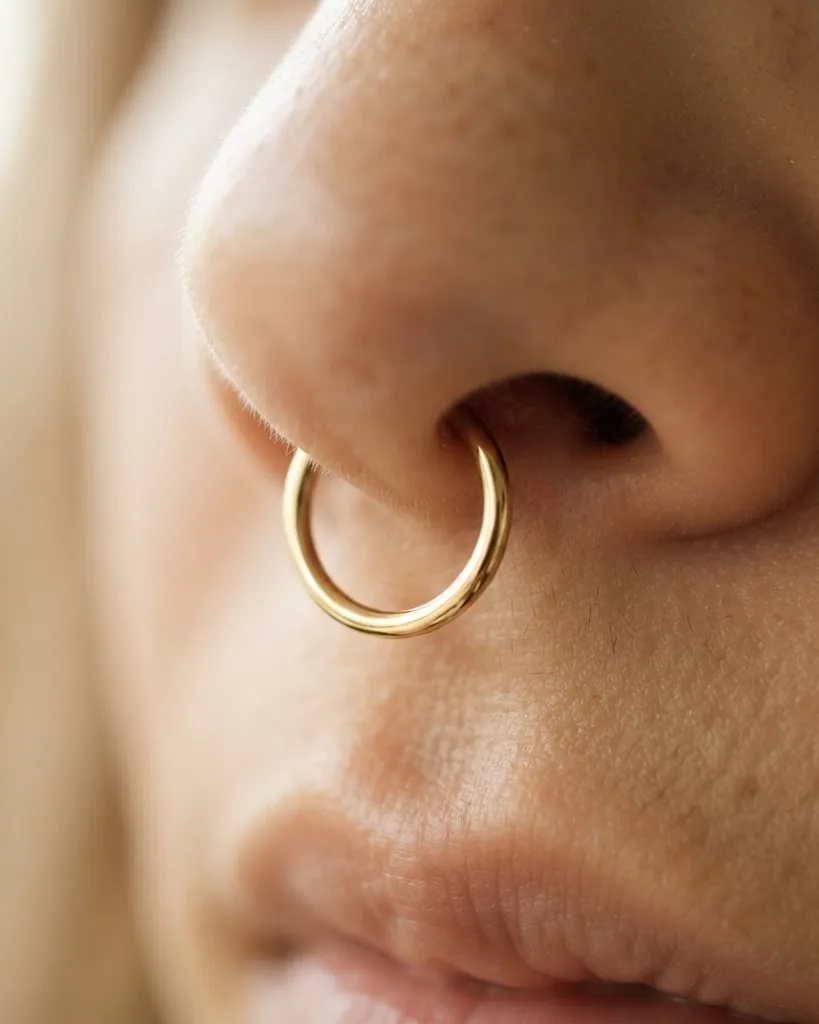
The healing timeline, stage by stage
Every piercing moves through the same three biological stages: inflammation, then repair, then maturation. They overlap rather than switching off cleanly, but knowing which stage you are in tells you what is normal and what is not. The table below maps the typical windows for a septum sitting in the sweet spot.
| Stage | Typical window | What you notice |
|---|---|---|
| Inflammatory | Weeks 1-8, peak weeks 1-3 | Swelling, tenderness, warmth, thin whitish-yellow discharge that crusts. Sharpest in the first few days. |
| Proliferative (repair) | Weeks 2-6 | Swelling eases, the internal channel starts forming, crusting slows, soreness fades. |
| Maturation | Months 2-12 | Surface looks and feels healed; the internal fistula keeps toughening. Cleaning can taper but should not stop early. |
In the first week or two, some tenderness and a runny or crusty discharge are expected, not alarming. Many people find the septum less painful than they feared because the sweet spot is soft tissue, though the eyes may water reflexively during the piercing itself. The most intense discomfort generally settles within the first 1 to 3 weeks.
By weeks 2 to 6, the piercing should be visibly calmer. If it is getting more painful, more swollen, or more inflamed as the weeks pass rather than less, that is a signal to check in with your piercer, because healing should trend in one direction. From roughly the second month onward you are in maturation: the piercing feels normal, but the tissue is still doing quiet structural work, which is the reason jewelry changes and long periods without jewelry are still risky at this stage.
Why placement decides your timeline: sweet spot versus cartilage
The biggest single factor in your healing time is where the needle actually went. The sweet spot is a small band of thin, flexible tissue at the front of the septum, sitting just below and in front of the rigid cartilage. It is soft, well supplied with blood, and quick to heal. The harder septal cartilage above and behind it is a different material entirely: dense, less vascular, and slow to repair.
A piercing set cleanly through the sweet spot versus one placed through cartilage is not a small difference. The sweet-spot piercing typically heals in that 2 to 3 month initial window and hurts far less. A cartilage placement, which usually happens when the sweet spot is missed or a person’s anatomy is unusual, commonly stretches to 4 to 8 months and can run to 6 to 9 months or beyond, with more pain, more swelling, and a higher chance of an irritation bump forming along the way.
This is the strongest argument for choosing your piercer carefully and insisting on a needle rather than a piercing gun, which cannot place a septum accurately or hygienically. A reputable studio uses a single-use sterile needle, marks the spot, and checks symmetry before piercing. If you want to understand why the tool matters this much, our comparison of being pierced with a needle rather than a gun covers the safety and precision gap in detail. For anyone weighing how their nose shape affects placement, nose piercings for different nose shapes is a useful companion read.
What speeds up or slows down healing
Placement sets the baseline, but several other levers push your timeline in either direction. Some you control completely, others are down to biology. The list below covers the ones that matter most in practice.
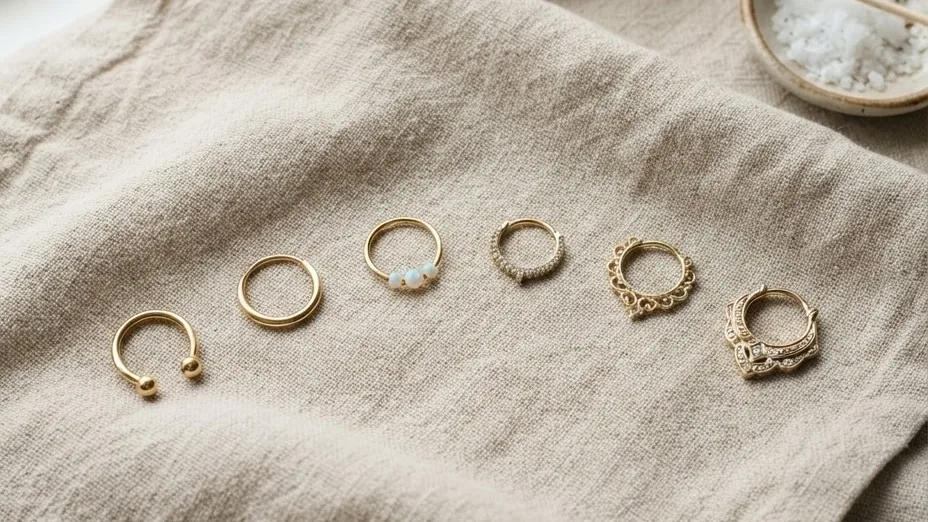
- Jewelry material. Implant-grade titanium (ASTM F-136), solid 14k or higher gold, and 316L surgical steel are the materials professional piercers trust. Nickel-free, implant-grade metal lowers the odds of an allergic reaction and irritation bump. Cheap mystery-metal and acrylic are a common cause of stalled healing.
- Gauge and fit. The standard starting thickness for a septum is 16 gauge, which is 1.2 mm, though some piercers use 14 gauge at 1.6 mm. Jewelry that is too tight against swollen tissue or too heavy can prolong irritation, which is why an initial circular barbell or horseshoe with a little breathing room is common.
- Aftercare consistency. Regular sterile-saline cleaning and, just as important, keeping your hands off the jewelry, is the single habit that separates smooth healers from stubborn ones.
- Trauma and movement. Bumping the ring, flipping it up and down repeatedly, sleeping face-down, or catching it on a towel all reset the clock a little each time.
- General health. Smoking, poor sleep, and high stress slow wound healing everywhere in the body, and a septum is no exception.
Two of these deserve emphasis. First, material is not a place to save money: the small premium for implant-grade titanium is trivial next to the cost of an extra three months of irritation. Second, the flip-up trick that makes a horseshoe discreet is fine for a healed piercing, but constant fiddling with fresh tissue is a real setback, so during healing keep handling to a minimum.
A saline aftercare routine that matches the APP
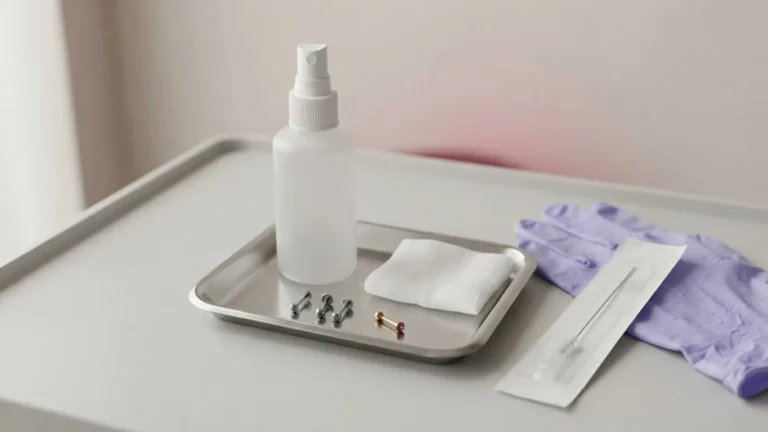
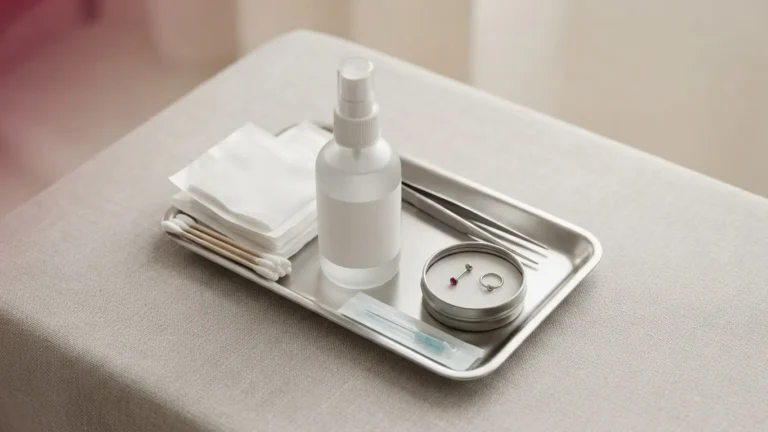
Aftercare for a septum is refreshingly simple, and simpler is better. The Association of Professional Piercers recommends a sterile saline wound wash whose only listed ingredient is 0.9 percent sodium chloride, sometimes with purified water. Notably, the APP no longer recommends mixing your own sea-salt solution at home, because homemade mixes are easy to make too strong and end up drying out and irritating the piercing. You can read the current guidance directly from the Association of Professional Piercers.
Here is a clean daily routine that follows that guidance. Do it about twice a day during active healing, and resist the urge to do more, since over-cleaning irritates tissue just as surely as neglect does.
- Step 1 – Wash your hands thoroughly with soap and water before touching anywhere near the piercing.
- Step 2 – Spray or soak the piercing with sterile saline, letting it sit on the tissue for a minute or two to soften any crust.
- Step 3 – Gently wipe away loosened crust with clean disposable gauze; do not force it and do not twist or rotate the jewelry.
- Step 4 – Pat the area dry with fresh gauze or a paper product, since cloth towels harbor bacteria and snag the ring.
- Step 5 – Leave it alone until the next cleaning. Hands off is part of the routine, not separate from it.
A short list of things to avoid saves a lot of grief: skip alcohol, hydrogen peroxide, iodine, and antibacterial soaps, all of which are too harsh and slow healing. Skip ointments, which trap moisture and debris. Keep the piercing out of pools, lakes, and hot tubs while it heals, and keep makeup, sprays, and lotions away from it. If you need to hide the piercing at work or school, a healed septum can be flipped up, but a genuinely discreet option during healing is limited; some people ask about piercing retainers once their piercer clears a first jewelry change.

Reading the signs: normal healing versus infection
Because this is your face and airway, it is worth being precise about what is routine and what is a red flag. Normal healing includes mild swelling, tenderness, occasional itching, and a whitish-yellow secretion that dries into crust. That discharge is lymph, not pus, and it is a sign the wound is working, not a problem.
Infection looks and feels different. Watch for pain that increases rather than fades, skin that is hot to the touch, redness that spreads outward, thick yellow or green pus with a foul smell, and any fever or feeling generally unwell. Mayo Clinic advises seeing a healthcare professional if redness, swelling, or a color change does not improve, or if the site oozes blood or pus, and notes that a problem not improving within 5 to 7 days may need antibiotics. For skin reactions such as a persistent bump or contact irritation, the American Academy of Dermatology is a reliable reference on when a rash warrants a professional. You can review the full guidance from Mayo Clinic on preventing and treating piercing complications.
One important safety point: if you suspect an infection, do not pull the jewelry out yourself. Removing it can trap the infection inside as the surface closes over it, turning a treatable irritation into an abscess. Leave the jewelry in, keep cleaning gently, and get seen by your piercer or a clinician. A professional piercer can tell an irritation from an infection quickly and will tell you honestly when a doctor needs to be involved. When in doubt about anything on your face, err toward getting it looked at.
The septum bump, crusties, and changing jewelry
Two things worry new septum owners more than they should: a small bump and daily crust. Crust, or crusties, is just dried lymph. Soften it with saline and wipe it away gently; never pick at it dry, which reopens the wound and invites a bump.
A bump beside the piercing is usually an irritation bump, not a keloid. The distinction matters because the two are treated very differently. Studies and clinical estimates put irritation bumps at roughly 84 to 94 percent of piercing bumps, with true keloids accounting for only about 6 to 16 percent, and keloids are far more common on the earlobe and chest than inside the nose. An irritation bump is your tissue reacting to a cause you can usually remove: cheap jewelry, a too-tight fit, over-cleaning, repeated knocks, or moisture. Fix the cause, return to basic saline care, and most irritation bumps settle. Do not reach for undiluted tea tree oil, aspirin paste, or other home remedies that often make things worse; have your piercer look at it instead.
On changing jewelry, the honest answer is that there is no safe fixed date, only a safe condition. Professional piercers generally say wait at least 8 to 12 weeks and, more importantly, have them confirm the piercing is healed and swap the piece for you the first time. As early swelling drops, a piercer may downsize the jewelry to a better-fitting piece, which itself reduces irritation. Trying to force a new ring through a channel that is not ready is a reliable way to create a bump or reset your healing, so let the piercing, not the calendar, make the call.
What it costs and what to expect at the studio
Cost is not the same as healing time, but it shapes both the jewelry and the placement you end up with. A septum piercing itself typically runs about $40 to $100 for the procedure at a reputable studio, before jewelry and a tip, and prices vary by region and piercer experience. The jewelry is a separate line: implant-grade titanium clickers commonly land around $9.95 to $15.95, hinged rings start near $8.98, circular barbells range from about $9.95 to $47.95, and gem-set pieces can run $22.99 to $64.99.
Paying a little more for an experienced piercer and quality metal is the cheapest insurance you can buy against a long, bumpy healing. A studio that finds your sweet spot on the first pass and starts you in nickel-free titanium is quietly buying back weeks of your timeline. The reflex to save $20 on the initial jewelry is exactly the false economy that leads to the irritation and stalled healing described above.
Frequently asked questions
How long does a septum piercing take to heal?
Initial healing for a well-placed septum runs about 2 to 3 months, and the internal tissue fully matures over 6 to 12 months. A piercing set through cartilage rather than the soft sweet spot commonly takes 4 to 8 months and can run longer. The surface calming down is not the same as the channel being mature, so keep up aftercare past the point where it looks healed.
When can I change my septum jewelry?
Wait at least 8 to 12 weeks and, more importantly, have your piercer confirm it is healed and make the first change for you. There is no safe calendar date, only a safe condition. Forcing a new ring through a channel that has not matured is a common way to create an irritation bump or restart healing, so let the piercing tell you it is ready.
Does a septum piercing hurt more than other piercings?
Most people rate a well-placed septum as surprisingly manageable, because the sweet spot is soft tissue rather than cartilage. Your eyes may water reflexively during the piercing, and there is a sharp pinch, but the lasting soreness is usually mild and fades within the first 1 to 3 weeks. A piercing that drifts into cartilage tends to hurt more and longer.
What should I clean my septum piercing with?
Use a sterile saline wound wash that lists 0.9 percent sodium chloride as its only ingredient, about twice a day. The Association of Professional Piercers no longer recommends homemade sea-salt mixes, which are easy to make too strong. Avoid alcohol, hydrogen peroxide, antibacterial soaps, and ointments, all of which slow healing rather than help it.
How do I know if my septum piercing is infected?
Normal healing means mild swelling, tenderness, and a whitish-yellow crust. Infection means increasing pain, warmth, spreading redness, thick yellow or green foul pus, or fever. If those appear, or if things do not improve within 5 to 7 days, see a professional; you may need antibiotics. Do not remove the jewelry yourself, which can trap the infection inside.
What gauge is a septum piercing?
The standard starting gauge is 16 gauge, which is 1.2 mm thick, though some piercers use 14 gauge at 1.6 mm. A common initial diameter is around 8 mm. Starting jewelry is usually a circular barbell or horseshoe in implant-grade titanium, chosen for a comfortable fit while the tissue is still swollen.
The bottom line
A septum piercing rewards patience over urgency. Plan on about 2 to 3 months for the surface to settle and 6 to 12 months for the tissue to truly toughen, and remember that placement through the sweet spot rather than the cartilage is the biggest thing standing between you and a quick, quiet heal. Clean it only with sterile 0.9 percent saline, keep your hands off it, and choose implant-grade titanium in a 16 gauge fit rather than the cheapest metal on the shelf. Learn the difference between a normal crust and a hot, pus-filled red flag, leave the jewelry in if you suspect infection, and get seen when anything trends the wrong way. Do those things, let your piercer clear the first jewelry change instead of the calendar, and the piercing that felt like a leap of faith will settle into the easiest part of your face to care for.