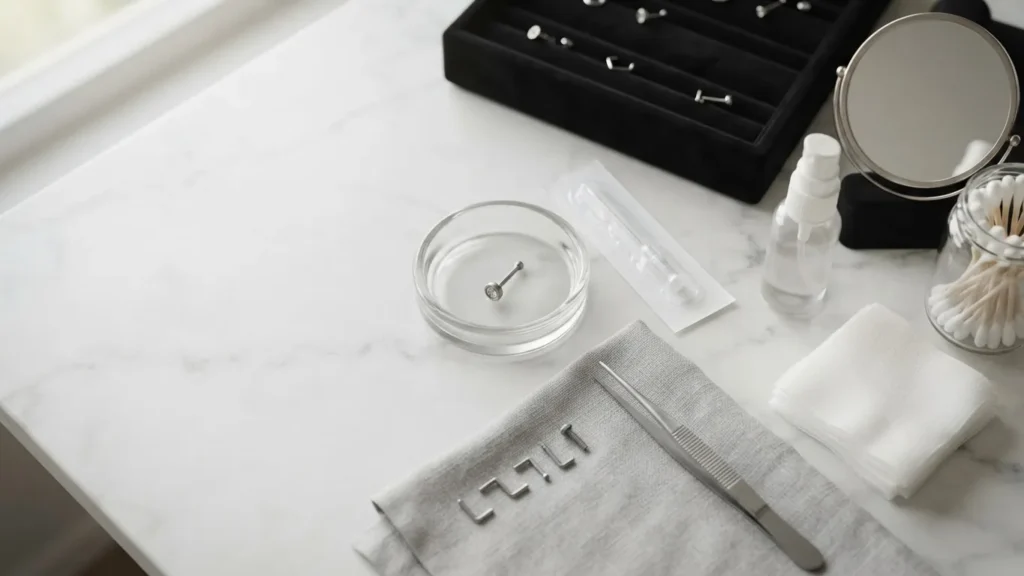
Drafted with AI language models. How this page was made
A standard nostril piercing heals on the surface in about two to three months, but the channel underneath can stay fragile for six months or longer, which is why aftercare runs past the point the piercing feels fine. How long does it take for nose piercing to heal depends on placement, jewelry gauge, and your own healing rate. Sources set different numbers because they measure different things: the moment it stops hurting, the day crusting ends, and full internal healing are three separate milestones.
The short answer: a nostril piercing is commonly cited at 2 to 3 months by a jewelry retailer and 2 to 6 months by a piercing shop, while Healthline puts the overall figure at 4 to 6 months. A septum heals fastest, at 2 to 3 months or 6 to 8 weeks. A rhino runs 6 to 9 months and a high nostril 6 to 12 months. Treat the longer numbers as the real endpoint for jewelry changes.
Nostril Jewelry and Why the Material Changes Your Timeline
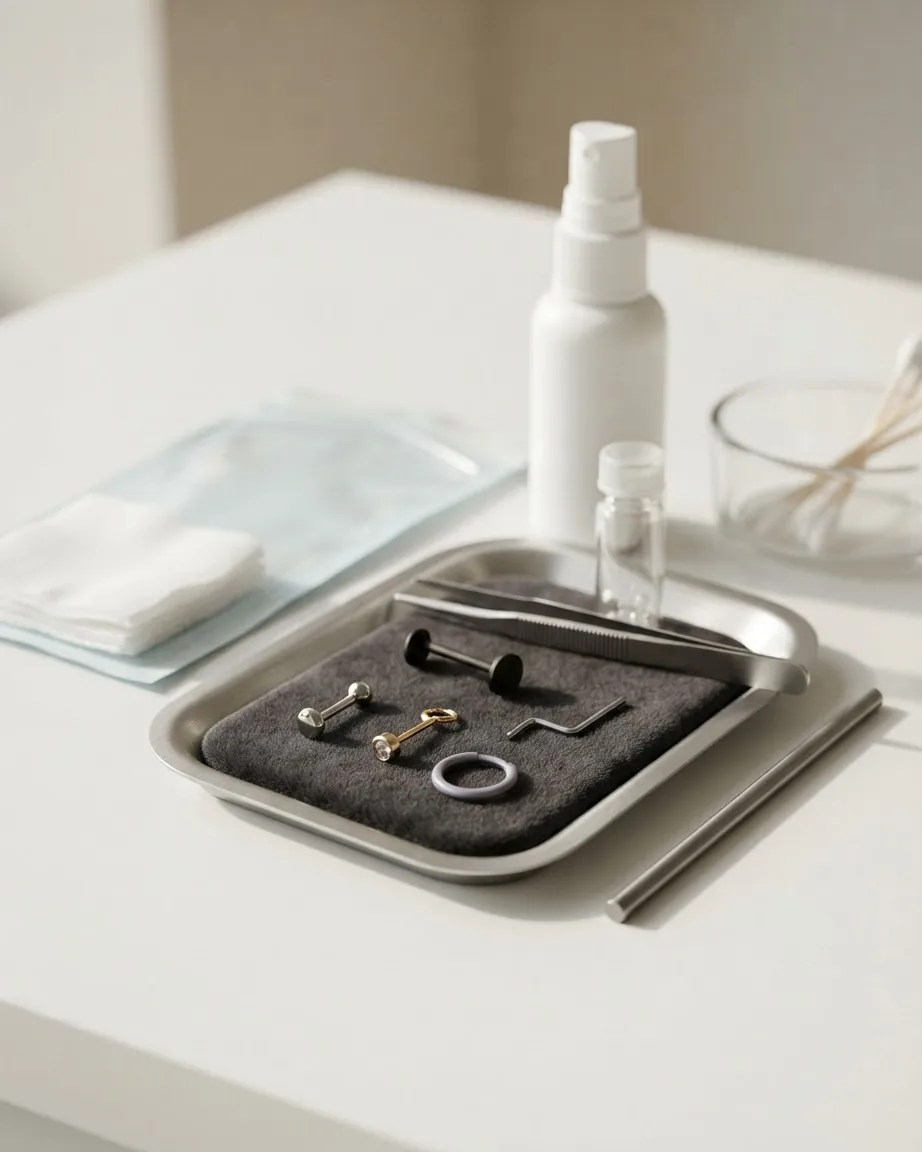
The piece worn through a fresh nostril is not chosen for looks. It is chosen to let an open wound settle without irritation, and the metal it is made of directly affects whether that wound heals on schedule or stalls.
Healthline lists the jewelry materials you will encounter: nickel, 18- or 24-karat gold, stainless steel, titanium, and niobium, and names material as one of the three factors that decide healing speed alongside placement and aftercare. The reason material matters is allergy, not just comfort. The Cleveland Clinic notes that allergic reactions to metal piercings are common, and nickel is a metal frequently used in jewelry. An allergic reaction reads as an itchy, rash-like area with small raised red dots, distinct from infection, and swapping to a higher-quality metal usually resolves it.
What that means for the reader deciding on a first stud:
- Pick a hypoallergenic initial piece.
- Avoid nickel-containing jewelry during healing. A metal marketed as “nickel-free” is not a guarantee of zero reaction; if itching and a rash appear, a clinician, not the shop, should confirm whether it is an allergy.
- Match the gauge to the placement. A thin ring can close quickly if removed; a thicker gauge stud or ring holds the channel open longer.
Jewelry choice carries over into every piercing placement. For the wider subject, see our aftercare healing section, and for how metal coatings behave on a fresh channel, our guide to black ear piercing studs.
What Happens at the Appointment and in the First Hour
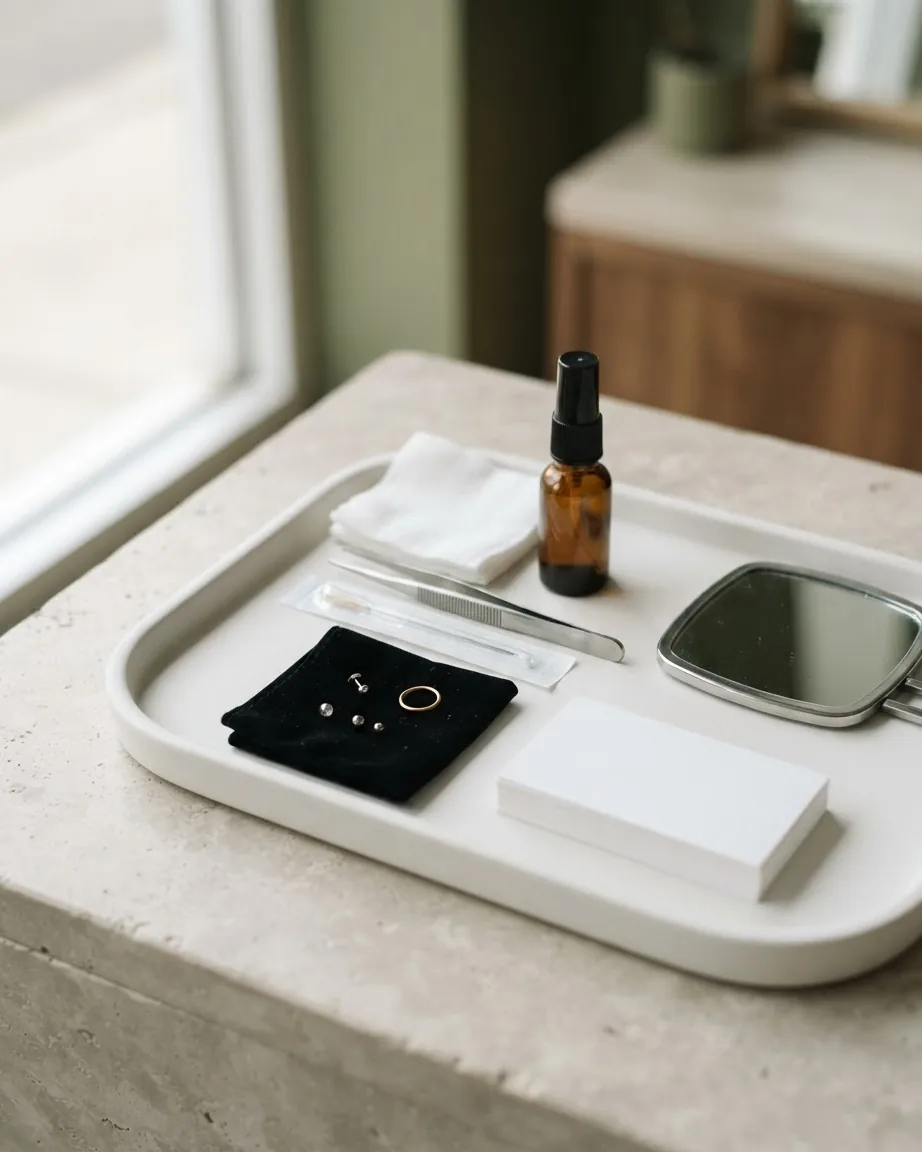
The piercing itself is brief. A professional should wear gloves and use sterilized equipment; the Cleveland Clinic’s advice is to walk away if the environment is not clean, and to never attempt it yourself. From the moment the stud is in, the clock on both healing and infection risk starts. The highest risk of infection sits in the first week, so the piece goes in and stays in. Expect mild pain, redness, and clear fluid that forms a crust in the first days; with proper care, those symptoms should improve within a few days per the Cleveland Clinic. The stud you leave with is the one you keep through healing, not a placeholder to swap next week.
Daily Nose Piercing Healing Timeline, Stage by Stage

Healing is not linear, and the surface misleads. The Association of Professional Piercers explains the mechanism plainly: “this type of wound will heal from the outside to the inside”, so a piercing can feel fine on the outside while the interior is still fragile. That single fact reconciles why one source says two months and another says six: they are describing different layers.
Thistle Piercing & Fine Jewelry frames the progression in three stages, and the table below aligns each stage with what you can and cannot do.
| Stage | Window | What is happening / what to do |
|---|---|---|
| Initial | 0 to 4 weeks | Fresh wound; focus is preventing infection. Do not change jewelry. |
| Early healing | 4 to 12 weeks | Tissue starts to heal but the piercing stays delicate; premature changes cause irritation and delay. |
| Established healing | 3 to 6 months | More stable, but the interior channel is still maturing. |
In the first stage you will see the whitish-yellow fluid the APP calls normal, forming crust on the jewelry. That crust is healing, not infection. The APP’s cleaning method is deliberately minimal: wash hands, spray with sterile saline labeled as wound wash, then dry gently with disposable gauze. The APP has dropped homemade sea salt mixes because they often come out too strong and over-dry the piercing. Rotating the jewelry during cleaning is not necessary and can irritate the wound.
By the early stage, surface redness fades and discharge tapers. By the established stage the piercing feels settled, but UC Berkeley University Health Services sets full healing at 12 to 24 weeks depending on location, and the APP notes tougher tissue such as nostrils may take six months or longer. The practical read: trust your comfort for daily life, but trust the longer number before you remove anything.
For a sense of how cartilage channels elsewhere behave on a similar outside-in schedule, see our conch piercing healing time guide.
Common Questions While a Nose Piercing Settles
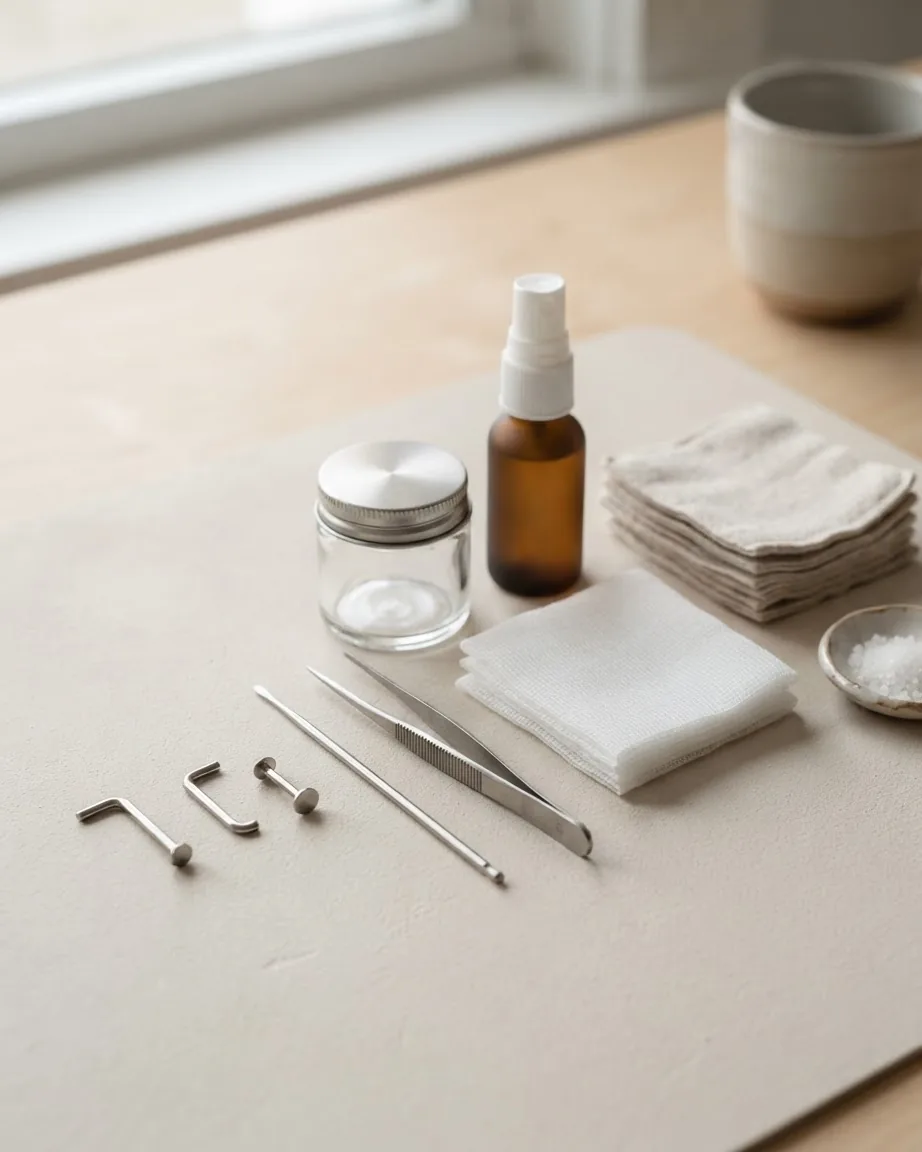
Three questions come up repeatedly in the first weeks, each with a clear answer:
- Is this discharge an infection? Whitish-yellow fluid that crusts on the jewelry is normal healing per the APP. Thick yellow pus, with pain, warmth, and spreading redness, is not.
- Can I sleep on it? The APP advises against trauma from pressure; keep bedding clean and avoid resting weight on the piercing while it heals.
- Should I twist or rotate it? No. The APP states directly: during healing, do not twist, spin, or rotate your jewelry.
How to Put a Nose Ring In Safely
Inserting a ring is not a first-week activity. Thistle Piercing & Fine Jewelry sets the stud-to-ring switch at a minimum of 6 months, because changing the jewelry shape from a straight stud to a curved ring can irritate an interior that is not fully healed and set healing back. If a ring goes in too early and the piercing reacts, the fix is to put the stud back and give it more time.
When the time is right, work with clean hands, line the ring up with the existing channel, and never force it. The APP warns that even a healed piercing can shrink, so if a ring will not seat easily, a qualified piercer should handle it rather than forcing the tissue.
How to Speed Up Nose Piercing Healing
You cannot rush tissue repair, but you can remove the things that slow it. The nose heals slowly in part because, as the Houston shop Lunar Ink (Tattoo Shop TX) explains, it pierces through thick cartilage with less blood flow than tissue like the earlobe, and blood flow delivers the nutrients and oxygen that repair the wound.
What actually helps, drawn from professional aftercare guidance:
- Clean only as directed and no more. The APP warns that over-cleaning delays healing and irritates the piercing.
- Leave the original jewelry in for the full healing period. The APP advises against changes during healing except by a qualified piercer for a needed downsize.
- Protect it from trauma. Avoid friction, playing with the jewelry, and vigorous cleaning, all of which the APP links to scar tissue and prolonged healing.
- Cut irritants. The APP lists excessive stress, nicotine, caffeine, and alcohol as factors that can prolong healing.
When You Can Change Your Nose Piercing
“Changing” means different actions on different schedules. A downsize to a shorter stud happens around 10 to 12 weeks on average per Thistle. Urban Body Jewelry treats 2 to 3 months as the standard before a swap. UC Berkeley says do not remove the stud for 8 weeks. A stud-to-ring switch waits a minimum of 6 months. Have a piercer do any downsize or change during healing.
What Not to Do During Healing
The fastest way to reset the clock is a wrong move early. From the APP’s aftercare guidance:
- Do not clean with alcohol, hydrogen peroxide, antibacterial soap, or iodine. These damage cells; UC Berkeley adds that alcohol and peroxide dry and kill new healthy cells.
- Do not submerge it. Avoid lakes, pools, oceans, and hot tubs during healing.
- Do not apply makeup, lotions, or sprays on or around the piercing.
- Do not hang charms or force jewelry changes before the piercing is fully healed.
How to Tell When Your Nose Piercing Is Healed
The sign to trust is the absence of crust. Urban Body Jewelry offers the rule: if a nostril goes a solid 2 to 3 weeks without any crust or discharge, it could be fully healed. Pair that with no soreness and jewelry that moves without pain. Because healing runs outside-in, confirm with your piercer before removing anything.
Aftercare Information and Separating Normal Healing From Warning Signs
Most nose piercing infections are minor and treatable at home, the Cleveland Clinic notes, thanks to the nose’s rich blood supply. But nearly 1 in 4 people with body piercings outside the earlobes have had an infection or other medical issue, so the warning signs are worth knowing precisely.
The core routine is simple and the same across sources: wash hands, rinse or spray with sterile saline twice a day, dry gently with a disposable product, and leave the jewelry alone otherwise. Do not over-clean.
Here is the distinction that prevents both panic and neglect, with the action and who to see for each.
- Normal healing: mild pain, redness, clear fluid that crusts (Cleveland Clinic), plus itching and whitish-yellow secretion (APP). Action: continue saline care; no clinician needed.
- Possible infection: thick yellow pus, warmth, swelling, and pain that worsens or persists (Cleveland Clinic); blood or pus that is white, green, or yellow (NHS). Action: see a healthcare provider, not only the shop. A piercer cannot diagnose or treat an infection.
- Possible allergy: an itchy, rash-like area with small raised red dots (Cleveland Clinic). Action: a clinician confirms it; a metal swap often resolves it.
- A small lump: the NHS notes small lumps (granulomas) can form around an ear or nose cartilage piercing. Action: have a clinician assess a persistent lump.
- Fever: the Cleveland Clinic calls fever rare and a sign of more severe infection. Action: seek medical attention immediately.
Higher-risk groups need extra caution: the Cleveland Clinic names poorly managed diabetes, where extra blood sugar can fuel bacterial growth, and a weakened immune system. For swimming, avoid pools for at least a week and lakes until the piercing has fully healed.
How Long a Nose Piercing Takes to Close
This is the detail most generic guides skip, and it changes behavior. A nose piercing does not close on a comfortable schedule. Healthline says some nose piercings may start to close in less than a day after jewelry is removed. UC Berkeley is blunter: nose piercings can close within hours, so never leave the piercing without jewelry. The APP goes further, warning that even well-healed piercings can shrink or close in minutes, sometimes after years.
Those three figures are not a contradiction; they describe different conditions, and the shortest one governs your decision. For example, if you need a stud out for a medical scan, the APP’s advice is to ask your piercer for a non-metallic retainer rather than leaving the channel empty. A healed hole is not permanent insurance against closure.
How to Heal a Nose Piercing Fast
There is no safe way to beat biology, and the honest framework is to protect the slowest-healing layer. Here is a before-during-after checklist built from the sources above, the kind of single view no single guide assembles:
- During, weeks 0 to 12: sterile saline twice daily, no twisting, no over-cleaning, no submerging (APP); keep the original jewelry in until a piercer downsizes around 10 to 12 weeks.
- After the surface settles: wait for the 2 to 3 week crust-free window before trusting it, and the minimum 6 months before a ring.
The mechanism behind the wait is blood flow: cartilage circulates less than the earlobe, so repair is slower and irritation sets it back further, per Lunar Ink. Patience is the technique.
How Long Until a Nose Piercing Heals, Resolved
Pulling the ranges together: for a standard nostril, plan on 2 to 3 months before it feels settled and the APP’s six-months-or-longer standard before you treat the interior as fully healed. Healthline’s overall 4 to 6 months sits between those, and the ceiling it gives is 9 months, after which a piercing still not healed warrants a provider visit. Different numbers, one reader takeaway: judge daily comfort by the shorter figure, and judge jewelry removal by the longer one.
Each nostril’s thickness and each person’s healing differ, so the only figure that fits your exact piercing is the one your piercer gives after looking at it. If you want to compare how other placements run long, our ear piercing healing guide tracks the same outside-in pattern.
The Jewelry-Change Math: Feeling Healed vs. Being Healed
The article gives you every milestone, but the number that actually governs your decision is the gap between the two. Run the arithmetic on the figures already quoted here and the waiting gap stops being vague:
- You wait well beyond the point it feels healed. The safe ring change sits at a minimum of 6 months, while the surface settles far sooner, so the original stud stays in for the difference.
- The interval you cannot see outlasts the one you can. The internal channel keeps maturing long after the surface feels fine, which is why comfort is not the signal for a ring change.
- Placement swings the whole timeline by up to 4x. A high nostril at 12 months divided by a septum at 3 months = 4x longer, so a single “nose piercing” estimate is close to meaningless without the placement.
- Even the clinical window leaves 12 weeks of slack. The UHS full-healing range of 12 to 24 weeks is a 12-week spread (about 3 months) on its own, which is why you go by crust-free weeks and comfort, not a fixed calendar date.
Frequently Asked Questions About Nose Piercing Healing
How long does it take for nose piercing to heal?
A nostril’s surface commonly settles at 2 to 3 months, while the APP’s standard for tougher nostril tissue is six months or longer. Healthline’s overall figure is 4 to 6 months, with a 9-month outer ceiling. Because the wound closes outside-in, the longer number is the one that governs when it is safe to remove jewelry.
How long does a nose stud take to heal?
A standard stud tracks the nostril timeline. UC Berkeley advises keeping the stud in for a minimum of 8 weeks and sets full healing at 12 to 24 weeks by location. A downsize to a shorter stud typically comes around 10 to 12 weeks, and only a piercer should perform it while healing continues.
How long does nose piercing swelling last?
Swelling concentrates in the first week, which the Cleveland Clinic flags as the peak infection-risk window. Mild redness and clear crusting should ease within a few days with proper care. If swelling climbs instead of falling, or pairs with thick yellow pus and warmth, that points to infection and a healthcare provider should assess it.
When can I take my nose piercing out?
Not until the final healing stage is complete. Healthline notes you may need to wait up to 8 months or more before replacing jewelry, and that removing it early can cause infection or let the hole close. Confirm with your piercer rather than judging by surface comfort, since the interior channel heals last. This guide compiles published aftercare standards and healing figures; it is not medical advice. Anything that looks infected, allergic, or simply wrong should be seen by a healthcare provider, with a professional piercer for jewelry and fit.