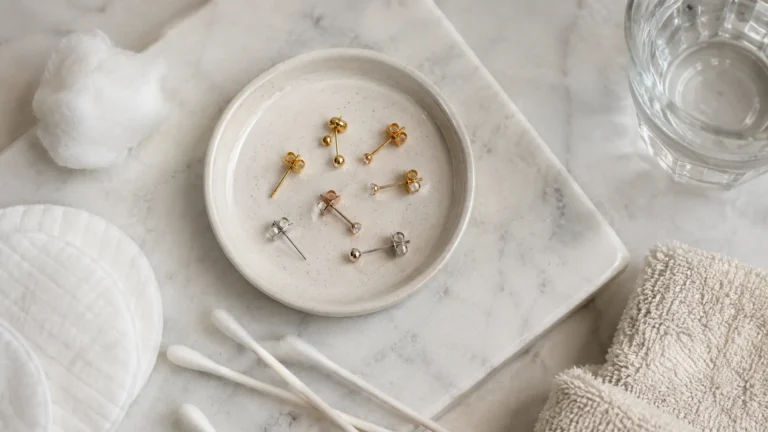
A cartilage piercing can look settled on the outside while the channel inside is still open and fragile, which is why “it doesn’t hurt anymore” is the wrong test for whether you can change the jewelry. The time for a cartilage piercing to heal is counted in months, not weeks, and published ranges run from roughly four to twelve months depending on which part of the ear is pierced and what “healed” is being measured. This guide maps those ranges to your specific piercing, explains the saline method professional bodies now recommend, separates ordinary healing from the signs that warrant a clinician, and spells out why a cartilage infection is treated more aggressively than a sore earlobe.
Cartilage piercings include the helix, tragus, conch, rook, and daith. For the wider topic, see our aftercare healing section.
Quick answer: A cartilage piercing typically takes anywhere from 4 to 12 months to heal completely, and some sources cite 3 to 12 months or “up to six months or a year” for named placements like the helix, tragus, and conch. Cartilage heals from the outside in, so the surface closing over does not mean the channel underneath is done. Clean it once or twice daily with sterile 0.9 percent saline, and keep cleaning for at least 3 to 6 months even after it looks healed. Do not change the jewelry yourself until the piercing has been in for a year or more.
How long the time for cartilage piercing to heal actually runs

The published figures do not all say the same thing, and the differences are real but explainable. Healthline puts complete cartilage healing at anywhere from 4 to 12 months, while a separate Healthline page covering infected ears describes cartilage broadly as taking 3 to 12 months and notes it can be more prone to infection than lobe tissue. Cleveland Clinic frames it by placement, stating that cartilage piercings may take up to six months or a year to fully heal, and that daith, rook, conch, helix, and tragus piercings should be expected to take between six and 12 months.
Then there is the broadest statement of all. Mayo Clinic notes that most piercings heal within about six weeks, but some might take several months or longer. That six-week figure describes the fast end of the spectrum, not cartilage.
These ranges are not in conflict so much as measuring different things. One source is talking about all piercings, another about cartilage as a category, a third about specific named placements. The endpoint also shifts: “looks healed from the outside” arrives far sooner than “fully healed through the channel.” The practical takeaway is to find the figure that matches your exact placement and treat the longer end of its range as the honest one. A helix pierced three months ago is, by every source above, still in the middle of healing.
- Cartilage, broadly: 3 to 12 months (Healthline) and 4 to 12 months to heal completely (Healthline).
- Named placements – daith, rook, conch, helix, tragus: six to 12 months (Cleveland Clinic).
- Earlobe, for contrast: usually 6 to 8 weeks (Healthline).
That lobe figure is worth holding onto. An earlobe piercing usually takes 6 to 8 weeks to heal, while a cartilage piercing typically takes 4 to 12 months to heal completely – the single clearest reason not to borrow a lobe routine or a lobe timeline for a helix. If you want the lobe comparison in more detail, see our second lobe piercing guide.
Why cartilage heals so much slower than the lobe
The slowness is structural, not a sign anything is wrong. Cartilage sits on the harder part of the ear and carries a lower blood supply than the soft, well-fed lobe. Blood delivers the cells and nutrients that rebuild tissue, so less circulation means a longer repair. Healthline notes that cartilage piercings, on that harder part of the ear, generally take longer to heal and can be more prone to infection for the same reason.
The second factor is direction. Cartilage heals from the outside in: the visible surface closes first, while the interior of the channel is the last part to stabilize. This is the mechanism behind the most expensive aftercare mistake, which gets its own section below. For a placement-specific look at the same process, our tragus piercing healing time page works through one cartilage site in depth.
Sterile saline cleaning, and the DIY recipe that no longer applies
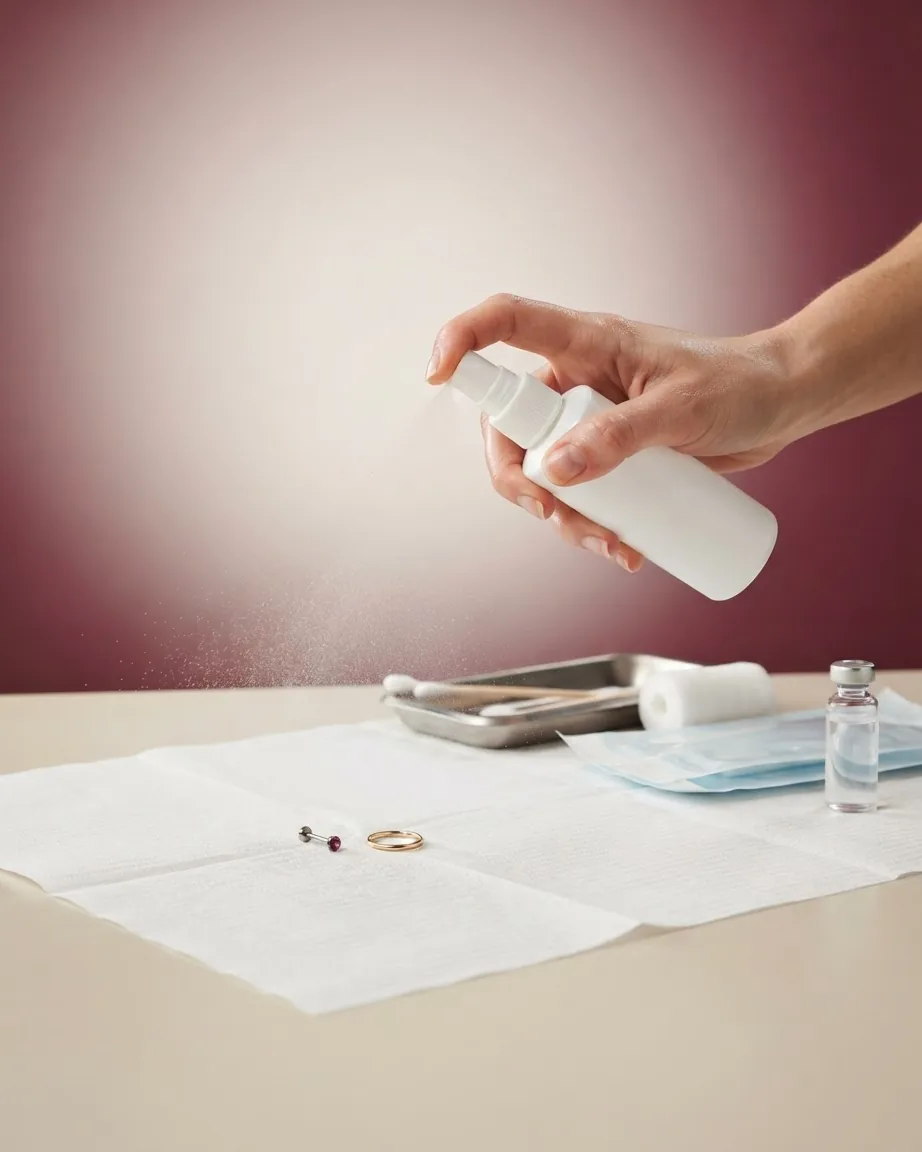
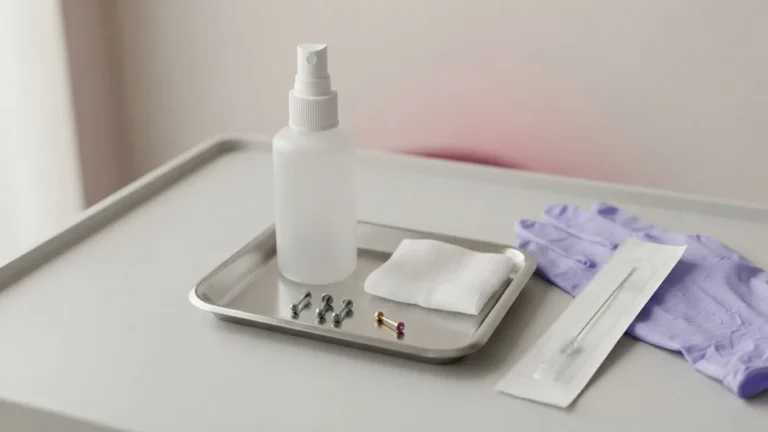
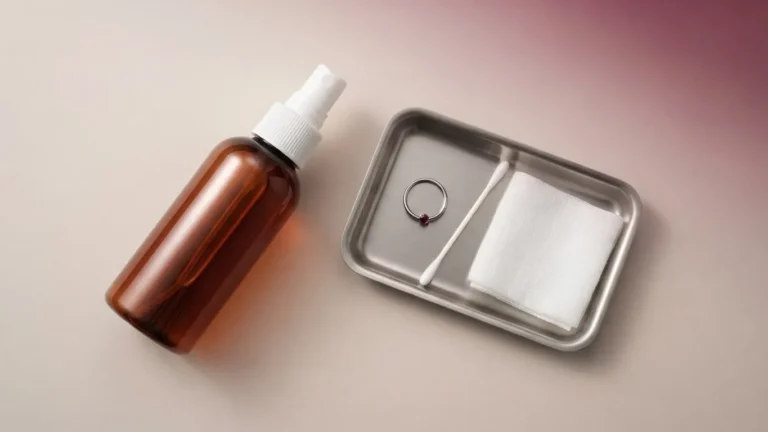
The cleaning advice has changed, and following outdated guidance can slow healing. The Association of Professional Piercers recommends a sterile saline wound wash and is specific about the product: your saline ingredients should list 0.9% sodium chloride as the only ingredient. A pre-made bottled wound wash meeting that spec is the current standard; self-mixing is no longer a suggested practice from the APP.
There is a genuine point of divergence worth naming. The Healthline page on infected ears offers a self-mixed option – combine 1/4 tsp. of salt with 8 oz. of distilled water – but that recipe appears in the context of treating a piercing that is already infected, used three times a day alongside a recommendation to seek care if it does not improve. That is a different situation from routine aftercare on a healthy, healing piercing, where the professional preference is the pre-made 0.9 percent product. The two pieces of advice are not interchangeable; match the method to the situation rather than assuming the home recipe is the everyday default.
Cleaning method, in prose: soak or spray the sterile saline onto the piercing, let it loosen any crust, and gently clear debris without forcing the jewelry to turn. Pat dry with a clean, disposable material rather than a shared towel.
Two habits sabotage cartilage specifically:
- Over-cleaning and harsh agents. Scrubbing, or using alcohol, hydrogen peroxide, or ointments not meant for the job, irritates healing tissue and can extend the timeline. More cleaning is not better cleaning.
- Rotating or twisting the jewelry. The old “turn it to stop it sticking” habit tears the forming channel. Leave the jewelry still; let the saline do the loosening.
Keep cleaning past the point it looks done. Even if your piercing appears healed, you should still clean it every day for at least 3 to 6 months, per Healthline – a direct consequence of the outside-in healing described above.
When it is actually safe to change the jewelry
This is where the outside-in problem does real damage. A cartilage piercing can feel and look healed while the inner channel is not ready, and swapping jewelry too early can reopen or tear it. “No pain” is not the benchmark. Time in place is.
The cited safe-change marker is clear: if you’ve had your piercing for a year or more, it should be safe to change the jewelry at home, according to Healthline. Before that year, a swap is best handled by a piercer who can assess the channel and downsize correctly, rather than attempted at the bathroom mirror. The gap between “externally healed” and “safe to change” is exactly the interior healing that cartilage does last.
Downsizing and hoop readiness follow the same logic – a channel is not ready for a ring just because the surface closed. Our conch piercing hoop guide addresses that specific transition.
Normal healing versus the signs that mean see a doctor
Some mess is expected. Light crusting, a little tenderness, and some pinkness are part of a normal course. Discharge that is thick, yellow or green, spreading redness, swelling, warmth, and significant pain are not normal and point toward infection. Because cartilage is harder to treat than the lobe, the threshold for getting it looked at should be lower.
Healthline sets a concrete deadline for an infected ear piercing: seek medical attention if the infection doesn’t improve with home treatment within 2 days. For cartilage specifically, do not wait out that window hoping it turns a corner – if it looks infected and is not clearly improving, a clinician is the right call rather than continued home care. Keep the jewelry in while symptomatic unless a professional tells you to remove it; taking it out can trap infection inside a closing hole.
Nothing here is a diagnosis, and none of it replaces a hands-on assessment. If something looks wrong, the safe move is to have it seen.
Why a cartilage infection outranks a lobe infection
The stakes are not the same. An infected lobe is usually a surface problem resolved with diligent care. A cartilage infection is higher-stakes: it is harder to treat, more likely to call for oral antibiotics, and in serious cases can lead to hospitalization or lasting change to the shape of the ear. Mayo Clinic’s broader guidance on preventing piercing complications reflects why clean technique and early attention matter most on cartilage.
That asymmetry is the practical reason the “wait two days then reassess” threshold should be applied even more conservatively to a helix or conch than to a lobe. The downside of waiting too long is simply larger on cartilage.
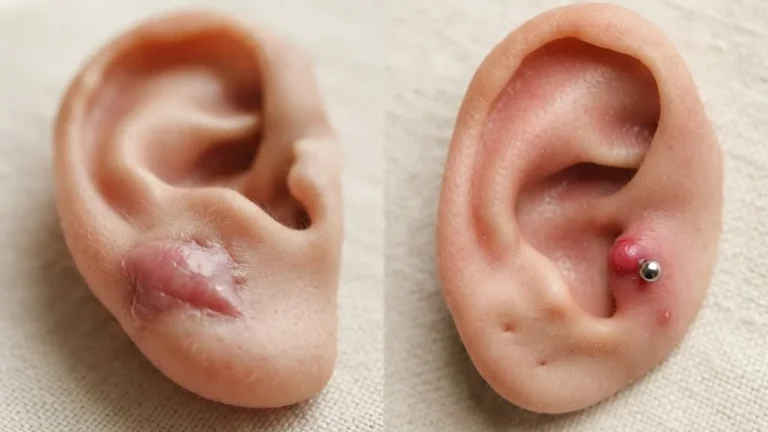
Reading the bump: pustule, granuloma, hypertrophic scar, or keloid
A bump beside a cartilage piercing is common and does not automatically mean infection. Sorting out which kind you are looking at matters, because the responses differ – and self-treatment can make some of them worse. This is triage, not diagnosis; a professional confirms which one it is.
- Pustule: a small, pus-filled spot, often tied to irritation or a minor localized infection.
- Granuloma: per Healthline, a lesion that occurs about 6 weeks after a piercing. The same source describes soothing approaches such as a chamomile compress – place a bag of chamomile tea in warm water and allow it to steep for 4 to 6 minutes – used as a warm compress rather than a cure.
- Hypertrophic scar: raised scar tissue that stays within the bounds of the wound.
- Keloid: an overgrown scar that extends beyond the original site; keloid risk is higher in people with darker skin, which is worth factoring into decisions about cartilage work.
Two rules cut across all of them. Do not try to pick, pop, or pull off granulation tissue, and keep the jewelry in while the piercing is symptomatic – removing it can trap the problem and complicate treatment. For how to tell a troublesome bump apart from normal swelling, Medical News Today’s write-up on cartilage piercing bumps covers the scar-versus-infection distinction in detail. If a bump grows, hurts increasingly, or discharges, treat that as a reason to see a professional rather than to escalate home remedies.
Everyday habits that quietly extend the timeline
Beyond cleaning errors, several controllable habits lengthen the time for a cartilage piercing to heal. None of these is dramatic on its own; together they can add months.
- Sleeping on the piercing. Pressure through the night can shift the jewelry’s angle and irritate the channel. A travel pillow with a hole, or simply sleeping on the other side, helps.
- Submerging it. Pools, hot tubs, lakes, and long baths expose a healing wound to bacteria. Keep it out of standing or shared water until healed.
- Rotating, twisting, or snagging on hair, phones, masks, and pillowcases. Repeated movement reopens the forming tissue.
- Stress, nicotine, alcohol, and caffeine. These affect general healing and are worth moderating while the piercing settles.
The common thread is that cartilage, with its limited blood supply, has little margin for repeated disruption. Protecting it from pressure and contamination does more for the timeline than any product.
Matching your piercing to the number you should trust
Rather than memorizing one figure, line your piercing up against the sourced ranges and plan around the honest end. A helix, tragus, conch, rook, or daith falls in the six-to-12-month band from Cleveland Clinic and the 4-to-12-month complete-healing figure from Healthline. Treat anything under a year as “still healing” for the purpose of changing jewelry, keep sterile 0.9 percent saline going for at least 3 to 6 months past the point it looks done, and apply the two-day rule for suspected infection with a lower threshold than you would for a lobe. Those four decisions – which range applies, how long to keep cleaning, when to change jewelry, and when to escalate – are the ones that actually change outcomes on cartilage.
Is it safe to change my cartilage jewelry at 6 months if it feels fine?
Feeling fine is not the marker, because cartilage closes on the surface long before the inner channel stabilizes. The cited at-home benchmark is a full year in place. At the six-month point, a piercer can assess and swap it for you, but a self-performed change risks tearing a channel that is not yet ready.
Why does one source say six weeks and another says a year?
They measure different things. The six-week figure from Mayo Clinic describes the quick end across all piercing types, and roughly matches the 6-to-8-week earlobe window. Cartilage is the slow end: Cleveland Clinic gives six to 12 months for named placements, and Healthline cites 3 to 12 and 4 to 12 months. Match the figure to your exact piercing.
Should I use a homemade salt solution to clean a healthy cartilage piercing?
For routine care on a healing piercing, the professional preference is a pre-made wound wash listing 0.9% sodium chloride as its only ingredient; self-mixing is no longer suggested. The quarter-teaspoon-salt-in-distilled-water recipe appears specifically for an already-infected ear, used three times daily – a treatment context, not everyday maintenance.
Can I take the jewelry out if I think it is infected?
Generally no. Removing jewelry from a symptomatic cartilage piercing can let the opening close and trap infection inside, which complicates treatment. Keep it in, continue gentle care, and if there is no clear improvement within two days, get it seen. Cartilage infections can require oral antibiotics, so early professional attention matters more here than on a lobe.
Cartilage vs. earlobe: how many lobe-healings fit inside one cartilage healing
The surest way to retire a lobe-sized expectation is to put both timelines in the same unit. Healthline cites an earlobe at 6 to 8 weeks and a cartilage piercing at 4 to 12 months to heal completely. An earlobe piercing usually takes 6 to 8 weeks to heal, while cartilage piercings typically take anywhere from 4 to 12 months to heal completely.
| Item | Value |
|---|---|
| Fast-end cartilage in weeks | 52 ÷ 12 × 4 ≈ 17.3 weeks (from 4 months). |
| Slow-end cartilage in weeks | 52 ÷ 12 × 12 = 52 weeks (from 12 months). |
| Fewest times longer than a lobe | 17.3 ÷ 8 ≈ 2.2× (shortest cartilage vs. longest lobe). |
| Most times longer than a lobe | 52 ÷ 6 ≈ 8.7× (longest cartilage vs. shortest lobe). |
| Extra healing time at the slow end | 52 − 8 = 44 additional weeks beyond the longest lobe timeline. |
In plain terms: a routine or a calendar built around the 6-to-8-week lobe can be off by half a year or more, which is exactly why ‘it stopped hurting’ is not the signal to change your jewelry.