Leave a fresh second hole empty for an afternoon and it can shrink shut before the stud goes back in. Vital Piercing warns that second lobes can close within hours, especially in the first year, and advises keeping something in 24/7 for the first 12 months minimum. That one fact changes the clock worth watching for a second lobe piercing: it is done when a piercer confirms the channel has built, which arrives well after the soreness fades. This guide covers the healing windows and why published numbers disagree, the metal that belongs in a new hole, the gauge and backing a piercer reaches for, spacing above the first hole, and the infection signs that mean you stop improvising and call someone.
A second lobe sits in the same soft fat and skin as your first hole, so it heals on the same clock: roughly 6 to 8 weeks before it feels settled, with deeper tissue remodeling for months afterward. Pain is close to a first lobe because it is the same tissue, not cartilage. Expect 18G or 20G jewelry, placed about 5 to 8mm above the existing hole. Clean it twice a day with sterile 0.9% saline, leave jewelry in around the clock through the first year, and keep the original studs until a piercer confirms the channel is ready for a change.
Why one site says 8 weeks and another says 6 months

The gap is real, and it comes from two groups measuring two different things. Cleveland Clinic puts earlobe healing at about six to eight weeks, much faster than cartilage. Monica Vinader gives the same 6 to 8 weeks and adds a point most people miss: the amount of time a piercing takes to heal does not change depending on whether it is a first, second, or seventh. Lyang & Co. also lands on 6 to 8 weeks for lobes, with cartilage running 3 to 6 months.
Then STUDS lists full lobe healing as 4 to 6+ months and separates two moments: a downsize window around 2 to 3 months, and full healing at 4 to 6+ months. Both camps are correct about what they describe. Three of these sources agree the outward timeline is 6 to 8 weeks, the point at which the surface settles and daily soreness ends. STUDS is tracking the slower internal remodeling of the channel, which keeps going after the outside looks fine.
So use two windows rather than one date. The 6 to 8 week figure tells you when a second lobe stops feeling like an open wound. The longer 4 to 6+ month figure tells you when the tube of skin lining the hole has matured enough to handle a jewelry swap or a hoop. Judge your own ear by what the tissue is doing, and confirm with your piercer before relying on either number.
| Source | Lobe healing figure | What it measures |
|---|---|---|
| Cleveland Clinic | 6 to 8 weeks | Surface healing, versus slower cartilage |
| Monica Vinader | 6 to 8 weeks | Same regardless of first, second or seventh |
| Lyang & Co. | 6 to 8 weeks | Lobe versus cartilage at 3 to 6 months |
| STUDS | 4 to 6+ months full; 2 to 3 months downsize | Full internal healing and swelling drop |
Does a second lobe hurt more than your first?
No meaningful difference. A second lobe passes through the same soft lobe tissue as the first, so the sharp pinch and the few seconds of sting land in roughly the same place. The tissue carries nothing like the dense, poorly supplied cartilage higher on the ear, which is why cartilage placements read as more painful on most charts.
Pain is subjective, and the published scales do not line up cleanly from one chart to the next. For how different placements rank against each other, see our Ear Piercing Pain Scale breakdown. For the second lobe specifically, set expectations at “the same as last time,” not worse. If a fresh second lobe keeps hurting after the first several days, that is a signal to look at it closely rather than wait it out.
What to settle before you book
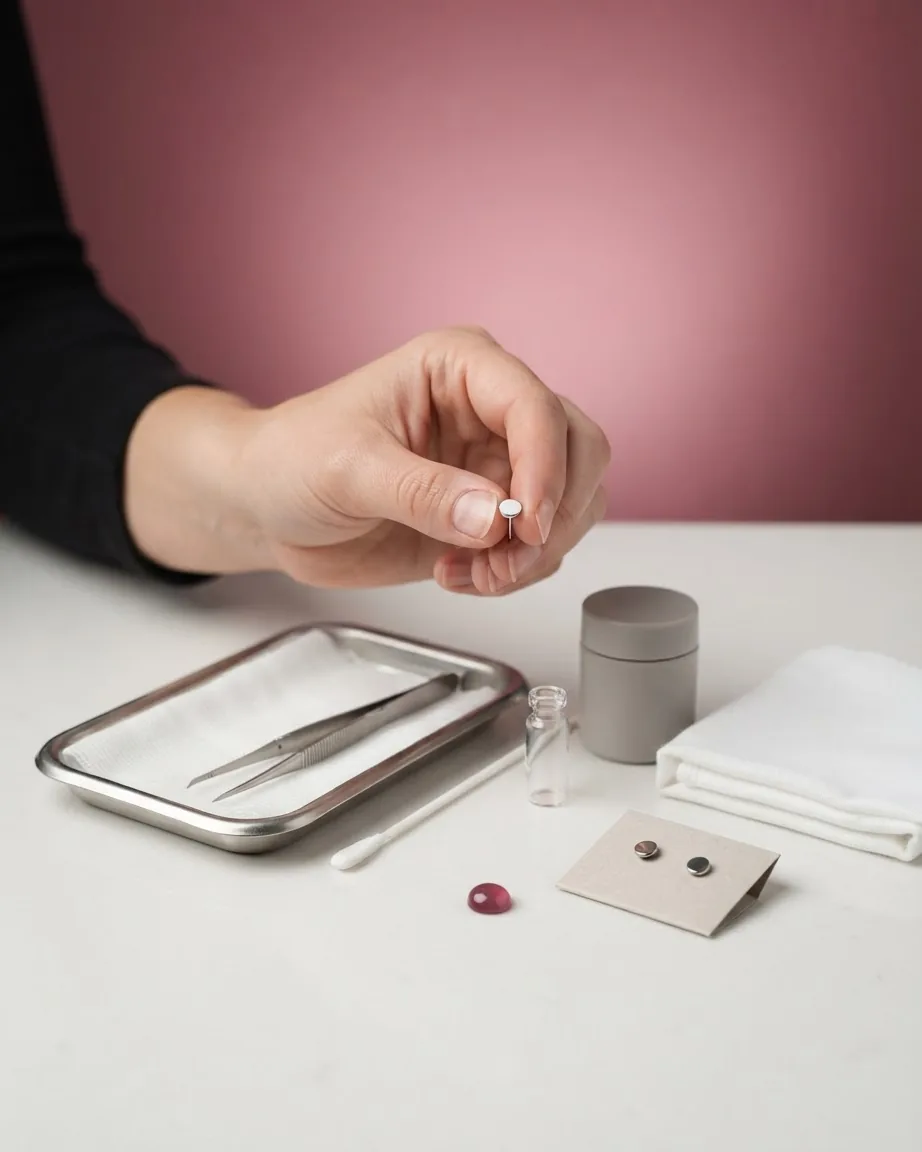
The choice that protects the hole is the jewelry, so decide on it before the appointment. The Association of Professional Piercers sets the standard for initial jewelry: implant-certified titanium (Ti6Al4V ELI) that is ASTM F-136 compliant, or solid gold that is 14k or higher and nickel- and cadmium-free. Ask what a studio actually starts people in. A studio that stocks implant-grade material and sizes you at 18G or 20G is working to that standard.
Whatever method a studio uses to make the hole, the metal left in it and the sterility of the setup are what you can check against a published standard. Cost is not standardized: the piercing fee and the jewelry are usually priced separately, and implant titanium or solid 14k gold runs higher than basic steel. Get the full total before you commit, since the cheapest jewelry is often the kind that fails the material standard above.
Second lobe versus cartilage placements: how the windows compare
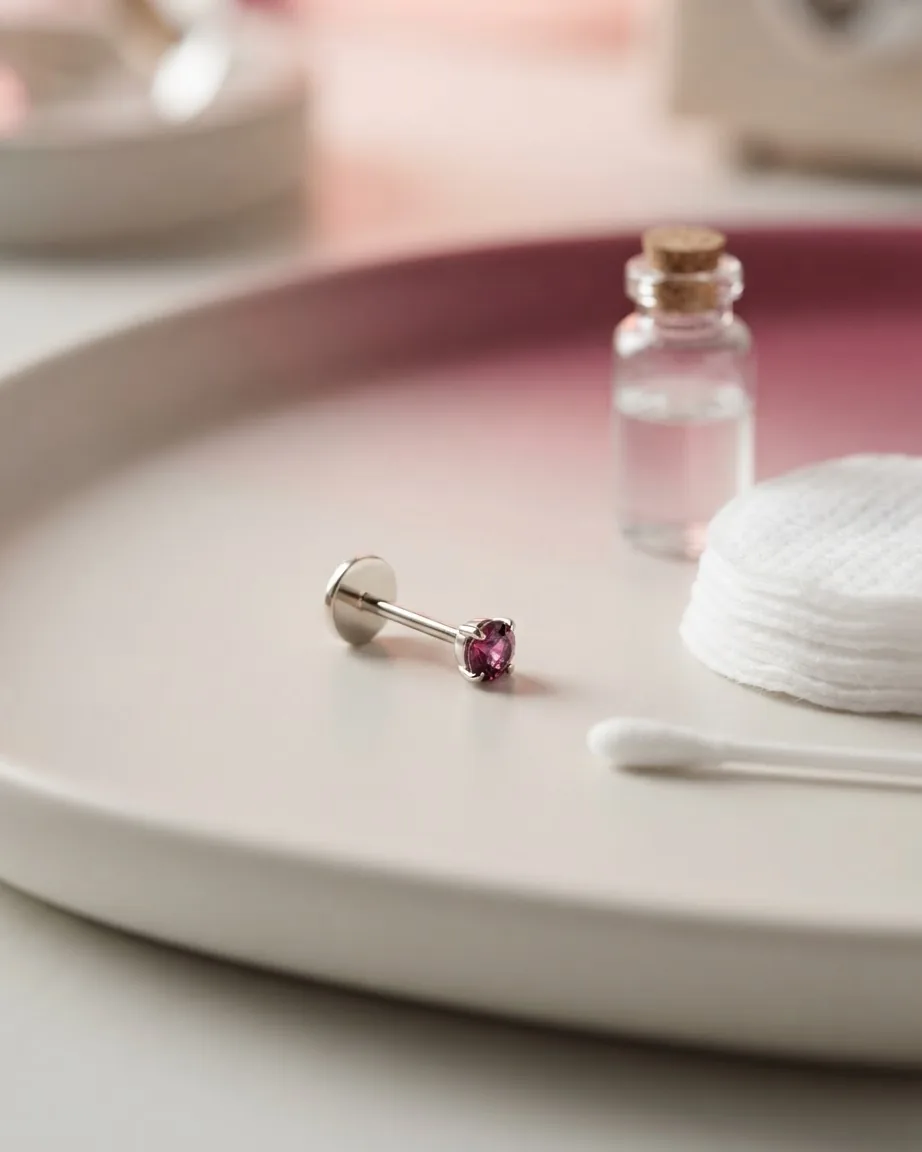
A second lobe is still lobe tissue, which is why it heals on the short clock. Move up the ear into cartilage and the numbers climb, because cartilage has a thin blood supply and rebuilds slowly. Monica Vinader puts an ear piercing anywhere from 6 weeks to 12 months depending on where on the ear it sits, and lists daith, conch, helix and tragus at 6 to 12 months. Lyang & Co. gives a shorter cartilage range of 3 to 6 months. Those two figures do not match, so treat anything cartilage as a months-long commitment and lean toward the longer window if your ear is slow to settle.
The anatomy explains the ranking. The helix is the outer rim of cartilage; the tragus is the small flap in front of the ear canal; the conch is the deep bowl; the daith is the ridge above the canal. All four are cartilage, all four hurt more than a lobe, and all four heal far slower. Fresh cartilage takes a flat-backed stud, never a hoop, until it is fully healed. A second lobe is the gentler project by comparison: soft tissue, a short healing clock, and a straightforward 18G or 20G stud. If you are planning a curated ear, stack the lobes first and save cartilage for when you have the patience for a half-year or longer.
Which metal is safe for a healing second lobe piercing
This is where mall-counter language gets people into trouble. “Surgical steel” is not a regulated term. The APP notes that only a few specific grades of stainless steel are proven biocompatible, namely steel that is ASTM F-138 compliant or ISO 5832-1 compliant. As Vital Piercing points out, nickel sits in the alloy of every 316L stainless steel, which is exactly why the hypoallergenic label does not apply. A generic “surgical steel” stud gives you no guarantee of which grade you are wearing.
For a fresh second lobe, the shortlist is narrow:
- Implant titanium – ASTM F-136 (Ti6Al4V ELI) or equivalent, which the APP flags as ideal for anyone concerned about nickel sensitivity.
- Solid gold, 14k or higher – nickel- and cadmium-free. Going above 18k is a mistake, because gold higher than 18k is too soft for body jewelry and scratches or nicks easily.
- Properly graded steel – only if it is documented as ASTM F-138 or ISO 5832-1, not “surgical” by name alone.
Two popular metals are for later, not now. Sterling silver tarnishes and can leave black staining inside a healing channel, so it belongs on fully healed lobes only. Lyang & Co. lists sterling silver, 14K/18K gold and surgical-grade stainless steel as options after the initial healing period, which fits: those are post-heal choices, not starter jewelry. Gold-plated and vermeil pieces are solid base metal under a thin gold layer, so they do not meet the “solid 14k or higher” bar for an initial piercing; keep them out until the hole is built.
Allergen warning
If nickel is the worry, the reaction gives you a timeline to watch. Mayo Clinic notes an allergic reaction to nickel usually begins within a couple of days after contact with the metal, and dermatologists confirm it with a patch test that leaves nickel on the skin for 48 hours. If nickel sensitivity is a concern, switching to implant titanium removes the variable.
| Metal | Fresh second lobe? | Standard to look for |
|---|---|---|
| Implant titanium | Yes | ASTM F-136, Ti6Al4V ELI |
| Solid gold 14k – 18k | Yes | Nickel- and cadmium-free; not above 18k |
| Graded steel | Only if documented | ASTM F-138 or ISO 5832-1 |
| “Surgical steel” (generic) | No guarantee | Unregulated term; 316L contains nickel |
| Sterling silver | After full healing | Tarnishes, can stain the channel |
| Gold-plated / vermeil | No | Base metal under a thin layer |
Butterfly backs and flat-back studs, and the gauge a piercer uses
Second lobe piercings commonly use 18G or 20G jewelry, a thin post that matches the soft tissue it passes through. The gauge is the thickness of the bar; 18G is slightly thicker than 20G, and a piercer picks between them by your anatomy and the jewelry you want to wear later.
The backing is a comfort and fit choice. A flat disc back sits flush against the skin behind the lobe, which many piercers favor for a new hole because there is no clasp pressing into tender tissue. The familiar butterfly back, the pinch clasp on cheap studs, can collect debris in its grooves and is fiddly to clean around a fresh piercing. Neither one changes the healing timeline on its own; the metal grade and your aftercare do that. If your studio offers a flat-back labret post in implant titanium or solid gold, that is a reasonable default for a second lobe.
Spacing: how far above the first hole a second lobe sits
Vital Piercing puts the usual spacing at 5 to 8mm above the first hole, perfectly aligned, with the piercer adjusting to your anatomy. That range exists for a reason. Too tight and the two holes crowd; too high and a second hole risks the firmer transitional tissue near the top of the lobe, which heals differently from soft lobe. A good piercer marks the spot standing back from your ear and checks it against the curve of the lobe, not a fixed ruler measurement.
Order matters as much as distance. Each piercing heals on its own schedule, so add the next one only once the current hole has settled rather than lining up several at once. If you are planning symmetrical pairs or a graduated stack, map the full set before the first appointment so nothing ends up off-center later. For the geometry and timing of running two holes on the same lobe, see our Double Lobe Piercing guide. The wider map of placements is laid out across our ear piercings section.
Cleaning a second lobe without setting it back
Aftercare for a second lobe is deliberately dull, and that is what works. The APP recommends a sterile saline wound wash whose only ingredient is 0.9% sodium chloride, and it no longer recommends mixing your own sea salt solution at home. Check the label: if it lists anything beyond saline, it is the wrong product. Spray or soak the piercing, front and back, twice a day, and pat it dry with clean paper rather than a towel that harbors bacteria.
Skip the childhood ritual of twisting the earring. Rotating a healing stud drags crust and bacteria through the fresh channel and irritates tissue that is trying to knit; current practice is to leave the jewelry alone and only move it enough to clean around it. Keep skincare, hair products, makeup and dirty phone screens away from the ear. And keep the stud in: Vital Piercing’s point about second lobes closing within hours in the first year is the reason the jewelry stays in through the full 12 months, day and night.
When you can change the jewelry or switch to a hoop
Here is the mismatch that catches people. STUDS separates a downsize window at 2 to 3 months, when the initial swelling has dropped and a slightly shorter post can go in, from full healing at 4 to 6+ months. It also warns plainly against switching over to hoops before fully healed. A hoop moves constantly and tugs the channel open; a healing hole cannot take that.
So the sequence is: leave the original stud through the first weeks, consider a downsize at the 2 to 3 month mark if your piercer agrees, and hold off on hoops and fashion jewelry until the hole is fully healed on the longer clock. Changing too early is what tears a channel and restarts healing. Even once a second lobe is established, leaving it empty for a stretch in that first year invites it to shrink, so keep something in until you are well past the full-heal window.
Signs of infection, and when to stop treating it yourself
Normal early healing oozes a little and feels tender, and that settles over the first days. What should not settle is pain that climbs instead of fading, redness that spreads out from the hole, or discharge that keeps building. If the trouble keeps escalating, stop improvising and call your piercer or a doctor.
The two deadlines hidden in the numbers
Nobody in the sources spells this out, but their own figures do once you subtract them. Two gaps matter for a second lobe, and both are longer than the point where your ear stops hurting.
- Downsize-ready is not healed. STUDS clears a downsize at 2 to 3 months but calls full healing 4 to 6+ months. Subtract one from the other and there are still 2 to 3 months of internal remodeling left after you swap to a shorter post (4 − 2 = 2; 6 − 3 = 3).
- Healed still does not mean “safe to leave empty.” Take STUDS’ full-heal mark of 4 to 6 months and set it against Vital Piercing’s rule to keep something in for the first 12 months. That leaves 6 to 8 months where the channel is done healing but jewelry still stays in 24/7 because a second lobe can shrink shut fast (12 − 4 = 8; 12 − 6 = 6).
So the “feels healed” date, the “fully healed” date, and the “can go a few hours without an earring” date are three different moments, spread across most of the first year. Confirm each one with your piercer rather than the calendar.