Drafted with AI language models. How this page was made
One ring passes through two holes, and that single fact changes everything about how an orbital heals. It is not two independent piercings that happen to sit close together; it is two wounds sharing a single piece of metal, so any snag, any angle error, any night spent sleeping on the wrong side pulls on both channels at once. Orbital piercings are a category, not a fixed spot on the ear, which is why healing figures scatter so widely from one source to the next. This desk compiles the documented numbers and the professional-body guidance so you can decide placement, jewelry, and timing before you sit in the chair rather than after.
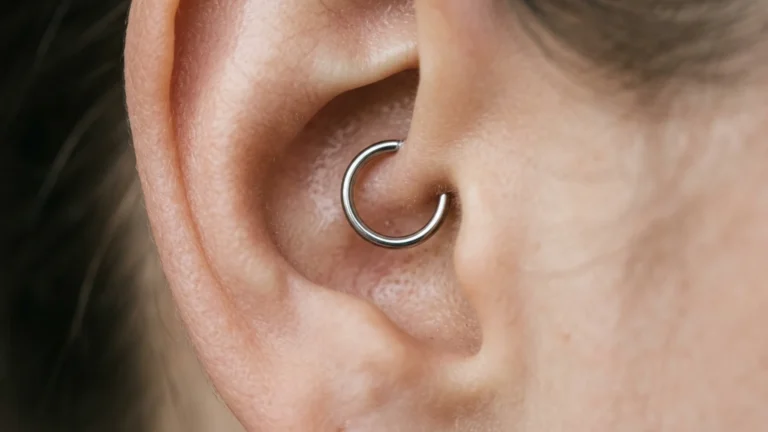
An orbital is defined by its structure: a single ring threads two separate perforations in the same region of the ear. Vital Piercing describes one ring connecting “two separate holes in the ear,” which distinguishes it from a conch hoop (one hole) and from an industrial, where a straight barbell spans two holes on opposite sides rather than a curved ring through two close ones.
Across the major retailer and studio guides, orbital pain lands around a 4 on a 1-10 scale, but that average hides a placement spread: a lobe orbital is near the easy end, while a conch orbital runs several points higher per hole. Healing depends entirely on tissue. A lobe orbital usually closes in roughly 6 to 8 weeks; a cartilage orbital is a much longer commitment, with published figures ranging from a few months to two years depending on who you ask and exactly where the ring sits. Expect 14G or 16G jewelry, a service fee around $50 and up with jewelry billed separately, and saline cleaning twice or three times daily for the full healing period.
Orbital vs. conch hoop vs. industrial: what actually makes it an orbital
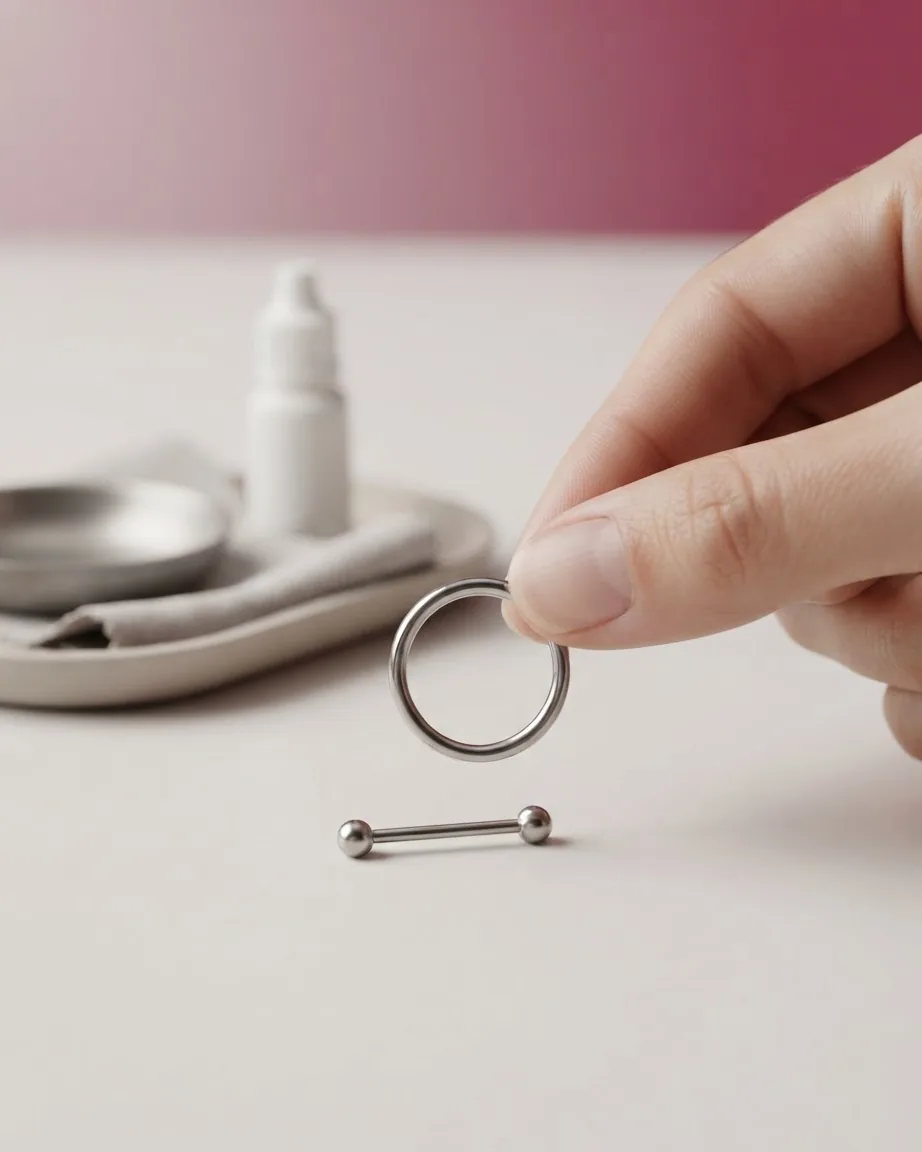
The word gets misused constantly, so start with the structure. An orbital requires two holes threaded by one ring. A conch hoop is a single perforation with a ring looped through it, which looks similar but behaves like any other single piercing. An industrial also uses two holes, but it joins them with a straight barbell across opposite points of the ear rather than a curved ring through two close ones. Vital Piercing draws the line cleanly: “An industrial uses a straight barbell connecting two holes on opposite sides of the ear. An orbital uses a curved ring connecting two holes that are close together.”
This matters for a practical reason. A standard stud or earring cannot create or hold an orbital, because it does not pass through two channels. If someone offers to “turn your two lobe piercings into an orbital,” they mean swapping in a ring sized to span both existing holes, not performing a new piercing. Whether that swap is safe depends on spacing and angle, which belongs to a piercer’s assessment rather than a guess at home.
Where an orbital can sit: lobe, helix, conch, and the combinations
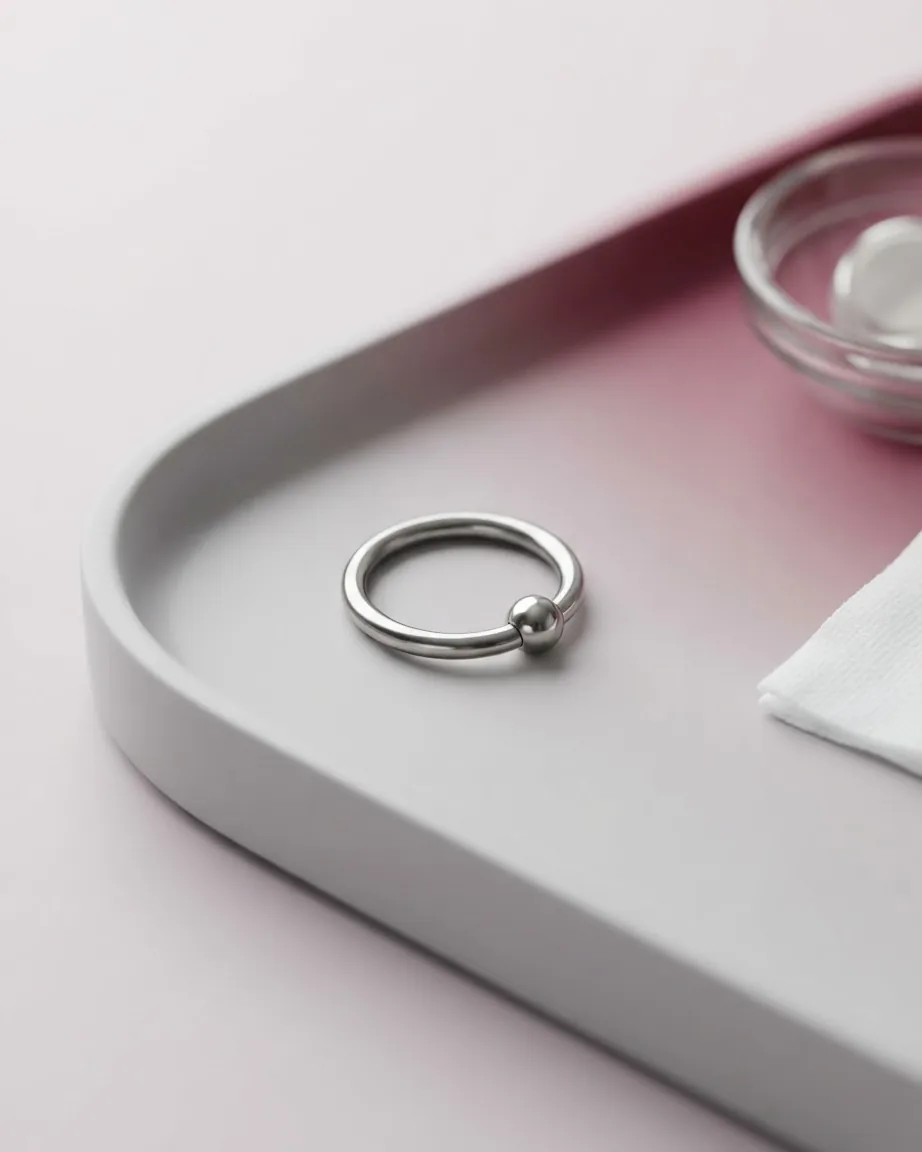
Because an orbital is a category, placement is the first real decision, and it drives pain, healing, and the lifestyle rules that follow. The common homes are the lobe, where soft tissue heals fastest, and various cartilage sites that heal slowly. Documented combinations include conch-to-flat, helix-to-helix, tragus-to-tragus, and helix-to-rook, among others. Each pairing sets the ring’s inner diameter and the angle the two channels must share.
The anatomy underneath explains the gap between lobe and cartilage. Lobe tissue is soft and well supplied with blood. Auricular cartilage is not. The American Academy of Family Physicians, writing in American Family Physician, notes that high cartilage piercings “are associated with poor healing and more serious infection because of the avascular nature of auricular cartilage”: meaning cartilage lacks the direct blood flow that carries healing cells and fights infection. That single mechanism is why every cartilage figure below runs months longer than any lobe figure.
For a fuller map of where each named spot sits and how it is pierced, the desk’s broader coverage of ear piercings sets out the wider family. See also our guide to different types of ear piercings.
How much an orbital piercing hurts, and why the second hole is worse
The headline average, from At Present, is that “most people rate orbital piercing pain at a 4” on a 1-10 scale. That number is useful as a midpoint, but it flattens a real spread. Vital Piercing breaks pain down by hole and by placement: a helix or flat orbital reads around 4/10 per hole and a conch orbital around 5/10 per hole, against roughly 2/10 for a lobe. A lobe orbital, in other words, is close to the mildest piercing on the ear; a conch orbital is a different experience.
There is a compounding effect most pain charts miss. An orbital means two perforations, usually in one sitting, and the second one lands harder than the first. Vital Piercing explains the mechanism: “The second hole hits harder because the area is already throbbing from the first; the holes are only 5-10mm apart, so the inflammation zone overlaps.” The two wounds sit inside a single swollen patch of tissue, so each adds to the other rather than hurting in isolation. If you want the pain figures for every ear placement laid out together, see the ear piercing pain chart.
Orbital piercing healing time: the lobe figures, and why cartilage numbers disagree
Healing is where sourced guidance splits most sharply, and resolving it is the whole value of planning ahead. The split falls cleanly along the lobe-versus-cartilage line, so take them separately.
For a lobe orbital, the sources cluster but do not match exactly. Impuria states it “usually heals in 6 to 8 weeks”. NeilMed and At Present both put it at “at least 6 weeks”, a floor rather than a window. Vital Piercing and Evolution Piercing give a longer 2 to 3 months, and Refinery29 describes an overall figure of “around 8-10 weeks.” These are not really in conflict: the lower figures are minimums, the higher ones are full-healing estimates, and the honest planning range for a lobe orbital is roughly six weeks to three months. Treat six weeks as the earliest you might be healed, not a promise.
Cartilage is where the figures genuinely scatter, and the brief reason is that different sources measure different things: minimum healing versus full healing, and specific sites rather than “cartilage” as one block. The documented figures:
- Urban Body Jewelry: cartilage orbitals “take one to two years to fully heal,” the longest estimate on record.
- Impuria: a cartilage orbital “can take 4 to 12 months to heal.”
- NeilMed and At Present: “around 6-9 months” and 6-9 months respectively.
- Vital Piercing: helix or flat at 6-9 months, conch at 6-12 months.
- Evolution Piercing: “typically 3-6 months or more.”
Two public-health sources put a wider official frame on it. The Michigan Department of Health and Human Services lists ear cartilage healing at “Three to 12 months” (state aftercare sheet), and the Association of Professional Piercers gives “6-9 Months or longer” for all cartilage variations in its procedure manual. The desk’s reading: do not trust a single cartilage number. Plan for the longer end (six months at minimum, with a year a realistic possibility for conch), and understand that a ring looks healed long before the channel underneath actually is. Vital Piercing also notes cartilage orbitals “swell noticeably for the first 1-2 weeks”, so early swelling is expected rather than a red flag on its own.
The lever effect: why one ring through two wounds is harder than two piercings
This is the part most guides skip, and it is the real reason an orbital earns its long cartilage timelines. Because a single ring passes through both holes, the two wounds are mechanically linked. Catch the ring on anything and the force transfers. Vital Piercing puts it plainly: “If you catch the top of the ring on your shirt, the bottom of the ring is forced upward into the other piercing channel.” One snag traumatizes two channels at once, which is why an orbital is slower and more fragile than two independent piercings healing side by side.
Angle compounds the problem. Evolution Piercing warns that “if the angles are off (even slightly) it can create unnecessary pressure, friction, or twisting in the jewelry,” and in a two-hole system that pressure has nowhere to go but into the tissue. There is also an infection dimension unique to shared jewelry: because the ring passes through both holes, an infection in one can spread to the other through the metal that connects them. The two channels are not isolated, so a problem in one is rarely confined to one.
For that reason, Urban Body Jewelry advises against the improvised route: “While it may be tempting to heal an orbital piercing as two separate piercings and join them with a ring later, this is not recommended.” If you want the orbital look with less tissue strain, the documented alternative is to heal each hole with a flat-back stud first; “piercing both holes with individual flat back studs first, letting the channels fully heal, and then connecting them with a ring once the tissue is established,” per Vital Piercing; accepting that the ring, and the finished look, arrives later.
Ring sizing: matching inner diameter to the 5-10mm hole gap
Orbital jewelry fails in a way straight-barbell jewelry does not, because the ring has to bridge a specific distance. The two holes sit only about 5 to 10mm apart, and the ring’s inner diameter has to match that gap. The Association of Professional Piercers frames the rule without naming a universal size, stating jewelry “must be of appropriate length or diameter for your unique anatomy and the placement of the piercing” (initial-jewelry standards). There is no one correct orbital ring; there is a correct one for your spacing.
Get it wrong and the failure modes are specific. Too small, and Vital Piercing describes the result: “The ring pulls the two holes toward each other, causing constant pressure, pain, and eventual migration or rejection.” Too large, and the ring flops, catches on everything, and feeds the snag problem above, which tends to produce irritation bumps. As a concrete reference point, At Present describes a sample orbital ring in 14k yellow gold with a 14mm outside diameter and an 11mm inside diameter: a reminder that outer and inner measurements differ, and the inner one is what has to fit your holes.
Gauge and material: 14G to 20G, and the nickel problem
Gauge guidance differs by source but not wildly. Vital Piercing recommends 16G for cartilage placements (helix, conch, flat) and 18G or 20G for lobe orbitals. Impuria reports that most orbital piercings use 16G or 14G jewelry, “though some piercers may opt for different sizes based on anatomy and preference.” The practical read: cartilage orbitals land around 16G, lobe orbitals can run thinner, and the final call belongs to the piercer assessing your ear.
Material is a safety question, not a style one, and there is a common misconception worth clearing. Not all stainless steel is nickel-free; the American Academy of Family Physicians states flatly that “not all stainless steel products are nickel-free,” which matters because nickel is a frequent cause of contact allergy. For initial jewelry, the Association of Professional Piercers points to a specific standard: “Look for implant certified titanium (Ti6Al4V ELI) that is ASTM F-136 compliant.” For a fresh orbital through cartilage that already heals slowly, an implant-certified titanium ring removes one variable that can stall healing.
What an orbital piercing costs: service fee, jewelry, and why totals don’t match
Cost figures across sources look contradictory until you notice they measure different things, so they cannot be added or averaged. Impuria quotes a typical all-in range: “an orbital ear piercing costs between $40 and $100.” Urban Body Jewelry prices only the labor: “the needle or service fee will cost between $50 and up. The jewelry will be a separate charge.” And one studio, 23rd Street Body Piercing, publishes jewelry-only starting prices where “jewelry costs can start as low as $15 for a ring and $26 for a barbell” (their pricing page).
The desk’s resolution: treat Impuria’s $40-$100 as a reasonable total expectation for a basic orbital, but understand that a service fee starting at $50 with jewelry billed separately can push the real number higher once you choose implant-certified titanium or gold rather than the cheapest ring. Ask the studio to quote the service fee and the jewelry as two line items, because a quote for one is not a quote for the other.
Aftercare for an orbital piercing: saline, and where the authorities disagree
The one point every source agrees on: clean with saline. NeilMed advises you “clean it 2-3 times daily with a piercing aftercare saline solution for the entire healing period.” That is the baseline, and for an orbital it runs for the full timeline: weeks for a lobe, many months for cartilage.
Two aftercare questions do not have a single answer, and flattening them into a false consensus would mislead you, so here is the documented split. On turning the jewelry, the NHS advises you “gently turn the jewellery while cleaning the piercing,” while the Association of Professional Piercers states the opposite: “Moving or rotating jewelry is not necessary during cleaning/rinsing and may actually irritate the piercing” (APP aftercare). For a healing orbital, where any movement transfers through the ring to both channels, the non-rotation position carries a mechanical logic worth weighing.
On soap, the conflict is jurisdictional. The APP says to avoid “antibacterial soaps, iodine, or any harsh products,” while the Texas Department of State Health Services instructs you to “properly cleanse the pierced area by using antibacterial or antimicrobial soap for the external skin” (Texas FAQ). These reflect different standards from different bodies. None of this is personalized medical advice; when the guidance conflicts, follow the specific aftercare your own piercer gives for your placement, and ask them to reconcile it with these standards.
Sleep and earbuds: the lifestyle rules that decide whether an orbital heals straight
Two everyday habits can wreck an orbital, and most guides never mention them. Sleep is the first. Because a ring tilts under weight, Vital Piercing warns that “if you sleep on an orbital, the weight of your head tilts the ring, causing the holes to heal at a crooked angle.” A lobe orbital that heals crooked is a cosmetic problem; a conch orbital that heals crooked can be permanent. For the months a cartilage orbital takes, that means keeping pressure off the pierced side night after night.
Earbuds are the second, and they are the deal-breaker for a conch orbital specifically. Vital Piercing is blunt: earbuds “are completely off-limits on that side for at least 6 months,” because “the pressure from an earbud pushes against the ring and causes permanent migration.” If you wear in-ear headphones daily and will not switch to over-ear or the other side, a conch orbital is the wrong placement for your life. That is a decision to make before the needle, not after.
Infection signs and what to do with the ring
Expect some early swelling: the 1-2 weeks of noticeable cartilage swelling above is normal. What is not normal is spreading redness, increasing pain, heat, or discharge, especially past the first couple of weeks. Because the shared ring links both holes, trouble in one channel can reach the other, which raises the stakes on acting early.
The instinct to pull the jewelry out is usually wrong. The NHS guidance on infected piercings is direct: “Leave your jewellery in, unless a doctor tells you to take it out” (NHS infected piercings). Removing the ring can trap infection inside a closing channel. For cartilage specifically, the clinical concern is higher: cartilage infections heal poorly and can become serious, per the American Family Physician reasoning above. If an orbital through cartilage shows signs of infection, that is a reason to see a clinician rather than wait it out. Anything that looks wrong (on any placement) belongs with your piercer or a doctor, not a home fix.
Infection and complication topics around piercings touch health and safety directly; the figures and standards here are compiled from the named professional and public-health sources, and none of it replaces an in-person assessment of your own ear.
When you can change the jewelry, and converting existing piercings
Do not swap the ring on your own schedule. A lobe orbital, healing in roughly 6 to 8 weeks at the fast end and up to 2 to 3 months at the full-healing end, can be changed once the channel is genuinely settled rather than merely closed on the surface. A cartilage orbital is a different clock entirely: with figures running from 3-6 months to as long as one to two years, the ring stays until a piercer confirms the channel is established. Changing a cartilage orbital early reintroduces the snag and angle problems before the tissue can take them.
Converting piercings you already have into an orbital is possible but conditional. Well-spaced lobe piercings with the right ring diameter can sometimes be joined, provided the spacing matches the 5-10mm constraint and the angles line up. Cartilage is usually not safe to convert unless it was originally pierced with an orbital in mind, because mismatched angles feed the pressure and twisting that stall cartilage healing. The right-sized ring makes or breaks it, so a piercer should assess your spacing and angle before anything gets threaded. If you are weighing how many piercings to add and in what order, the desk’s guide to multiple ear piercings covers the planning side.
How Many Saline Cleanings a Lobe Orbital Actually Takes Before It’s Healed
Aftercare advice usually stops at “clean it two or three times a day.” But a lobe orbital heals in roughly 6 to 8 weeks, and doing the arithmetic turns that into a concrete commitment. At the low end (six weeks healing at twice a day) you are looking at 84 separate saline cleanings before the channel closes. At the high end (eight weeks at three times a day) that climbs to 168 cleanings. Every additional week of healing adds another 21 sessions at the three-times-daily pace, which is why a slow-healing orbital quietly turns into hundreds of cleanings rather than dozens. Seeing the full count up front is the honest way to judge whether you are ready for the routine before you sit in the chair, not after.
Frequently Asked Questions
Is an orbital the same as a conch with a hoop?
No. A conch hoop is a single perforation with one ring through it. An orbital needs two separate holes sharing one ring. The visual overlap confuses people, but the structure differs: one wound versus two linked wounds, which is why their healing demands and failure modes are not alike.
Can I get an orbital done as two piercings and join them later?
You can heal each hole with a flat-back stud and connect them once established, which eases tissue strain but delays the finished look. What piercers caution against is improvising the join without planning the spacing and angle first. An unplanned later connection risks pulling mismatched channels together, inviting migration.
Which orbital placement heals fastest?
The lobe, by a wide margin. Soft lobe tissue carries blood that cartilage lacks, so a lobe orbital settles in weeks while conch placements can run close to a year. If quick healing drives your choice, pick the lobe; if you want a cartilage location, plan for the long timeline and the sleep rules.
Why do published healing times vary so much for cartilage?
Sources measure different things. Some quote a minimum before the surface looks closed; others quote full internal healing. A few lump every cartilage site into one figure, while conch and helix differ in practice. The honest approach is planning for the longer estimates rather than the shortest one you find.