On a pain scale of 1 to 10, the gap between the easiest and the hardest ear piercing is wide: the earlobe sits near 2/10, while the industrial runs around 8/10. That single spread explains most of what separates the different kinds of ear piercings from one another, because it tracks the tissue underneath each spot. Lobes are soft, fatty, and well supplied with blood; cartilage is dense, firm, and poorly supplied. The Lobecraft Editorial Desk compiles these figures from the pain and healing charts published by MADAJ, Studs, Zensa Skin Care, Byrdie, and Airtasker, cross-referenced against aftercare guidance from the American Academy of Dermatology and gun-versus-needle standards from the Association of Professional Piercers.
Pain ratings below come from subjective 1-to-10 scales, and each source scores its own way, so treat the numbers as orientation, not a verdict on how any one ear will feel.
Quick Answer: What the Numbers Say Across Placements
The earlobe is the least painful ear piercing at roughly 2/10 and heals in about 2 months, per the charts reviewed. Cartilage runs harder and slower: helix and tragus are the mildest at 4/10, the daith sits around 5/10, the conch at 7/10, and the industrial is the most painful standard placement at about 8/10 because it is two cartilage punctures in one session. Lobe healing lands near 6 to 8 weeks; upper and inner-ear cartilage can take 6 to 12 months or longer. In the United States, placement cost ranges from $35 for a single lobe to $115 or more for complex work.
Ear Piercing Chart: Where Each Spot Sits and How Long It Heals
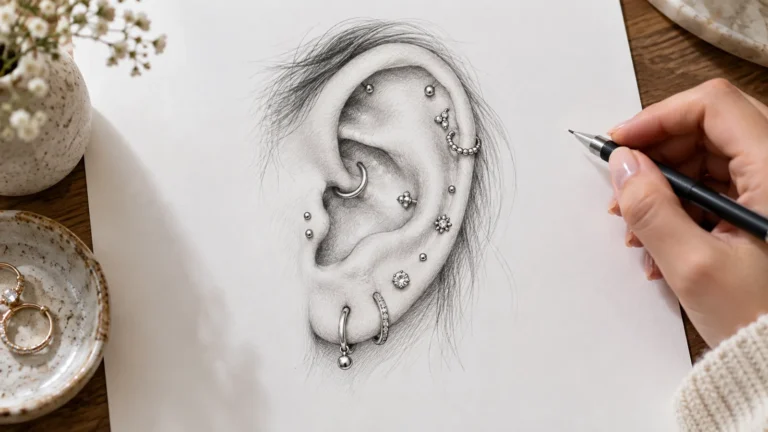
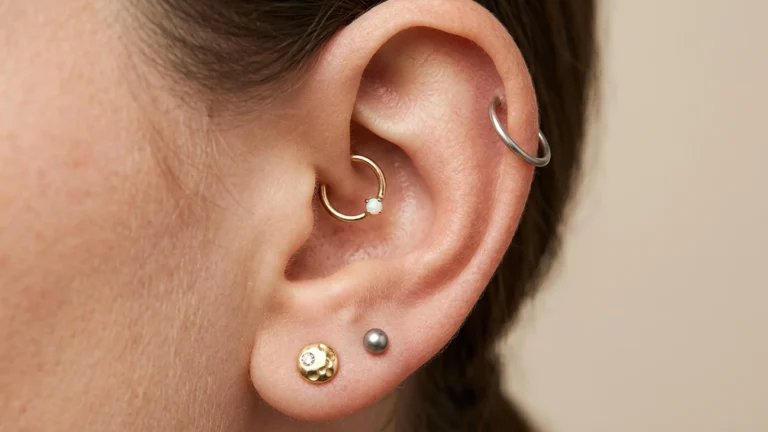
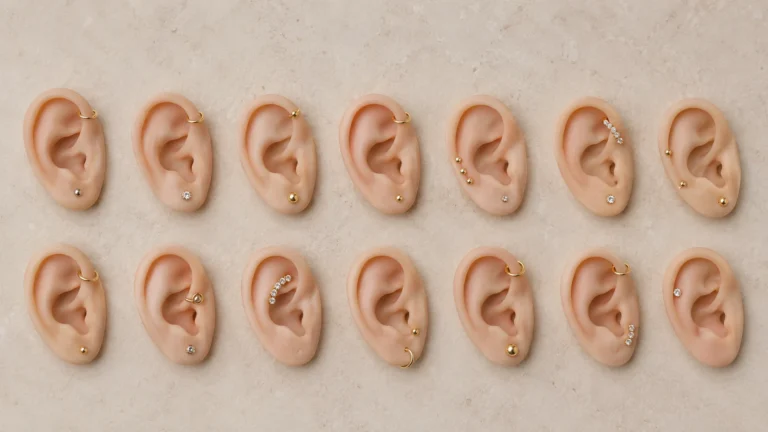
Every placement is named for the anatomy it passes through, so the map of the ear is also the map of healing time. The lobe is the soft fatty flap at the bottom with no cartilage, which is why it closes fastest. Working up and inward, the tissue stiffens.
- Lobe – soft fatty tissue at the base. Pain about 2/10. Healing roughly 6 to 8 weeks; some sources describe full closure of the channel in 1 to 2 months.
- Helix – the outer rim of upper cartilage. Pain 4/10. Initial healing around 3 to 4 months, full healing about 6 to 12 months.
- Forward helix – the cartilage ridge at the front where the ear meets the face.
- Tragus – the small cartilage nub over the ear-canal opening. Pain 4/10.
- Anti-tragus – the cartilage bump above the lobe, facing the tragus.
- Daith – a thick, deep fold of cartilage above the ear canal. Pain 5/10, healing 9 to 12 months by MADAJ’s chart.
- Rook – the inner cartilage ridge within the upper ear fold.
- Snug – the anti-helix, the vertical inner fold; Byrdie calls it the most painful cartilage piercing.
- Conch – the thick central cartilage bowl. Pain 7/10, healing 6 to 12 months.
- Flat – the flat panel of cartilage inside the upper rim.
- Industrial – two cartilage holes joined by one barbell. Pain about 8/10.
- Orbital and transverse lobe – defined by jewelry rather than a single new spot, covered below.
The reason cartilage lags so far behind the lobe is blood supply. Cartilage has a limited blood supply, which slows the healing process and keeps the spot tender for months after a lobe would have settled.
Names and Diagrams: Matching Every Term to a Fold
Several names on the chart describe the same structure under different labels, and a couple describe jewelry rather than a location. Three distinctions remove most of the confusion.
First, the snug and the anti-helix are the same piercing. The snug sits in the inner vertical ridge that runs parallel to the outer rim, and a piercer may use either term. Our anti helix breakdown is the companion reference for that fold.
Second, the orbital and the industrial both join two holes, but the jewelry sets them apart. An orbital uses a single ring to connect two piercings – two cartilage holes, or a first and second lobe hole – while the industrial threads a straight barbell across two upper-cartilage punctures. If someone describes “a bar across the top of the ear,” that is the industrial; a loop linking two points is the orbital.
Third, the transverse lobe is a lobe piercing turned sideways. A transverse lobe piercing is threaded from side-to-side using a barbell, where a standard lobe is pierced front to back. Same tissue, different axis, visibly different jewelry.
Needle Only: Why Cartilage Should Never Meet a Piercing Gun
This is the one rule on the list that is a safety decision, not a style preference, and it is worth walking out of a studio over. Cartilage should never be pierced with a gun; a needle is the only acceptable tool for any spot above the lobe.
The Association of Professional Piercers states that when guns are used on structural tissue such as cartilage, serious complications including auricular chondritis, shattered cartilage, and excessive scarring are common. The APP also notes that plastic ear piercing guns cannot be autoclave sterilized and may not be sufficiently cleaned between clients, which is why its members may not use reusable guns at all.
The practical screen: if a studio reaches for a spring-loaded gun to do a helix, tragus, or any cartilage placement, stop. A sterile single-use needle is the standard that applies to every type on this list except, at most, a simple lobe.
Cost by Placement: Does Complexity Drive the Price?
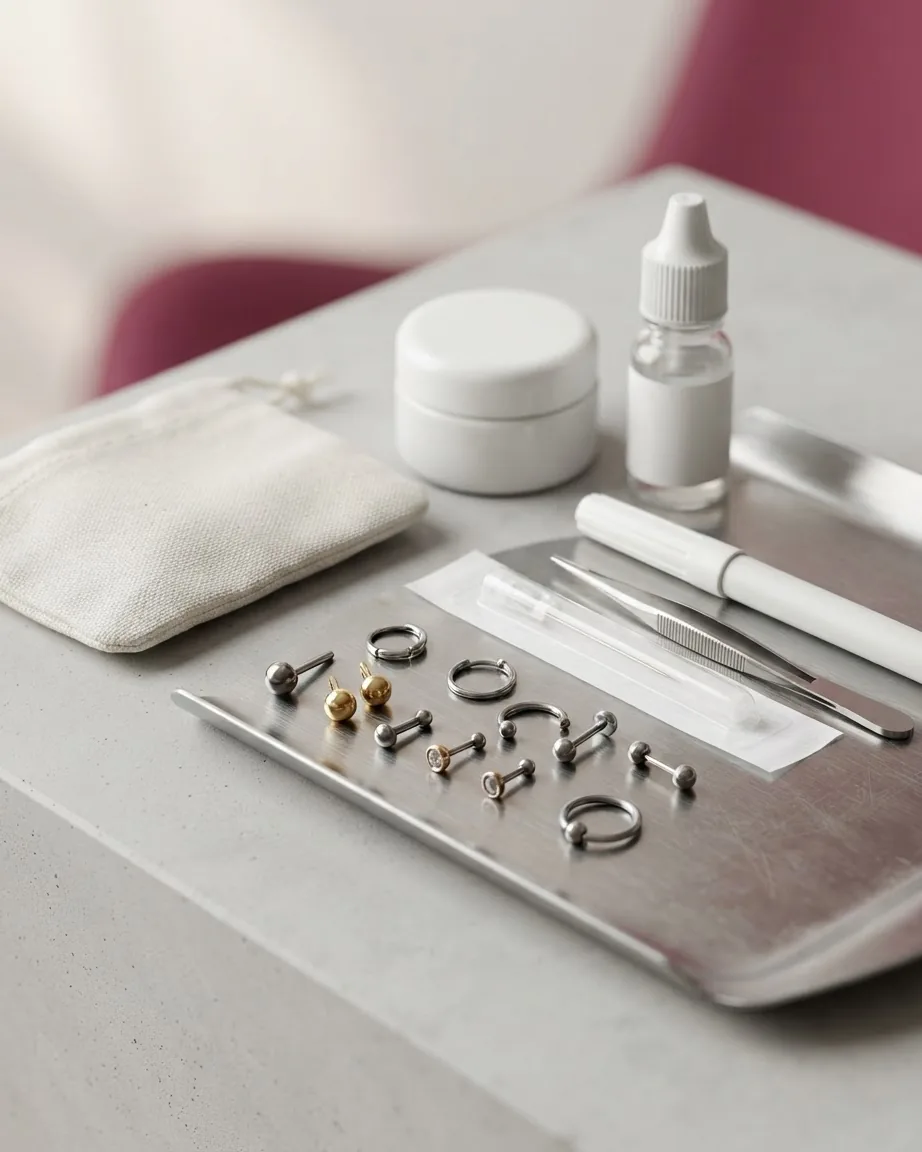
Complexity and price move together, which is the clearest piece of decision support on this subject. Simple tissue costs less; multi-hole and firmer cartilage costs more. US averages compiled by Airtasker run from $35 to $115 or more depending on placement complexity and studio location.
- Single earlobe: $35 to $50.
- Industrial (advanced, multi-hole): $75 to $115.
Two readings follow from that spread. The lobe is the only placement that is both low pain (about 2/10) and low cost, which makes it the default first piercing for most people. And the price step from a flat to an industrial tracks the jump from one hole to two, confirming that what you pay largely reflects how much work the placement demands rather than the jewelry alone.
Choosing Your Placement: Pain, Healing, and Whether Your Ear Qualifies
Three factors decide which type of ear piercing fits a given person: pain tolerance, how long they can commit to healing, and whether their anatomy even allows the spot. The first two are on the chart. The third is settled in the chair.
If low pain and fast recovery matter most, the lobe is the clear pick. Airtasker notes that most people rate lobe pain at around 2 out of 10, with healing in just 5 to 7 weeks. For a first cartilage piercing, the helix and tragus are the mildest options at 4/10 – a manageable pinch through thinner cartilage – though both still carry the long cartilage healing window of 6 to 12 months. There is no low-pain cartilage piercing that also heals quickly; those two traits only overlap at the lobe.
Anatomy is the factor people most often forget. Not everyone can get a snug; Zensa Skin Care notes that your piercer will tell you whether your ear anatomy makes you eligible, and the same gate applies to the daith and rook, which depend on having a fold deep or pronounced enough to hold jewelry. Expect that some placements may be declined. For how that eligibility check plays out on specific spots, see our outer conch piercing and vertical helix guides, and the wider types charts section for the full map.
One lifestyle note that changes a decision: the tragus sits over the ear-canal entrance. Byrdie points out that because the tragus protects the outer ear canal, a post placed there blocks where earbuds go, so daily earbud users should weigh that before booking.
Does a Daith Piercing Help Migraines? What the Evidence Actually Says
This claim circulates widely, and the sources split, so it deserves a direct answer rather than a hedge. Byrdie, citing a dermatologist, describes the daith as the only location that has shown potential real science for supporting a medical use. Clinical bodies disagree.
The American Migraine Foundation states that the only evidence supporting daith-for-migraine is anecdotal and that no research supports the theory, with reported relief believed to be placebo. The American Migraine Foundation adds that the Cleveland Clinic says there is no evidence to support the claim that daith piercings relieve migraine.
Where an editorial source and clinical authorities disagree on a medical outcome, the clinical position carries more weight. The honest reading: get a daith if you want the piercing, not as a migraine treatment. Expect pain around 5/10 and healing of 9 to 12 months by MADAJ’s chart, and note that migraine care belongs with a clinician, not a piercing needle. This is a sensitive health topic; if migraines are affecting your life, a healthcare provider is the right person to talk to.
Aftercare and Trouble Signs by Tissue Type
Lobe and cartilage do not ask for the same care, and the difference is mostly patience and what you avoid. The American Academy of Dermatology advises leaving starter jewelry in for six weeks or more, keeping it in even at night, because removing it too early may let the new channel close.
Two cleaning errors recur. The AAD warns against hydrogen peroxide and antibacterial soaps, which can damage healing skin. And for cartilage specifically, Zensa Skin Care advises never twisting the jewelry while cleaning, because turning it can cause scarring or delay healing. A lobe is relatively low maintenance and should settle inside 1 to 2 months; cartilage stays tender far longer.
The trouble threshold is where this crosses into medical ground. The AAD notes that raised skin around a piercing may be a developing keloid scar. Any sustained redness, swelling, heat, discharge, or raised tissue is a reason to see your piercer or a clinician – this guide aggregates documented standards and is not a substitute for a professional looking at your ear. For how lobe timelines in particular can read differently across reputable sources, see our how long lobe piercings take guide.
Numbing Cream Before an Appointment: The Timing That Matters
Lidocaine-based numbing creams can dull the pinch, but the timing window is narrow and worth getting right. MADAJ’s guidance is to apply the cream to the area 30 minutes to one hour before the appointment and cover it with plastic wrap to hold it in place.
There is a counterweight to flag: the same source advises avoiding numbing products for at least 24 hours before the appointment in some cases, because topical agents can affect the tissue a piercer needs to work with. Raise it with your piercer first rather than arriving pre-numbed unannounced – the person doing the piercing may have a preference that overrides the cream’s own instructions, and the healthy approach is to let them decide.
Reading Conflicting Healing Numbers Without Getting Misled
The same placement often carries different healing figures across trusted sources, and that is not an error to correct so much as a definition to understand. For the lobe, Studs gives 4 to 6 months, Zensa Skin Care describes full closure in 1 to 2 months, and Airtasker reports 5 to 7 weeks. The daith shows the same spread: MADAJ lists 9 to 12 months, while Airtasker suggests giving it 3 to 9 months before styling it with anything from a minimalist stud to a charm barbell.
These ranges are not strictly comparable, because sources define “healed” differently – some mean the channel has closed enough to change jewelry, others mean the tissue is fully settled underneath. The usable takeaway: trust the longer end of the range before you change jewelry or stop cleaning, and let your piercer confirm. For jewelry sizing on a firm placement during that window, our tragus piercing jewelry guide is the companion on gauge and length. Underneath every one of these numbers is the same fact that orders the whole chart: pain and healing both rise as you move from the soft, well-fed tissue of the lobe into the dense, blood-starved cartilage above it.
Is the snug really the most painful cartilage piercing?
It depends on the chart. Byrdie names it the most painful cartilage spot, while MADAJ scores it 7/10 – the same tier it gives the conch, not above it. Because each source grades on its own subjective scale, both can be right. Expect a snug to rank among the harder placements regardless.
Which spot should a first-timer pick?
For anyone nervous about pain or unwilling to commit to a long recovery, the lobe at roughly 2/10 is the answer, healing in weeks rather than months. If the goal is cartilage, the helix or tragus at 4/10 are the gentlest entry points, though both still need the full cartilage healing stretch before any jewelry change.
Can a piercer turn me away for the placement I want?
Yes, and a good one will. The snug, daith, and rook all require a specific fold or ridge depth, and if your ear lacks it, a reputable piercer declines rather than forcing jewelry into tissue that cannot hold it. Treat that refusal as a sign of competence, not a setback, and ask what your anatomy does suit.
How does cost connect to which piercing I choose?
Price rises with the work involved rather than with the metal. If budget is tight, a simpler placement is also usually the one that hurts less and heals faster.
The Cost Step From a Lobe to an Industrial, in Dollars
The article says complexity and price move together, but it never puts a number on the gap. Using only the published US ranges, here is what the jump from one hole to two actually costs. A single earlobe runs $35 to $50; an industrial runs $75 to $115.
- Low-end step: $75 industrial minus $35 lobe = $40 more.
- High-end step: $115 industrial minus $50 lobe = $65 more.