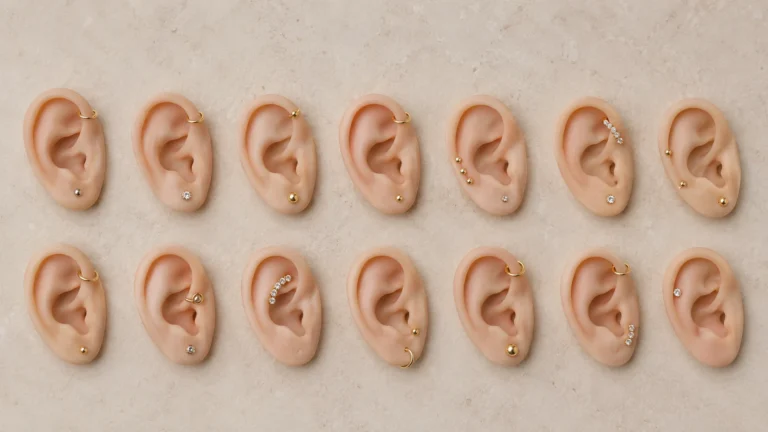
A chart shows where a piercing can go, not where it should go on you – and that distinction, which PiercingAI puts at the center of its mapping, is what most people miss when they bring a screenshot to a studio. An ear piercing diagram is a reference for anatomy, not a menu to order from. The rook, the snug, the daith: each depends on a cartilage fold you may or may not have. This guide labels each spot, gives a rough pain and healing figure to orient by, and flags the one placement with a named infection risk that a lobe does not carry.
Quick answer: An ear piercing diagram divides the ear into two tissue types – the soft-tissue lobe and the surrounding cartilage. The lobe heals fastest and hurts least (roughly 2/10, one to two months). Cartilage placements like the helix, rook, daith, snug, and industrial sit higher and heal in months, not weeks, because cartilage has low blood flow. Pain figures are ordinal, not clinical: use them to rank spots, not to predict your own. Whether a placement is even possible depends on your individual anatomy, which only an in-person consultation can confirm.
What each spot on the ear piercing diagram is called
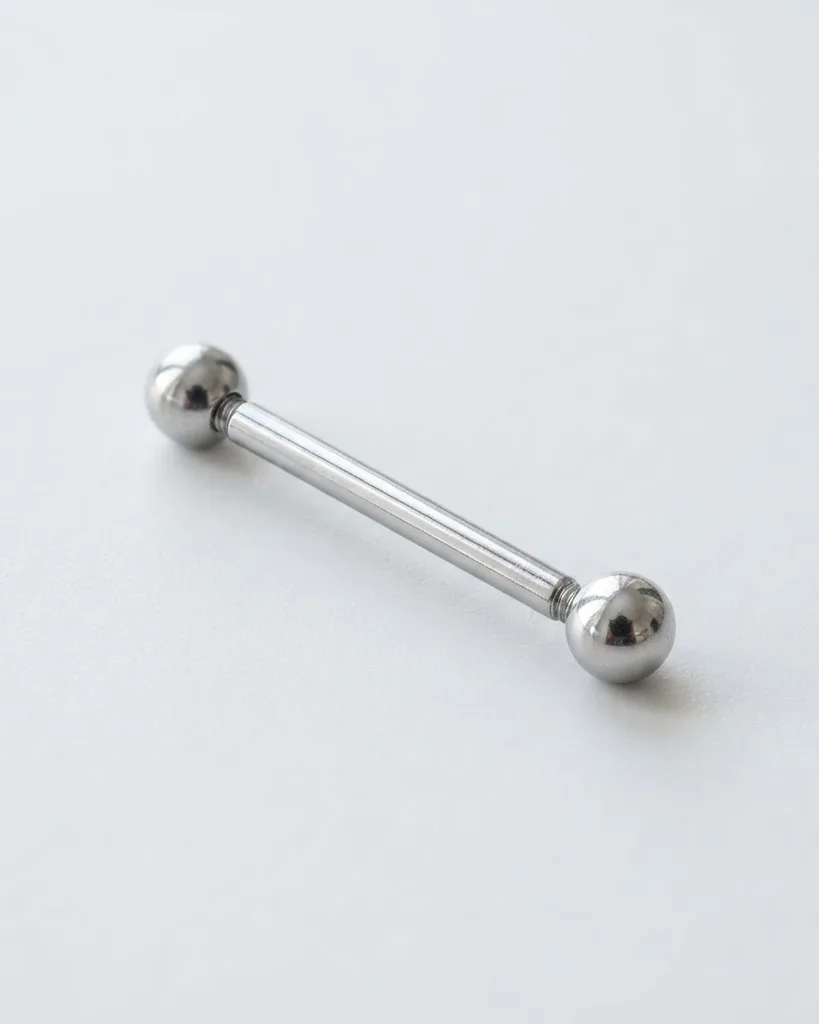
Named ear piercings are regions of anatomy, not fixed points. According to PiercingAI, the lobe is the only soft-tissue region of the ear – no cartilage, generous blood flow – which is why it is the fastest-healing and least painful placement, and the near-universal first hole.
Everything above the lobe sits in cartilage. A useful rule from the same source: every helix is a cartilage piercing, but not every cartilage piercing is a helix. “Cartilage piercing” is the umbrella term; the specific name tells you which fold or rim the jewelry passes through.
- Lobe: soft tissue at the bottom of the ear.
- Helix: the upper outer rim.
- Daith: the innermost cartilage fold, just above the ear canal.
- Rook: the ridge of the antihelix, the inner fold above the daith.
- Snug (anti-helix): a shallow horizontal piercing through the inner cartilage ridge.
- Tragus: the small flap in front of the ear canal.
- Conch: the large cup of cartilage in the middle of the ear.
- Industrial: two holes through the upper rim joined by one barbell.
Names drift across borders. PiercingAI notes that the industrial is the US name while scaffold is the UK name – one barbell, two holes through the upper rim either way. If you read British studio sites, “scaffold” and “industrial” mean the same thing.
Pain and healing times to orient by, placement by placement

Treat the numbers below as a ranking, not a verdict. The pain ratings come from a single specialist source, Vital Piercing, and pain is subjective – no independent clinical pain scale for ear placements was available to verify them. Use them to see that a lobe hurts less than a snug, not to predict the exact sensation you will feel. For a broader look at how placements compare, see our piercing pain chart.
Vital Piercing rates a standard lobe at 2/10, healing in one to two months. A helix on the upper outer rim rates 4/10 and heals in 6-9 months. The snug is described as the hardest ear piercing to heal – a 7/10 rating, an 8-16 month timeline, a high rejection rate, and a placement that is not anatomically possible for everyone, which is why many piercers decline to do it.
The healing ranges look wildly different depending on who is counting, and that is not a contradiction – it is a matter of what each source is measuring:
- Mayo Clinic states most piercings heal within about six weeks, but some might take several months or longer. This is a general figure that does not break out cartilage separately.
- The Association of Professional Piercers notes that tougher tissue such as ear cartilage, navels, and nostrils may take six months or longer.
- Vital Piercing’s per-placement ranges (helix 6-9 months, snug 8-16 months) describe named spots specifically.
These describe different populations – all piercings, ear cartilage as a group, and one named placement – so no single number covers your situation. When the cut is through cartilage, plan around months. The physical reason, per Vital Piercing, is that cartilage is mostly avascular (low blood flow), which is why it heals in months instead of weeks.
Why the diagram is not a menu: anatomy decides what fits

The gap between what a chart shows and what your ear can hold is the one thing a diagram cannot tell you. Vital Piercing is blunt about the consequence: forcing a piercing into the wrong anatomy leads to migration, rejection, or a piercing that never heals.
Several of the most-requested placements are conditional on anatomy you may not have. The daith requires a cartilage shelf not everyone has – Vital Piercing advises booking a consultation first. The snug, as noted above, is not anatomically possible for everyone. The rook threads through the antihelix ridge, another fold that varies person to person.
This is where a diagram ends and a piercer begins. A studio can look at your ear, press the fold, and tell you whether a rook or snug will sit flat or fight you for a year. For the piercings that do suit most ears – a second lobe hole, for instance – the decision is lower-stakes; our second lobe hole guide covers that gentler end. For the trickier folds, the rook sits among the hardest to fit well, and our rook jewelry guide goes into the sizing a healing one needs.
High cartilage carries an infection risk the lobe does not
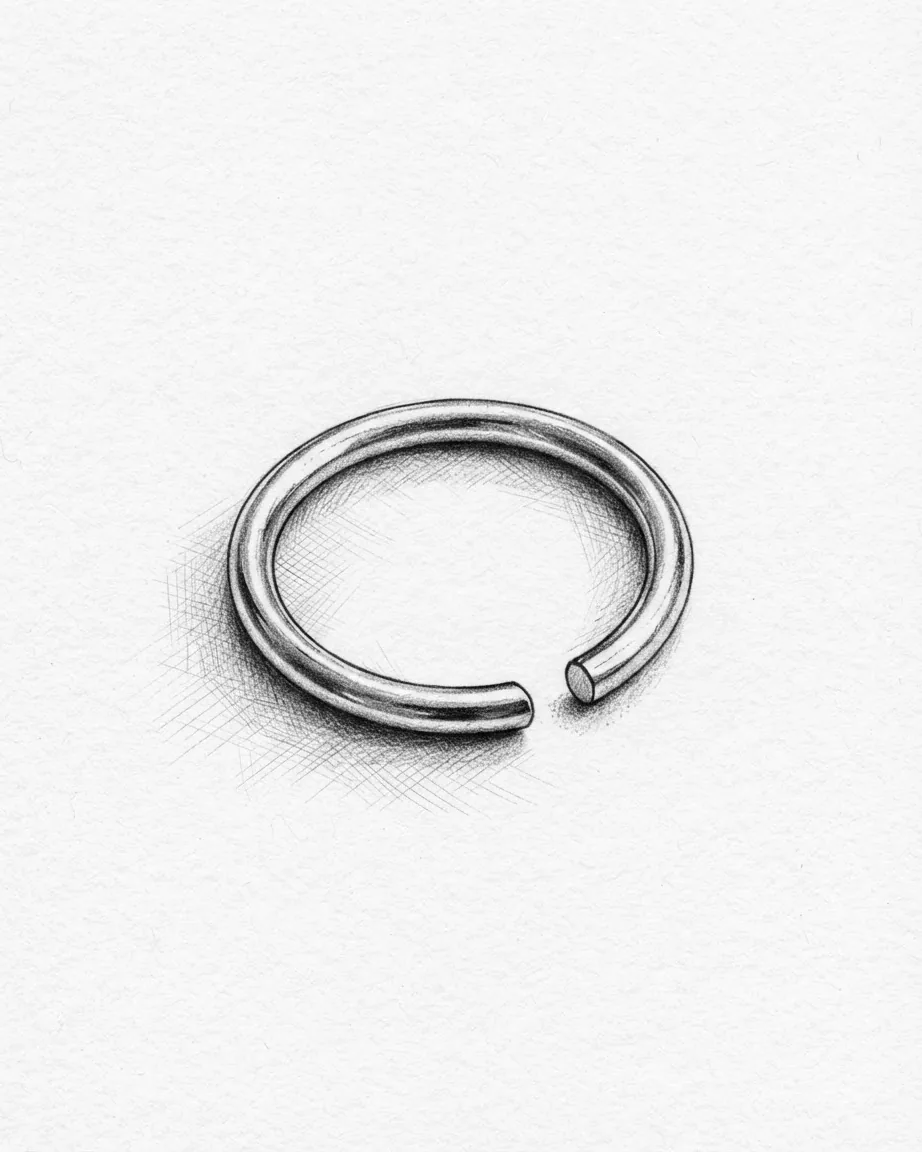
This is the single figure a generic ear chart almost never includes, and it has a clinical name. According to Cleveland Clinic, perichondritis is an infection of the tissue covering the cartilage of your outer ear, and ear trauma – most commonly high ear cartilage piercing – is the usual cause.
Cleveland Clinic states plainly that the upper ear has a greater risk of infection than the earlobe, and that the condition can be prevented by not piercing high ear cartilage at all – their advice is to stick with rings in the lobes. That does not mean cartilage piercings are off the table for everyone; it means the risk profile is genuinely different, and the choice should be made knowing that, not in spite of not knowing it.
A reliable, verified number for how much more often perichondritis occurs in high cartilage was not available, so this guide does not state one. The directional fact – greater risk, named condition, lobe as the lower-risk alternative – is what should shape the decision.
The daith-for-migraine claim, checked against headache medicine
If you have seen a daith piercing recommended as a migraine treatment, the clearest correction comes from headache specialists, not piercers. The American Migraine Foundation states there is no research that supports that theory, and that any reported relief is believed to be a placebo effect.
The Foundation goes further: the piercing itself is often painful, carries a high risk of infection, and may even make migraine symptoms worse in the long run. Given that the daith also depends on a cartilage shelf not everyone has, choosing it as a medical intervention means accepting a procedure with no evidence of benefit and a documented downside.
If migraine relief is the goal, the honest read is that a daith piercing is not a treatment. Get the piercing if you want the piercing; do not get it as medicine.
Aftercare that matches the tissue: saline, sleeping, and jewelry change
Aftercare for an ear piercing is not generic advice – it tracks the tissue type shown on the diagram, and the sourced specifics below differ from the folk routines many people still follow. Nothing here replaces your piercer’s or a clinician’s guidance for your own ear; it is a summary of published professional standards.
On cleaning, the Association of Professional Piercers no longer recommends mixing your own sea salt solution. The advised product is a sterile saline wound wash whose ingredients list 0.9% sodium chloride as the only ingredient. The same body warns against cleaning with alcohol, hydrogen peroxide, antibacterial soaps, iodine, or any harsh products, because these can damage cells.
On sleeping, two sources point the same direction with different specificity. The APP notes that sleeping directly on a healing cartilage piercing can cause irritation and even shift the piercing’s angle, suggesting a travel pillow. Vital Piercing puts a window on it: avoid sleeping on the pierced side for at least the first 3 months.
On changing jewelry, patience is the whole instruction. A piercing heals from the outside to the inside, so it can feel healed on the surface while the channel underneath is still fragile. Vital Piercing’s rule: cartilage piercings need at least 6 months minimum before any jewelry change, and many take longer. For the daith and conch specifically, the throbbing is front-loaded – Vital Piercing warns that thick cartilage will throb for the first 48 hours. Deeper routines live in our types charts section.
Safe metals for a healing ear, from the medical floor to the spec
Allergen warning
The metal choice matters most while the piercing is open, and two authorities converge on it from different angles. Mayo Clinic identifies nickel-containing jewelry as a particular cause of allergic reactions and lists hypoallergenic options as surgical stainless steel, titanium, niobium, or 14- or 18-karat gold.
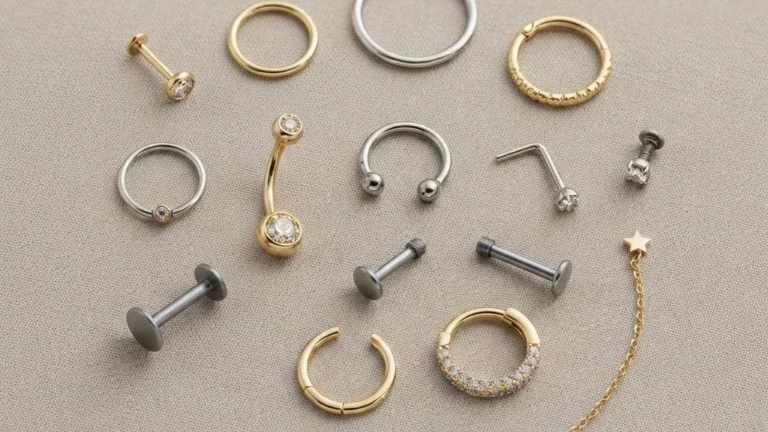
Vital Piercing narrows that to a healing-specific standard: implant-grade titanium (ASTM F-136), solid 14K or 18K nickel-free gold, or niobium for any healing piercing. The two agree on the principle – nickel out, biocompatible in – with the specialist spec adding the exact titanium grade. Match the jewelry style to the spot: flat-backed labret studs for the tragus and helix, curved barbells for the rook and daith, and a single straight barbell for the industrial.
Guns versus needles, and what to do if it looks infected
Two practical facts carry more weight than any style choice. First, on equipment: Mayo Clinic reports that the Association of Professional Piercers warns reusable piercing guns can’t be properly sterilized, which raises infection risk and may damage ear tissue. This is the reason piercers discourage mall guns for cartilage in particular. If you want the mechanics of the alternative, our piercing needle guide walks through it.
Second, if a piercing looks wrong, the instinct to pull the jewelry out is the wrong one. The NHS advises leaving your jewellery in unless a doctor tells you to take it out, because removing it can trap the infection inside. The NHS also distinguishes a benign lump from an infection: small lumps called granulomas are trapped fluid, and can be treated by soaking a pad in warm water then holding it against them once a day.
None of this is a diagnosis. If you see spreading redness, swelling, heat, discharge, or feel unwell, see your piercer or a clinician, and in the UK contact a GP or 111 for urgent help. A granuloma you can manage at home; an infection you cannot – and telling them apart is a job for someone who can see your ear.
Matching a placement to your own ear
Read the diagram in a specific order. Start with tissue: the lobe is soft tissue and forgiving; everything above it is cartilage and slow. Then read the fold: a daith, rook, or snug needs a shelf of cartilage that your ear either has or does not. Then read the risk: high cartilage carries the perichondritis risk a lobe does not, and that belongs in the decision, not after it.
Bring the diagram to a consultation and let the piercer check what your anatomy actually supports. The chart narrows the options; the hands-on look confirms them. If you are stacking several holes at once, the sequencing and healing load change – our multiple ear piercings guide covers how many an ear can take at a time.
The healing-time commitment the diagram hides: snug vs. lobe
A diagram puts the lobe and the snug a few millimetres apart, which makes them look like comparable choices. Run Vital Piercing’s own per-placement healing ranges through the arithmetic and the gap is anything but comparable. Using the same source for both figures (lobe 1-2 months, snug 8-16 months), the worst-case snug can take 16 times longer to heal than the fastest-healing lobe, and even best-case to best-case it is 8 times longer. In plain calendar terms, that is up to 14 extra months of healing compared with a lobe’s longest estimate.
The width of each healing window tells the same story a second way – how much the timeline can swing once you commit:
- Lobe: a 1-month window (2 − 1), so the outcome is fairly predictable.
- Helix: a 3-month window (9 − 6) – the uncertainty triples.
- Snug: an 8-month window (16 − 8) – the gap between a lucky and an unlucky heal is itself longer than a lobe takes to heal at all.
All inputs are Vital Piercing’s single-source ranges, so these are internal comparisons within one source, not a blend across sources. Healing figures from Mayo Clinic and the Association of Professional Piercers describe different populations and are deliberately not combined here. Pain ratings are ordinal and are not calculated. Treat this as a planning scale: the farther up the cartilage you go, the longer – and the less predictable – the commitment the diagram never spells out.
Frequently asked questions
Can everyone get a rook or daith piercing?
No. Both sit in inner cartilage folds, and the shelf of tissue they pass through varies from ear to ear. Vital Piercing advises a consultation before a daith because not everyone has the supporting cartilage, and the snug is explicitly flagged as not possible on every ear. Forcing one leads to migration or a wound that never settles.
Is a piercing fully healed once it stops hurting?
No – surface comfort is misleading. This kind of wound closes from the outside inward, so the visible opening can feel settled while the channel underneath stays fragile. That is why cartilage needs a minimum of six months before any jewelry swap, with many taking longer. Changing a stud early can reopen the interior and restart the process.
Which metal is safest while the piercing is still open?
Skip anything containing nickel, the metal most tied to reactions. The biocompatible choices are surgical stainless steel, titanium, niobium, or 14- to 18-karat gold. For a wound still healing, the tighter standard adds implant-grade titanium certified ASTM F-136 and solid nickel-free gold. The grade matters as much as the metal name on cheap jewelry.
What should I do first if my ear piercing looks infected?
Keep the jewellery in unless a clinician directs otherwise, since pulling it can seal an infection inside the tissue. Clean with sterile saline only – no alcohol, peroxide, or antibacterial soap. A soft lump may just be a fluid-filled granuloma treatable with a warm compress. Spreading redness, discharge, or fever warrants a prompt visit to a professional. This is general information drawn from published medical and professional-body guidance, not a substitute for an in-person assessment. Anything that looks or feels wrong on your own ear should be seen by your piercer or a clinician.