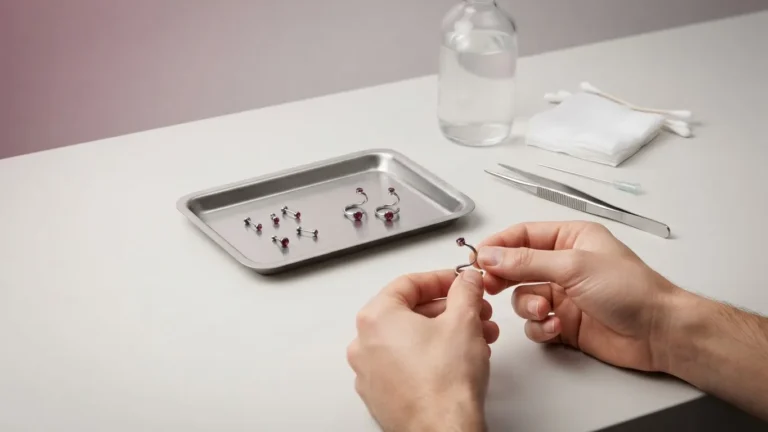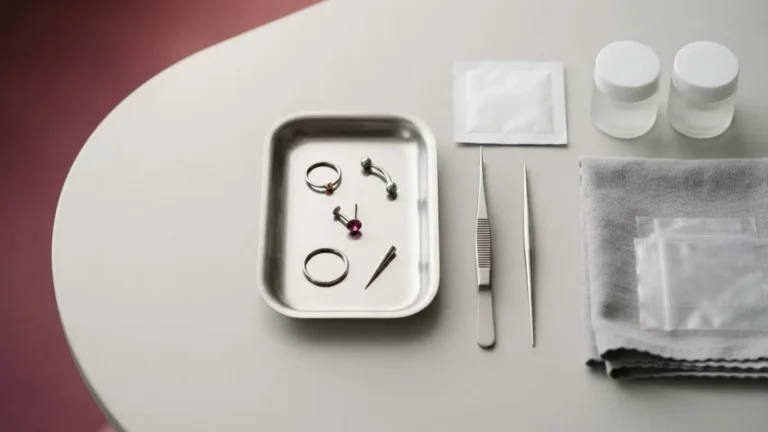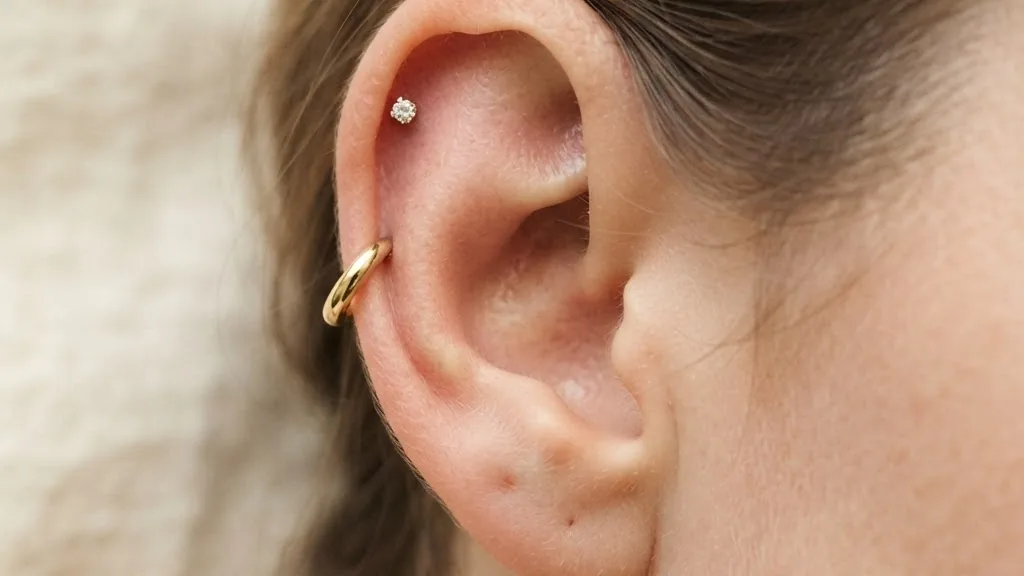
Double ear piercing means two holes in the same earlobe, and it is one of the gentlest upgrades you can make to your ears. Lobe tissue is soft and heals fast, which is why people stack a second hole here long before they ever attempt a helix piercing higher up the ear. Still, a second hole is a wound. It carries real, measurable risks around metal reaction and infection that the styling-first guides tend to skip, and those are the parts worth getting right.
Quick answer: A double ear piercing is two piercings in the earlobe, usually stacked vertically or set side by side. The lobe is soft tissue, so the surface closes in roughly 6-8 weeks, with full internal healing taking about 3-6 months. Get it done with a single-use needle, not a piercing gun. Wear implant-grade titanium or another low-reaction metal, clean only with sterile saline, and never twist the jewelry. Most problems trace back to cheap nickel-releasing metal or an unlicensed piercer, both of which you can avoid if you plan the appointment instead of walking into the first shop you see.
What a double ear piercing actually is
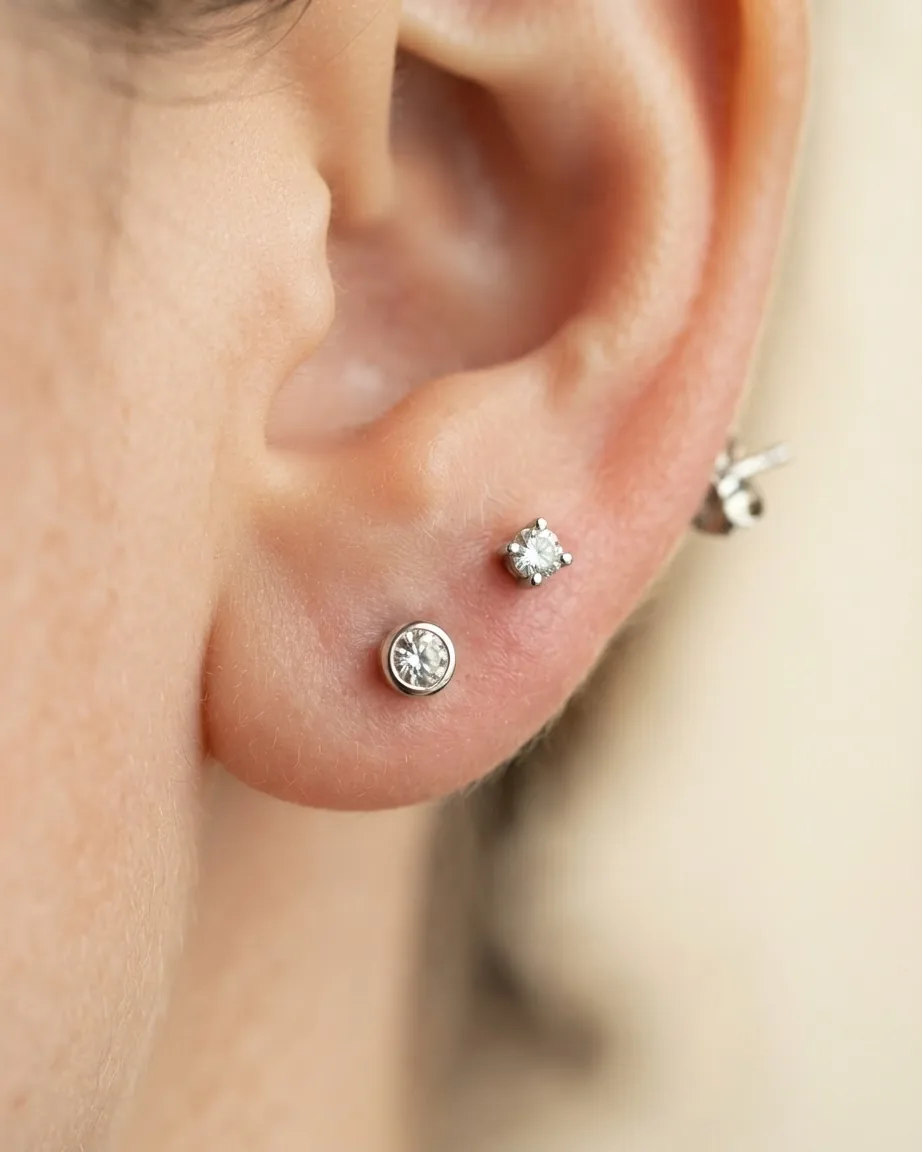
A double lobe piercing is two separate holes placed in the earlobe, either stacked one above the other or set side by side near the original hole. It is not the same as stacking cartilage piercings up the ear, even though shoppers constantly mix the two up. The distinction matters for one practical reason, and that reason is healing. Fleshy, well-supplied lobe tissue recovers quickly. Cartilage does not. A second lobe hole and a second-hole-up-the-helix get marketed together but behave nothing alike.
Placement comes down to a piercer’s judgment about your lobe height and how symmetrical you want the pair. Most piercers leave at least 5 to 8 millimeters between the two holes, enough room that the jewelry does not collide and the tissue between them stays strong. A lobe that is short top to bottom may only comfortably fit two holes with a tighter gap, and a piercer should tell you that up front rather than force a spacing that will strain the skin.
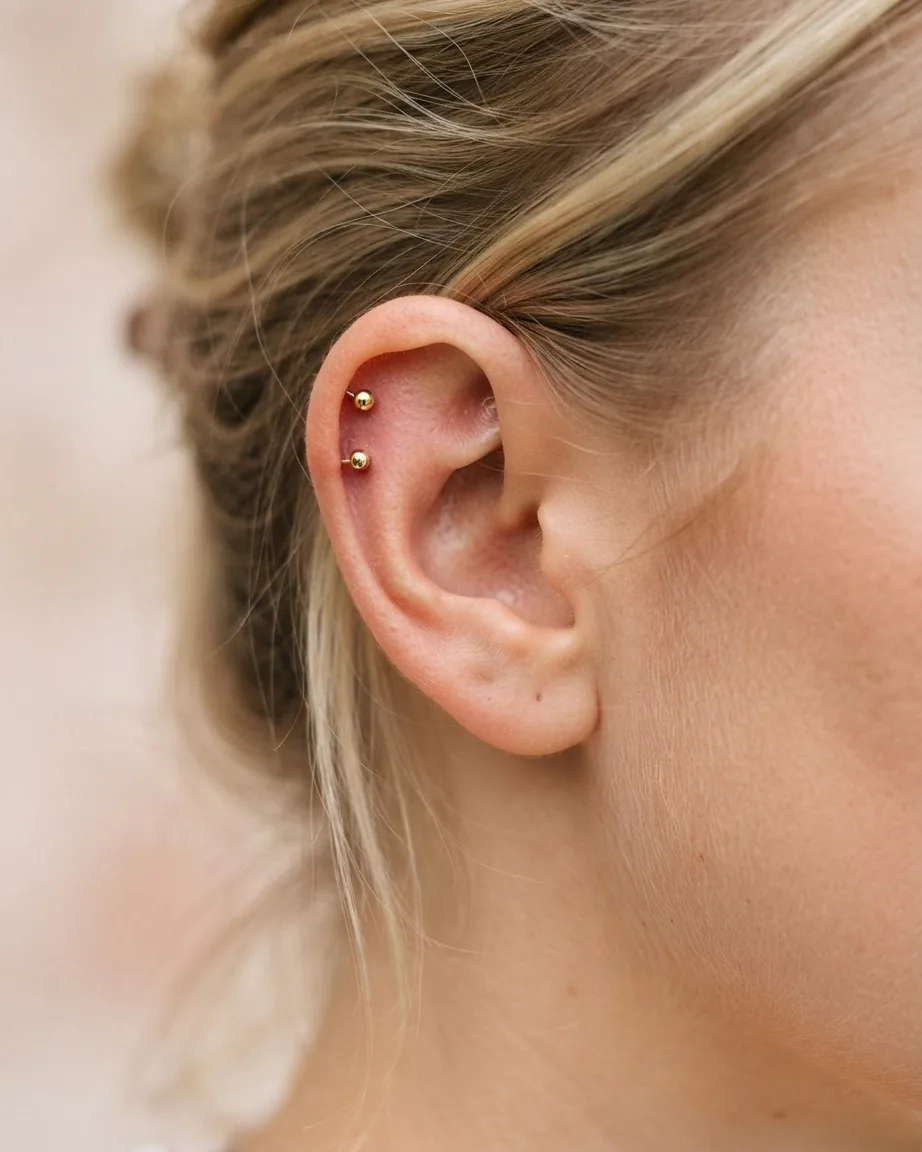
Some people want a tight vertical ladder. Others want a wider spread that reads as two distinct studs. Both are standard requests, and a careful piercer marks the spot with a surgical pen, has you check it in a mirror from the front and the side, and confirms the mark before the needle ever comes out. If something looks off in the mirror, say so then. Once the hole exists, it exists.
Needle or gun? How a second lobe hole is done
Reputable studios pierce a second lobe hole with a single-use, sterile needle, never a spring-loaded gun. A needle removes a clean core of tissue. A gun forces blunt jewelry through the lobe under pressure, which crushes tissue and is far harder to sterilize between clients. The Association of Professional Piercers backs single-use needle equipment for exactly that reason: it can be fully sterilized or discarded, which cuts the infection risk that reusable gun mechanisms carry.
Mall kiosks and some jewelry counters still use guns because they are fast and cheap to run, and that is precisely why they remain a risk factor worth avoiding for a second hole. A gun’s plastic components cannot be autoclaved the way surgical steel can, and the blunt-force mechanism causes more tissue trauma than a sharp needle sliding through cleanly. The trauma difference alone tends to slow healing and raise the odds of a bump forming at the site.
You can usually get both holes done in one appointment. Some piercers would rather add a fresh second hole once the first is fully healed, so the lobe is stable and the marks land precisely. Two brand-new holes at once is also normal. Ask three questions before you sit down: is the needle opened from a sealed pouch in front of you, how is the jewelry sterilized, and what metal is the starter piece. Those answers separate a professional from a mall kiosk.
A typical appointment runs in a fixed order. First, paperwork and a quick health check, including whether you are on blood thinners or have a metal allergy history. Second, marking and mirror approval. Third, the piercer opens a sealed needle pouch in front of you, pierces, and threads the starter jewelry through immediately. Fourth, they walk you through aftercare verbally and hand you a printed sheet. If any of those steps gets skipped, that is a signal to ask more questions or walk out.
How much it hurts and how long it heals
A second lobe piercing hurts about as little as a piercing can. The earlobe is soft tissue with no cartilage to punch through, so most people feel a brief sharp pinch and a few seconds of heat, then it fades. Surface healing runs roughly 6-8 weeks. Full internal healing takes about 3-6 months, and that longer number is the one that actually governs when you can change jewelry safely.
For comparison, cartilage placements sit much higher on the pain scale and can take 4 months to 1 year to heal. If you want to see where a second lobe lands next to everything else, our breakdown of how much each ear placement hurts ranks it spot by spot.
People with needle nerves often ask about topical numbing agents. They help less than you would hope on a fast lobe piercing, and piercers have specific reasons to be wary of them; we lay out whether numbing cream is worth it in a separate guide.
Here is the honest shape of healing, broken down by roughly what week you are in:
- Week 1: tenderness, mild swelling, a little blood or clear fluid. All normal. Ice wrapped in cloth, held briefly against the outside of the ear, can take the edge off swelling on day one.
- Weeks 2-3: swelling settles and light crusting forms around the post as the channel builds. Saline rinses twice a day are enough; more frequent cleaning can actually irritate the wound.
- Weeks 4-8: the outside feels closed, but the inside is still raw. This is the stage where people get overconfident and start twisting the jewelry to check on it. Do not. Leave it alone.
- Months 3-6: full internal healing, when it is finally safe to swap jewelry for the first time.
Getting a second hole in an already-healed lobe follows the same timeline as a first piercing. The old, settled hole gives you nothing extra. New tissue heals on its own clock, so treat the second hole with the same patience you gave the first one, even if the first one feels ancient history by now.
Aftercare that actually protects the piercing
Clean a healing lobe piercing with sterile saline and almost nothing else. The Association of Professional Piercers recommends a wound-wash saline whose only ingredient is 0.9 percent sodium chloride. Skip the products your grandmother swore by. Rinse as needed, pat dry with clean gauze, and then leave the jewelry alone. The single most common self-inflicted setback is fiddling with a hole that was healing fine.
Keep these away from a fresh piercing:
- Hydrogen peroxide and rubbing alcohol, which dry out and damage new skin.
- Antibacterial soaps, tea tree oil, Neosporin, and Bactine.
- Twisting or rotating the jewelry, which tears the healing channel open.
The full routine from the Association of Professional Piercers aftercare guidelines is worth reading start to finish, because the small details are where people slip.
One rule trips up almost everyone. For the first 6 months or so, do not leave the hole without an earring for more than 24 hours. Fresh channels shrink fast, and reinserting into a half-closed hole is miserable at best.
Sleep and daily habits matter more than most aftercare sheets admit. Sleeping directly on a fresh second hole presses the post into the pillow and can cause micro-trauma night after night without you noticing. A travel pillow with a cutout, or sleeping on the opposite side for the first few weeks, prevents a lot of avoidable irritation. Hair products, especially dry shampoo and hairspray, should be kept off the piercing site since the propellants and residues can sit in the wound and cause a low-grade irritation that mimics infection.
Phones and headphones are a second, less obvious snag risk. Pressing a phone against a healing lobe or wearing over-ear headphones that clamp on the piercing can catch the jewelry and pull it, which reopens tissue that was closing. Earbuds are the safer choice during the first two months if you spend a lot of time on calls.
Best metal for a fresh second hole
For a fresh piercing, wear implant-grade titanium and skip anything mystery-metal. Piercers point to titanium meeting the ASTM International F-136 grade, in a flat-back labret style, because it traps less moisture and snags less than a butterfly back. Mayo Clinic lists titanium, niobium, nickel-free or surgical steel, 18-to-24-karat gold, and sterling silver as low-reaction options. That short list is your whole safe zone for a healing hole.
The flat back matters more than people expect. A butterfly back sits close to the skin, holds fluid against the wound, and catches on hair and pillows. A flat disc lies smooth against the back of the lobe. Surgical steel that meets the ASTM International F-138 grade, sometimes labeled 316L, is another common starter metal. Niobium is inert and a solid pick for reactive skin.
Gold deserves a separate word of caution. Gold-plated jewelry is not the same thing as solid gold, and plating can wear through within weeks of daily contact with skin and moisture, exposing whatever base metal sits underneath, which is often nickel-bearing. Solid gold at 18-to-24 karat is a genuinely low-reaction option for a healing piercing, but only if it is actually solid, not plated or filled. Precious-metal fineness in jewelry follows the ISO 9202 standard, and a legitimate seller should be able to point to that marking or an equivalent hallmark on request.
| Material | Standard or grade | Why piercers pick it |
|---|---|---|
| Titanium | ASTM International F-136 | Implant-grade, very low reaction, light |
| Surgical steel | ASTM International F-138 (316L) | Implant-grade steel, common starter metal |
| Niobium | Elemental, nickel-free | Inert, kind to sensitive skin |
| Gold | 18-to-24-karat, solid, ISO 9202 fineness | Low reaction when high-karat and not plated |
Once you are past healing and choosing everyday pieces, spacing and post length start to matter as much as metal. Our rundown of earrings that actually fit two lobes covers backs, posts, and how close together the two studs can comfortably sit.
Downsizing and changing jewelry safely
The starter jewelry a piercer puts in is usually slightly longer than a finished piece, to leave room for swelling in the first few weeks. Once swelling goes down, most people benefit from downsizing to a shorter post, but that swap should wait until the piercing has had enough time to stabilize, rather than the moment it merely feels less puffy on the surface.
Changing jewelry too early, before the internal channel has firmed up, risks tearing tissue or introducing bacteria into a wound that is not yet a closed channel. A good rule of thumb is that if you are unsure whether the hole is ready, it is not ready. When in doubt, have the piercer do the first swap rather than doing it yourself at home, since they can check the healing state at the same time and catch a problem early.
Troubleshooting: bumps, irritation, and keloids
Not every red or raised spot on a healing lobe means the same thing, and mixing them up leads to the wrong fix. There are three common categories worth being able to tell apart.
An irritation bump is small, flat-topped, and usually caused by sleeping on the piercing, a low-quality starter metal, or jewelry that is slightly too tight after swelling goes down. It tends to shrink on its own once the irritating cause is removed and saline cleaning continues as normal. A hypertrophic bump or keloid is different: it is a firmer, sometimes shiny overgrowth of scar tissue that keeps growing rather than settling, and it can appear weeks or months after the piercing looks otherwise healed. The American Academy of Dermatology flags this kind of raised skin around a piercing as worth a dermatologist visit rather than home treatment, since keloids do not resolve with saline alone and respond better to early professional care.
An actual infection looks and feels different from either of those. It brings increasing pain rather than settling pain, real swelling that keeps building instead of leveling off, and thick yellow or green discharge, sometimes paired with a low fever. If the area is getting worse day over day instead of better, treat it as infection and get it looked at rather than waiting to see if it clears up.
Allergy or infection: how to tell them apart
Nickel allergy and infection look different once you know the tells. An allergic reaction shows up as itchy, dry, spreading redness around the whole area, often symmetrical, and it flares whenever the metal touches skin. An infection runs hotter and more localized: increasing pain, real swelling, and thick yellow or green discharge, sometimes with a fever. Allergy is the metal. Infection is a bug. They call for different responses.
Nickel is the single most common cause of this kind of reaction, and the numbers are not small. In the EDEN Fragrance Study, which patch-tested a random sample of 3,119 adults across five European countries, age-standardized nickel sensitization ran to 14.5 percent, from a high of 18.5 percent in Portugal to a low of 8.3 percent in Sweden. The same study tied nickel allergy to past piercing at an odds ratio of 3.86, and to currently having 3 or more piercings at an odds ratio of 5.58. You can read the full EDEN Fragrance Study for the methods behind those figures.
The pattern is dose-dependent, which is the whole argument for doing a second hole with clean metal. Female sex alone carried an odds ratio of 5.19 in the same data. Broader estimates put nickel allergy at roughly 8 to 19 percent of European adults and around 8 to 10 percent of children and teenagers, with ear piercing coming up repeatedly as one of the strongest risk factors measured, including odds ratios as high as 5.57 in schoolchildren specifically.
A 2025 systematic review and meta-analysis by Spreckelsen and colleagues, published in the journal Contact Dermatitis, went further and found that a meaningful share of earrings on the market still release nickel above legal limits, even in regions where those limits are supposed to be enforced. That single finding is the strongest argument for choosing a labeled implant-grade metal rather than trusting a generic “hypoallergenic” claim on a package, since that word carries no enforced legal definition in most markets.
On the infection side, the American Academy of Dermatology flags raised skin around a piercing as a possible keloid, and yellowish oozing with soreness as a sign of infection. Their guidance on caring for pierced ears is blunt about it: if symptoms do not settle quickly, see a board-certified dermatologist.
See a doctor if:
- Pain, swelling, or redness worsens after the first few days instead of easing.
- The piercing leaks thick yellow or green discharge, or you run a fever.
- A firm, raised scar starts growing beyond the piercing site.
Licensing, inspections, and the metal rules that vary by country
Where you get pierced is regulated, but the rules depend heavily on your country. In the United States there is no single federal nickel limit for body jewelry; the U.S. Food and Drug Administration sets no consumer nickel cap comparable to Europe’s. Studios are instead licensed and inspected at the county or state level, mostly for sterilization and hygiene. In the European Union, the metal itself is regulated by law, which is a completely different model.
On the U.S. side, the practical burden falls on the studio. Local county and state health departments handle licensing, sterilization standards, and inspections, and the infection-control practices a clean studio follows line up with guidance from the Centers for Disease Control and Prevention. There is no nationwide nickel test to pass, so the metal you get is only as safe as the shop’s sourcing. Asking to see a studio’s health department certificate posted on the wall is a normal, expected question, not an awkward one.
Europe flips that. The European Chemicals Agency, under the EU chemical regulation known as REACH, restricts how much nickel jewelry may release. The Nickel Institute and the same rules describe limits that a manufacturer must actually test against:
- Under 0.2 micrograms per square centimeter per week of nickel release from posts inserted into pierced ears.
- Under 0.5 micrograms per square centimeter per week for items in prolonged skin contact.
- Compliance checked over a simulated 2-year wear period using the EN 1811 test method.
Nickel content for items in intimate body contact is effectively held near 0.05 percent by weight. Meeting that means lab testing, corrosion simulation through methods like EN 12472, and design choices that cost the maker real money and real time. It is why compliant European jewelry tends to be pricier and better documented than a bulk import.
For children, the American Academy of Pediatrics finds no health risk to ear piercing at any age, provided the setting and procedure are sterile, and advises waiting until the child can manage aftercare. Readiness, not a birthday, is the deciding factor.
Cost and choosing a reputable piercer
Price for a second lobe hole varies widely by region and studio, and it usually covers the piercing fee plus a starter piece of jewelry, which is where most of the cost actually sits if you choose implant-grade titanium over a bargain stud. A studio charging noticeably less than everyone else nearby is often cutting a corner somewhere, whether that is the jewelry grade, the sterilization equipment, or the piercer’s training. Paying a bit more for documented implant-grade metal up front is usually cheaper than paying for a dermatologist visit later.
A short checklist covers most of what matters when picking a studio:
- Single-use needles opened from a sealed pouch in front of you, not a gun.
- Jewelry labeled with a specific grade, such as ASTM International F-136 titanium, not just “hypoallergenic.”
- Visible licensing or health department certification posted at the counter.
- A piercer willing to answer questions about sterilization and material without getting defensive.
- A written aftercare sheet handed to you, not just a verbal summary.
If a shop cannot check every one of those boxes, that alone is a reasonable reason to book somewhere else, even if it means waiting a few extra days for an appointment.
Styling a second lobe once it heals
Once both holes are fully healed, a second lobe opens up a lot of quiet styling range. The classic move is a stud in the first hole and a smaller huggie or hoop in the second, which frames the ear without shouting. Vertical stacks read tidy and symmetrical. Side-by-side pairs read a little bolder. Mixing metals is fine now that healing is done and reaction risk has dropped. The one rule that still applies: keep post length and back style comfortable for daily wear, since two studs sitting too close can pinch or twist against each other.
Frequently asked questions
How long does a double lobe piercing take to heal?
The surface usually closes in roughly 6-8 weeks, but full internal healing takes about 3-6 months. Judge it by the longer number. The hole can feel fine on the outside while the channel inside is still fragile, so wait for full healing before you change jewelry or leave the earring out.
Needle or piercing gun for a second lobe hole?
A single-use, sterile needle, every time. The Association of Professional Piercers backs needle equipment because it can be sterilized or discarded, while spring-loaded guns crush tissue with blunt force and are hard to clean between clients. If a shop reaches for a gun, walk out and find a studio that pierces with needles.
What metal is safest for a fresh piercing?
Implant-grade titanium meeting the ASTM International F-136 grade, ideally in a flat-back style. Mayo Clinic also lists niobium, nickel-free or surgical steel, 18-to-24-karat gold, and sterling silver as low-reaction options. Avoid unlabeled costume metal on a healing hole. A flat back traps less moisture and snags far less than a butterfly back.
Nickel allergy or infection, how do I tell?
Allergy is itchy, dry, spreading redness that flares when metal touches skin, often on both ears. Infection is hotter and localized: rising pain, swelling, and thick yellow or green discharge, sometimes fever. Nickel drives most allergic reactions. If symptoms worsen instead of easing after a few days, treat it as infection and see a doctor.
Can I get both holes done the same day?
Usually yes. Two brand-new lobe holes in one appointment is a normal request. Some piercers prefer to add a fresh second hole once the first has fully healed, so the lobe is stable and the marks sit exactly right. Either approach is standard, so ask your piercer which they recommend for your ears.
Is there an age limit for piercing a child’s ears?
The American Academy of Pediatrics finds no health risk to ear piercing at any age, as long as the setting and procedure are sterile. Their practical advice is to wait until a child can care for the piercing themselves, since aftercare prevents most problems. Readiness matters more than a fixed birthday.
When can I downsize to shorter jewelry?
Wait until swelling has fully settled and the piercing feels genuinely stable, not just calmer on the surface. Have the piercer do the first swap so they can check the healing state at the same time.
The bottom line
A second lobe hole is low-pain and low-drama when you control the two variables that actually cause trouble: the metal and the piercer. Choose a licensed studio that pierces with needles, wear implant-grade titanium, clean only with sterile saline, and give it the full 3-6 months before you start changing jewelry. Get those right and the styling is the easy part. If you are weighing a second lobe against something higher on the ear, our guide to every placement explained by body area lays out the trade-offs before you commit.