Set a second hole too high on the lobe and it can catch the transitional zone, where soft tissue starts firming into cartilage – which, by Vital Piercing’s account, brings more pain, slower healing, and more complications. That one constraint drives most of what matters for a double lobe piercing, from where the mark lands to how long you wait before touching it. What follows is what published professional standards and working piercers actually say about spacing, cost, pain, healing, metal, and the aftercare that keeps a second hole from going wrong.
A double lobe piercing means a second hole in the same earlobe, usually set 5 – 8mm above the first and adjusted to the size of your lobe. Expect roughly $50 – $100 for the pair, against $25 – $50 for a single piercing. Surface healing on a lobe generally runs 6 to 8 weeks, though the channel underneath can take longer. Pain sits low, around a 3 on a 10-point scale. Piercers favor flat-back studs and implant-grade metal, cleaned twice daily with sterile 0.9% saline. Keep jewelry in continuously through the first year, because fresh lobe holes can shrink within hours.
Where a second lobe sits: 5 – 8mm and the transitional zone
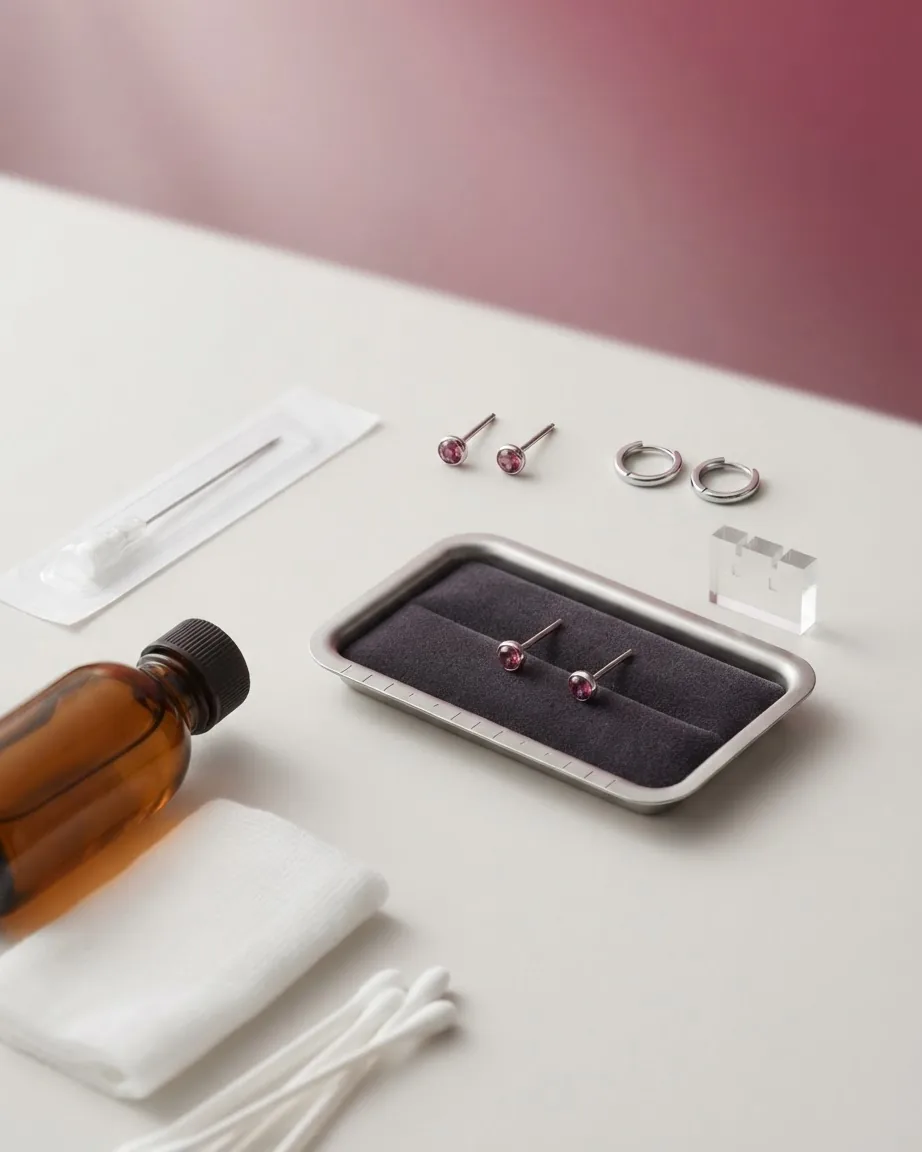
The second hole is almost always placed above the first, stacked vertically up the lobe. Both Vital Piercing and Pierced Addiction put the usual gap at 5 – 8mm above the first hole, with the piercer adjusting to your anatomy rather than measuring to a fixed rule. The gap is doing real work: too tight and two studs crowd each other, too loose and the stack reads as scattered.
Lobe size changes the number. Pierced Addiction suggests 4 – 6mm for petite lobes and 6 – 8mm for fuller lobes, so a smaller ear gets tighter spacing and a larger ear gets more room. Gabriel & Co. lands on 6 – 8mm between piercings for a lobe stack, framing that gap as room that helps limit migration and leaves space to layer rings comfortably.
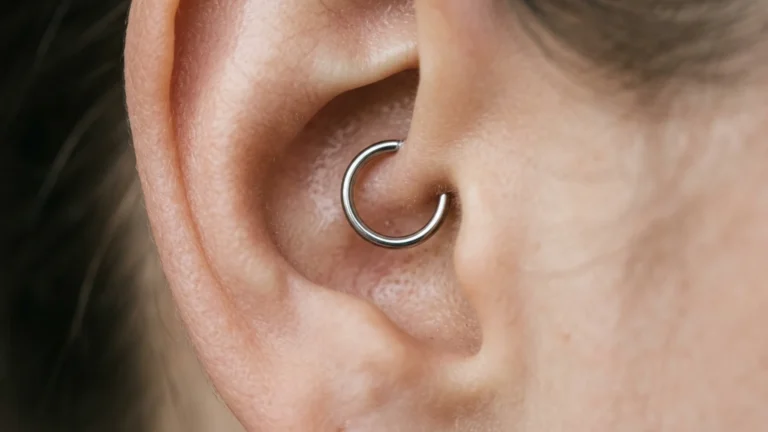
The ceiling on placement is anatomical. Push the second hole too high and it can reach the point where the soft lobe begins to stiffen into cartilage. Vital Piercing flags that transitional zone as a genuine hazard, because a hole landing there behaves less like a lobe piercing and more like a cartilage one – slower, more painful, more prone to problems. A piercer marking the spot is reading the edge of your soft tissue, not applying a template. If you are weighing where the whole stack goes, see also our second lobe hole guide.
How much a double lobe piercing costs
According to Byrdie, a double ear piercing runs about $50 – $100 for the pair, while a single piercing generally sits at $25 – $50. That figure is for the service. Jewelry is usually priced on top, and implant-grade or solid-gold pieces cost more than entry studs, so the walk-out total depends heavily on what you leave the shop wearing.
Two practical points hide inside that range. First, doing both ears at once is not simply double the single price in most studios – the pairing is what the $50 – $100 figure describes. Second, a lower quoted price often signals the jewelry, the sterilization method, or both, which matters more for a healing wound than the headline cost. The sections below on metal and aftercare are where that difference shows up.
Does a second lobe hurt more than the first?
Not meaningfully. A piercer quoted by Byrdie rated double lobe pain at about 3 out of 10. The lobe is soft, fleshy tissue with no cartilage to force through, which keeps it among the gentlest placements on the ear. A second hole in that same tissue feels much like the first – a quick pinch, over fast.
The comparison that actually changes the number is lobe versus cartilage. A helix, tragus, conch, or daith sits in firm cartilage and both hurts more going in and heals on a far longer timeline, which is exactly why the transitional-zone warning above carries weight: a lobe hole that strays into cartilage trades a 3-out-of-10 experience for something harder. For a placement-by-placement read, see also our ear piercing pain chart, and for where a second lobe lands on the broader map of ear piercings.
One sitting or two: getting both lobes pierced at once
Piercing both ears in a single appointment is common and reasonable for lobes. Gabriel & Co. advises keeping multiple lobe piercings in one session to 2 – 3 at a time, on the logic that the body’s healing resources are finite and spreading too many fresh wounds thins out recovery for all of them.
The real limiter is sleep. Vital Piercing identifies side-sleeping on a fresh piercing as the most common cause of irritation bumps in the first month. Pierce both ears and you remove the escape route of rolling onto the unpierced side. That is the trade-off to decide in advance: symmetry and one healing window against a month with no comfortable side to sleep on.
When to add the next piercing is the easier call. Wait until the current holes have healed before stacking another above them – layering a new wound onto tissue still recovering stretches everything out and raises the odds of irritation. A healed lobe stack is the starting point for the next one, not a half-healed one.
Healing a second lobe: surface time versus the channel
Here the sources look like they disagree, and the disagreement is worth resolving rather than averaging. Byrdie puts double piercings at about six to eight weeks, and Pierced Addiction agrees that lobes heal faster than cartilage, most within 6-8 weeks. Vital Piercing gives a longer second-lobe average of 2 to 3 months.
The gap is one of definition. The 6 to 8 weeks describes surface healing – the point at which the outside looks settled and a jewelry change becomes reasonable. The 2 to 3 months describes the channel underneath finishing its internal healing, which runs behind the surface. Both can be right at once. The practical takeaway: treat 6 to 8 weeks as the earliest window, not a finish line, and handle the piercing gently well past it.
Context from the rest of the ear sharpens this. Monica Vinader notes an ear piercing can take anywhere from 6 weeks to 12 months depending on placement, with lobes recovering in roughly 6 to 8 weeks and daith, conch, helix, and tragus taking 6 to 12 months. A second lobe sits at the fast end of that spread – which is the upside of keeping it in soft tissue and off the cartilage line.
Flat-back studs, butterfly backs, and metal that won’t react
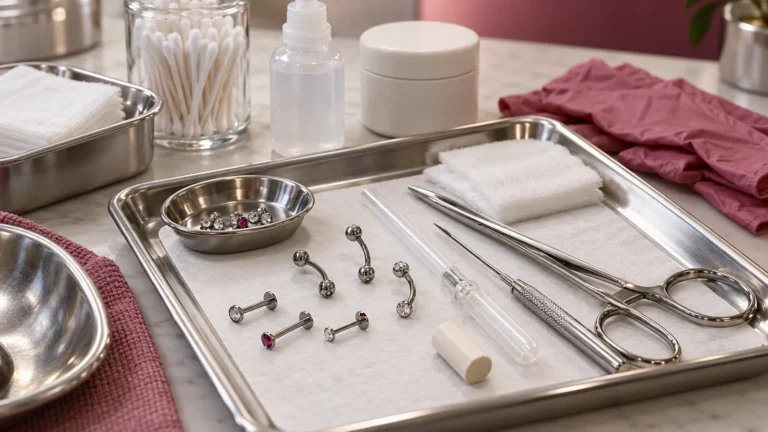
The back of the jewelry matters more than most people expect. Vital Piercing points out that butterfly backs can be effectively swallowed when skin grows over a back pushed in too tight, and that flat-back labret studs avoid the problem. For a healing lobe, a flat-back design sits flush against the skin with a smooth disc behind the ear, which is why piercers reach for it on fresh work. A piercer also sizes the post length and gauge to your lobe, so the jewelry sits without pressing or snagging.
Allergen warning
Metal choice is where “hypoallergenic” gets misused. Vital Piercing is blunt that all 316L stainless steel contains nickel as part of the alloy, so it should never be labeled hypoallergenic. Nickel is the most common contact allergen in jewelry, and a fresh wound is the worst place to test your tolerance. Implant-grade pieces exist precisely to minimize that exposure.
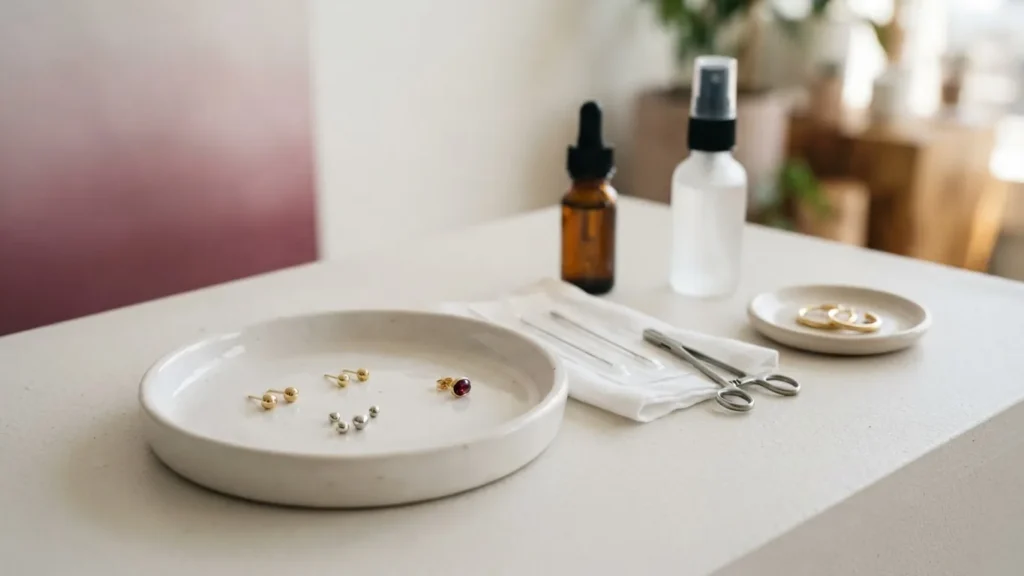
Gold carries its own caveat. A dermatologist cited by Byrdie recommends gold above 14 karat – 18 karat specifically – on the reasoning that lower-purity gold can harbor harmful bacteria, and adds that white gold can contain nickel. So “it’s gold” is not automatically a safe answer for a healing piercing; karat and color both change the picture. Once you are healed and styling the stack, our double piercing earrings guide is the natural next stop.
Saline, swimming, and sleeping through the first weeks
The Association of Professional Piercers keeps aftercare narrow on purpose. APP advises that sterile saline list 0.9% sodium chloride as the only ingredient, and warns off contact lens saline, nasal spray, and eye drops, which carry additives a piercing does not need. APP also no longer recommends mixing your own sea salt solution, because homemade mixes are commonly too strong and can over-dry the piercing and interfere with healing. Twice-daily cleaning with the right saline covers most of the job.
Swimming is where sources set different windows, and the safe move is the stricter one. Monica Vinader advises not swimming in the sea or chlorine water for 4 weeks after a piercing. Pierced Addiction goes further, telling people to wait until fully healed, 6-8 weeks minimum, before swimming. Pools, lakes, and the sea all introduce bacteria into an open channel, so holding out until the longer mark has passed costs you nothing and removes a real infection route.
Sleep is the other daily battle. APP suggests placing a travel pillow on top of your regular pillow and resting the ear in the opening, so the fresh piercing bears no direct pressure – a simple fix for the side-sleeping irritation that drives first-month bumps. Keep bedding clean, and give the pierced side as little contact as the arrangement allows.
Normal lymph versus the signs you should not wait on
Knowing what is normal keeps you from panicking over healing and from ignoring a real problem. Vital Piercing describes clear-to-yellow discharge, which is lymph, and light crusting as normal during lobe healing. That thin fluid dries into the small crusts you clean away with saline. It is expected, not a warning.
The warning signs are different in character. Yellow or green pus, spreading redness in streaks away from the piercing, a hot throbbing lobe, fever, or pain that worsens after the first week are, per Vital Piercing, reasons to contact a piercer or a doctor. Those point toward infection rather than ordinary healing. This is general guidance, not a diagnosis – if a second lobe looks or feels wrong, have your piercer or a healthcare professional examine it in person rather than waiting it out or self-treating.
Changing the jewelry: why the first year is the rule
The reflex to swap jewelry early is the one worth resisting. Vital Piercing notes that lobes can close fast – sometimes within hours, especially in the first year – which is why jewelry should stay in continuously, 24/7, for at least that first year. A fresh channel left empty even briefly can shrink enough to make reinsertion painful or impossible.
Timing a change means separating “looks healed” from “is healed.” Surface healing at 6 to 8 weeks is the earliest point a careful change makes sense; the 2 to 3 months of internal healing is the more conservative mark, and erring toward the longer figure protects the channel. When you do switch, do it clean, with a smooth implant-grade or high-karat piece, and insert without forcing. If anything resists, the hole is telling you it is not ready – not that you need to push harder. Through the first year, “keep something in it” is the rule that prevents the most avoidable loss: a hole that closed because it sat empty for an afternoon.
Can you get a second lobe pierced with a gun?
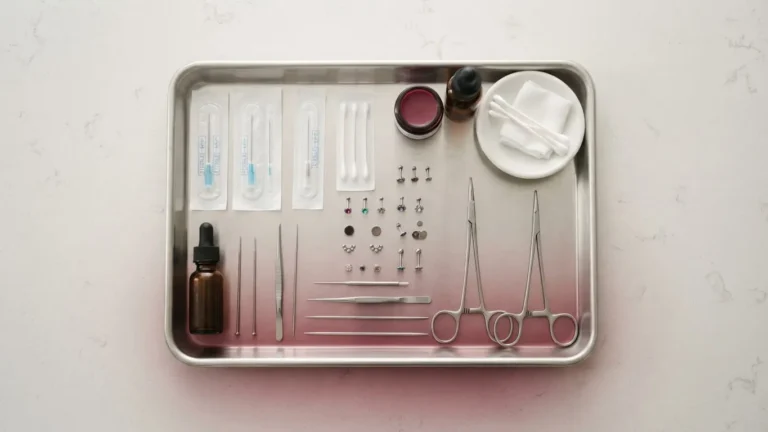
A studio piercer uses a sterile, single-use needle, which cuts a clean channel and can be fully disposed of afterward. Spring-loaded devices are harder to sterilize between clients and force the tissue rather than cutting it. If a shop offers only a gun, that alone is reason to look elsewhere. The mechanics are covered in our piercing needle guide, and your piercer can walk you through their method.
Should I skip caffeine or painkillers before the appointment?
It can help. Monica Vinader notes that alcohol and tablets such as aspirin and ibuprofen may thin the blood and affect how much a piercing bleeds, and that caffeine can have a similar effect. None of these are hard bans, but easing off them beforehand can mean a tidier piercing and less oozing on day one. If you take blood-thinning medication regularly, raise it with your piercer rather than stopping anything on your own.
The real aftercare commitment: 84 – 112 saline cleanings
Twice-daily saline sounds light until you run it across the whole surface-healing window.
- By week 6 (earliest window): 2 × 6 × 7 = 84 saline cleanings
- By week 8 (far end): 2 × 8 × 7 = 112 saline cleanings
So the honest figure is roughly 84 to 112 cleanings per hole just to clear surface healing. Pierce both ears in one sitting and you double that commitment across two wounds at once. And note the ceiling: these numbers only cover the surface. The channel underneath runs 2 to 3 months, so 6 – 8 weeks – and the 84 – 112 cleanings that span it – is the earliest point to ease off, not the finish line.