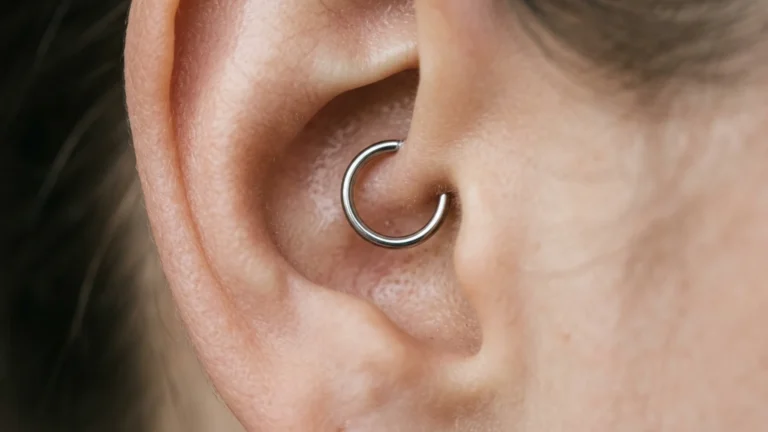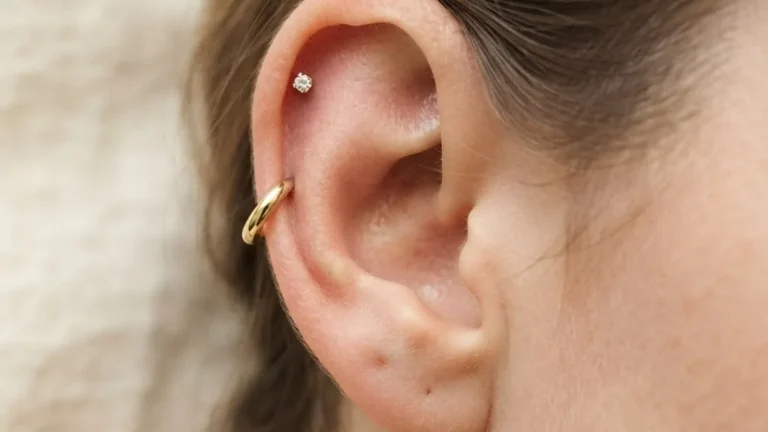
The confusion starts with the name. A flat helix piercing and a “flat piercing” are the same placement under two labels: the broad, flat plane of upper-ear cartilage that sits inboard of the outer rim. Laura Bond and the professional piercer behind ipricku call it a flat helix; Rowan and FreshTrends call it a flat. A standard helix, by contrast, runs through the curved outer edge of the ear. These are competing naming conventions, not three separate piercings, and knowing that lets a reader walk into a studio and ask for the exact spot they want rather than the one the counter guesses at.
That distinction matters because the flat plane behaves differently from the rim during healing, and because cartilage anywhere in the upper ear carries risks a lobe does not. What follows pulls the numbers, the jewelry standards, and the medical red flags into one place.
Quick answer: A flat helix piercing passes through the flat upper cartilage shelf of the ear, not the outer rim. Pain rates around 4 out of 10, per Laura Bond, though this varies by person. Healing runs long because cartilage has little blood supply; reported ranges span 4 to 12 months depending on the source. A piercer uses a flatback stud, places a longer bar first to allow for swelling, then downsizes after roughly one week. Clean twice to three times daily. Expect the procedure fee to run $40 to $80, jewelry separate. See a professional for any sign of infection.
Flat helix versus standard helix versus the “flat”: reconciling the names
Studs defines the flat helix by its location: the flat section of cartilage in the upper ear, distinct from the rolled outer rim where a conventional helix lives. The ipricku piercer draws the same line, treating the flat as its own placement on the interior shelf and the helix as the outer edge.
Where retailers diverge is only the word. Rowan and FreshTrends drop “helix” and simply write “flat.” The anatomy they describe is identical. So if a shop quotes you a “flat” and you came in asking for a “flat helix,” you are talking about the same hole in the same cartilage. The one real difference to hold onto: a standard helix on the outer rim and a flat on the inner shelf are different placements with different fits, so specify the plane you want.
For the wider map of upper-ear placements, see our ear piercings section. Readers weighing two holes at once may also want the double helix piercing breakdown.
Where a flat helix sits and whether your ear can take one
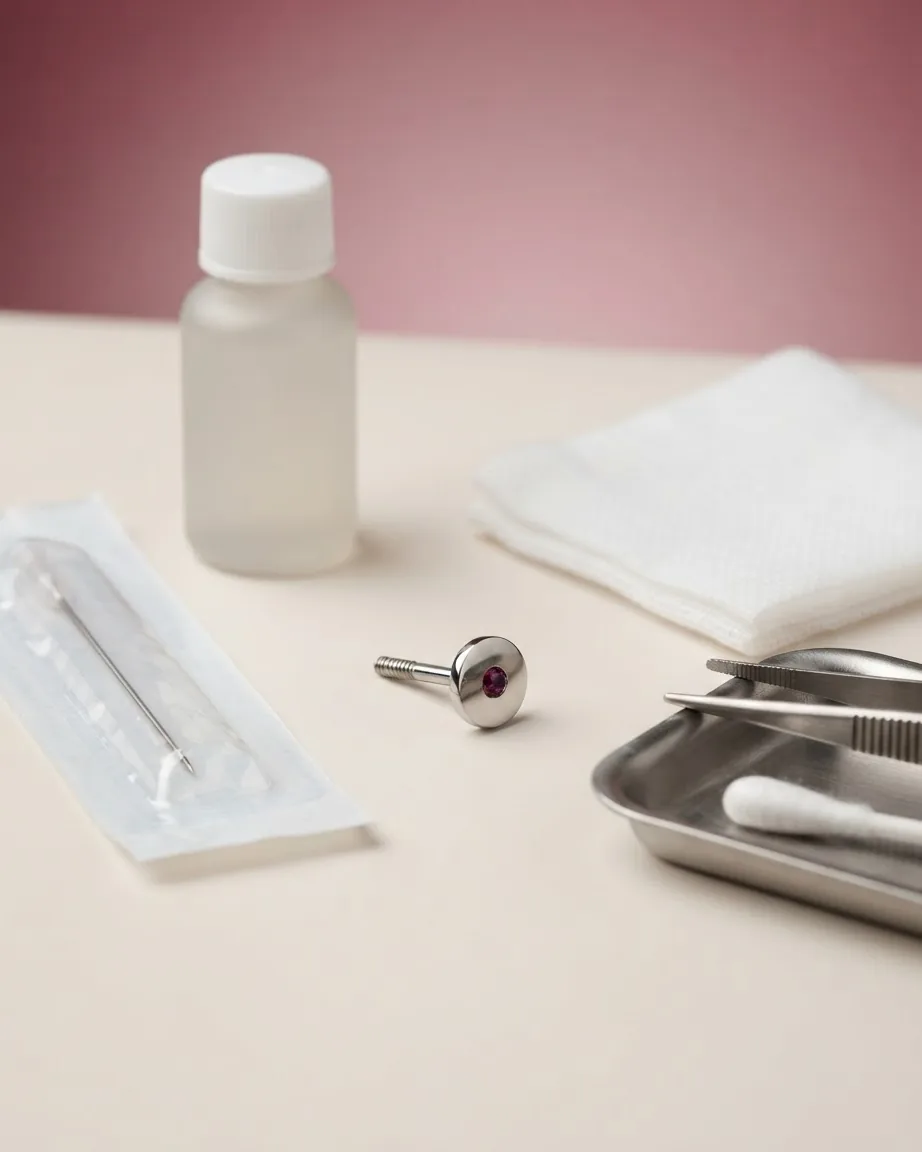
Not every ear carries a wide enough shelf. A piercer assesses whether there is enough flat cartilage surface to seat a stud cleanly and leave room for the disc on the back. If the anatomy is tight, a piercer may steer you toward the rim or another placement entirely.
This is an in-person judgment. No online guide can confirm your ear is a candidate, and a reputable piercer will tell you on the spot if it is not. For a related inner-cartilage placement that also lives on a flat plane, our faux rook piercing guide covers a different shelf of the same ear.
Why a flat helix piercing takes months to heal when your lobe did not
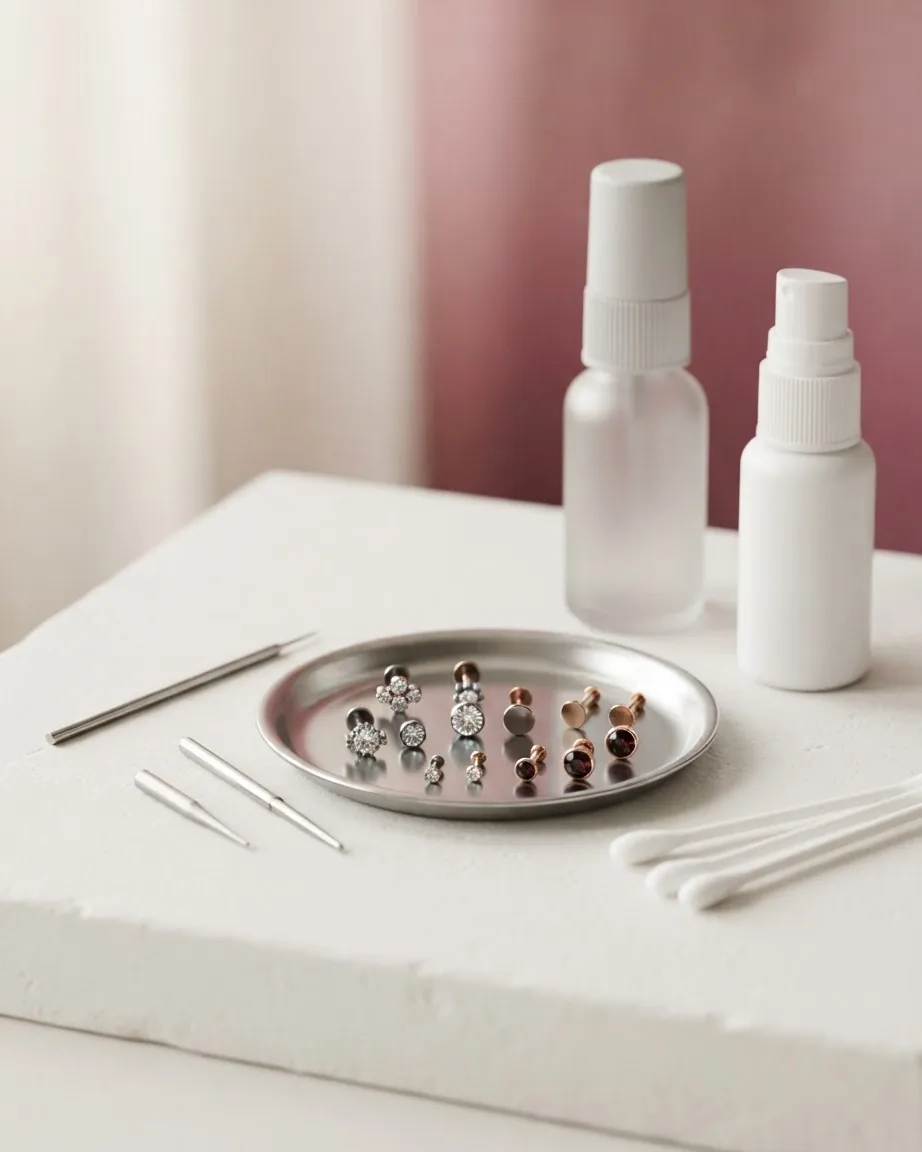
A lobe is soft tissue with a steady blood supply, so it closes fast. Cartilage is avascular, meaning blood barely reaches it. The flat helix piercing sits in that low-flow tissue, and the cells that rebuild the channel get their oxygen and immune support slowly. That single physiological fact, not studio preference, is why the timeline stretches across most of a year.
The reported ranges do not agree, and the honest move is to show them rather than average them. Laura Bond’s flat-helix page is reported two ways in our sourcing: one record shows no duration figure on that page, and another shows the page stating a flat helix “can take anywhere between 4-12 months to fully heal,” varying by person. We keep both as reported and do not resolve which is correct.
Across the other sources, the spread looks like this:
- Rowan lists a standard healing time of 9-12 months.
- FreshTrends says at least 6 months, as long as 9 months to one year.
- The ipricku piercer gives 6-12 months, noting it can run longer if you sleep on it or wear tight headphones, and in a second place frames it as 6-12 months depending on jewelry size, aftercare, and individual healing.
- Laura Bond (as reported) gives 4-12 months.
The ranges differ mainly at the low end: 4, 6, or 9 months, depending on who is counting and which population they draw from. Rather than collapse these into one number, plan for the long side. Treating the piercing as settled at 4 months because one source allows it risks disturbing a channel that is still forming. The practical takeaway: assume the back half of a year at minimum, and verify readiness with your piercer before any change.
How much a flat helix hurts next to a lobe
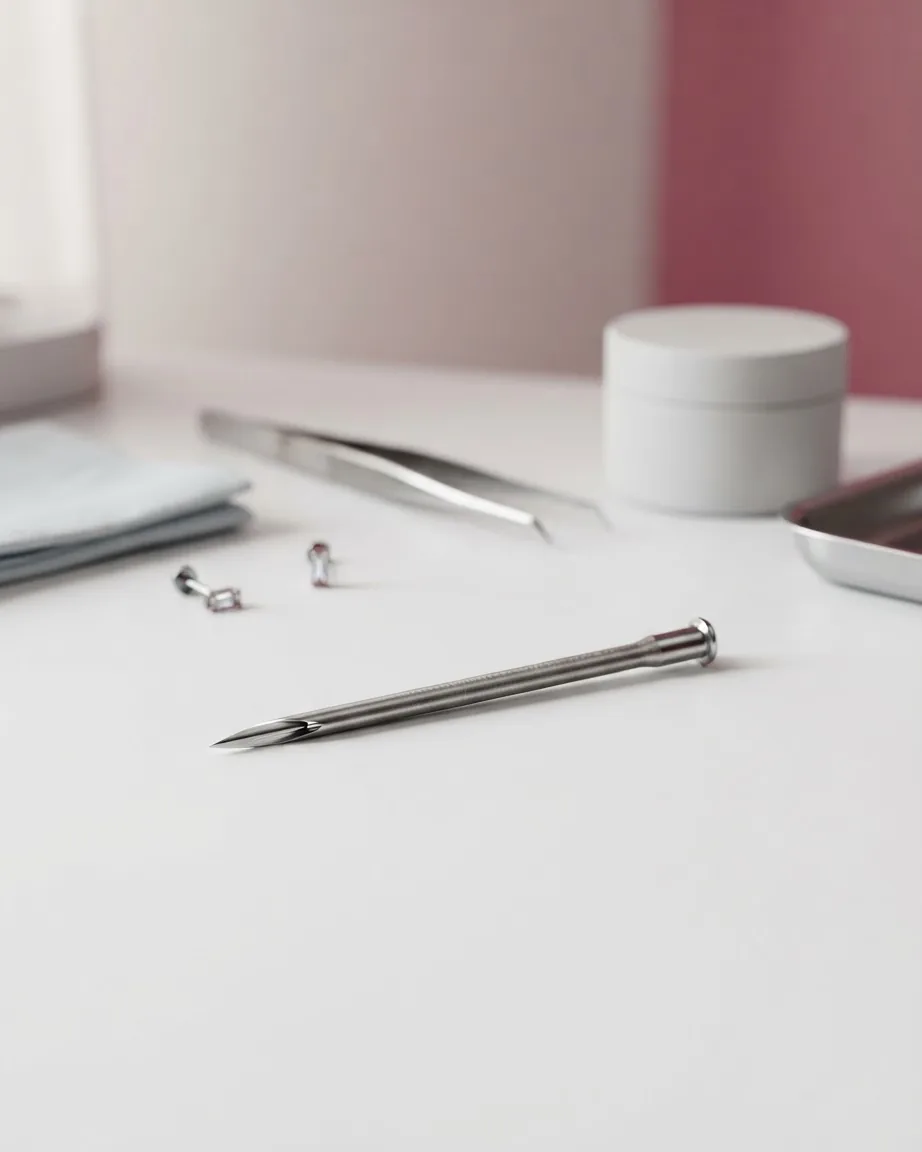
Laura Bond rates the flat helix at about 4 out of 10 on a pain scale, with the explicit caveat that it varies from person to person. A lobe, which pierces through soft tissue, sits lower than that. Cartilage resists the needle more than a lobe does, so the moment of the pass registers as firmer pressure and a sharper pinch, and the area can stay tender longer into healing than a lobe would.
Four out of ten is a single person-reported scale, not a clinical measurement, so read it as a rough guide rather than a guarantee of your own experience. If you want a sense of the stepped-up sensation of taking cartilage more than once, our vertical helix piercing guide addresses a related upper-ear placement.
Gauge, flatback studs, and the long-bar-then-downsize sequence
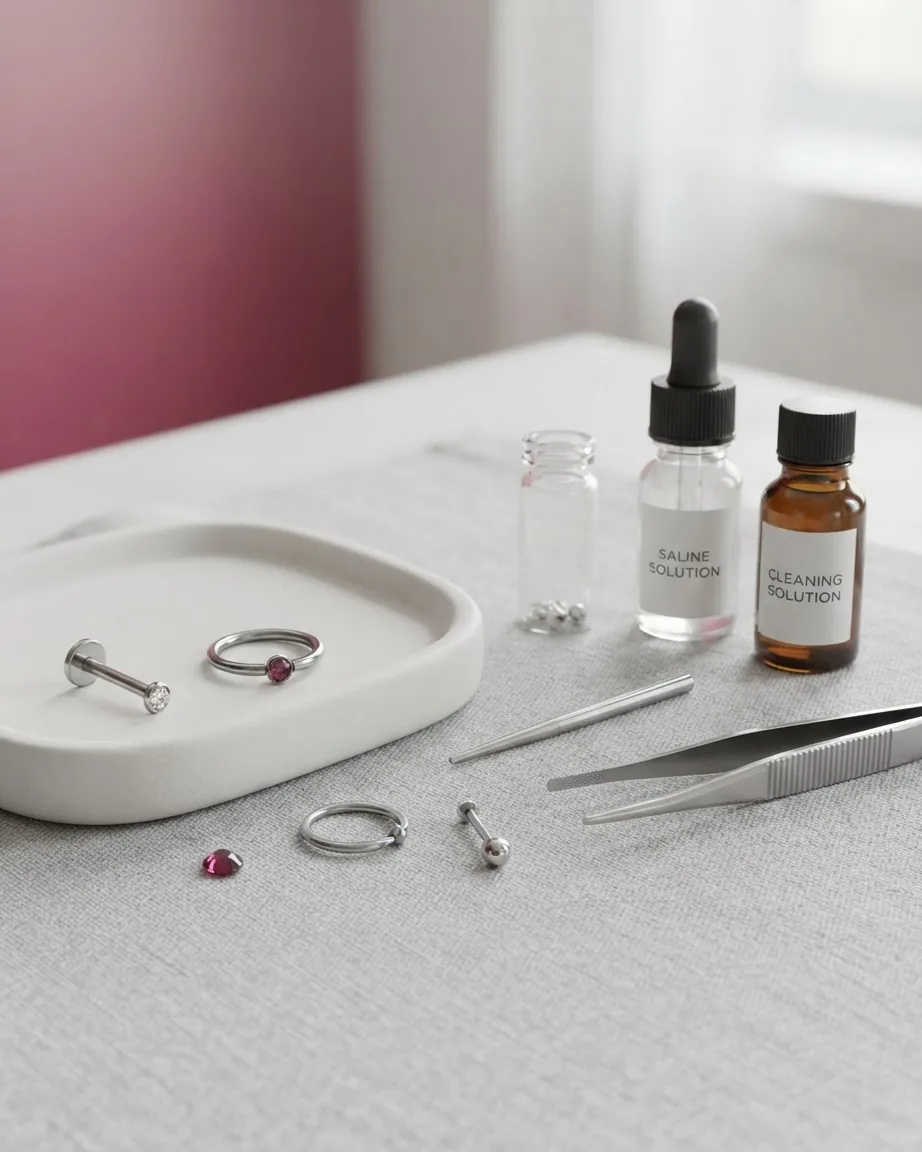
Studs describes the jewelry for this placement as a flatback stud: a post with a flat disc on the reverse that sits against the back of the ear rather than a protruding ball or butterfly clasp. The flat back is deliberate. It reduces pressure and snagging on cartilage, and it is easier to keep clean during a long heal.
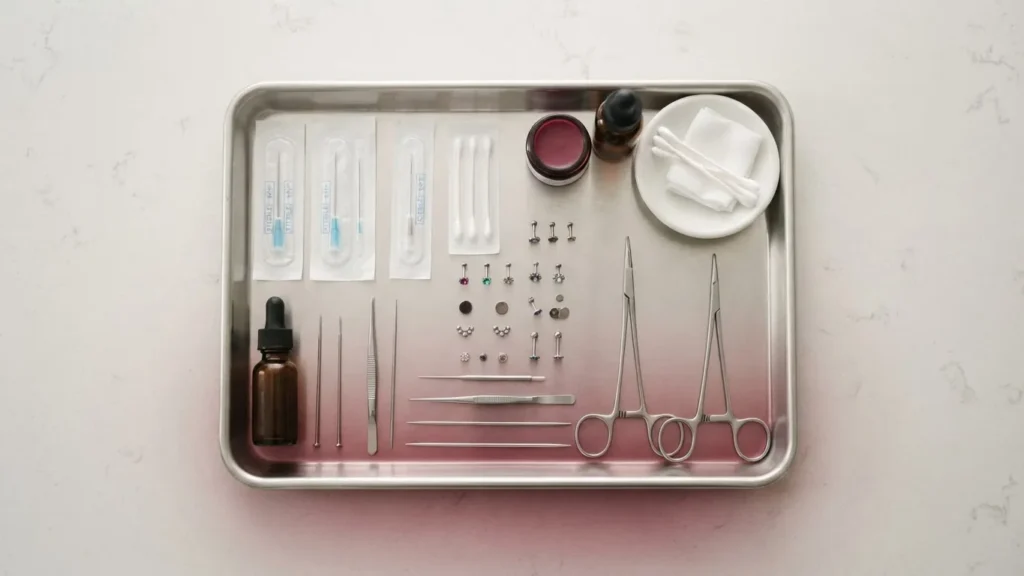
The sequence a piercer follows is the part most first-timers do not expect. FreshTrends explains that the first piece of jewelry is longer than the final fit and will only be worn for about a week before a piercer switches it out for a smaller piece. The reason is swelling. A fresh cartilage piercing puffs up, and a short bar would dig in; the extra length gives the tissue room. Once the initial swelling drops, the longer bar becomes a snagging and pressure hazard of its own, so it comes out in favor of a shorter one. That downsize is not optional fine-tuning. Skipping it can prolong irritation and encourage the piercing to migrate or bump.
Allergen warning
On the metal itself: the long healing window is exactly when a reactive material causes trouble, so a starter should be a nickel-free, body-safe metal chosen to minimize allergic response. The ipricku piercer notes a practice built on implant-grade jewelry from brands including Anatometal, Industrial Strength, BVLA, and Pupil Hall, naming over 25 years of experience behind that preference. Confirm the exact material standard with your own piercer before the procedure.
Needle versus piercing gun, and the outbreak evidence behind the warning
FreshTrends advises against a gun for this placement, and the medical record gives that advice teeth. A JAMA outbreak investigation traced a cluster of cartilage infections to a contaminated piercing gun. The confirmed cartilage infections in that investigation were linked to gun piercing.
The mechanics explain why. A gun forces a blunt stud through cartilage by pressure, crushing tissue rather than cutting a clean channel, and many guns cannot be fully sterilized between clients the way single-use needles are. Cartilage is already the riskier tissue; a gun compounds that. A single-use needle in a trained hand is the method a reader should ask for and the one to walk away without if a shop reaches for a gun.
Read the full JAMA outbreak investigation for the primary account. The onset window there, hours to three days, also doubles as an early-warning timeline worth remembering.
Aftercare: what to clean with, and the products that slow healing
The routine is simple and the discipline is the hard part over a heal this long. Rowan’s guidance is to clean the front and back of the piercing with a saline aftercare solution 2 to 3 times per day for at least 8 weeks. Saline rinses away debris without stripping the forming tissue.
The common mistake is reaching for something stronger in the belief that it cleans better. It does the opposite. Alcohol, hydrogen peroxide, and antibiotic ointments like Neosporin or Bacitracin can delay healing: the harsh agents kill the new cells the channel is trying to build, and thick ointments trap debris and block airflow to tissue that already struggles for oxygen. Gentler is not a compromise here; it is the correct choice.
A few more practical constraints during the fresh phase:
- Laura Bond advises avoiding swimming in lakes, pools, or hot tubs for 2-3 weeks while the piercing is still fresh. Standing and treated water both carry bacteria that a new cartilage channel is poorly equipped to fight.
- Sleeping on the piercing and tight headphones both press on it; the ipricku piercer flags both as reasons healing runs long.
- Laura Bond recommends a routine check-up with your piercer around 6 weeks after the procedure, which is a sensible point to confirm the downsize and spot early trouble.
None of this substitutes for professional judgment. Treat the schedule as a starting framework and defer to your piercer or a clinician on anything specific to your ear. For a broader look at cartilage-care costs, our cartilage piercing cost guide sits alongside this one.
Irritated or infected: the thresholds that mean see someone now
Early redness, mild swelling, and some tenderness are ordinary for a fresh cartilage piercing. The job is knowing when ordinary crosses into infection, because upper-ear infections can turn serious in a way lobe infections rarely do. The Cleveland Clinic states plainly that piercings in the upper ear are more likely to become infected, and that infections there are sometimes serious.
Rowan’s red-flag list gives concrete thresholds: a fever at a temperature of 100.4 °F or higher, an area warm to the touch, and extreme pain. Any one of those moves the situation out of self-care. The JAMA onset window adds a timing cue, with symptoms possible within hours to 3 days of a piercing gone wrong.
The severity data is why these thresholds deserve respect, though each figure belongs to its own population and none of them is a rate for flat helix piercings specifically. A peer-reviewed review reported through the Canadian Family Physician and PRETx work found the prevalence of infection after ear cartilage piercing significantly higher than after earlobe piercing, 41.4% versus 29.6% in a cohort of young women in Riyadh, with that difference statistically significant. The same review noted Pseudomonas in 87.2% of post-piercing perichondritis cases, with more than 90% of those patients needing hospitalization. Those are not flat-helix customers; they are specific study groups, and the numbers describe how bad a cartilage infection can get, not how likely yours is.
Separately, a general study of pierced ears cited by the Cleveland Clinic found that as many as 35% of people with pierced ears had one or more complications, including minor infection in 77%, allergic reaction in 43%, and keloid scar formation in 2.5%. These percentages use different bases and cannot be added together or turned into a single infection risk. Read the Cleveland Clinic infected ear piercing page for the full list. The practical rule stands regardless of the exact number: cartilage trouble escalates faster than lobe trouble, so err toward getting checked.
If it is infected, leave the jewelry in
The instinct when a piercing looks infected is to pull the jewelry out. Pierced advises against it, and the reasoning is sound: removing the piece can let the surface close over an active infection, sealing bacteria inside the channel where they cause an abscess instead of draining. The jewelry keeps the tract open so pus and fluid can escape.
Keep the piece in and get the infection assessed by a clinician, who can decide on treatment. Do not self-diagnose a serious upper-ear infection, and do not remove the jewelry on your own assumption that it will help. This is the point in the whole process where reaching a professional matters most.
Flat helix cost: the fee, and what it does not include
FreshTrends puts the flat piercing procedure at $40 to $80, explicitly not including the jewelry. That figure is the piercer’s service fee. The flatback stud is quoted separately, and on a cartilage placement that means a body-safe starter on top of the base price, so the checkout total runs higher than the quoted fee alone.
Budget for the metal and, where it is customary, a tip. For how upper-ear pricing adds up in practice, our how much is a helix piercing guide breaks the components apart.
When you can change a flat helix stud
The timeline for the first jewelry change is not the same as the full heal, and it is also not the one-week downsize, which a piercer performs while the channel is still raw. The first change you make yourself should wait much longer. Rowan advises waiting at least 6 months before changing the jewelry.
That 6-month floor runs well short of the 9-to-12-month full-heal figures several sources give, which is the tension to respect. A flat helix that looks healed on the surface can still be unformed inside the cartilage, and a change made too early can tear the channel and restart healing. The safe path is to confirm with your piercer at the check-up rather than guess from the mirror. Our changing an ear piercing guide covers the broader timeline.
Stacking a flat helix with other ear piercings
A flat sits on the inner shelf, which leaves the outer rim free for a helix and the surrounding cartilage open for other placements, so it curates well into a built-up ear. The order and spacing matter because each new hole is its own months-long heal. Adding a second cartilage piercing beside a flat that is still forming asks one ear to heal two avascular channels at once, which strains the tissue and the aftercare routine both.
The conservative approach is sequential: let the flat helix reach a settled, piercer-confirmed state before booking the next piece next to it, rather than stacking two fresh cartilage holes in one sitting. Spacing is an anatomy decision your piercer makes on your ear, not a measurement to copy from a photo. If the structure you are curating around is an ear that sits away from the head, the anti helix guide addresses that fold.
Is a flat helix the same as a helix piercing?
No. The outer-rim helix runs through the curled edge of the ear, while the flat variant passes through the broad interior shelf of upper cartilage. Retailers muddy this by calling the shelf placement a “flat,” dropping the word helix entirely. When booking, name the plane you want so the studio does not aim at the rim by default.
Can I use a healing ointment to speed things up?
Ointments like Neosporin or Bacitracin work against you here. They seal moisture and debris over tissue that needs airflow, and on low-blood-flow cartilage that can stall recovery. Saline rinses are the recommended choice. Alcohol and hydrogen peroxide carry the same drawback, stripping the fragile new cells a channel is building rather than protecting them.
How soon after piercing could an infection show up?
The JAMA outbreak cohort saw symptoms emerge within a few hours to three days, at a median of one day. That early window is worth marking on a calendar. If sharp pain, heat, or a temperature of 100.4 °F or higher appears in those first days, that is not routine settling, and an upper-ear infection warrants prompt professional assessment.
Why does my piercer put in a bar that looks too long?
The oversized starter is intentional swelling insurance. Fresh cartilage puffs, and a snug bar would press into inflamed tissue. The extra length gives the swelling room for roughly a week, after which the piece is swapped for a shorter one. Leaving the long bar in past that point turns it into a snagging hazard instead.
This guide compiles placement, healing, and aftercare figures from published piercer and medical sources named throughout. It is informational, not medical advice or a diagnosis, and it is no substitute for an in-person assessment. For anything on your ear that looks or feels wrong, see your piercer or a clinician.
What the 6-week check-up and 2 – 3-week swim rule mean against a 4-month minimum heal
Laura Bond’s own guidance sets two early milestones – lift the swimming ban after 2 – 3 weeks, and see your piercer for a routine check-up around 6 weeks – while giving a healing window of 4 to 12 months. Lined up against the shortest end of that window, those milestones land far earlier than they feel.
- Being cleared for the pool is not the same as being healed.
The takeaway: these early checkpoints mark the start of the heal, not the finish. Treat the channel as still forming for months after both have come and gone.