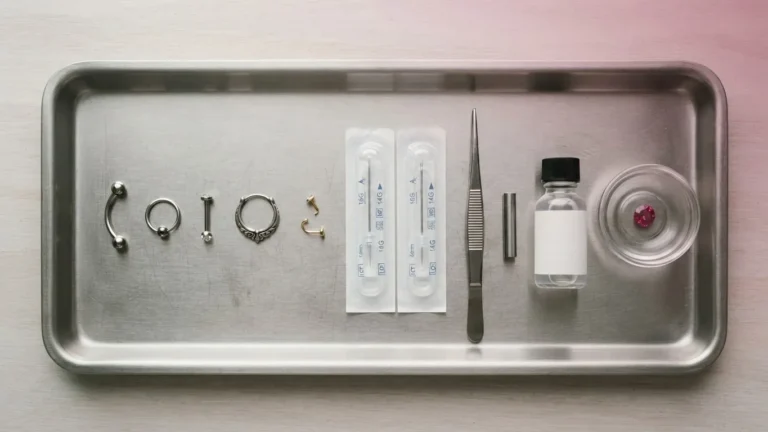
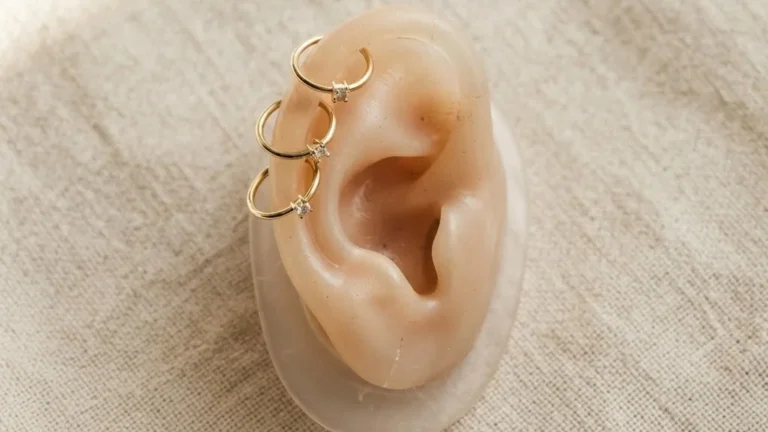
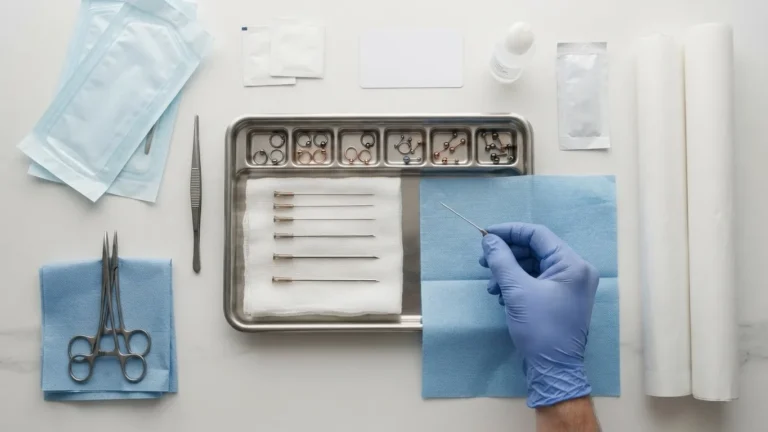
A $30 helix rarely leaves the shop at $30. That advertised figure is usually the service fee alone, and the jewelry threaded through your cartilage is billed separately. So the honest answer to how much is a helix piercing depends on which number a studio quoted you and which three it left off the window sign. This guide separates the three layers you actually pay, benchmarks double and triple totals so you can flag an outlier quote, and explains why the cheapest option at the mall is the one to walk away from.
A single helix piercing service fee and starting jewelry are billed as separate layers, so the all-in total depends on which pieces you choose. Tipping is encouraged but not required, with 20 percent treated as the norm. Expect a pain level near 4 to 6 out of 10 during the procedure and a 6-to-9-month healing window before the piercing is settled.
Why a “$30 helix” costs more at the register
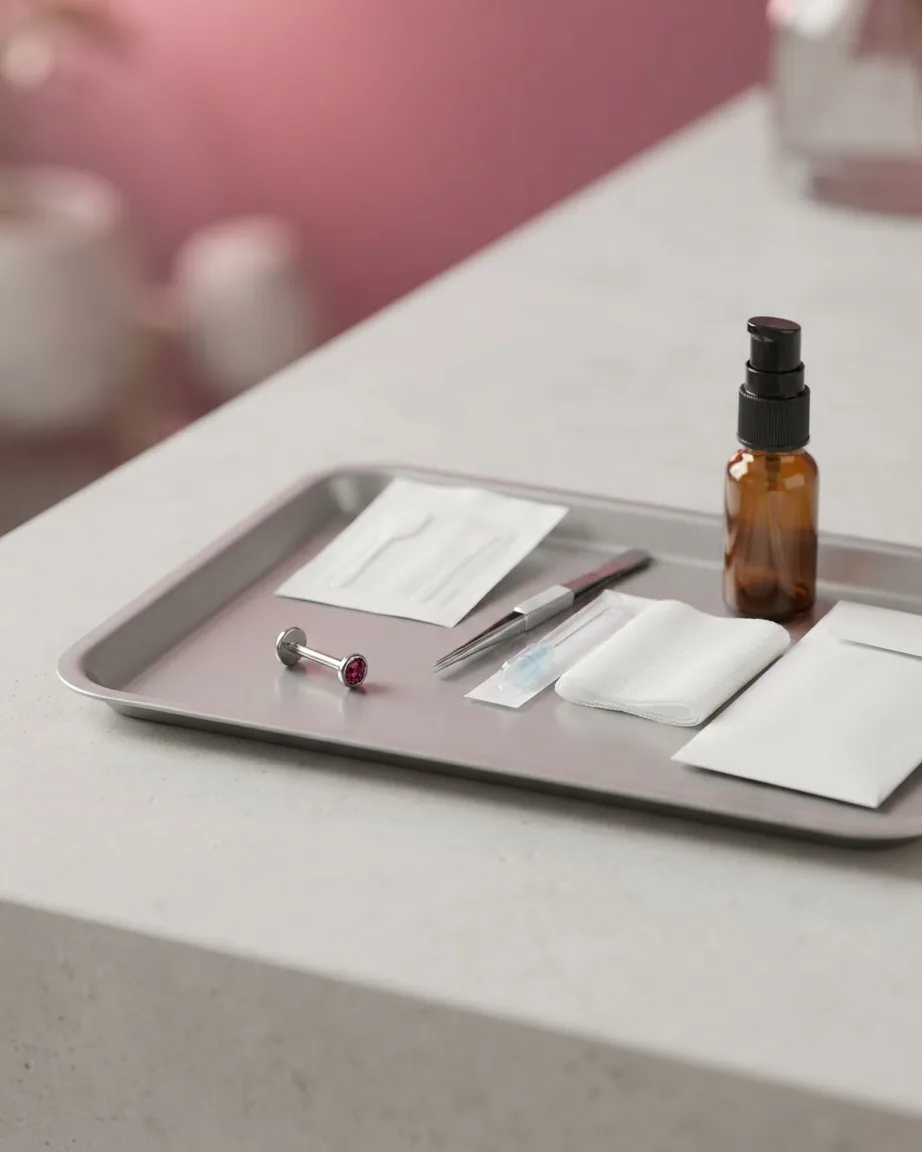
The sticker shock at checkout comes from how studios itemize. The service fee covers the piercer’s labor and the sterile setup. The jewelry is a second line. The tip is a third. A single studio page rarely shows all three stacked, which is how a reader walks in expecting one number and leaves having paid another.
Somatic Body Piercing lays out its service fee and starting jewelry cleanly on its published price list, with the jewelry billed as its own line. That starting figure is the floor, not the ceiling. It assumes you take the basic piece the fee includes and nothing fancier.
FreshTrends frames the same spread differently. Its helix guide describes the piercing service at $30 to $75 on its own, then estimates most people spend around $40 to $50 all told. A working piercer answering a question on r/piercing itemized the cost into a piercing fee against a post and a basic titanium dome, reaching a higher total once jewelry was included per piercing. Same placement, three cost bases, no single comparable “price.”
These are not contradictions to resolve so much as different accounting. One figure is fee-only. One is a spend estimate. One is a firm all-in. Before you compare two studios, ask which basis each quote uses, because a fee-only number and an all-in number can describe the identical appointment.
Single, double, and triple helix pricing you can benchmark

Stacking piercings multiplies both fees and jewelry, and studios scale those totals in ways you can check against each other. Having a benchmark in hand is what lets you spot a quote that drifts well above the pack and ask for a line-item breakdown.
At Piercer Tiffany’s studio, the tiers are flat and easy to read on the piercing price list: a single helix is $50, a pair or double is $75, three is $100, and four is $125. Those are among the lower all-in figures you will find, which is worth noting when another shop quotes far more.
Impuria’s double helix guide gives a wider market range, $80 to $160, because two piercings and two pieces of jewelry are in play. A professional on r/piercing quoted a firmer structure from inside a working shop, with jewelry included.
These figures diverge because the bases diverge, one is a studio’s own rate, one is a market estimate, and they are not directly comparable. The practical takeaway: if a shop quotes you an unusually high number for a plain double with basic titanium, the number itself is your cue to ask what the jewelry costs and whether the fee includes a multi-piercing discount.
The three-layer cost model, service fee plus starting jewelry plus optional tip or upgrade, is the tool to carry into any consultation. It turns an opaque quote into something you can audit on the spot.
Forward helix: a different placement with a different price
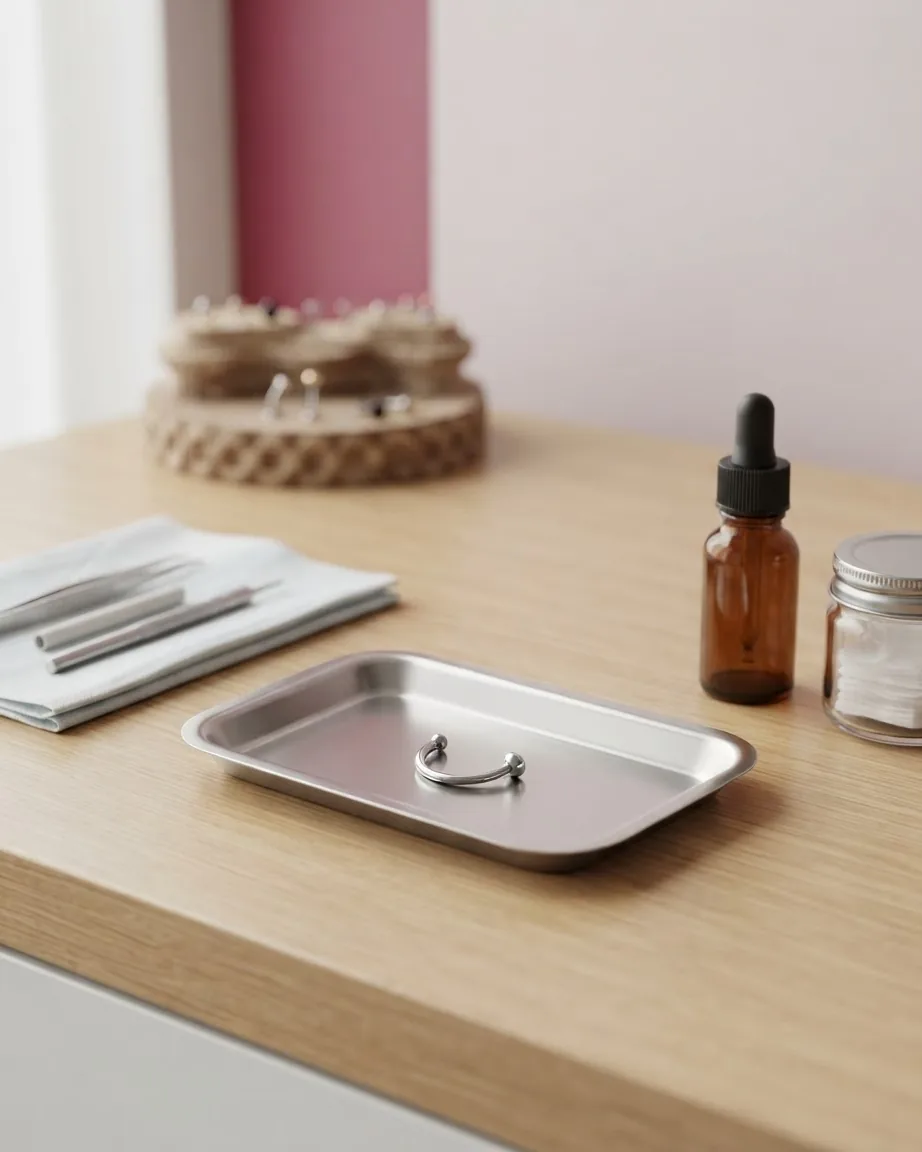
The forward helix sits at the front edge of the ear near the face, not along the outer rim, and studios price it as its own service. Do not assume it matches a standard helix.
Somatic’s price list puts a forward helix noticeably above its standard helix. The gap is almost entirely jewelry, not labor. Live By The Sword Tattoo prices a forward-helix-level piercing at $40 on its piercing price guide, with standard hypoallergenic surgical steel jewelry included and upgrades available on top.
That difference, a higher starting total at one shop versus $40 jewelry-inclusive at another, shows that the single biggest driver of price across placements is the jewelry, not the piercer’s time. When you compare forward helix quotes, pin down whether jewelry is bundled or billed separately before you decide which studio is cheaper.
Where the jewelry upgrade does the real damage
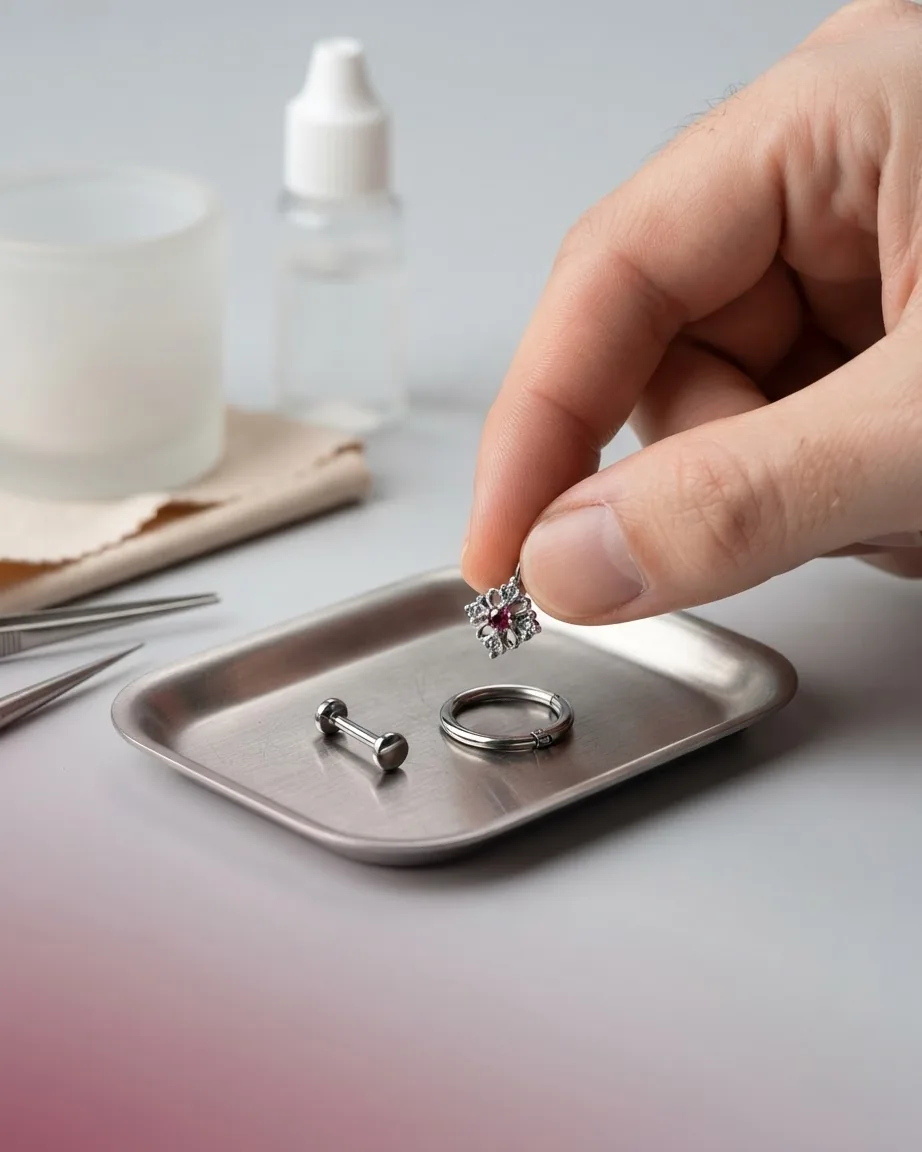
The starting jewelry a fee includes is usually basic titanium or surgical steel. Swap in a decorative end and the total can climb past anything the service fee suggested.
A clear example comes from r/piercing, where one person logged a single helix with a piercing fee, a yellow-gold Dior end, and a tip, landing at a far higher figure for one piercing. Nearly every dollar of the jump is jewelry and gratuity, not the hole itself.
Infinite Body Piercing’s piercing services page shows the same split in its bundled listing: an ear lobe and outer helix pair starts at a $45 service fee and $32 jewelry, for a $77 starting total before tax. “Starting” is the operative word, since upgraded ends move that figure up.
If budget is the constraint, take the included basic piece now and change to a designer end once the piercing has healed. You pay the labor once; the jewelry you can upgrade later without paying for another procedure.
Multi-piercing discounts and when tipping applies
Booking more than one piercing in a single sitting can shave the per-service cost, and the saving lives in the fee, not the jewelry. Where a client books more than one piercing in a single sitting, Infinite Body Piercing takes $10 off each service fee. On a two-piercing visit that is $20 back before you have chosen any ends.
Tipping is a separate layer that neither the fee nor the jewelry includes. Infinite Body Piercing describes a tip as encouraged but not required, with 20 percent treated as standard, the same convention as other service industries. The amount scales with your total, so a larger bill means a larger tip. Budget for it as its own line so the number at the counter does not surprise you.
- Service fee: the piercer’s labor and sterile setup, often $30 to $50, and the layer a same-sitting discount touches.
- Starting jewelry: basic titanium or steel, and one of the main reasons placements and studios differ on price.
- Tip and upgrades: 20 percent is standard for the tip, and a decorative end can add well over $100 on its own.
Why the $20 gun piercing is the costliest choice
A mall counter with a piercing gun will almost always beat a studio on price. FreshTrends notes a gun piercing would likely run around $20, then tells readers in plain terms not to do it for a helix. The reason is not snobbery; it is the tissue.
The Association of Professional Piercers draws a hard line. Its position on piercing guns states that APP members may not use reusable ear piercing guns for any type of piercing procedure, citing sterility and tissue damage. On cartilage specifically, the APP documents that serious complications including auricular chondritis, shattered cartilage, and excessive scarring are common when a gun is used on structural tissue. A gun crushes a blunt stud through cartilage rather than cleanly removing a channel, and cartilage does not forgive that the way a lobe can.
The site’s editorial desk compiles aftercare and method guidance from these published professional standards rather than from any single shop’s house policy, which is why the needle-over-gun call is consistent across sources. The $20 you save up front is dwarfed by the cost of correcting shattered cartilage or a chondritis infection. For the wider picture on fees versus jewelry across placements, see our pain cost section, and for a broader view on cartilage piercing cost.
What the price buys: 6 to 9 months of healing and real infection risk
Cost is only half the decision. The other half is the commitment you take on, because a helix is cartilage and cartilage heals slowly and reacts badly to shortcuts.
Pierced Addiction’s helix pain and healing guide puts the procedure pain at 4 to 6 out of 10 and the healing window at 6 to 9 months, during which the cartilage stays reactive to pressure and trauma. For contrast, the same source puts lobe healing at 6 to 8 weeks with minimal soreness. Tenderness after a helix typically lasts 2 to 4 weeks, with occasional sensitivity up to 3 months.
Healing figures do vary by source. FreshTrends states cartilage heals slower than the lobe, in the 6-to-12-month range. Impuria puts a double helix at 6 to 12 months. Treat the number as a band, not a point: somewhere from about 6 to 12 months, assume the channel inside is still fragile even when the outside looks fine.
The risk side carries weight too. Cleveland Clinic’s guidance on an infected ear piercing notes that piercings in the upper ear are more likely to become infected, and that infections there are sometimes serious because cartilage has less blood flow. The same source reports that in one study, as many as 35 percent of people with pierced ears had one or more complications. None of this is a reason to avoid a helix; it is a reason to pay for a competent piercer rather than the cheapest hole available, and to see your piercer or a clinician promptly if anything looks wrong.
Jewelry gauge and the saline soak your total should cover
The care that protects your spend costs almost nothing but matters more than the end you chose. Getting the gauge and the soak right is what carries any piercing through to a healed one, regardless of what you paid.
Impuria lists hoops as a common pick for a double helix, typically pierced at 16G by professionals, and names 16G as the recommended gauge. FreshTrends describes a saline soak in which a saline-soaked cotton ball is held still against the piercing for the 3 to 5 minutes of the soak. These are supporting standards, not a treatment plan, and nothing here replaces a conversation with your piercer.
Changing the jewelry too early is where a healthy-looking helix goes wrong. A cartilage channel can look settled outside while it is still open inside, so the general rule is to leave the first piece in until the piercing is genuinely healed, within that 6-to-12-month band, not merely painless. For the timing specifics, see the guide on changing an ear piercing and the realistic time for cartilage piercing to heal. If redness, swelling, warmth, or discharge appears, or if pain worsens rather than fades, stop self-treating and consult a clinician.
Reading a quote line by line before you book
Walk into a consultation with the three-layer model and one question: which layer does your number include? A quote of “$30” that means fee-only and a quote of “$80” that means all-in can describe the same chair, the same titanium, and the same piercer. Ask for the service fee, the starting jewelry price, and whether a same-sitting discount applies if you are stacking piercings.
Use the benchmarks as guardrails. A single helix commonly lands within the ranges above all-in. A double sits roughly $75 to $160 depending on the studio’s basis. A triple reaches higher still with jewelry from a working piercer. A plain quote far above those, with basic titanium and no designer end, is your signal to ask what you are paying for, not a price to accept quietly.
Does the piercing fee include the jewelry?
It depends entirely on the shop. Some bundle a basic piece into the service charge; others bill every post and end separately. Live By The Sword includes standard surgical steel at $40, while Somatic lists its starter jewelry as its own line beside a separate fee. Always confirm which model a studio uses before comparing two quotes.
Is a double helix twice the cost of a single?
Not quite, and sometimes less. Piercer Tiffany charges $50 for one and $75 for a pair rather than $100, and Infinite Body Piercing knocks $10 off each service fee when you stack piercings in one visit. Two holes mean two pieces of jewelry, though, so the saving sits in the labor, not the metal.
How much more is a forward helix than a standard one?
At Somatic the forward helix starts above its standard helix, a gap driven almost wholly by the jewelry rather than the labor. Elsewhere a forward helix runs $40 with steel included. The placement itself is not dramatically harder to pierce; the jewelry choice sets the difference.
Can I pay less by getting it done with a gun?
A gun piercing may cost around $20, but it is the wrong tool for cartilage. The Association of Professional Piercers bars its members from reusable guns entirely, and gun use on cartilage is linked to chondritis and shattered tissue. The money saved is trivial next to correcting that kind of damage.
Why do healing estimates range from 6 to 12 months?
Sources measure differently and bodies vary. Pierced Addiction cites 6 to 9 months for a helix; FreshTrends and Impuria extend the band to 12. Treat the figure as a window rather than a deadline, and judge readiness by whether the channel is truly settled, not by whether it has simply stopped hurting.
What share of your bill is actually jewelry, not the piercer
Every studio in this guide splits a quote into a service fee and a jewelry line, but the window sign only ever shows one of them. Run the two studios that publish both numbers and the real driver of price jumps out: at Somatic, the forward helix is a $40 fee against $44 jewelry on an $84 starting total, which means the jewelry is 52.4% of what you hand over and the piercer’s labor is just 47.6%. Put another way, more than half of that bill is the metal, not the hole. Infinite Body’s ear-lobe-and-outer-helix pair runs a $45 fee against $32 jewelry on a $77 starting total, so there the jewelry is a smaller 41.6% of the bill. The two studios are close on labor yet land apart on how much of your money is jewelry, which is why the article’s advice to ask whether jewelry is bundled or billed separately is the single most useful question you can bring to a consultation.
- Somatic forward helix: jewelry is 52.4% of the $84 total; the piercer’s fee is only 47.6%.
- Infinite Body lobe/outer-helix pair: jewelry is 41.6% of the $77 total.
- The takeaway: when two shops quote similar fees, a swing in the jewelry’s share can decide which one is truly cheaper, so price the metal, not just the labor.