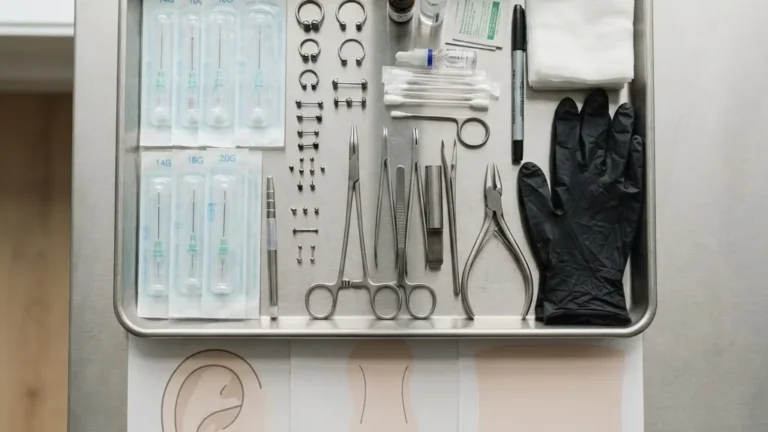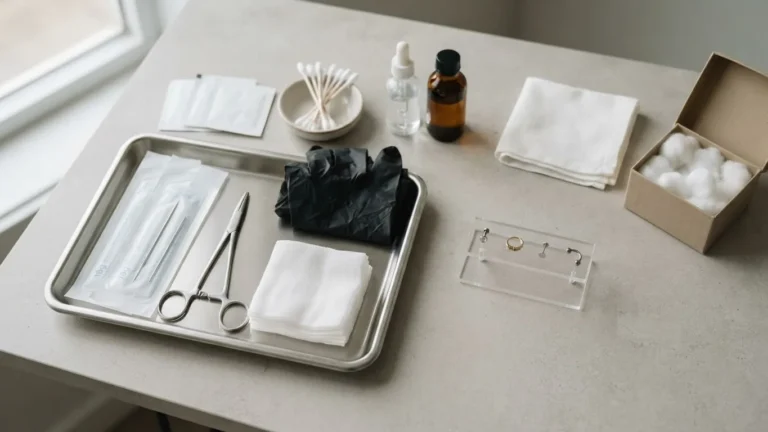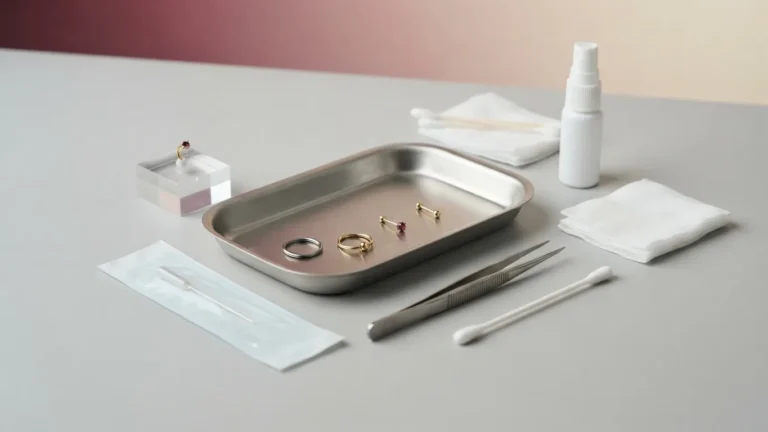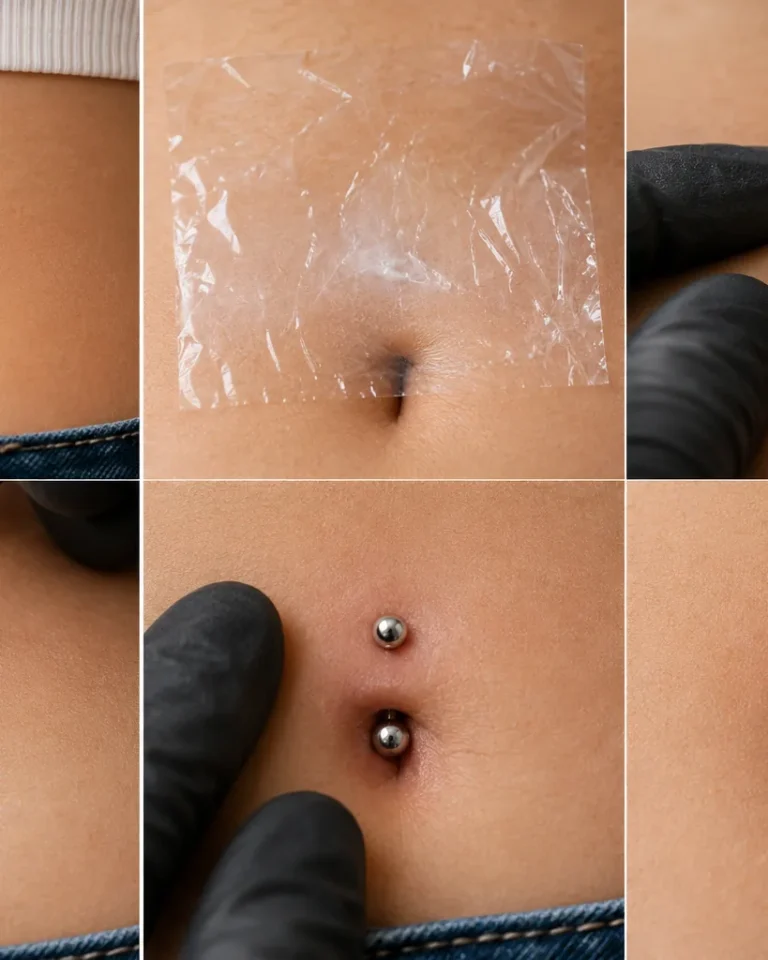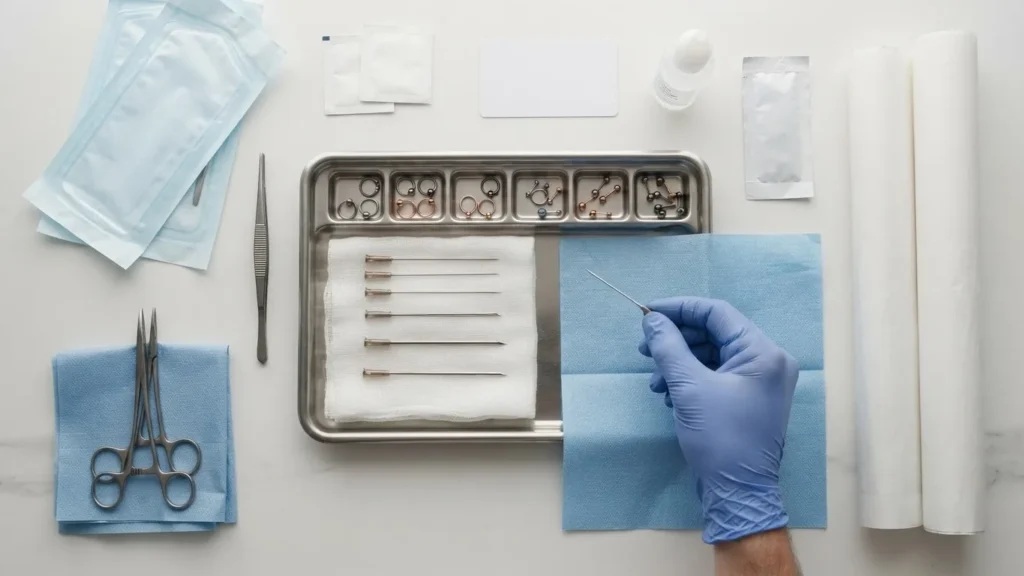
Piercing needle geometry is the reason a body piercing heals as a clean channel instead of a bruised tear. A modern piercing needle is a hollow, single-use blade with three ground bevels, and that shape does something a spring-loaded gun physically cannot: it removes a core of tissue rather than crushing skin around a blunt stud. The Association of Professional Piercers and the Mayo Clinic both point clients toward the needle for exactly that reason. Before you book, or before you make the mistake of buying a box online, here is what the tool is, how it is sized, and what the sourced numbers actually say about risk.
Quick answer: A piercing needle is a sterile, single-use hollow needle with a tri-bevel tip (point, cutting, and heel-stretching bevel) used once and dropped into a sharps container. Size is measured in gauge, where a lower number is thicker: 20G equals 0.81 mm, 18G equals 1 mm, 16G equals 1.2 mm, and 14G equals 1.6 mm. Earlobes are typically pierced at 20G or 18G, septums at 16G or 14G, and navels, nipples, and tongues at 14G. The jewelry, not the needle, sets the final hole size.
Why a hollow tri-bevel needle beats a solid stud
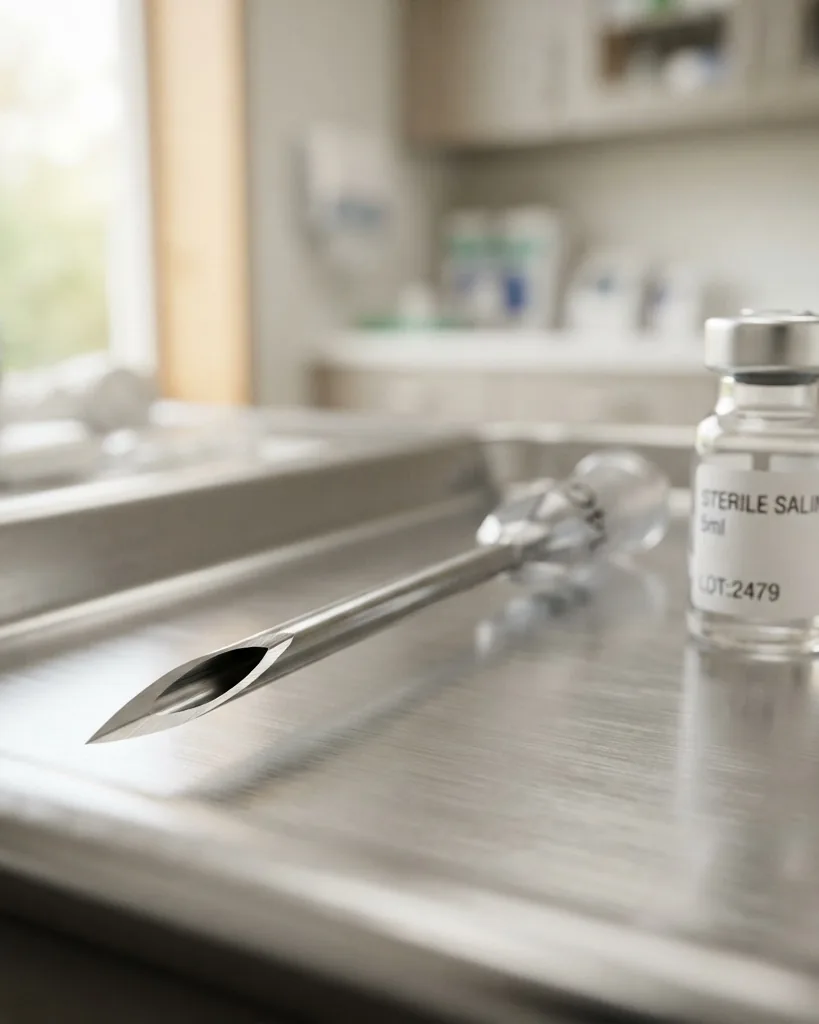
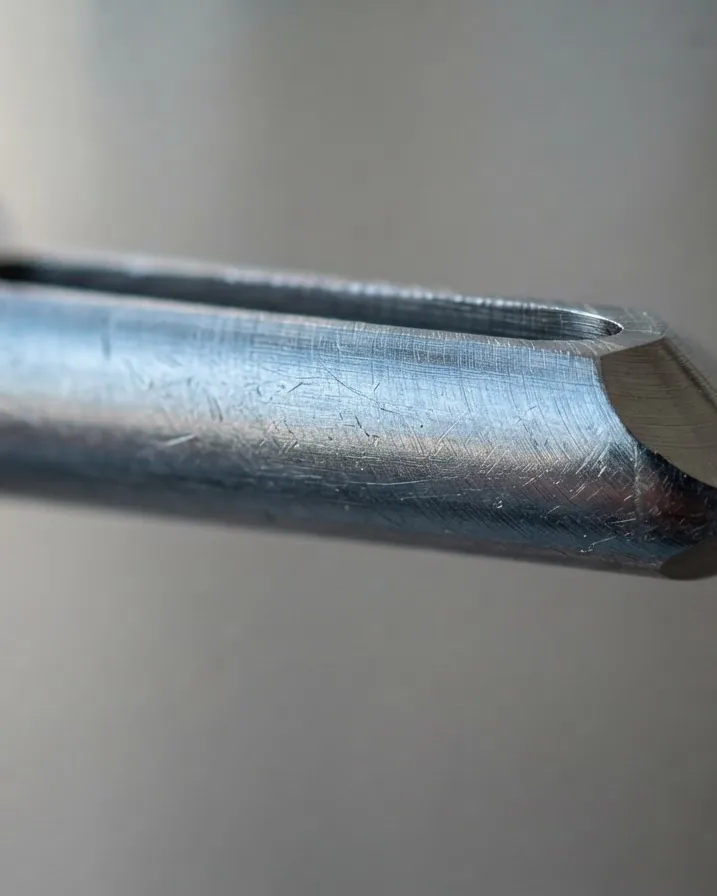
A piercing needle works by coring, not crushing. The tip carries three separate ground surfaces: a point that starts the entry, a cutting bevel that opens a clean slit, and a heel bevel that gently stretches the channel to full diameter as the shaft passes through. Because the needle is hollow, it lifts out a tiny cylinder of tissue and leaves an open fistula the exact width of the shaft.
A piercing gun, by contrast, forces a blunt stud through skin using spring pressure, tearing and compressing surrounding tissue. The tri-bevel design traces back to the 1980s and was inspired by medical hypodermic needles, and working piercers such as Lynn Loheide document the same point-to-cutting-to-heel anatomy that defines the tool today.
That geometry matters for healing. A crushed channel swells more, drains poorly, and carries a higher chance of trapping bacteria against damaged tissue. A cored channel drains cleanly along a smooth wall, which is a large part of why it heals faster and with fewer complications.
The needle also opens a passage sized for the jewelry going in behind it, so the wound and the ornament match from minute one. That match is not a small detail. A gun-pierced hole is often slightly narrower or irregular where the stud forced its way through, which is one reason so many gun piercings shift or thicken with scar tissue during healing.
The full gauge-to-millimeter chart every studio should hand you
Gauge is a diameter scale, and the counterintuitive rule is that a lower number means a thicker needle. The system descends from American Wire Gauge, where the number counts drawing passes, so a fat 10G is far wider than a slim 20G. The figures below come from a published conversion chart and cover the range you will actually encounter at a reputable studio. Memorize the four common ones and you will never be confused by a supplier listing again.
- 20G = 0.81 mm – thinnest common option, standard for delicate earlobes.
- 18G = 1 mm – the other common earlobe size, slightly more durable.
- 16G = 1.2 mm – typical for septum and many cartilage placements.
- 14G = 1.6 mm – the workhorse for navel, nipple, tongue, and heavier septum.
- 12G = 2 mm – stepping into stretched or specialty territory.
- 10G = 2.5 mm – thick gauge, well past standard first-piercing sizes.
Somatic Body Piercing publishes these diameters on its gauge conversion chart, and they line up with the sizing most piercers quote at the counter. Note the jump between steps is not linear: going from 18G to 16G looks small on paper but is a noticeably thicker needle in the hand, and the jump from 14G to 12G is bigger still. That is why a piercer will rarely move you up more than one or two gauges at a time when stretching an existing piercing later.
Matching needle gauge to the placement on your body
Placement decides gauge, and the choice is not arbitrary. Thin skin on a lobe wants a thin needle so the wound is no larger than it needs to be, while high-movement or high-load sites like a navel or nipple need a thicker shaft so jewelry does not act like a wire cutting through soft tissue.
Poli International and other supplier sizing guides converge on the same practical ranges: earlobe at 20G (0.8 mm) or 18G (1.0 mm), septum at 16G (1.2 mm) or 14G (1.6 mm), and navel, nipple, and tongue at 14G (1.6 mm). A piercer may adjust for your anatomy, but a lobe pierced at 14G or a navel pierced at 20G should make you ask questions.
Here is the short version by site:
- Earlobe: 20G (0.8 mm) or 18G (1.0 mm).
- Septum: 16G (1.2 mm) or 14G (1.6 mm).
- Navel, nipple, tongue: 14G (1.6 mm).
Cartilage sites are more varied than the list above suggests. A helix or tragus is commonly done at 18G or 16G, while an eyebrow or a labret is usually 16G. A piercer choosing a thicker gauge for cartilage is often planning for a curved barbell rather than a stud, since a slightly heavier shaft resists rotation and pressure from sleeping on that side of the head.
If you are stacking several holes at once, our guide to placement and safety for multiple ear piercings walks through how gauge and spacing interact across the ear.
Why the fistula heals to the jewelry, not the needle
The needle sets the opening, but the jewelry sets the permanent hole. A fistula, the healed tube of skin that forms the piercing channel, closes down snugly around whatever sits in it during healing. If a piercer opens you at 14G and then threads 18G jewelry, the channel heals to the thinner post and the extra room becomes a gap where the ornament shifts and drags.
That mismatch is where migration and the so-called cheese-cutter effect start: jewelry that is too thin for its wound can slowly slice outward as your body reshapes the channel around it. In practice this shows up as the piercing appearing to move closer to the edge of a lobe or the rim of an ear over weeks or months, sometimes accompanied by thinning skin on one side of the hole.
The rule is simple. Needle gauge and initial jewelry gauge should match, and only later, deliberate stretching should change the size. Stretching itself should proceed gradually, typically no more than a size or two at a time with weeks of recovery between steps, using a taper or a properly lubricated insertion pin rather than forcing a new piece straight in.
This is also why swapping metals or bar shapes early is risky. If you are healing a rook, the fit between a correctly sized curved barbell for a rook piercing and the channel it healed into matters as much as the needle that made it.
How a needle piercing is actually performed: receiving tubes and technique
Most needle piercings use a receiving tube, a small hollow guide held on the far side of the tissue that the needle passes into as it exits. The tube does two jobs: it gives the piercer a firm, controlled target so the needle travels in a straight, predictable line, and it catches the tip so it never plunges freely once it clears the skin. For a lobe or a septum, this is usually a cork or a metal receiving tube; for tighter spots like a nostril, a smaller-diameter tube is used so the exit point stays precise.
The sequence in a compliant studio runs the same way almost everywhere. The piercer marks the entry point and confirms placement with you while you look in a mirror, opens the sterile needle package in front of you, positions the receiving tube, and pushes the needle through in one continuous motion rather than several small stabs. Jewelry is threaded in immediately behind the needle, often taped or twist-connected to the needle shaft so it follows the same path with no second insertion attempt. The needle then goes straight into the sharps container.
Understanding this sequence is useful for spotting a rushed or under-trained piercer. Multiple small pushes instead of one smooth pass, no receiving tube where one is normally used, or jewelry that is inserted separately after the needle rather than following it directly are all signs of technique that increases tissue trauma beyond what the tool itself requires.
Single-use sterility: what a safe piercing needle handling looks like
A piercing needle is a one-pass tool, and anything else is a red flag. The Association of Professional Piercers sets the standard plainly: every needle must be single-use, sterile, and dropped into a medical sharps container after a single piercing, never re-sterilized or reused.
In a compliant studio the sealed, pre-sterilized needle is opened in front of you, used for one pass, and discarded immediately. Reusable tools that touch the process, such as forceps and receiving tubes, are cleaned and run through an autoclave between clients, while the needle itself is never recycled. If you cannot see the package opened, or you see a needle set aside rather than binned, walk out.
You can read the standard directly on the APP’s know your rights page for piercing clients.
Pre-sterilized also has a specific meaning. Brands like Metal Mafia sell tri-beveled needles at 2 inches long, EOS gas-sterilized, in gauges from 20G through 4G, and that gas sterilization is done before the sealed package ever reaches the studio.
Needle material and specs: what is inside the sealed package
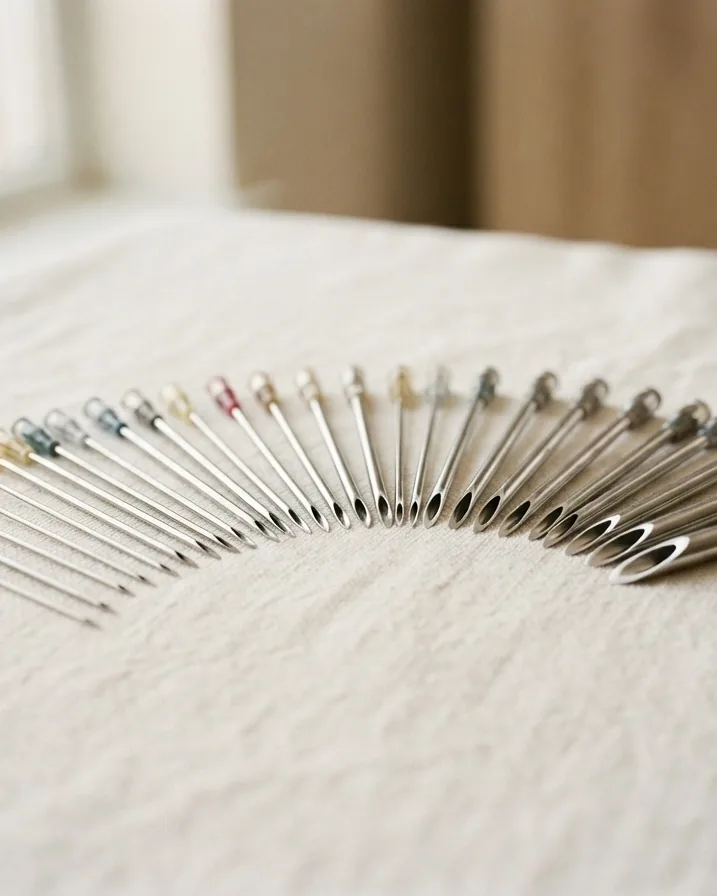
The needles sold by reputable suppliers are made from surgical-grade stainless steel, commonly 316L, chosen because it resists corrosion and does not shed the kind of surface contaminants that lower-grade steel can. A typical needle blank starts as a straight length of hollow tubing that is ground down at one end to form the tri-bevel tip, then cleaned, packaged, and sterilized, usually with ethylene oxide gas rather than heat, since gas sterilization does not distort the fine ground edge the way an autoclave cycle can over repeated use.
Length matters more than most buyers expect. A 2 inch needle, the length Metal Mafia lists for its standard line, gives a piercer enough shaft to work through thicker anatomy like a septum or a nipple without running out of usable length before the tip clears the far side. Shorter needles exist for shallow lobe work, but a studio stocking a single universal length is not unusual since the extra length simply is not used on thinner tissue.
Gauges sold commercially typically run from a fine 20G down through a heavy 4G, covering everything from a first earlobe piercing to advanced stretching work, and boxes are usually sold pre-sorted by gauge rather than mixed, which is part of why matching the right box to the right placement is a simple, low-error process for a trained piercer.
The sourced infection numbers: HBV, HCV, and what a needlestick means
Body piercing carries a measurable, sourced increase in bloodborne infection risk, and honest numbers beat vague reassurance. A peer-reviewed systematic review and meta-analysis hosted on the NIH’s PubMed Central pooled the data and found body piercing associated with an odds ratio of about 1.79 for hepatitis B and about 1.83 for hepatitis C, meaning a nearly doubled relative risk compared with unpierced controls.
Separately, infection-control references put the transmission risk from a single needlestick with an infected source at roughly 3 to 10 percent for hepatitis C and about 0.3 percent for HIV. Those figures are exactly why single-use needles and sharps disposal are not optional niceties.
The meta-analysis is available through the PubMed Central review of piercing and bloodborne infection, and the Hepatitis B Foundation summarizes transmission risk from tattoo and piercing equipment in plain language on its public education pages.
The takeaway is not fear. It is that the risk lives almost entirely in reused or non-sterile equipment, which sterile single-use technique is designed to eliminate. An odds ratio near 1.8 describes population-level exposure across all piercing settings, including unregulated ones, and a studio following APP and OSHA standards is operating in the low-risk end of that range rather than the high end.
The regulations behind the sharps container: OSHA, CDC, and licensing costs
Behind every legitimate studio sits a stack of enforceable rules, and understanding them tells you what a clean shop is paying for. The core U.S. rule is the Occupational Safety and Health Administration’s Bloodborne Pathogens Standard, codified at 29 CFR 1910.1030, which governs how sharps are handled, how surfaces and reusable tools are sterilized, how needles are disposed of, and what exposure-control plan a shop must keep on file.
It is not piercing-specific law, but it is the framework any studio drawing blood must satisfy. The Centers for Disease Control and Prevention cross-references the same standard through its PPE-Info system, so the federal expectations are consistent across agencies.
What does that cost an operator in practice? Compliance is a recurring line item, not a one-time purchase:
- Sharps containers and medical waste pickup are ongoing, because every needle after one pass is regulated waste, not trash.
- An autoclave plus routine spore testing to verify sterilization actually works on reusable forceps and receiving tubes.
- A written exposure-control plan and staff bloodborne-pathogen training that 29 CFR 1910.1030 requires be reviewed and kept current.
- Local health-department licensing and inspections, which vary by jurisdiction and add permit fees on top of the federal baseline.
The regulation text lives on OSHA’s page for the Bloodborne Pathogens Standard 1910.1030, and its plain-language general bloodborne pathogens guidance lays out the exposure-control basics. The Association of Professional Piercers layers voluntary body-piercing standards on top of that federal floor, and a shop that meets both is the shop you want. When a studio shows you a sealed needle and a labeled sharps container, you are watching those rules in action rather than taking anyone’s word for it.
Age and consent rules sit alongside these health regulations and vary by location. Lobe piercings are sometimes permitted from around age five with parental consent depending on local law, while other placements often carry higher minimum ages or require a parent present regardless of the client’s age. Checking your local health department rules before booking a minor’s piercing avoids a wasted trip.
Metals that will not turn your fresh hole into a rash
The needle makes the wound, but the metal you leave in it decides whether your body fights the piercing. Nickel is the usual culprit behind an itchy, red, weeping fresh piercing, and swapping to a hypoallergenic metal for the initial jewelry is the cheapest insurance you can buy. The Mayo Clinic names the safe shortlist directly: surgical stainless steel, titanium, niobium, and 14- or 18-karat gold. Those are the metals to insist on for a first piece, before the fistula has healed and while the channel is most reactive.
Most piercings heal in about six weeks, though the Mayo Clinic notes some take several months or longer.
Cartilage and inner-ear sites sit at the slower end. If you are choosing a first piece for a fresh helix or rook, our breakdown of how to pick rook earrings that actually heal covers metal and size together.
Signs of an allergic reaction versus a normal healing response are worth learning early. Mild redness, slight swelling, and clear discharge in the first few days are typical of a healing wound. Persistent itching, a rash spreading beyond the piercing site, or dry flaking skin that does not settle after the first week or two point toward a metal sensitivity, and the usual fix is switching the jewelry to titanium or niobium rather than waiting it out.
Troubleshooting common piercing needle problems
Even with correct technique, a handful of predictable issues come up often enough to plan for.
- Bumps or small lumps near the piercing: often irritation bumps from friction with clothing or bedding rather than infection, usually easing with a gentler cleaning routine and less handling of the jewelry.
- Keloid scarring: a raised, thickened scar that some people are more prone to genetically, most common on ears; it is a scarring response rather than an infection and generally needs a dermatologist rather than antibiotics.
- Jewelry that will not turn or feels stuck: a sign the piercing is still healing and should be left alone rather than forced, since forcing rotation can reopen microtears in the channel wall.
- Thick yellow or green discharge with spreading redness and heat: the pattern more consistent with a true infection, warranting a visit to a piercer or clinician rather than home treatment.
None of these substitute for an in-person look from your piercer or a doctor if symptoms worsen, but knowing the difference between normal healing and a genuine problem prevents both needless panic and needless delay.
Should you ever pierce yourself at home?
No, and the reason is structural, not squeamish. A home setup cannot reproduce the two things that make studio piercing reasonably safe: verified sterility and correct technique. You cannot autoclave-test a kitchen, you cannot guarantee a truly single-use sterile field, and you cannot dispose of a used needle as regulated medical waste from your bathroom.
Given a needlestick transmission risk of roughly 3 to 10 percent for hepatitis C from an infected source, the equipment you cannot verify is exactly the equipment that carries the danger. Suppliers who sell needles by the box rarely say this out loud, because they sell needles.
Piercing guns bought for home use compound the problem rather than solving it, since they crush tissue with a blunt stud and, unlike a professional autoclaved tool setup, are rarely designed to be sterilized between uses at all. A box of piercing needles ordered online without training behind it does not turn a kitchen table into a sterile field, and safety ear-piercing kits marketed for home use generally use the same blunt-force stud mechanism rather than a true needle.
If cost or nerves are pushing you toward a DIY attempt, a studio consultation is free at most shops and removes the risk entirely.
How to vet a piercer before you sit down
You can judge a studio in the first two minutes by watching how it handles the needle. A safe piercer opens a sealed, pre-sterilized needle in front of you, uses fresh gloves, keeps an autoclave for reusable tools, drops the needle into a sharps container after one pass, and holds current local licensing. Any hesitation on those points is your cue to leave. This is the same checklist the Association of Professional Piercers frames as your right as a client, and it costs you nothing to insist on.
Run through this before you commit:
- Sealed needle opened in front of you, not pre-loaded or set aside.
- Fresh single-use gloves put on after hand hygiene.
- A visible autoclave and sharps container, plus displayed local licensing.
A few extra questions round out the vetting process. Ask what gauge and jewelry material they recommend for your placement and whether it matches the ranges above; a piercer who explains their reasoning is generally more trustworthy than one who brushes the question off. Ask how aftercare instructions are provided, since a shop with a printed or written aftercare sheet tends to also be the shop keeping its other paperwork, like autoclave logs, in order.
If you are still deciding between a needle piercing and a device or gun elsewhere, our guide to a health-grade second lobe hole compares the methods for the most common first piercing.
Needle versus gun: a side by side comparison
Laid out directly, the differences between the two tools explain why professional guidance consistently favors the needle for anything beyond a basic lobe piercing.
- Tissue effect: needle cores a clean channel; gun crushes tissue around a blunt stud.
- Sterilization: needle is single-use and disposed of after one pass; guns are typically plastic-bodied and cannot be autoclaved, so only the stud is single-use while the gun mechanism itself is reused across clients.
- Placement range: needle can be used almost anywhere on the body; guns are largely restricted to lobes because the mechanism cannot safely reach or apply correct pressure to cartilage or other sites.
- Healing pattern: needle piercings generally heal with less swelling and lower complication rates in professional reporting; gun piercings on cartilage in particular carry a higher rate of complications including chondritis, an infection of the cartilage itself.
- Professional endorsement: the Association of Professional Piercers and the Mayo Clinic both recommend needle piercing over gun piercing, particularly for cartilage.
Frequently asked questions about piercing needles
Is a piercing needle the same as a medical hypodermic needle?
No. Both are hollow and share a design ancestry, since the tri-bevel piercing tip was inspired by 1980s medical needles. A hypodermic delivers fluid through a single-bevel tip, while a piercing needle uses three bevels to core a clean channel and open it to jewelry width. They are built for different jobs, and one cannot substitute for the other.
What gauge needle is used for a standard earlobe?
An earlobe is typically pierced at 20G, which is 0.81 mm, or 18G, which is 1 mm. The thinner 20G suits delicate lobes, while 18G gives slightly more durability for heavier jewelry later. Your piercer matches the initial jewelry to the same gauge so the fistula heals to the correct size rather than to a mismatched post.
Why do professionals refuse to reuse a piercing needle?
Because reuse is how bloodborne viruses spread. The Association of Professional Piercers requires every needle to be single-use, sterile, and binned after one pass. With hepatitis C needlestick transmission running roughly 3 to 10 percent from an infected source, a re-sterilized needle is a risk no reputable studio takes. Single-use technique is the core safeguard.
How long does a needle piercing take to heal?
Most piercings heal in about six weeks according to the Mayo Clinic, though some take several months or longer. Cartilage sites like the helix and rook sit at the slower end, while earlobes tend to be faster. Healing depends on placement, aftercare, and using a hypoallergenic first metal such as titanium, niobium, or surgical stainless steel.
Does using a needle instead of a gun lower infection risk?
Yes, meaningfully. A piercing gun cannot be fully sterilized between clients and crushes tissue, while a needle is single-use and cores a clean channel. The Mayo Clinic and the Association of Professional Piercers both steer clients toward needles for this reason. Cleaner technique plus verified sterility is what keeps the sourced hepatitis odds from becoming your problem.
Can a piercing needle be reused if it is sterilized again?
No. Regardless of sterilization method, professional standards require a piercing needle to be discarded after a single use. Repeated sterilization cycles can also dull or distort the fine tri-bevel edge, degrading the clean coring action that makes the tool safer than a gun in the first place, so re-sterilization is never treated as an acceptable substitute for a fresh needle.
The infection figures and transmission risks discussed here are drawn from published medical sources and describe population-level risk, not medical advice for your specific situation. This guide is informational, and a licensed piercer or clinician should answer questions about your own health.