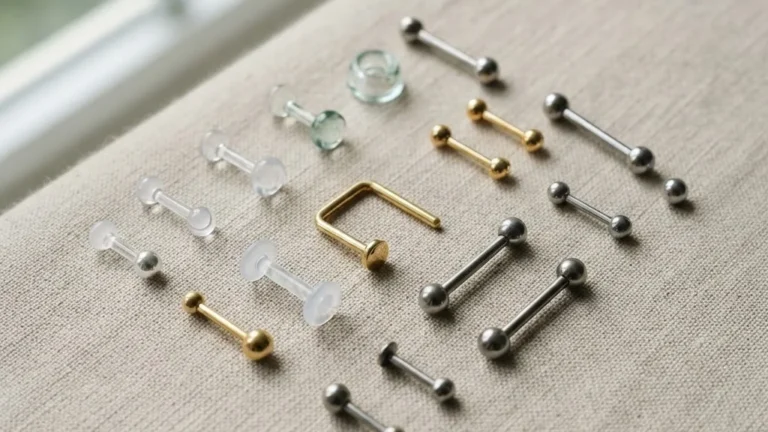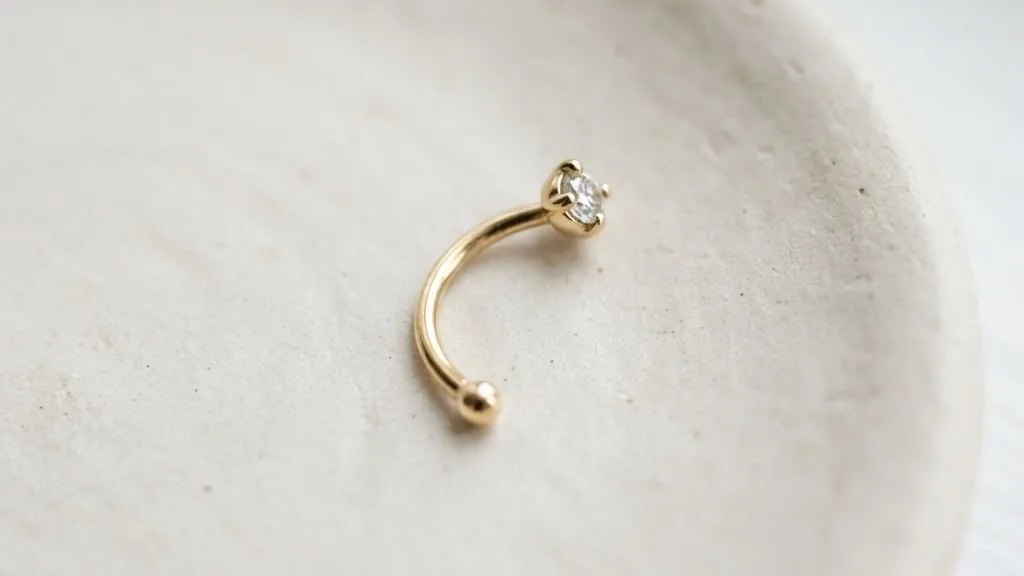
Curved barbell for rook piercing is the near-universal starter, and the reason is geometry: the rook passes through the antihelix fold, from the underside of the ridge up to its crest, so the channel itself is curved. A straight post cannot follow that arc. Most studios open a rook at 16G, which is 1.2 mm, and the honest full-healing window is 6 to 18 months, not the three months some sellers imply. The trouble is that a “curved barbell for rook piercing” listed as 8 mm on one site and 8 mm on another can mean two different physical objects, because sellers measure length differently. This guide fixes that.
Quick answer: For a fresh rook, order a curved barbell at 16G (1.2 mm) with an initial wearable length around 8 mm to leave room for swelling, in implant-certified titanium to ASTM F136 or implant steel to ASTM F138. Once swelling settles, a piercer downsizes you to roughly 6 mm. Threading must be internal or threadless. Rings and clickers are healed-only. Expect 6 to 18 months to full healing, and check that “length” means internal arc, not tip to tip, before you buy.
Why a Curved Barbell Beats a Ring or a Straight Post
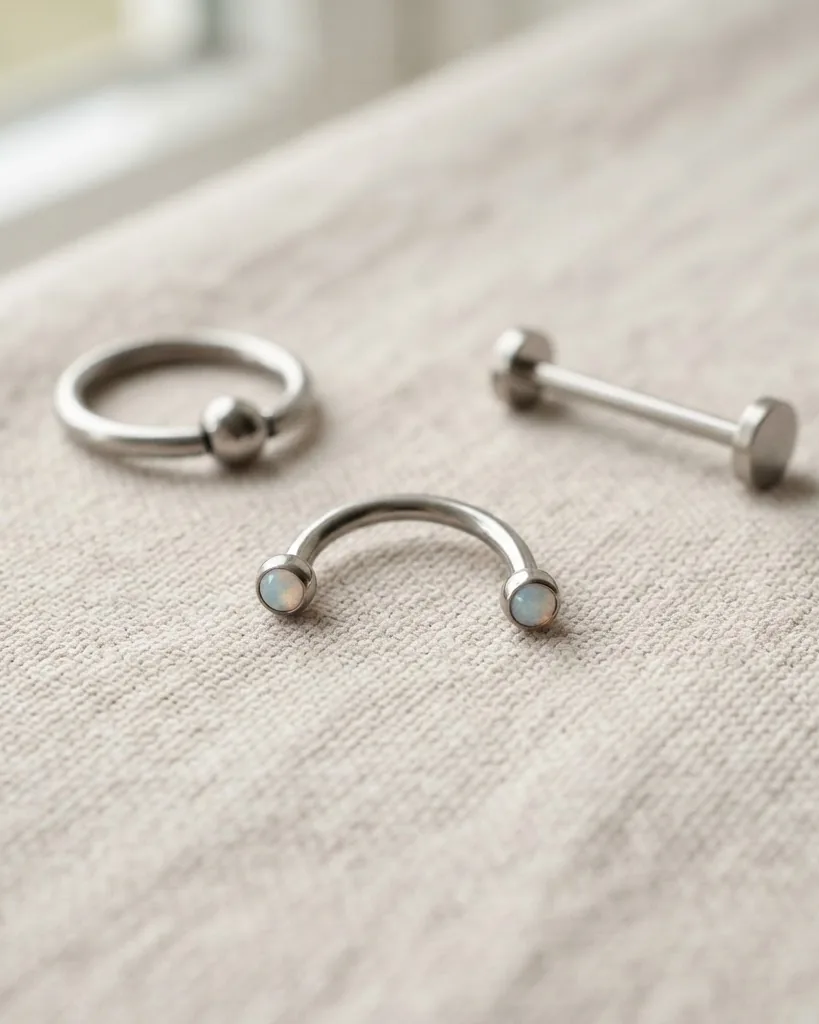
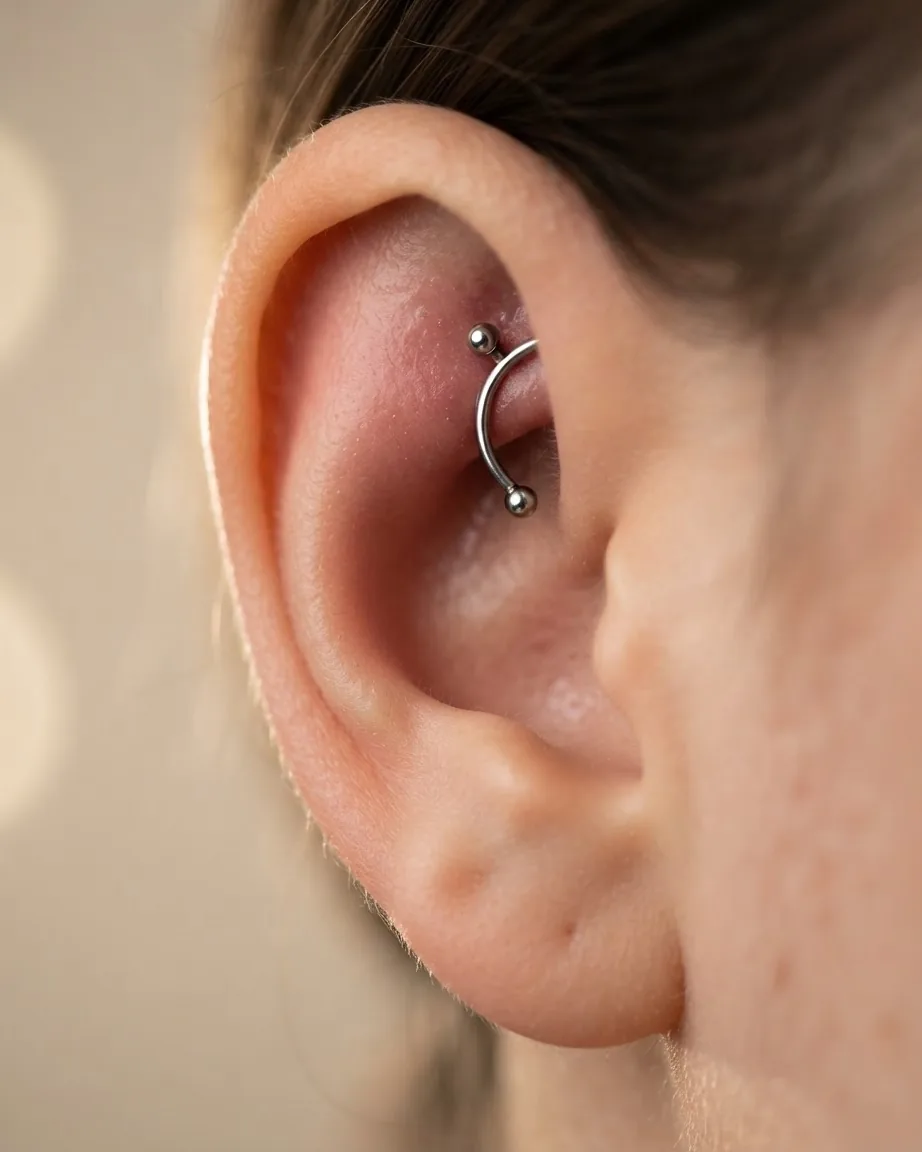
A curved barbell suits the rook because the piercing runs through the antihelix fold, entering the underside and exiting the top of the ridge rather than passing front to back. That path is an arc, so the jewellery has to be an arc too. A curved barbell carries less curvature than a captive bead ring, which means it puts less strain on the healing fistula while cartilage knits. A straight flat-back labret, sometimes recommended elsewhere, is the wrong shape entirely: the post is rigid and linear, and forcing it through a fold levers the tissue and drags on both openings.
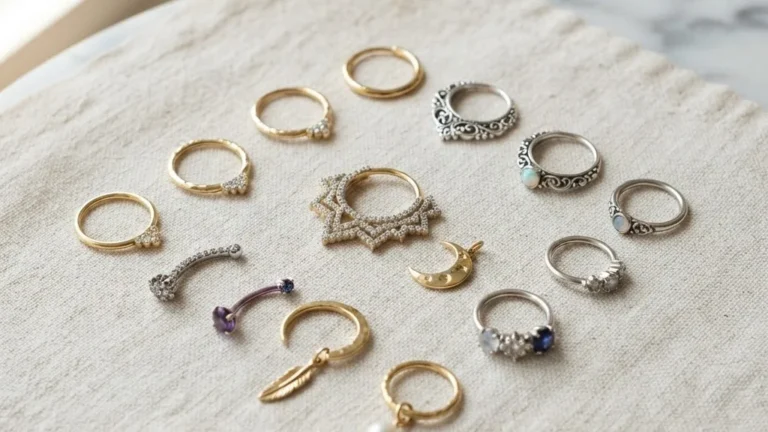
Clickers and seamless hoops are healed-only choices. They look clean once tissue is stable, but in a fresh rook a continuous ring rocks with every knock and every pillow. Start curved. If you want the visual options, see our breakdown of how to pick the right rook barbell and material before you swap anything.
- Curved barbell vs ring: less curvature, less strain on a fresh channel.
- Curved barbell vs straight labret: the labret cannot follow the fold.
- Curved barbell vs clicker or hoop: the latter two are for healed ears only.
How to Size a Curved Barbell: Gauge, Arc, and the 6 to 8 mm Question
Gauge comes first, and for the rook the standard is 16G, equal to 1.2 mm. For comparison, a standard lobe uses 20G at 0.81 mm, and 18G at 1.0 mm exists only as a healed-only downsize once the channel is stable. Post thickness should match the needle gauge used to open the piercing; never order below your channel gauge, because a thinner bar lets the tissue collapse around it and can trigger irritation. Length is where buyers get burned. The most common published range for a healed rook curved barbell is 6 mm to 8 mm at 16G, with 7 mm sold as the in-between, and a common protocol is an 8 mm initial bar downsized to 6 mm once swelling settles.
Here is the catch nobody states clearly: some sellers publish 8 to 10 mm initial and 6 to 8 mm healed, and at least one lists 10 to 12 mm initial and 8 to 10 mm healed, measuring the internal arc rather than tip to tip. That spread is almost certainly a measurement-convention conflict, not a real disagreement about anatomy.
| Stage | Gauge | Common length range |
|---|---|---|
| Initial (swelling) | 16G / 1.2 mm | 8 mm, up to 8 to 10 mm |
| Healed (downsized) | 16G / 1.2 mm | 6 mm to 8 mm |
| Post-heal daintier | 18G / 1.0 mm | 6 mm to 8 mm |
Before ordering, confirm whether a shop’s “length” means the internal arc, the wearable span, or tip to tip. If they cannot tell you, that is your answer about their quality control. Buyers cross-shopping cartilage projects often find the same confusion around helix stacks, which we cover in the triple helix placement, healing, and care guide.
Implant Metals, Standards, and Why “Surgical Steel” Means Nothing
Material is the part most rook pages skip, and it is the part that decides whether your ear heals or reacts. The Association of Professional Piercers, based in Lawrence, Kansas, publishes a list of accepted initial materials, and it is specific. For titanium, that means implant-certified Ti-6Al-4V ELI to ASTM F136, or Ti-6Al-7Nb to ASTM F1295 or ISO 5832-11, or ISO 5832-3, or commercially pure titanium to ASTM F67. For steel it means ASTM F138 or ISO 5832-1. Niobium is widely used and generally well tolerated, but it carries no implant-grade designation, so treat it as a considered choice rather than a certified one.
Two corrections matter. First, ASTM F136 is a written specification for Ti-6Al-4V ELI, not a “grade” of titanium, so a listing that says “grade 23” is using a nickname, not a certificate. Second, the phrase “surgical steel” has no regulatory definition at all; only steel meeting ASTM F138 or ISO 5832-1 is what the APP accepts. You can read the accepted list directly in the APP’s own reference on jewelry for initial piercings.
- Titanium: ASTM F136, ASTM F1295, ASTM F67; ISO 5832-3 and ISO 5832-11.
- Steel: ASTM F138 or ISO 5832-1 only.
- Gold: solid 14k or 18k, nickel-free, a healed-wear position rather than first-choice initial jewellery.
- Plated pieces: not implant grade; a coating is not a certificate.
Anodised titanium is worth a word: the colour comes from an oxide layer that bends light, and it does not change the metal’s biocompatibility. Titanium’s passive oxide layer forms almost instantly and sits on the order of nanometres thick, which is why the metal is so well tolerated once certified. Ask any seller for a mill certificate stating the standard and the grade. If they will not produce one, the metal is unproven, whatever the product page claims.
Nickel Limits, REACH, and the French Studio Rules
Regulation sets the floor that marketing cannot argue with. In the European Union, the European Chemicals Agency enforces REACH Annex XVII, and Entry 27 governs nickel. Jewellery inserted into a pierced site may not release more than 0.2 micrograms per square centimetre per week, while articles in direct and prolonged skin contact carry a looser limit of 0.5 micrograms per square centimetre per week. That gap matters because piercing jewellery lives on the stricter side. The limits trace back to Council Directive 94/27/EC, the original Nickel Directive, folded into REACH as Entry 27 in 2009 with the thresholds carried over unchanged.
Compliance is not a vibe; it is measured. The European Committee for Standardization publishes EN 1811 as the reference nickel-release method and EN 12472 as the accelerated wear and corrosion test for coated items, simulating roughly a two-year wear period. The EU even defines “prolonged skin contact” in law: 30 minutes or more on one or more occasions within two weeks, or 10 minutes or more on three or more occasions within two weeks. China mirrors both thresholds in GB 28480-2012, at the same 0.2 and 0.5 micrograms per square centimetre per week.
Why care? Nickel allergy prevalence in adults runs at 10 to 20 percent, and above 10 percent among women under 30, with earlobe piercing the most common route of initial sensitisation. If you pierce in France, the studio side is regulated too. Décret n° 2008-149 of 19 February 2008, with the arrêtés of 11 March 2009, requires “Hygiène et Salubrité” training, a declaration of activity to the ARS, class-B autoclave sterilisation or single-use sterile equipment, and a DASRI medical-waste stream. Non-compliance is punishable as a contravention de 5e classe. When you weigh which metal to trust, the same logic applies to studs elsewhere on the face, as in our look at choosing a nose stud, stone, and safe metal.
Downsizing: The Step Everyone Skips and the Bump It Creates
The initial bar is long on purpose. A rook sits in a tight fold that swells, and a bar sized snug on day one becomes a compression device once the tissue puffs. That is the mechanism behind the mystery lump people panic over. A bar that is too short presses swollen cartilage together and produces a pressure bump, which is then misread as infection; a bar left long for too long levers and snags on hair, pillows, and phone screens. Downsizing is the correction, and it exists to move you from swelling-room length to healed-fit length.
Published review windows differ. One source suggests reassessing at 6 to 8 weeks; another argues 8 to 12 weeks, reasoning that the rook runs later than flatter cartilage because swelling in the fold lingers and fluctuates. Both are defensible, so treat the earlier figure as the soonest a piercer might check, not a deadline. Do not self-change a fresh rook. The site is hard to see, harder to reach, and threading damage is real: external threads drag through the channel, and stripped threads or a lost ball can leave you stuck at the worst moment.
- Too short: compresses swollen cartilage, creates a pressure bump.
- Too long, too long: levers and snags, keeping the channel irritated.
- Right length, right time: a piercer swaps you once swelling settles.
Sleep is the underrated variable. Pressure from a side you favour keeps the fold inflamed, so switch sides and consider a travel pillow with a cut-out. The same pressure logic drives problems at other high-contact spots, which is why we walk through fit and healing separately for the tragus, its metal, and its healing curve.
Infection Risk, Perichondritis, and the 5-Day Rule
The rook is transcartilaginous, so it inherits the risk profile of high-ear piercings rather than the softer lobe. That distinction is not cosmetic. Cartilage has a poor blood supply, which makes infection harder to clear and more likely to damage the shape of the ear. The dominant organism is Pseudomonas aeruginosa, and the clinical literature is blunt about how fast it can escalate. This is the layer that turns a jewellery choice into a health decision, and it is the reason a competent piercer assesses your anatomy before touching a needle.
The numbers come from ENT journals. In Sosin et al., published in The Laryngoscope in 2015, a systematic review of transcartilaginous piercing infections examined how these cases present and progress. Pseudomonas aeruginosa was identified as the dominant organism recovered from infected sites, and a longer stretch of symptoms before treatment began was associated with a greater likelihood of hospitalisation. You can read the abstract of the transcartilaginous piercing infection review directly.
Later work reinforces it. In Ungar et al., in The Laryngoscope in 2025, 217 auricular perichondritis patients from 2006 to 2021 were studied, and 120 of them, or 55.3 percent, were piercing-induced; that group was younger, with more abscess formation and more P. aeruginosa colonisation. The piercing-induced cohort showed a shorter mean time from event to symptom onset compared with the non-piercing cases in the same study. The piercing-era perichondritis cohort is worth the read if you want the full clinical picture.
Outbreak surveillance shows the same pattern at population scale. In England, between July and September 2016, a national P. aeruginosa outbreak was traced to a contaminated aftercare solution, with 162 cases: 29 confirmed, 14 probable, 119 possible. All confirmed cases had ear piercings, 93 percent of them cartilage; 95 percent were female, median age 18. The England 2016 aftercare outbreak report documents how one bottle seeded a national event. An earlier US investigation found that of 15 confirmed cartilage-piercing cases, 9, or 60 percent, were hospitalised, with a median stay of 4.4 days, and the outbreak strain was recovered from the aftercare bottles. The same paper cites English survey data for ages 16 to 24: 31 percent of body piercings resulted in complications, 15 percent required professional help, and 0.9 percent resulted in hospital admission.
The 5-day rule: if pain, spreading redness, heat, swelling, or discharge persists or worsens beyond a few days, do not wait it out, because delay past five days is the point where the odds tilt toward hospitalisation. That is a “see a clinician now” trigger, not a “keep cleaning it” one.
Irritation Bump vs Real Infection: A Quick Decision Table
Not every lump is an infection, and reading the difference saves you both panic and pointless antibiotics. An irritation bump is usually a response to mechanical stress, such as a too-short bar, a snag, or side-sleeping, and it tends to sit quietly without systemic symptoms. Perichondritis behaves differently: it spreads, it hurts to touch across the cartilage, and it comes with heat and sometimes fever. When in doubt, the transcartilaginous risk profile means you escalate rather than gamble.
| Sign | Likely irritation | Likely infection |
|---|---|---|
| Onset | After a knock or downsize miss | Progressive, worsening daily |
| Pain | Localised, mild | Spreading, throbbing |
| Discharge | Clear or crusty | Cloudy, coloured, foul |
| Systemic | None | Heat, possible fever |
Allergic contact dermatitis from nickel is a third thing again: itchy, red, sometimes weepy skin around the site that tracks with the metal rather than a wound. It resolves when the offending metal comes out, which is exactly why certified titanium or steel matters from day one. Reported complication breakdowns for non-lobe ear piercing put localised infection around 77 percent of events, allergic reaction around 43 percent, and keloid scarring near 2.5 percent, though those are pooled secondary figures and should be read as indicative rather than exact.
Anatomy Comes First: When a Rook Should Not Be Pierced
The single biggest reason rook piercings migrate or reject is anatomy, and it is decided before any jewellery is chosen. The rook needs a well-defined antihelical ridge to sit in; that fold is what holds the bar and gives the piercing something to anchor against. A poorly defined ridge is a genuine contraindication, and an experienced piercer will assess it and may refuse. That refusal is a good sign, not lost business, because a rook forced into a shallow or absent fold has nowhere stable to heal.
This is why the “which bar” question is downstream of the “can I even” question. If your fold is shallow, no gauge or arc length rescues it. A skilled piercer marks the entry and exit, checks that the fold has depth, and only then talks jewellery. If you are still mapping out which ear projects suit your anatomy, our overview of every placement explained by body area and our guide to choosing rook earring size, metal, and style that heals are the sane starting points before you book.
How to Vet a Seller Before You Pay
A trustworthy seller answers four questions without flinching, and a weak one dodges all four. Because the rook is a cartilage site with real infection stakes, the sourcing conversation is part of aftercare, not separate from it. You are buying a certificate as much as a shape. The pages that rank on looks alone almost never state a standard, a threading type, or a measurement convention, which is precisely the information you need to place a safe order.
Run this checklist. It takes two minutes and filters out most of the risk.
- Mill certificates: will they show one naming the standard and grade?
- Stated standard plus grade: “ASTM F136 Ti-6Al-4V ELI,” not “surgical steel.”
- Threading type: internally threaded or threadless, never externally threaded.
- Arc convention: does “length” mean internal arc or tip to tip?
Finish matters too. A quality bar is mirror-polished with no casting porosity and no tool marks, because any rough spot drags through healing tissue. Ends should be modest in size and weight; a heavy or oversized ball levers the bar in a tight fold and keeps the site irritated.
Frequently Asked Questions
What size curved barbell for a rook piercing?
Most rooks start at 16G, which is 1.2 mm, with an initial length around 8 mm to allow for swelling. Once swelling settles, a piercer typically downsizes to about 6 mm, though healed lengths of 6 to 8 mm are all common. Confirm whether the seller measures the internal arc or tip to tip, since that changes what the number means.
Should I choose 16G or 18G for my rook?
Start at 16G (1.2 mm), the near-universal rook standard, and never order below your channel gauge. 18G (1.0 mm) is a healed-only downsize for a daintier look once the piercing is stable. A thinner bar in a fresh rook lets tissue collapse around it and can prolong irritation, so 18G is a later-stage option, not a starter choice.
6 mm or 8 mm for a curved rook barbell?
Use 8 mm initially so the fold has room to swell, then downsize toward 6 mm once inflammation drops. Many people heal comfortably anywhere in the 6 to 8 mm band depending on fold depth. Because sellers measure length differently, an 8 mm from one shop may not match an 8 mm from another; ask which convention they use before buying.
Can I wear a hoop in a fresh rook piercing?
No. A captive ring, clicker, or seamless hoop is a healed-only choice. In a fresh rook, a continuous ring rocks with every knock and pillow, straining the channel and inviting irritation. Heal with the curved barbell your piercer inserts, complete downsizing, and only then consider a small-inner-diameter ring once the site is fully stable.
When can I change my rook jewellery myself?
Full healing runs 6 to 18 months, and the first change should be a downsize done by your piercer, usually reviewed somewhere between 6 and 12 weeks. Do not self-change a fresh rook: it is hard to see and reach, and threading damage, stripped threads, or a lost ball can leave you stuck. Wait until it is fully healed and stable.
Why does titanium get recommended so often for rooks?
Certified titanium to ASTM F136 or ASTM F67 is highly biocompatible and nickel-safe, which matters given that 10 to 20 percent of adults have a nickel allergy. It forms a stable oxide layer almost instantly, resists corrosion, and is light, reducing lever on the fold. Anodised colour does not change its biocompatibility. Always ask for a mill certificate proving the standard.
The Short Version
Buy a 16G (1.2 mm) curved barbell in certified titanium or implant steel, sized around 8 mm to start with a downsize to about 6 mm, internally threaded or threadless, from a seller who will show a mill certificate and tell you how they measure length. Let a piercer confirm your antihelical ridge can hold it, heal on the initial bar, and treat any spreading pain past five days as a reason to see a clinician rather than wait.
Infection, perichondritis, and self-harm-adjacent aftercare shortcuts are genuinely sensitive territory for a cartilage piercing; if a wound is worsening, a real clinician beats any product page, this one included.