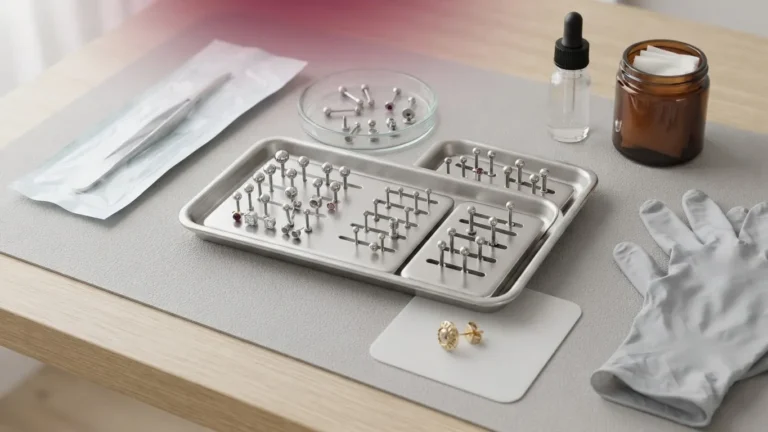
Rook piercing jewelry is the part of a rook that people get wrong most often, and it is the part I spend the most time on in the studio. The rook sits in a fold of cartilage in the upper inner ear, so the piece has to seat into a curve, ride out swelling, and stay put while a slow cartilage channel closes around it. Get the shape, gauge and metal right and the piercing tends to behave. Get them wrong and you invite a bump, migration, or months of nagging irritation that no amount of saline fixes.
This guide walks through exactly what I put in a fresh rook, why, and what you can graduate to once it heals. I will give you the real numbers I work from, the two metals worth trusting, and the difference between what belongs in a healing rook and what belongs in a settled one.
Quick answer: For a fresh rook, wear a curved barbell in 16 gauge (1.2 mm), sized around 10 mm to 12 mm to leave room for swelling, with smooth threadless or internally threaded ends. The metal should be implant-grade titanium (ASTM F136) or solid 14k gold, never plated or gold-filled. Leave that starter piece in and let the piercer downsize it to roughly 8 mm to 10 mm once swelling settles, usually near the 6-week mark. Save small hoops and clickers, typically 6 mm to 8 mm, for after full healing, which runs 6 to 12 months and sometimes longer.
What a rook piercing actually is, and why it changes your jewelry choice
The rook is the ridge of cartilage in the upper ear where the antihelix folds back on itself, sitting above the tragus and inside the outer rim. Because the piercing passes through a fold rather than a flat sheet, the jewelry has to bridge two surfaces at an angle. That single fact drives almost every choice below.
On a flat spot like a standard helix, a straight post or a ring can sit comfortably. The rook does not give you that freedom. A straight barbell fights the curve and puts uneven pressure on the tissue, and a ring wants to rock and rotate through a channel that hates movement. The fold is why the curved barbell became the default, and why fit in millimeters matters more here than on almost any other ear placement.
Anatomy also decides whether you can be pierced at all. Some ears have a shallow or nearly absent rook ridge, and a good piercer will tell you honestly when there is not enough cartilage to hold jewelry safely. If you want to understand how the rook fits alongside the rest of the ear, this map of the different types of ear piercings and placements is a useful reference before you book.
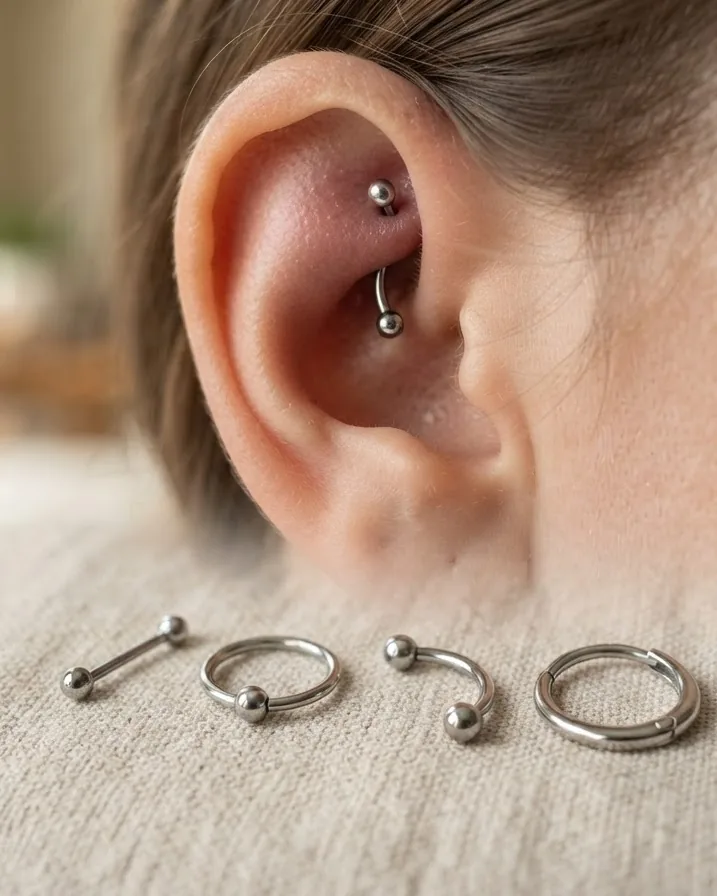
The best jewelry for a rook piercing, ranked by what actually works
For a healing rook, a curved barbell is the piece I reach for almost every time. It follows the natural bend of the fold, keeps two low-profile ends flush against the ear, and moves far less than a ring. Rings and hoops look great, but they belong to the healed stage, not the fresh one.
Here is how I think about the options in order of usefulness for a new piercing:
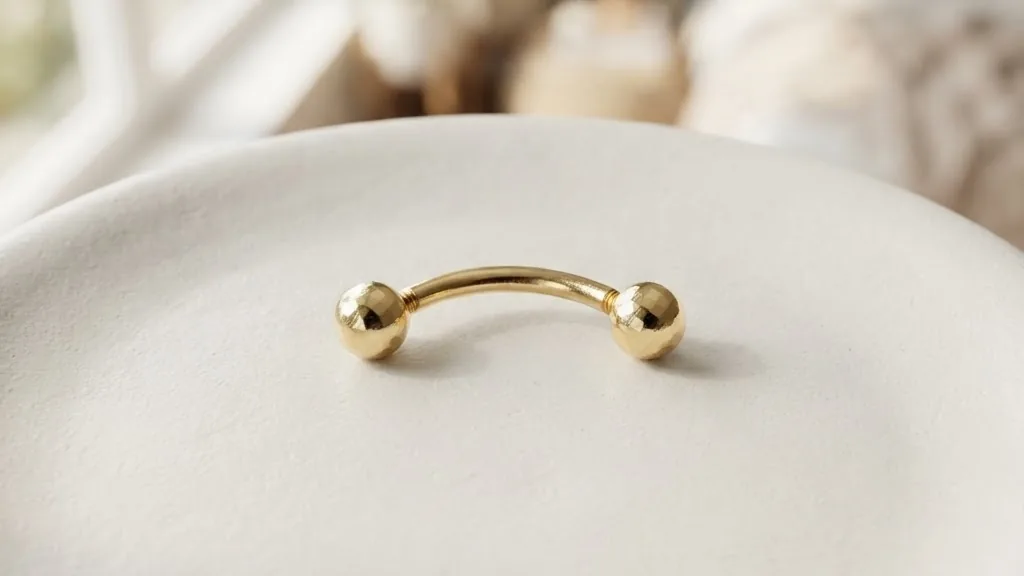
Curved barbell (the starter). Also called a banana barbell, this is the workhorse. The curve matches the rook fold, the two ball or gem ends sit close to the skin, and there is no continuous ring for a pillow to snag. Almost every rook I do starts here and stays here through healing.
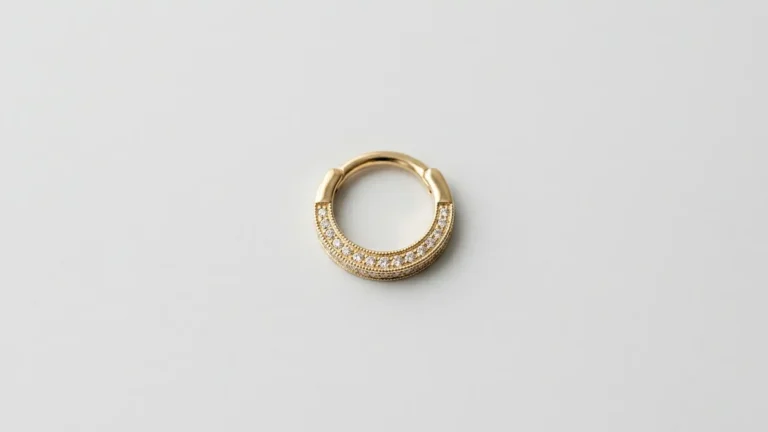
Small hoops, clickers and hinged rings (the reward). A clicker is a hinged ring that snaps shut, so it is easy to insert and secure. These give you that clean circle look around the fold, but they add movement and pressure a fresh piercing cannot absorb. I fit them only once the channel is fully healed, usually in a 6 mm to 8 mm diameter depending on the ear.
Thread type matters as much as shape. Choose threadless (push-fit) or internally threaded jewelry, where the post is smooth and the threading hides inside the end. Externally threaded pieces drag exposed screw threads through the fresh channel every time they move, and that is a needless source of irritation. The Association of Professional Piercers backs smooth, quality-threaded jewelry for healing piercings, and you can read their guidance on their professional piercing resource site.
One more thing on ends: keep the fresh piece low-profile. Big charms, dangles and oversized gems add weight and give hair, pillows and headphone cushions something to catch. A small flat disc or a modest bezel-set gem on a curved barbell heals far more peacefully than a chunky decorative front. You can always trade up to something bolder once the rook is settled, and that patience is a big part of why some rooks heal in months while others drag on for over a year.
Gauge and sizing: the numbers I work from
Gauge is the thickness of the post, and for a rook the standard is 16 gauge, which equals 1.2 mm. Some piercers step up to a slightly finer 18 gauge (1.0 mm) for delicate anatomy, but I avoid going thinner than that in cartilage because a too-thin post can slowly cut through the tissue like wire through cheese.
Length and diameter are where people get burned buying online. A fresh rook needs a curved barbell of about 10 mm to 12 mm so there is room for the swelling that always follows a cartilage piercing. If you start too short, the ends press into swollen tissue and you get embedding and angry bumps. That extra length looks a little loose at first, and it is supposed to.
Once the swelling goes down, the piece is too long and the loose ends start catching. That is when you downsize, typically to a barbell around 8 mm to 10 mm, which sits snug and stops the jewelry from levering on the channel. For a healed rook moving to a ring, most people land in a 6 mm to 8 mm clicker, again depending on the depth of the fold.
It helps to know why the fresh size feels wrong at both ends of healing. On day one the long barbell looks loose, but that gap is the swelling allowance and you need it. By the time you have healed, that same length is now excess post that levers on the fold and snags, which is the whole reason the downsize step exists. Buying a single “medium” size to skip the downsize is a false economy that tends to end in a bump.
None of these numbers are guesses you should make alone. Your piercer measures your actual anatomy at the appointment and again at the downsize check, usually around 6 weeks in. Cartilage is unforgiving about fit, so the millimeter that is right for your ear beats any chart, including this one.
Materials: titanium, gold, and what to keep out of your ear
Metal is not a place to save money on a healing rook. The two materials I trust for a fresh piercing are implant-grade titanium and solid gold, and the reason is simple: both are dense, non-porous, and biocompatible, so bacteria have nowhere to hide and reactive skin has little to react to.
Implant-grade titanium (ASTM F136). This is my default recommendation and the one I put in most fresh rooks. ASTM F136 is the Ti-6Al-4V ELI alloy trusted for surgical implants. It is nickel-free, which matters because nickel allergy is one of the most common metal sensitivities, a point the American Academy of Dermatology makes clearly on their dermatology public education site. Titanium is also roughly 45% lighter than steel, so it puts less weight and drag on a tender fold.
Solid 14k or 18k gold. Solid gold is a safe and beautiful option for a healing piercing, as long as it is genuinely solid. It costs more and is a touch softer than titanium, but many people love the warmer look. The key word is solid: 14k and 18k are fine, higher karats get too soft, and anything below that is usually alloyed with metals you do not want against a wound.
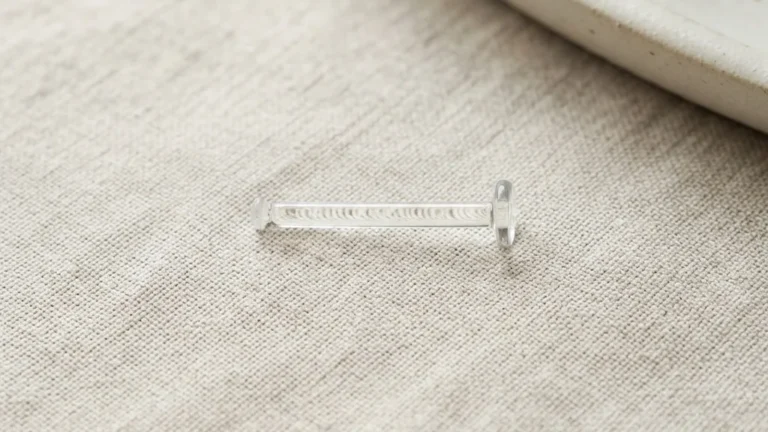
What to avoid. Keep gold-plated, gold-filled and gold vermeil out of a healing rook, because the thin gold layer wears through and exposes the base metal underneath. Skip acrylic, mystery “surgical steel” with no stated grade, and cheap fashion jewelry for anything that is not fully healed. Cleveland Clinic and Mayo Clinic both stress hypoallergenic, quality metal for new piercings, and you can review general care standards on the Mayo Clinic health information site.
What to wear during healing versus after it settles
The single biggest jewelry mistake I see is treating a fresh rook and a healed rook the same way. They are two different stages with two different jobs. During healing, jewelry protects the channel; after healing, jewelry expresses your style. Confuse the two and you restart the clock.
During healing, the rule is boring on purpose: one curved barbell, 16 gauge, sized long for swelling, in ASTM F136 titanium or solid gold, left alone. No swapping ends, no trying rings, no changing it yourself. Cartilage heals from the outside in, so the surface can look calm while the inner channel is still fragile, which is exactly why the tissue punishes early changes.
The first real milestone is the downsize, not a style change. Around 6 weeks, once initial swelling drops, your piercer trades the long starter barbell for a shorter one so the ends sit close again. This is still the same type of piece, just refit. Doing this at a studio matters because cartilage jewelry can be genuinely tricky to open and reseat without irritating the fold.
After full healing, which for a rook realistically means 6 to 12 months and sometimes up to 14 to 18 months, you finally get options. This is when clickers, seamless hoops and decorative curved barbells all become fair game. If you are unsure whether you have hit that mark, this walkthrough on when you can safely change a cartilage piercing lays out the signs, and the honest answer is usually “later than you want.”
Aftercare that protects both the piercing and the jewelry
Good aftercare is what lets quality jewelry do its job. The current professional standard is simple and it is not the sea-salt soak your friend swears by. The Association of Professional Piercers now recommends a sterile saline wound wash whose only active ingredient is 0.9% sodium chloride, used to gently rinse the piercing.
My studio routine looks like this. Clean once or twice a day by spraying sterile saline over the front and back of the piercing, then pat dry with clean disposable gauze or a fresh paper product, never a bath towel that harbors bacteria. Do not rotate, twist or slide the jewelry; that old advice about “turning” a piercing is outdated and it damages the healing channel.
The rest is about leaving it alone. Keep hair products, makeup and sunscreen off it, avoid sleeping on that ear, and be careful with over-ear headphones and phone screens that press the fold. If you chose internally threaded or threadless jewelry, an occasional saline rinse also helps clear any buildup that collects around the end. For what infection actually looks like versus normal healing, the Healthline health reference library and Mayo Clinic both describe the warning signs worth knowing.
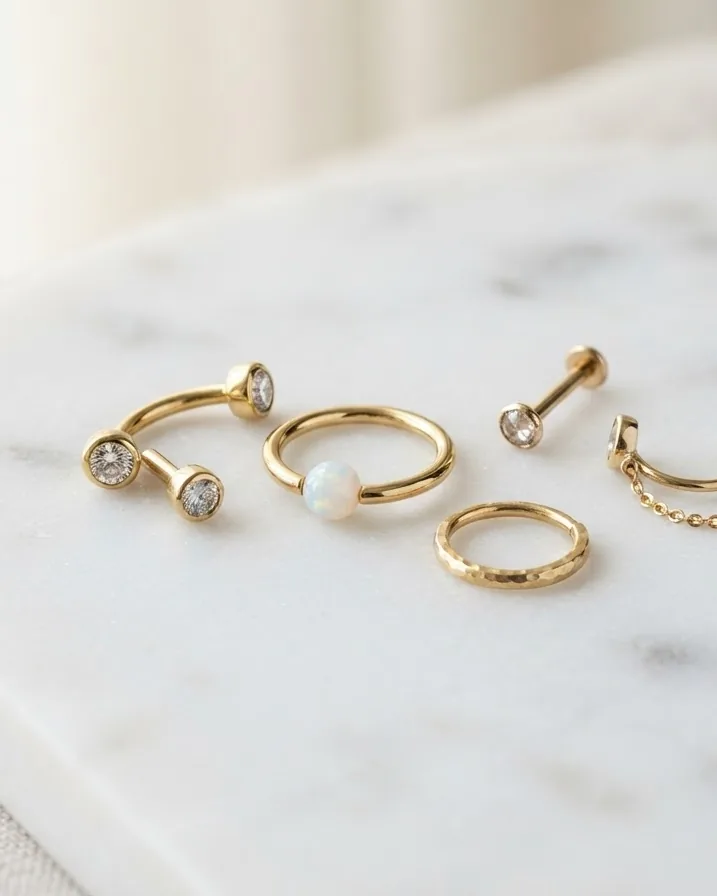
Styling a healed rook without wrecking it
Once a rook is fully healed, it becomes one of the best anchor points for a curated ear. It sits high and central in the fold, so a single standout piece there reads as intentional rather than crowded. My advice is to let the rook be a feature, not a filler.
A gemmed curved barbell keeps the low profile you healed with but adds sparkle, while a slim clicker in the 6 mm to 8 mm range gives you a clean ring inside the fold. From there you can build outward. A rook pairs beautifully with a conch piercing and its jewelry options below it and a helix piercing along the upper rim above, creating a vertical line of metal up the ear.
If you love the tucked-in ring look, the rook and daith play well together, and matching metals across both keeps the whole ear cohesive. Just resist the urge to over-accessorize a fold that only recently healed. New anatomy stays a little sensitive for a while, so change one piece at a time and give each swap a few days before you judge how it feels.
Troubleshooting fit, bumps and jewelry problems
Most rook trouble traces back to fit, movement or metal, and the good news is that all three are fixable. Before you panic about a bump, run through the basics: is the barbell the right length for this stage, is anything snagging it, and is the metal actually implant grade. A surprising share of “my piercing is rejecting” cases are really “my jewelry is wrong.”
A firm bump next to a cartilage piercing is often an irritation bump, not an infection, and it frequently comes from a piece that is too short after swelling, too long and catching, or being knocked in sleep. The move is to see your piercer, not to remove the jewelry, because taking it out can trap the problem inside a closing channel. Warm saline compresses and eliminating the source of pressure usually settle these over weeks.
Watch for real migration, where the jewelry visibly shifts toward the surface and the tissue between the holes thins. That needs professional eyes promptly. And if you see spreading redness, heat, throbbing pain or thick discharge, treat it as possible infection and get medical advice; Mayo Clinic and Cleveland Clinic both note that piercing infections respond best when addressed early rather than waited out.
Rook Jewelry Styles Compared Side by Side
Once the basics above make sense, it helps to see the main rook jewelry styles side by side. This is not a substitute for a piercer’s read on your actual anatomy, but it does show why a curved barbell wins the healing phase while rings and clickers wait their turn until the fold has settled.
| Style | Best For Phase | Typical Gauge / Size | Comfort While Healing | Notes |
|---|---|---|---|---|
| Curved barbell | Fresh piercing through full healing | 16g (1.2 mm); 10 to 12 mm starter, downsized to 8 to 10 mm | Best of the group; low profile with minimal rotation | The default starter piece; smooth ends resist snagging on hair and pillows |
| Clicker hoop (hinged ring) | Healed rook only | 16g (1.2 mm); 6 to 8 mm diameter | Workable once healed, but adds rotation a fresh channel cannot absorb | Hinge snaps shut, so it is the easiest ring style to open and reseat yourself |
| Seamless ring | Healed rook only | 16g (1.2 mm); 6 to 8 mm diameter | Comparable to a clicker once healed; a poor choice for a fresh piercing | Reads as one unbroken circle but needs pliers or a professional to open and close |
| Captive bead ring | Healed rook, occasional wear | 16g (1.2 mm); 6 to 8 mm diameter | Weakest option for comfort; the bead can catch on fabric and hair | A classic look, though most piercers now steer clients toward clickers instead |
Tip: Buy the downsize barbell from the studio that pierced you, not an online listing, so the post length is measured to your actual swelling instead of guessed from a generic size chart.
Frequently asked questions
What is the best jewelry for a fresh rook piercing?
A curved barbell in 16 gauge (1.2 mm), sized about 10 mm to 12 mm to allow for swelling, made of implant-grade ASTM F136 titanium or solid 14k gold, with threadless or internally threaded ends. That combination follows the fold, resists movement, and gives a clean channel the best chance to heal without irritation.
Can I put a hoop in a new rook piercing?
Not while it is healing. Hoops and clickers add rotation and pressure that a fresh cartilage channel cannot absorb, which invites bumps and prolonged healing. Wait until the piercing is fully healed, generally 6 to 12 months, then have your piercer fit a hoop or clicker, often around 6 mm to 8 mm in diameter for a rook fold.
What gauge and size is a rook piercing?
The standard gauge is 16g (1.2 mm), with some piercers using 18g (1.0 mm) for finer anatomy. A fresh curved barbell runs about 10 mm to 12 mm for swelling, downsizes to roughly 8 mm to 10 mm once settled, and a healed ring typically sits at 6 mm to 8 mm. Your piercer measures your exact ear at each stage.
Is titanium or gold better for a rook?
Both are safe if chosen correctly. Implant-grade titanium (ASTM F136) is nickel-free, lighter, and my usual default for healing. Solid 14k or 18k gold is also safe and looks warmer but costs more and is a bit softer. The non-negotiable is quality: never use gold-plated, gold-filled, vermeil, or unspecified steel in a healing rook.
How long before I can change my rook jewelry?
The first change should be a professional downsize around 6 weeks, not a style swap. A full jewelry change waits for complete healing, which for a rook is commonly 6 to 12 months and can reach 14 to 18 months. Because cartilage heals from the inside out, change it later than the surface suggests, and have the first swap done at a studio.
How much does a rook piercing cost?
Studio service fees commonly run about $40 to $100, and the jewelry is priced separately. Quality implant-grade titanium or solid gold ends add to that total, but they are the pieces least likely to cause problems. Paying more upfront for the right metal usually costs less than treating an irritated piercing later.
The bottom line
A rook rewards good jewelry decisions and punishes shortcuts. Start with a curved barbell in 16 gauge, sized 10 mm to 12 mm for swelling, in implant-grade ASTM F136 titanium or solid 14k gold, with smooth threadless or internally threaded ends. Downsize with your piercer near 6 weeks, keep it clean with 0.9% sterile saline, and leave the piece alone while the fold heals over its 6-to-12-month timeline.
Save the hoops, clickers and metal-mixing for the healed stage, where a well-placed 6 mm to 8 mm ring can anchor a whole ear. If you match placement, fit and material to the stage you are actually in, a rook becomes one of the most striking and trouble-free piercings you can wear. When in doubt, pick the boring, correct piece now and the pretty one later.