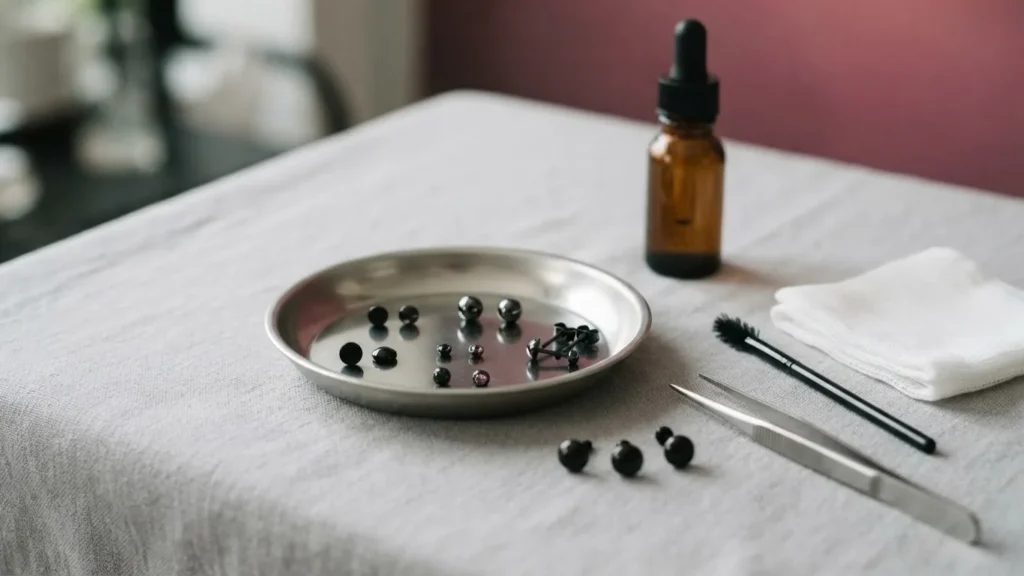
On a steel or titanium stud, the black you see is almost always a coating laid onto the surface, with the metal underneath staying its usual gray. That single fact decides whether black ear piercing studs belong in a fresh piercing, because a coating behaves very differently from a color grown into the metal’s own oxide. Blue and purple anodized titanium draw their color from that oxide. Black titanium, in nearly every case, draws its color from a deposited film that can thin, scratch, and wear through to the metal below. Where the color lives changes where the risk lives.
Black ear piercing studs get their color one of two ways. On titanium and surgical steel, black is a PVD coating applied over the metal, so it can wear or chip and expose the base material. On niobium, black can be a true anodized oxide that is part of the metal and will not rub off. For a fresh piercing, professional standards favor uncoated implant-grade metal: titanium meeting ASTM F-136, steel meeting ASTM F-138 or ISO 5832-1, or genuinely anodized niobium under ASTM F2384. A healed ear has more room for a coated decorative stud, as long as the base metal underneath is biocompatible and the finish is intact.
Why Black on Steel and Titanium Is a Coating

Two processes put color on piercing metal, and they are worlds apart in durability. Anodizing runs an electric current through the piece in an electrolyte bath, thickening the metal’s natural oxide. Light reflects off the top and bottom of that thin oxide film and interferes with itself, and the film’s thickness sets the color your eye reads. Skyjems describes how films measured in tens to low hundreds of nanometres can produce the full visible spectrum. The color is the metal’s own surface, so there is nothing sitting on top to flake away.
Anodizing has a ceiling. On titanium it reaches blues, purples, golds, and greens, while a deep, even black lies outside what the oxide can render. So a black titanium stud almost always owes its color to a second method. The archived explainer at motogp.com separates the two coloring routes for titanium: interference anodizing on one side, applied coatings on the other. Only one of them changes the metal’s own surface; the other puts a new material on top of it.
Black comes from physical vapor deposition, or PVD. Imaxshop describes its black titanium jewelry as a PVD layer, such as titanium nitride, laid over Ti-6Al-4V, which places the black on the surface. Trinity Body Jewelry lists its black titanium labret the same way: an implant-grade Ti-6Al-4V ELI post meeting ASTM F-136, finished with a PVD color. The post is sound metal. The black is a coating sitting on sound metal, and a coating is a wear item.
Niobium is the exception worth knowing. Among the metals accepted for initial piercings, it is the one that anodizes to a genuine, integral black. Nébuleuse Bijoux lists niobium conforming to ASTM F2384 among the APP-accepted options. A black niobium stud carries its color inside the oxide itself, which gives it a durability profile a coated piece cannot match. When a listing says “black niobium” and names that standard, the color and the metal are the same thing.
Can Black Studs Go in a Fresh or Healing Piercing?
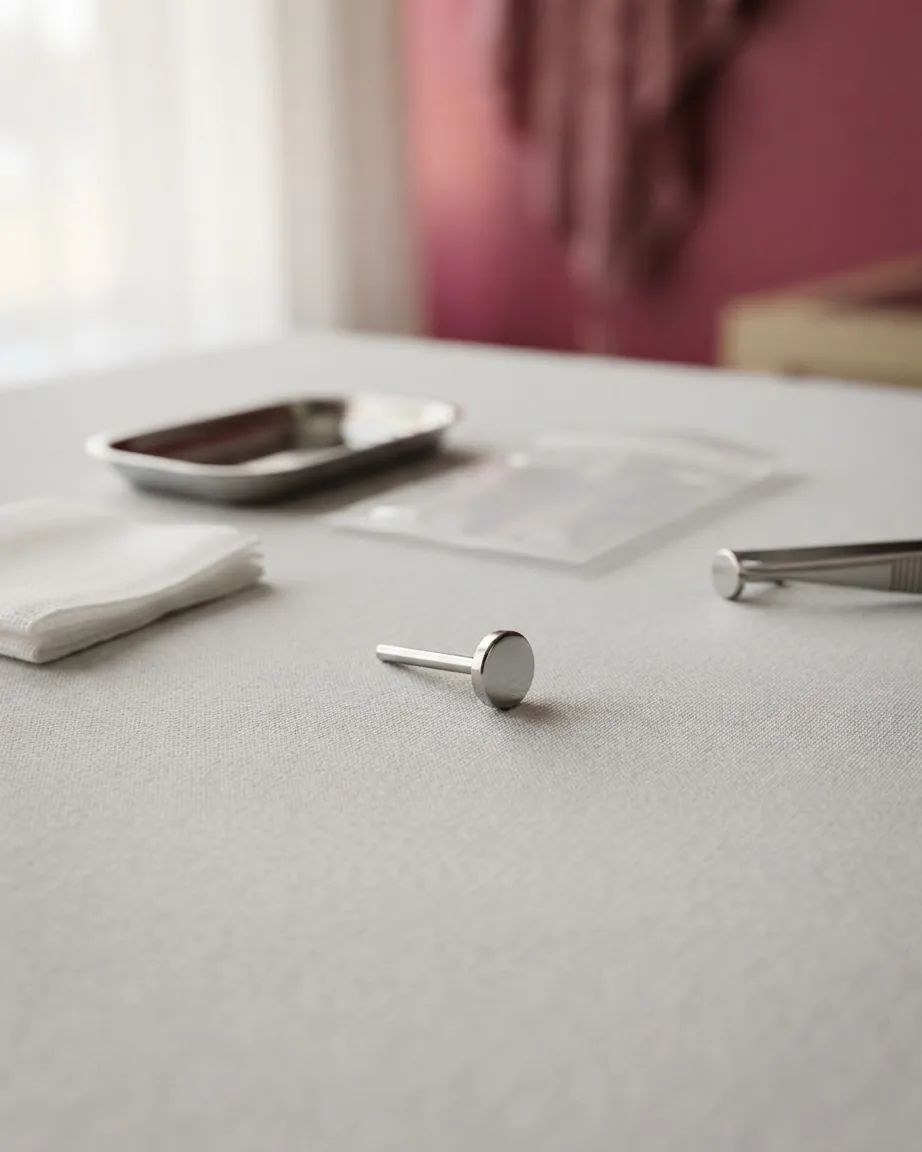
A fresh piercing is an open wound, and the jewelry inside it presses against raw tissue for weeks. The Association of Professional Piercers draws a hard line here: plated, filled, and coated jewelry does not belong in an initial piercing, because the colored surface is thin enough to wear or chip off. The APP describes that plated surface as “very thin – measured in millionths of an inch,”
and warns it can wear or chip away under normal handling. A layer that slight is no barrier inside a healing channel.
Once a coating wears, the metal underneath meets the wound directly. BodyJewelry.com, an industry supplier blog, concedes the same mechanism: when PVD wears, whatever metal lies beneath contacts the skin. If that base metal is a biocompatible grade, a worn spot is a cosmetic problem more than a medical one. If the base metal is unknown or low-grade, a worn patch can introduce an irritant to tissue that is still trying to close.
A healed piercing changes the picture. Once the channel has matured into skin-lined tissue, a decorative coated stud carries much less risk, provided the base metal is biocompatible and the ear is calm when you make the change. Even then, a coated stud with visible flaking or a dulled patch has reached the end of its service in a piercing, and it is worth retiring before the bare metal shows. For a channel that is still healing, the safer default is uncoated implant-grade metal in a plain or anodized finish.
“Suitable for Initial Piercing” on Coated Studs: What That Claim Means
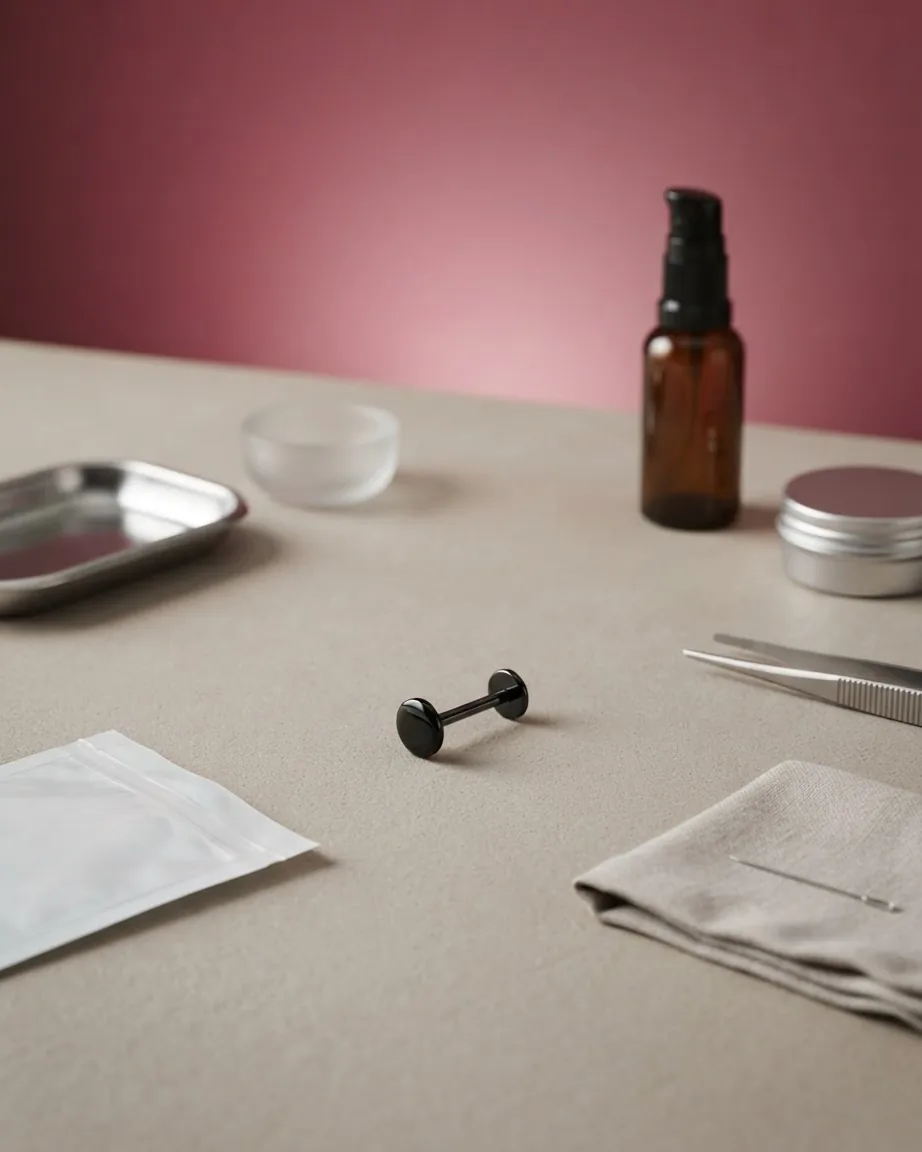
Retailer language around coated pieces is where buyers get caught. Blue Banana, for one, markets a 1.2mm PVD-over-steel ring as suitable for an initial piercing. That phrase is a shop’s durability claim. The APP’s material clearance is a separate judgment with its own criteria, and a coated piece does not automatically hold it. A coating can be tough in a display case and still fail the test that matters for a wound: what the skin touches after the finish gives way.
The honest way to read “suitable for initial piercing” on a coated stud is as a statement about the color lasting, not about the metal being approved. Two questions settle it. First, what is the base metal, and does its listing name an implant standard? Second, is the color a coating or an integral anodize? A PVD piece can be perfectly fine in a healed ear and the wrong choice in a fresh one, and the marketing line rarely makes that distinction for you.
The Material Standard to Check Before You Buy

With the color question answered, the real decision is the metal under it, and a listing either shows a recognized grade or it stays vague. The Lobecraft Editorial Desk compiles the following from published professional standards into one listing check you can run before anything reaches a cart:
- Titanium: ASTM F-136, the implant-grade Ti-6Al-4V ELI alloy. Healthline notes this grade is nickel-free and suited to both fresh and healed piercings.
- Steel: ASTM F-138 or ISO 5832-1. The APP treats only these specific grades as biocompatible for body jewelry, so a steel listing should name one of them.
- Niobium: ASTM F2384, the one approved metal that takes a true black anodize, per the APP-accepted metals summarized by Nébuleuse Bijoux.
- Gold: 14k or higher and free of nickel and cadmium; the APP flags gold above 18k as too soft for an initial piercing.
- Finish and threading: a mirror-polished surface and an internally threaded or threadless post, so no screw threads scrape the inside of the channel on the way in.
The gap this check catches is the bare “stainless steel” label. Trendhim sells a 4mm black steel button stud described as 316L, with no ASTM or implant designation attached. 316L is a real alloy used widely, but on a listing that never names F-138 or ISO 5832-1, “stainless steel” describes a family of metals rather than a biocompatibility grade, and the black on top remains a coating. For a first piercing, a missing standard is itself the answer: treat the piece as a healed-ear option at most.
The mirror finish and threading points are easy to skip and worth holding to. A polished surface gives healing tissue less to grab and fewer micro-scratches to harbor irritation. Internally threaded or threadless posts keep the threads off the wound, since an externally threaded post drags its ridges through the channel each time it goes in or out. Those two features matter in a fresh piercing regardless of color, and no black finish compensates for their absence.
When You Can Switch to Black Ear Piercing Studs
Changing jewelry too early is how a settled piercing turns angry again, so timing the switch to a black decorative stud should follow healing biology rather than a box’s calendar. Physician-reviewed guidance from Ubie Health puts earlobe healing at roughly 6 to 8 weeks on the surface, with cartilage taking longer, commonly 3 to 6 months and sometimes up to a year. Those ranges describe the tissue itself, independent of what brand you happened to buy.
Brand kits give shorter numbers, and it helps to see why they differ. A Claire’s black-stud piercing kit sets a window for applying its ear care solution and allows an early first change for lobes, or a longer one for cartilage, when its rapid cleanser is used. Those windows belong to that product’s protocol, measured for one specific aftercare routine. They do not declare that any lobe, healed with any method, is ready that early.
So which number should govern your ear? For a fresh piercing, the conservative read wins. Let a lobe reach the 6-to-8-week range and let cartilage reach months before the first swap, and treat a brand’s shorter window as valid for the routine it was written around and still premature for a channel healing on its own schedule. The practical signals point the same way: an ear that is calm, non-tender, and producing no discharge is likelier ready. When the signs are mixed, a piercer can assess it in person, which no timeline can do for you. See also our guide on lobe piercings take to heal.
Black Studs for Nickel-Reactive Ears
For skin that reacts to cheap earrings, a black coating makes a poor shield and a quiet trap. Reactions to costume jewelry are usually a nickel response, and a coating can hide a nickel-bearing base metal for a while, then wear and bring that metal against reactive skin at the one spot where it will cause the most trouble. Painting over nickel buys time; it does not remove the cause.
The durable route takes nickel out of the substrate instead of covering it. Healthline notes that implant-grade titanium meeting ASTM F-136 is nickel-free, which is why it suits sensitive wearers and works in both fresh and healed piercings. A black finish on that substrate is still PVD, so it can still wear, but a worn patch exposes nickel-free titanium, and the failure mode is far gentler than a worn coating over a nickel-bearing alloy.
For a reactive wearer set on black specifically, integral black niobium is the cleaner answer. The color lives in the metal, there is no coating to breach, and niobium itself carries no nickel. That combination removes both failure points at once: no thin surface to wear away, and no reactive metal to reach if it did. See also: our metals that keep nickel out.
Gauge, Size, Placement, and Retainers
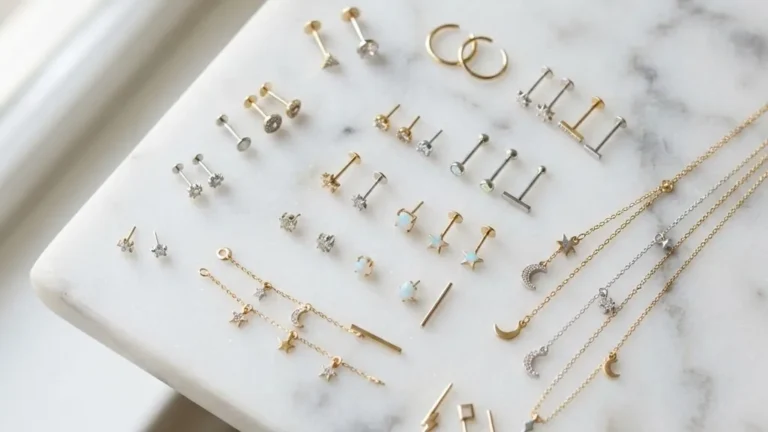
What a piercer fits depends on the spot, and choosing black changes the finish while leaving the mechanics the same. Lobes take a straightforward post. A common lobe gauge is slim, with a front ball or flat disc; Claire’s lobe studs and the Trendhim button stud both sit in that everyday range. For a fresh lobe, a flat-back labret post, a flat disc behind the ear with a threadless or internally threaded top, lies flatter against the tissue than a butterfly back and traps less behind it. A longer post length leaves headroom for early swelling, and a finer gauge appears mainly on thinner placements rather than standard lobes.
Cartilage asks for a different fit. Helix, conch, and tragus tissue is thicker and heals over the 3-to-6-month range above, so piercers favor flat-back labret studs over butterfly backs, and over hoops, in the early months. A flat back stays cleaner and snags less on hair and bedding. A black flat-back stud fits here only once the base metal clears the listing check and the piercing is settled enough to change at all. See also our types of ear piercings rundown.
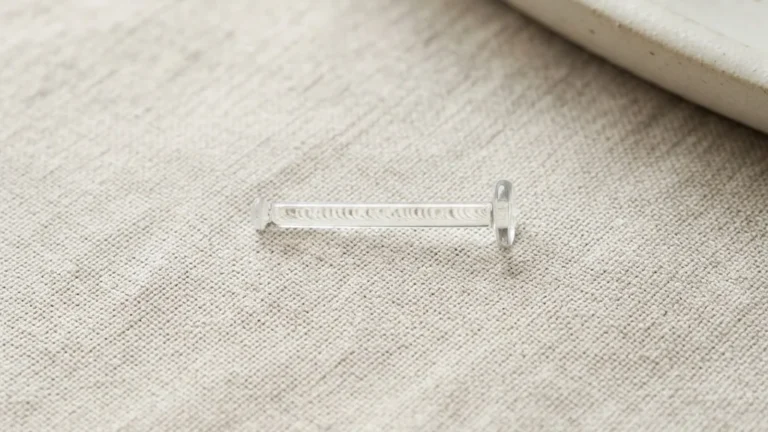
Studs and retainers answer opposite needs, and it is worth keeping them straight. A decorative black stud exists to be seen. A retainer, usually clear or skin-toned, exists to keep a channel open while hiding it, for a workplace or any setting where visible jewelry is off the table. If the aim is to go dark and low-profile at the same time, a plain black flat-back stud does the job better than a hoop, since a hoop swings, catches, and tugs a healing channel. Hoops suit a healed ear; for one that is still settling, a fixed flat-back post is the steadier wear.
On price, the pattern holds across suppliers: implant-grade titanium and anodized niobium studs cost more than coated high-street steel kits, and that gap pays for the metal under the color. A boxed coated-steel kit from a mall retailer sits at the low end, while individually sold implant-grade pieces from body-jewelry suppliers sit higher. For a first piercing, the metal standard is where spending earns its keep, so put the budget there rather than into the finish.
Finish aside, an ear that turns red, swells, stays painful, or weeps discharge is telling you to stop changing jewelry and have it looked at, by the piercer who did the work or by a clinician. That holds for black studs as much as any plain post, and it is the one call no listing check can make for you. For the wider world of piercing jewelry, the broader guides go through what each placement wants, spot by spot.
How Much Longer Before Cartilage Can Take a Black Decorative Stud
Since a black stud on steel or titanium is usually a coated decorative piece, the honest move is to wait for the channel to heal before switching into one. Lobe healing runs 6 – 8 weeks and cartilage 3 – 6 months, sometimes up to a year. Put those on the same scale and the gap is stark:
- A lobe is at the long end of its heal at 8 weeks. Cartilage at its fastest (3 months) is about 13 weeks – roughly 1.6× longer, or about 5 extra weeks before you’d think about a coated black stud.
- Cartilage at the worst case (up to a year) runs far past a lobe’s eight-week mark, adding many more weeks of waiting.
In plain terms: a timeline that lets you move a lobe into a decorative black stud at around two months can leave a cartilage piercing months short of ready. Judge the switch by the slower cartilage clock, not the lobe one.