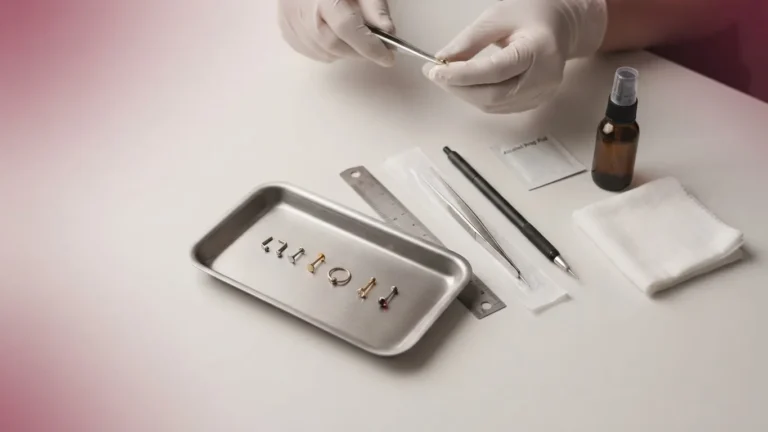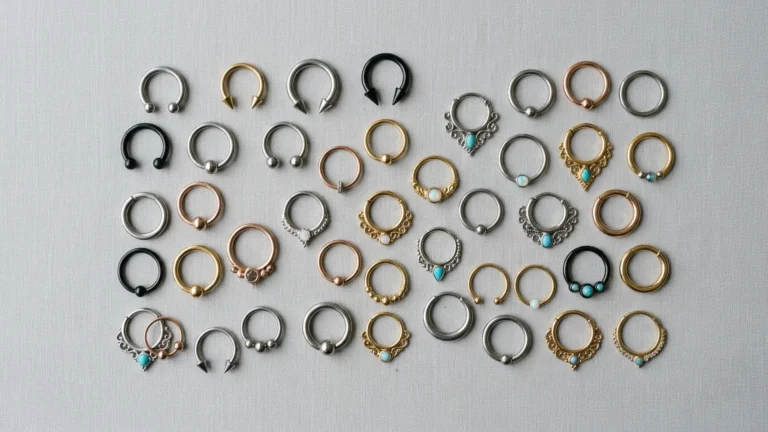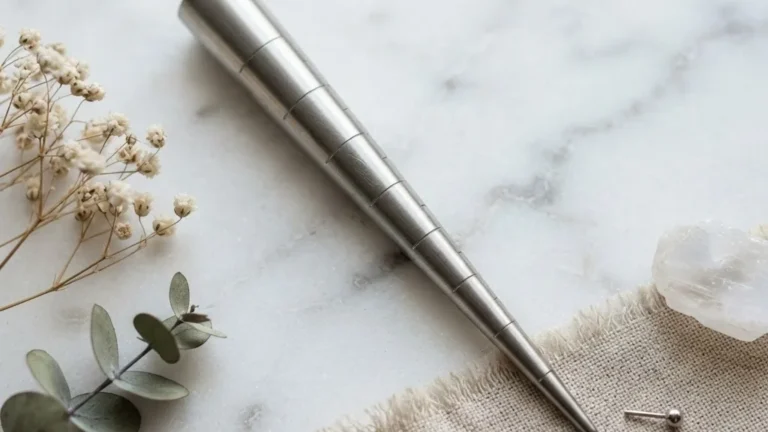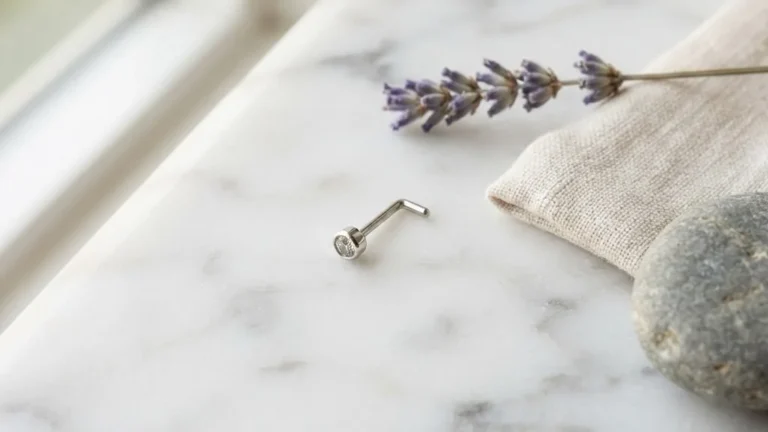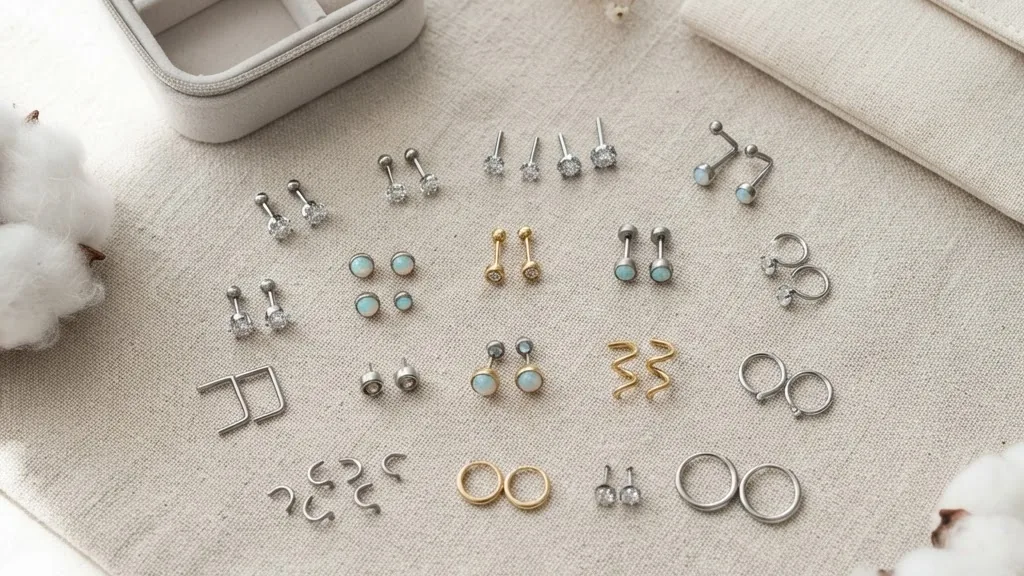
Hypoallergenic nose piercing jewelry is one of the most misused phrases I deal with in the studio, because the word “hypoallergenic” has no legal definition and gets stamped on metal that still leaks the exact thing your skin is fighting. Nine times out of ten, that thing is nickel. When a client tells me their nose stud itches, weeps, or leaves a red halo around the hole, my first question is never about aftercare. It is about what the jewelry is actually made of, and whether anyone can prove it. That is the whole game, and it is simpler than the marketing makes it sound.
The short version: safe nose jewelry is jewelry that can name a materials standard and back it up. Everything else is a guess you are making with an open wound.
Quick answer: For a fresh or reactive nose piercing, the genuinely safe choices are implant-grade titanium (ASTM F136), commercially pure titanium (ASTM F67), niobium, or solid gold at 14k or higher that is nickel-free. All four keep nickel away from your tissue, which is what your skin actually cares about. “Surgical steel” is not automatically safe, because standard 316L still contains 10 to 14 percent nickel. The single biggest hidden risk is plated or mystery-metal jewelry, where a safe-looking surface wears off and dumps a cheap base alloy straight into the piercing. If a seller cannot name the standard, treat the metal as unknown and walk.
Why nickel is the real problem, not “sensitive skin”
People love to blame their own “sensitive skin,” but most nose piercing reactions are a specific, testable allergy to nickel. It is the most common contact allergen there is. Depending on the dataset, somewhere around 17.5 percent of patch-tested people in North America react to nickel, and broader estimates put it above 18 percent of the population. It skews hard by sex too: roughly 17.1 percent of women versus about 3 percent of men, which lines up with who gets pierced younger and more often.
Kids are not spared. Pediatric patch-test data shows nickel sensitivity as high as 23.7 percent, and the American Academy of Dermatology has estimated the problem touches around 11 million children in the United States. Once you are sensitized, it is usually for life. That is why I treat nickel exposure in a fresh piercing as a one-way door: you do not want to teach your immune system to hate a metal it will meet again in glasses frames, jean buttons, and phone cases.
Here is the part that makes jewelry choice measurable instead of vibes. The European Union regulates how much nickel an item may release, not just whether it contains any. Under the REACH rules (Annex XVII, entry 27, the old Nickel Directive), anything in prolonged skin contact must release less than 0.5 micrograms per square centimeter per week. For posts inserted into a piercing, the limit is stricter still, 0.2 micrograms per square centimeter per week, measured with a standardized artificial-sweat test called EN 1811. Fresh piercings get the tighter number for a reason: an open wound has no skin barrier, so the tissue soaks up whatever the metal gives off.
So the goal is not vague comfort. The goal is a metal that either contains no nickel at all, or is locked down tightly enough to stay under that release ceiling while your piercing heals.
The metals that are genuinely hypoallergenic
Four materials do this job well, and the Association of Professional Piercers backs all of them for initial piercings on its professional piercing standards site. I will rank them the way I actually hand them to clients.
Implant-grade titanium (ASTM F136). This is my default and the one I reach for first for anyone with sensitive skin. F136 is the alloy Ti-6Al-4V ELI, which is titanium with about 6 percent aluminum and 4 percent vanadium and “extra low interstitial” impurities. Crucially, it contains zero nickel. It is inert, it is roughly half the weight of surgical steel so it drags less on the piercing, and it can be anodized into blues, purples, and golds using nothing but electricity, so the color does not add any coating that can flake. For a fresh nostril or septum, this is the safest, most comfortable, most forgiving option on the shelf.
Commercially pure titanium (ASTM F67). Same nickel-free story, slightly different spec. F67 is unalloyed titanium rather than the Ti-6Al-4V blend, and the APP accepts it for initial piercings right alongside F136. In practice both wear beautifully. If a shop stocks one or the other, you are in good hands.
Niobium. Niobium is my favorite budget hypoallergenic pick. It is an inert elemental metal with a long, boring, wonderful track record in piercing. It has no formal implant designation the way titanium does, but piercers have used it safely for decades. Like titanium it anodizes for color, and unlike titanium it can be anodized to a genuine black. It is a touch heavier than titanium but still very body-friendly. If titanium is out of budget, niobium is where I send people rather than letting them gamble on steel.
Solid gold, 14k or higher. Gold is the premium route, and it is a real one, but the karat and the alloy matter. The APP calls for 14k or higher, nickel-free, and alloyed for biocompatibility. That “nickel-free” clause is not optional. Yellow and rose gold are usually fine. The trap is white gold, because the classic way to make gold white is to alloy it with nickel. If you want white metal, ask for palladium white gold, or just wear titanium, which is grey-white anyway. And never go above about 18k for a fresh piercing, because 22k and 24k are too soft and bend or nick easily.
The surgical steel caveat everyone gets wrong
“Surgical steel” sounds like the safe answer, and for a lot of people it is fine once they are fully healed. But it is not a nickel-free material, and that distinction matters enormously for a sensitive person. The workhorse alloy, 316L stainless, runs about 16 to 18 percent chromium, 2 to 3 percent molybdenum, and crucially 10 to 14 percent nickel. There is a lot of nickel in there.
What makes good steel usable is that the nickel is bound tightly into the alloy, so a properly made piece releases very little, generally well under that 0.5 microgram REACH ceiling. That is why plenty of healed piercings live happily in 316L for years. But three things break that safety margin: a diagnosed nickel allergy, a fresh unhealed wound, and cheap steel that was not made to spec. In any of those cases, the small amount that does leach can be enough to keep a piercing angry.
If you want steel done right, look for implant-grade steel specifically, ASTM F138 (sometimes labeled 316LVM, a remelted, cleaner version), not the generic “surgical grade” sticker. But honestly, for a first nose piercing or for anyone who already reacts to metal, I skip the whole debate and use titanium or niobium. There is no upside to gambling on steel when nickel-free options cost about the same. When a client asks me to talk them into steel for a healing piercing, I usually talk them out of it.
What to avoid, and why it fails
The dangerous jewelry is rarely the stuff that is honestly labeled steel. It is the stuff wearing a costume.
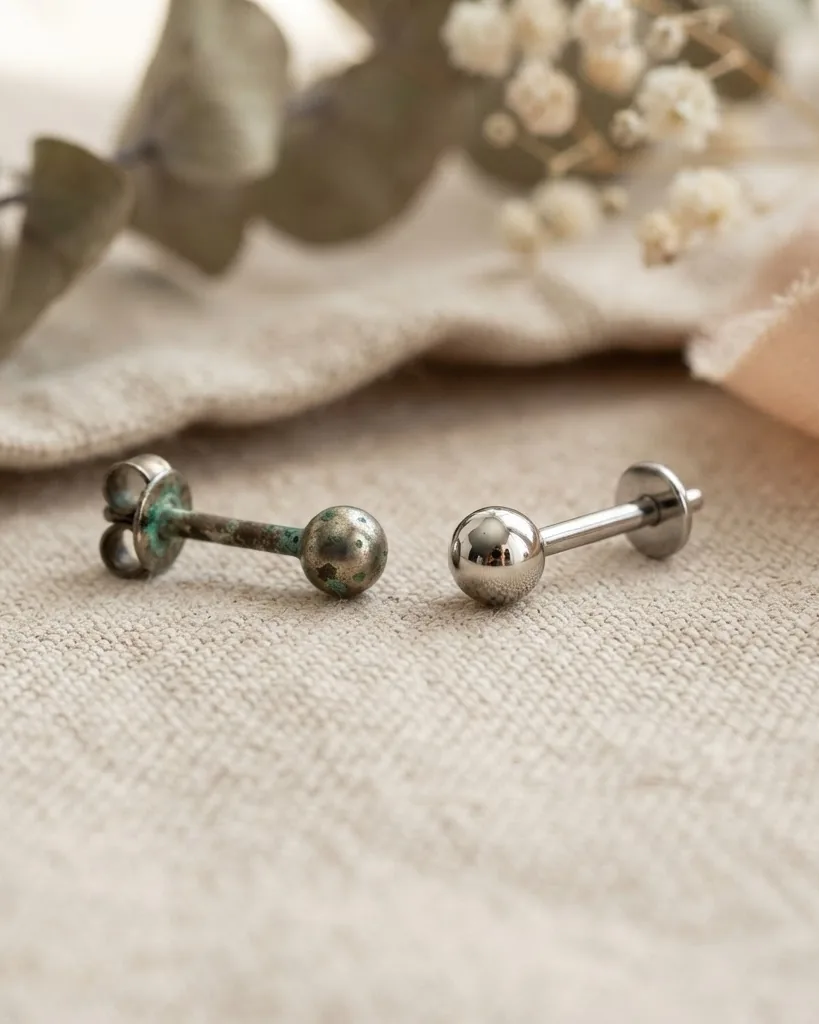
Plated jewelry. Gold plating is thin, typically 0.5 to 2.5 microns. That is a film, not a material. Friction from cleaning, clothing, and just living wears it through, and once it is gone your skin meets the base metal underneath, which is very often a nickel-heavy brass. So a piece that felt fine for a month suddenly starts reacting, and people blame their aftercare when the real culprit is a worn coating. In a fresh piercing this can happen fast because the jewelry is being wiped and moved constantly.
Gold-filled and vermeil. Better than flash plating, still a coating over a base core. Fine for healed lobes and fashion earrings, not what I want sitting inside a healing nostril.
Sterling silver. Silver tarnishes, and that tarnish and the copper in the alloy can irritate an open piercing and even leave a grey mark. I keep silver out of fresh piercings entirely and save it for long-healed ones if the client insists.
Mystery metal. The catch-all. If a listing says “hypoallergenic alloy,” “surgical grade,” or “nickel free” but names no ASTM or ISO standard, it is mystery metal. Those phrases are marketing, not proof. A cheap nose hoop off a marketplace that will not tell you the standard is exactly the piece that turns a routine piercing into a months-long problem.
How to verify materials before you buy
This is the part that separates people who heal cleanly from people who keep re-buying jewelry. You do not have to be a metallurgist. You just have to ask one question and refuse to accept fog for an answer.
Ask the seller to name the standard in writing. For titanium that is ASTM F136 or ASTM F67. For steel it is ASTM F138. For gold it is a karat number of 14k or higher plus “nickel-free.” A real supplier answers instantly, because they buy certified stock. A reputable studio can often show you a mill certificate or material certification for the exact batch their jewelry came from. That paper trail is the actual meaning of hypoallergenic nose piercing jewelry, far more than any label on the pouch.
A few practical tells. Internally threaded or threadless implant-grade pieces almost always come from quality suppliers, because the tooling is expensive and cheap factories do not bother; externally threaded jewelry with a screw thread that drags through the piercing is a lower-end sign. Anodized color on titanium is fine and safe. A painted or coated color is not. And remember the words that mean nothing on their own: “hypoallergenic,” “surgical,” and “nickel free” carry no legal guarantee in most markets. The standard number is the only thing that does. If the shop cannot give you one, the honest move is to assume the worst about the metal.
If you already own a piece and cannot tell, a home nickel spot-test kit (dimethylglyoxime solution) is a cheap sanity check. A pink color means nickel is releasing at the surface. It is not a lab, but it will catch obvious offenders before they go in your nose.
Choosing for a fresh piercing, sensitive skin, and healing
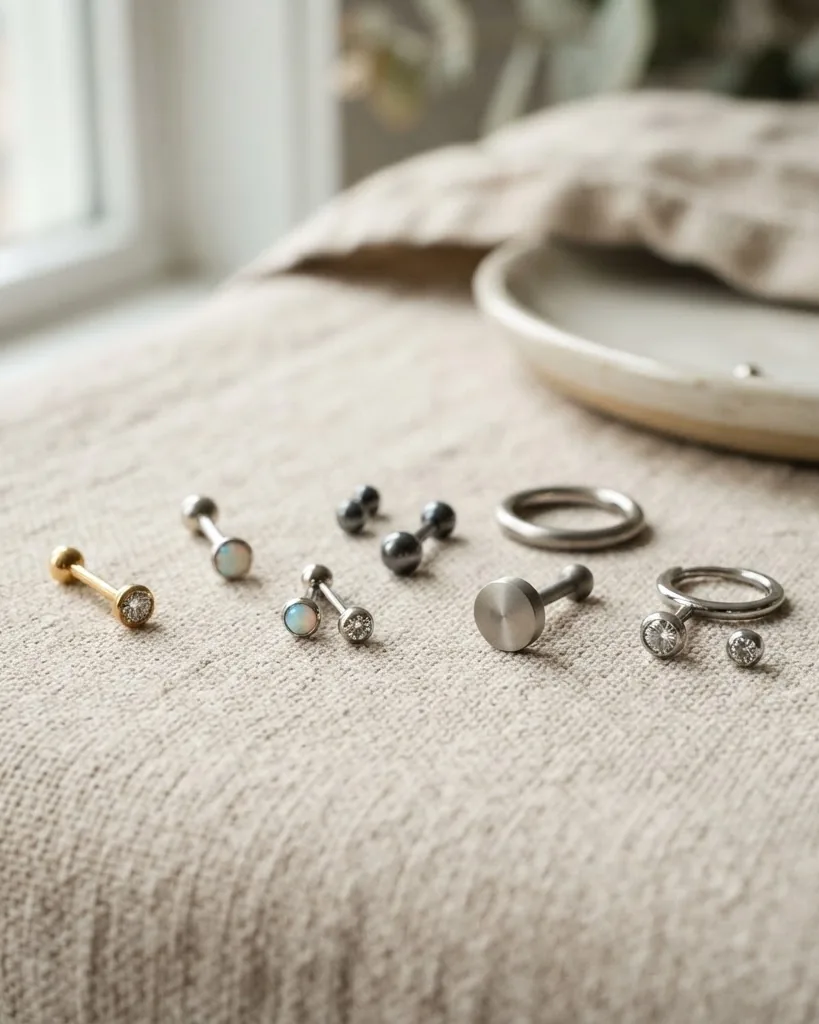
Material is most of the battle, but fit matters too, because a piercing that is fighting bad geometry will act like it is fighting the metal. Nose piercings are not one size. A standard nostril is usually pierced at 18 g or 20 g, with 20 gauge being the most common, and the starter is often set at around a 1/4 inch length to leave room for swelling. A septum runs thicker, typically 16 g or 14 g. Getting the gauge and length right the first time means you are not swapping jewelry mid-heal, which is when a lot of nickel exposure and irritation actually happens.
Give it time before you change anything. A nostril piercing generally takes 4 to 6 months to heal, and a septum is faster at about 2 to 3 months because there is less tissue to rebuild. During that window, keep the same implant-grade piece in and leave it alone. If you must change, change to another nickel-free material, not to a fashion piece you have not verified. For sensitive or allergy-prone skin, my order is simple: F136 titanium first, niobium if budget is tight, solid 14k or 18k gold if you want something special, and steel only once you are fully healed and know you tolerate it.
Aftercare belongs in the same conversation, because irritation and allergy look alike and people mistake one for the other. Clean gently with a proper wound-wash rather than harsh soaps or alcohol, and if you are unsure how to do that correctly, read our walkthrough on using a sterile saline solution for a nose piercing before you improvise. If a piercing keeps reacting even in verified titanium, the problem is usually placement, jewelry size, or a snag, not the metal, and that is a studio visit, not a new metal.
One healing detail worth planning for is downsizing. Piercers often start you with a slightly longer post, around that 1/4 inch, so early swelling has somewhere to go. Once the swelling settles, usually after the first several weeks, that extra length lets the jewelry shift, snag, and press on the piercing at odd angles, which reads as irritation but is really a fit problem. Swapping to a shorter, correctly sized nickel-free post at that point can quietly fix a piercing that seemed stubborn. It is a small, cheap change, and it should always be a same-standard material, so you are downsizing the length, not downgrading the metal.
Placement and jewelry style also depend on your anatomy. Septum jewelry in particular has to match the sweet spot inside your nose, and if you are shopping shapes and sizes, our rundown of the best septum ring styles pairs well with the material rules here. When you match the right nickel-free metal to the right fit, most healing problems simply do not start.
Putting it together: a simple buying rule
If you remember nothing else, remember this ranking. For anything fresh or reactive, buy implant-grade titanium (ASTM F136) or commercially pure titanium (ASTM F67). If money is tight, buy niobium. If you want luxury, buy solid gold at 14k to 18k that is stated nickel-free, and skip nickel-whitened white gold. Treat “surgical steel” as a healed-only, no-known-allergy option, and only in real ASTM F138. Refuse plated, gold-filled, sterling, and mystery metal for any healing piercing. And in every single case, make the seller name the standard before you pay. That one habit is what real hypoallergenic nose piercing jewelry actually looks like in practice.
Metal-by-metal comparison for nose piercing jewelry
Reading the same five materials side by side makes the buying decision faster than re-reading the sections above. Use this as a quick reference when you are standing at a counter or scrolling a listing and need an answer in ten seconds.
| Metal | Nickel Content | Heal-Safe for Fresh Piercings | Price Tier | Notes |
|---|---|---|---|---|
| Implant-grade titanium (ASTM F136) | 0 percent, nickel-free | Yes, first choice | Low to mid | Inert, lightweight, anodizes for color without adding a coating |
| Commercially pure titanium (ASTM F67) | 0 percent, nickel-free | Yes | Low to mid | Unalloyed titanium, accepted by the APP right alongside F136 |
| Niobium | 0 percent, nickel-free | Yes, best budget pick | Low | No formal implant spec but decades of safe piercing use, anodizes to true black |
| Solid 14k to 18k gold, stated nickel-free | 0 percent if alloyed correctly | Yes, once the seller confirms nickel-free | High | Yellow and rose gold are usually safe; skip nickel-whitened white gold |
| White gold, standard alloy | Often 4 to 10 percent | No | High | Classic whitening process uses nickel; ask for palladium white gold instead |
| Surgical steel 316L | 10 to 14 percent | Caution, healed piercings only | Low | Nickel is bound into the alloy but still leaches enough to bother sensitive skin |
| Plated or unlabeled metal | Unknown, often high once the coating wears through | No | Lowest | Coating runs about 0.5 to 2.5 microns and exposes a nickel-heavy base underneath |
Tip: Ask the seller to put the exact standard in writing before you pay: ASTM F136 or F67 for titanium, ASTM F138 for steel, or a stated karat plus “nickel-free” for gold. If they cannot produce that, treat the piece as unverified metal and choose titanium or niobium instead.
Frequently asked questions
Is titanium or surgical steel better for a nose piercing?
Titanium wins for anyone with sensitive skin or a fresh piercing. Implant-grade titanium (ASTM F136) contains no nickel and is about half the weight of steel, so it irritates less. Standard 316L surgical steel holds 10 to 14 percent nickel; it releases very little when well made, but titanium removes the risk entirely, which is why I default to it.
Does implant-grade titanium ever cause allergic reactions?
True titanium allergy is rare, far rarer than nickel allergy. Most reactions blamed on titanium are actually irritation from bad fit, too much cleaning, or a snag, or they come from cheap “titanium” that was never certified. Genuine ASTM F136 or ASTM F67 titanium is inert and one of the safest metals you can put in a healing nose piercing.
Is gold-plated nose jewelry safe for a new piercing?
No. Plating is only about 0.5 to 2.5 microns thick and wears through with normal cleaning and wear, exposing the base metal underneath, which is often nickel-heavy brass. That is exactly when a piercing that seemed fine starts reacting. For a fresh piercing, use solid nickel-free metal, not plated, gold-filled, or vermeil.
How do I know if my nose jewelry contains nickel?
Ask the seller for the exact standard: ASTM F136 or F67 for titanium, F138 for steel, or 14k-plus nickel-free for gold. A quality studio can show a mill certificate. Words like “hypoallergenic” and “surgical grade” prove nothing on their own. For a piece you already own, a home nickel spot-test kit will flag obvious offenders.
Can I wear white gold in a healing nose piercing?
Be careful. Classic white gold is often whitened with nickel, which defeats the purpose for a sensitive person. If you want a white metal, choose palladium white gold and confirm it is nickel-free, or simply wear titanium, which is naturally grey-white. Yellow and rose gold at 14k or higher are usually the safer gold choices for healing.
How long before I can change my nose jewelry?
Wait for full healing: about 4 to 6 months for a nostril and 2 to 3 months for a septum. Changing early invites irritation and can force you into whatever jewelry fits rather than what is safe. When you do change, stay in verified nickel-free metal and keep the correct gauge, usually 18 g or 20 g for a nostril.
The bottom line
Real hypoallergenic nose piercing jewelry is not a marketing badge, it is a metal that can name its standard and keep nickel away from your tissue. Reach for implant-grade titanium (ASTM F136), commercially pure titanium (ASTM F67), niobium, or solid 14k-plus nickel-free gold, and be honest about surgical steel: fine for many healed piercings, but it still carries 10 to 14 percent nickel, so it is not the safe default people assume. Avoid plated and mystery metal entirely while you heal. If you want to go deeper on nickel allergy itself, the American Academy of Dermatology and Mayo Clinic both have solid overviews. Buy the metal that can prove itself, get the fit right, and most nose-piercing drama never starts.