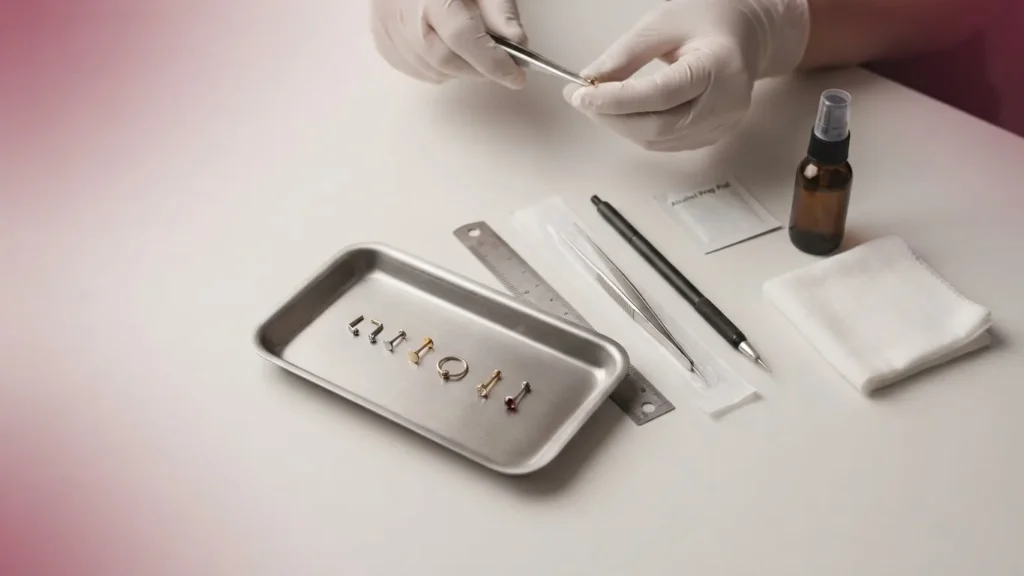
The spot most piercers aim for is not the crease itself but a point just below it, kept roughly centered on the nostril when viewed from the side. The professional piercer Lynn Loheide calls this the most common placement in her Nostril Piercing 101 guide, and the reason is mechanical rather than cosmetic: the crease moves every time you smile or flare your nose, it collects oil and dirt, and jewelry rarely sits flat in it. Getting nostril piercing placement right is less about the look on day one and more about which jewelry will ever fit, how the channel heals, and whether a future hoop will sit the way you picture it.
This guide compiles placement logic, gauge standards, and documented healing ranges from professional piercers, two body-jewelry retailers, a studio chain, the Association of Professional Piercers, and Mayo Clinic. It is informational, not a substitute for a consultation. Anything that looks wrong on your own nose belongs in front of your piercer or a clinician.
Quick answer: A standard nostril piercing placement sits a little below the crease, centered on the nostril. Start with a stud, not a hoop, and ask for at least 18g jewelry; 18g measures 1mm thick, while 16g is a common cartilage preference. Plan for 6 to 9 months of healing, sometimes up to a year. Lower placement allows a smaller, snug ring later; higher placement forces a larger one. Pick your side on anatomy and aesthetics both. Do not change the jewelry on a calendar date, only when the channel is genuinely healed.
Crease vs. Just-Below-Crease: Where the Hole Actually Goes
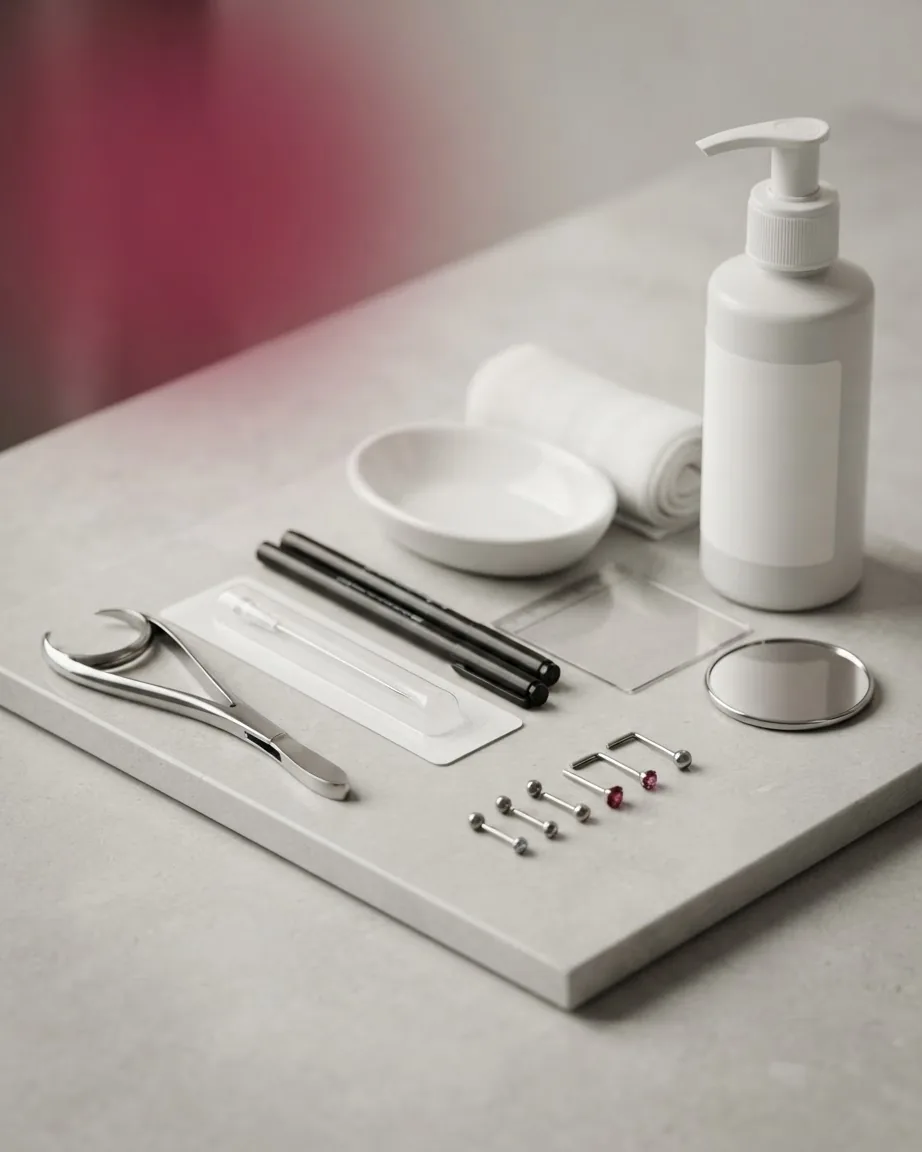
The classic look reads as “in the crease,” but that is often not where the needle goes. Lynn Loheide places the piercing a little below the crease and relatively centered, which still gives the visual impression of a crease piercing without the problems that come from sitting directly in the fold. The nostril flexes constantly as you talk, smile, and breathe, and a piercing planted in that hinge takes repeated motion all through healing. The crease also traps oil and debris, and studs tend not to lay flat there while hoops tend not to sit snug.
That said, there is no universal spot. Some people have almost no crease, and the piercer places the hole where a crease would otherwise be. Some have short nostrils where going even slightly below would land too low. For some, directly in the crease genuinely is the best-looking position, sometimes for cultural or religious reasons. The anatomy under the needle is not simply cartilage, either. Loheide describes the nostril as layers of cartilage, fatty tissue, connective membranes, and small muscles, with far more internal structure than an ear. That complexity is part of why these piercings can be fussier healers than people expect.
For the wider context on this area of the face, see our nose septum section.
Placement Height Decides Which Hoop Will Ever Fit

This is the decision most people make too late. If your end goal is a small, snug ring, the placement for that has to be planned before the needle goes in, not discovered afterward. The studio chain Essential Beauty explains in its nose piercing positioning guidance that the higher the piercing sits, the harder it is to change jewelry yourself and convert to a ring, and the larger that ring has to be. A hoop high up on the nose needs to be quite large to clear the tissue; the same style placed further down lets you choose a smaller, snug-looking ring.
Loheide makes the same point from the chair: placement may end up higher or lower to give you the hoop look you want, and if you are planning multiple nostril piercings, that planning has to happen at the first appointment. Her practical conclusion is direct. Most people asking to “be pierced with a hoop” are picturing a dainty, snug ring, which is not safe for initial healing. If that snug look is the goal, start with a stud, heal, then swap. The height you choose now makes that swap possible later.
A worked example of how this plays out in practice:
- Goal: tiny snug hoop. Lower, further-down placement; pierced with a stud first; convert once fully healed.
- Goal: larger, bolder hoop. Higher or further-back placement tolerates and even suits a bigger-diameter ring.
- Goal: nose chain. Position shifts forward or back so the chain rests cleanly rather than dragging.
- Goal: paired or stacked nostrils. Positions for all piercings get planned together at the first visit, not improvised one at a time.
Which Side: Reading Your Own Anatomy, Not Just the Mirror
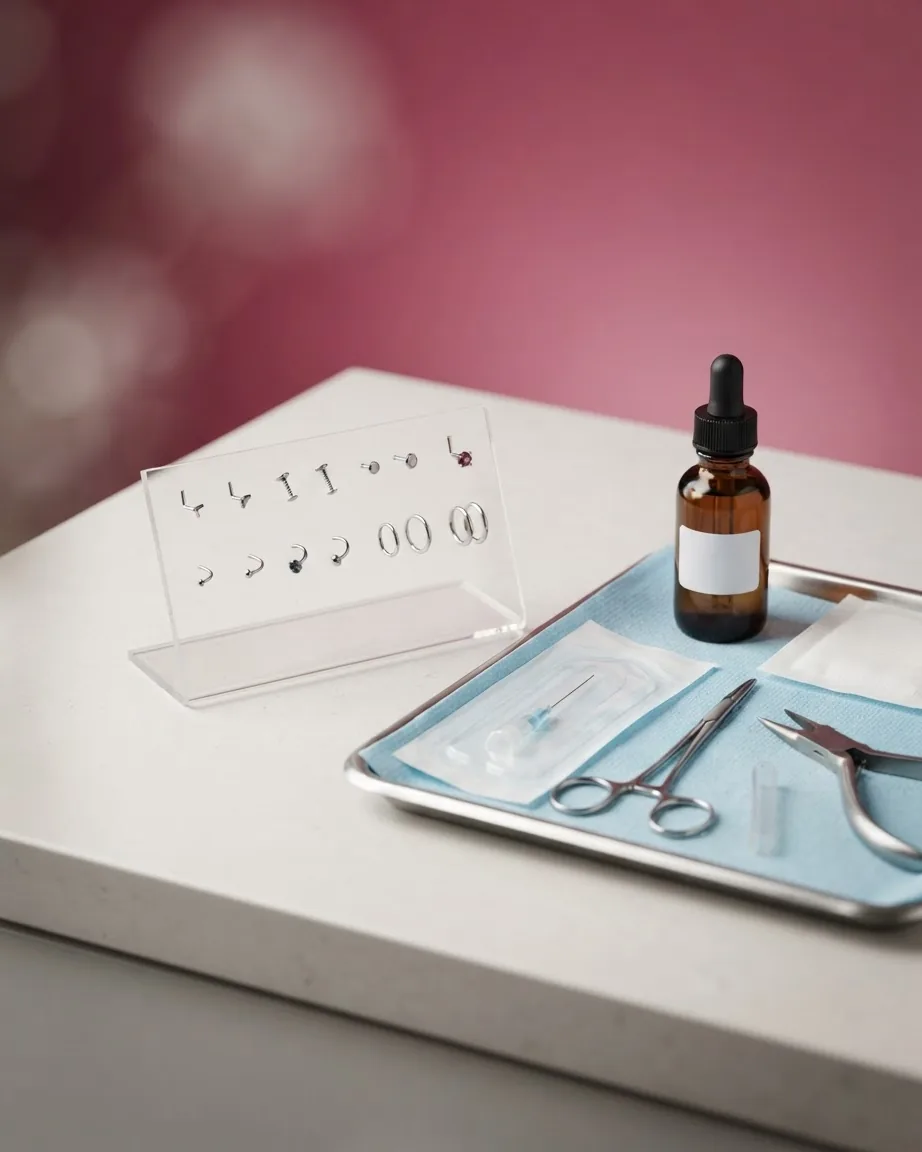
There is no medically correct side. Essential Beauty states plainly that neither side is right or wrong and that it comes down to you. Most people choose on aesthetics, often their “selfie side” or the side they favor in photos, or they balance the piercing against an existing feature like a mole or another piercing. Loheide notes her own casework has split roughly evenly between left and right over more than a decade, so the aesthetic choice is yours to make freely.
There is one anatomical criterion worth weighing alongside the aesthetic one. Essential Beauty advises choosing the thinner part of the nostril, the spot where it dips in more, because a thinner section means less tissue to swell and therefore less swelling to manage during healing. If one side is noticeably thicker or more bulging, that side has more room for a hoop to accommodate swelling, while the thinner, indented side tends to be the easier soft-tissue heal for a stud. If the two goals conflict, say so at the consultation; a piercer can tell you which compromise your particular nose handles better.
Initial Gauge: Why 18g Is the Floor and 16g Is Common
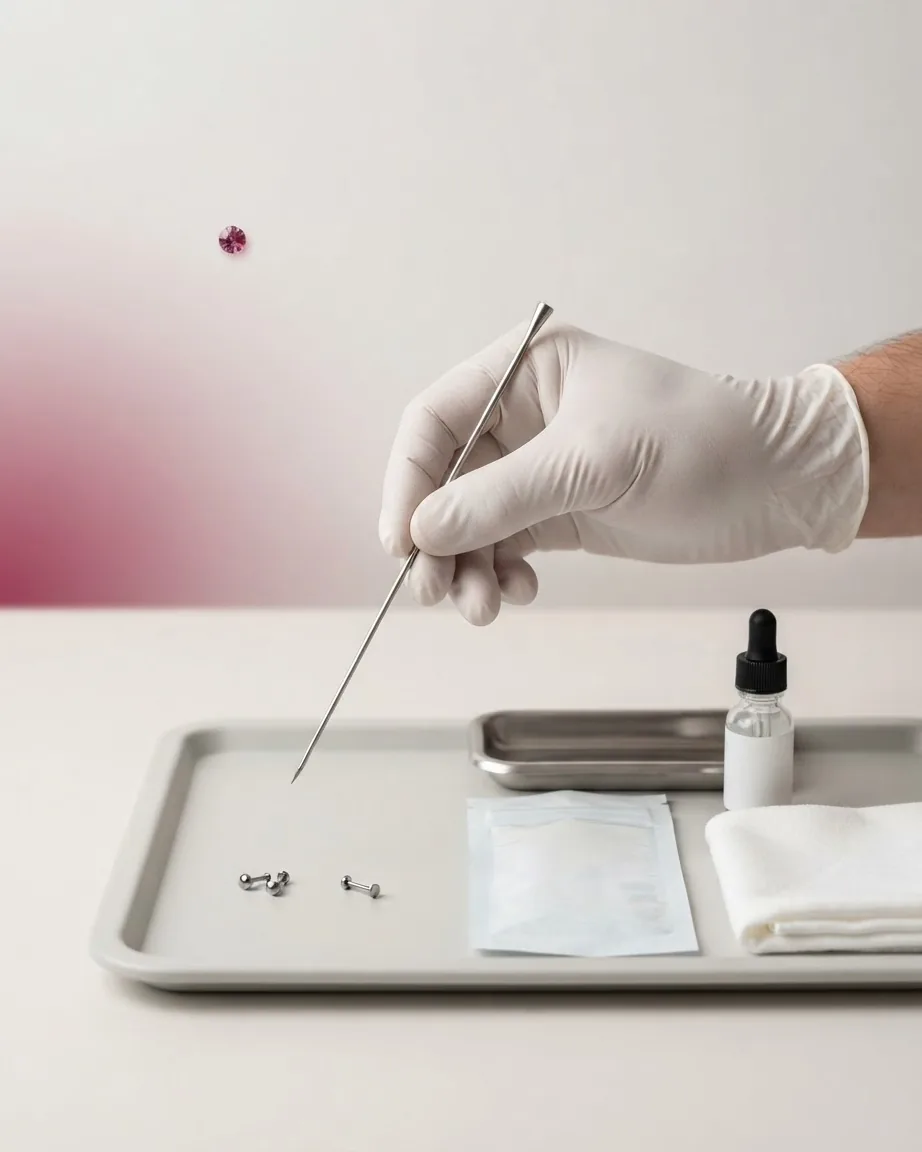
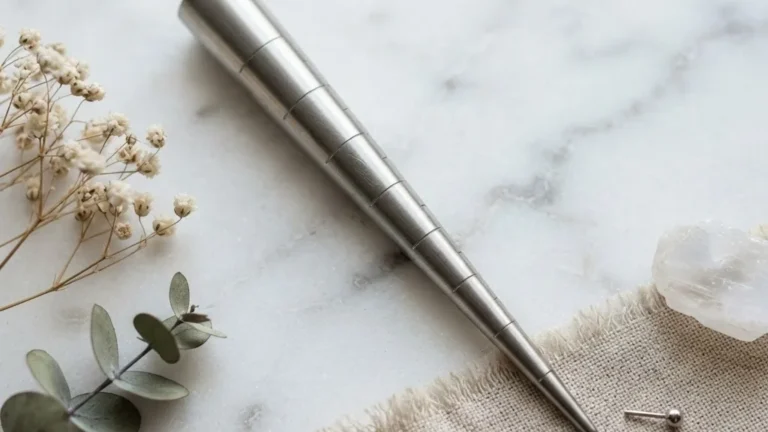
Gauge is the thickness of the post, and on a nostril it is a safety decision, not a style one. Thinner numbers mean thinner wire. Loheide sets 18g as the minimum she will use for an initial nostril piercing, because anything thinner invites the “cheese wire” effect: if the jewelry is snagged, a too-thin post can cut or tear through the tissue toward the edge of the nostril, causing irritation and potential scarring. Pierced Owl, in its guide to nostril piercings, gives the same floor of at least 18 gauge and describes that migration-toward-the-edge failure in the same terms.
The sources are not pushing a single magic number, and it matters that you don’t read them as if they were. Three separate claims line up as minimum, preferred, and observed range:
- Minimum. 18g, the thinnest Loheide and Pierced Owl will go for an initial piercing. 18g equals 1mm, and according to BodyArtForms in its complete nose piercing guide, that 1mm, 18-gauge size may currently be the most popular gauge for nose piercings.
- Preferred by many piercers. 16g. Loheide notes cartilage, whether on the ear or nose, often heals better with slightly thicker jewelry and that many piercers favor 16g, which she finds can be more stable, especially for people with specific jewelry goals or a history of difficult healing.
- Observed range. BodyArtForms records the typical range for nostril piercings as 20g to 16g, with 20g measuring 0.8mm. Z-Edge Piercing similarly cites a common 16g-to-20g span.
Don’t collapse these into one recommendation. The 20g end of BodyArtForms’ observed range is thinner than the 18g floor that Loheide and Pierced Owl recommend; a 20g post exists in the wild and gets sold, but it sits below the safety minimum two of these sources set. The practical read: ask for 18g at a minimum, accept 16g if your piercer favors it for stability, and treat 20g as a healed-piercing size rather than a starter. The Association of Professional Piercers frames why in its jewelry for initial piercings standard: the body may treat jewelry that is too thin in gauge like a splinter, resulting in migration or rejection.
Stud or Hoop First, and the Decorative End That Won’t Pull Through
The style of the initial piece is one of the biggest factors in whether a nostril heals cleanly, and the honest answer is a stud for most people. Loheide’s own order of preference runs threadless, then labret post, then nostril screw, with hoops reserved for a specific kind of client. The nostril screw is easy to insert and remove on your own, which is exactly the problem: it catches on pillowcases, towels, hair, and rings, and a fresh nostril that loses its jewelry closes fast. Her phrasing on that risk is blunt, that nostril piercings heal in a way that makes them prone to closing extremely quickly, so jewelry that comes out easily is a recipe for a closed piercing.
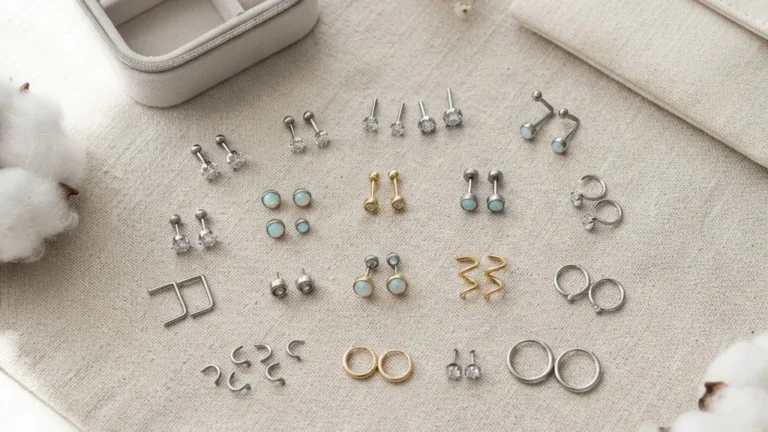
On the front of the jewelry, the decorative end has a safe window. Loheide identifies 2mm to 2.5mm as the sweet spot for an initial piece, large enough that an accidental snag won’t pull the end through the channel. Some studios won’t fit anything smaller than 2mm initially for exactly this reason.
Hoops are the contested case. BodyArtForms recommends against starting with one because a snug ring leaves no room for swelling, and because the curved angle can cause the piercing to heal crooked or form scar tissue. If what you picture is the small snug ring, that is a healed-piercing ring, and starting with a stud is the path to it. The same timing logic applies to a conch piercing hoop.
Threading and Material: What APP Standards Require in a Fresh Nostril
Beyond gauge and style, two specifications decide whether the jewelry is appropriate to heal in. Both come from the Association of Professional Piercers’ initial-jewelry standard.
The first is threading. The part of the jewelry passing through your skin must be smooth. The APP standard describes internally threaded jewelry, where the threads live on the removable end rather than the post, as avoiding any possibility of scraping your tissue with sharp threads, which it calls especially important with fresh piercings. Threadless, or press-fit, jewelry, which uses a pin coupling and has no screw threads at all, is named as an acceptable alternative. Externally threaded posts, where the screw pattern runs along the post itself, drag that rough surface through the tissue on insertion and removal.
The second is material. For initial piercings the APP lists implant-certified titanium, specified as Ti6Al4V ELI that is ASTM F-136 compliant, along with ASTM F1295, ISO 5832-3, or commercially pure titanium that is ASTM F-67 compliant. Gold is appropriate if it is 14k or higher, nickel- and cadmium-free; the standard adds that gold higher than 18k is too soft for body jewelry because it can easily be scratched or nicked. Z-Edge Piercing’s practice matches this, using ASTM F136 implant-grade titanium or nickel-free 14k or 18k gold and never steel for an initial nostril. If a shop offers to pierce you with plated, gold-filled, or vermeil jewelry, that coating can wear or chip off and is not acceptable for a fresh piercing.
Pain Level Compared to a Lobe, and the Needle-Not-Gun Rule
A nostril is sharper than a soft earlobe but brief. Z-Edge describes the sensation in its nostril healing guide as a quick pinch or sharp pressure that is over quickly, with the eye on that side commonly watering for a moment afterward. It passes through cartilage rather than the fatty, forgiving tissue of a lobe, so expect more of a bite than a lobe gives, though far short of the drama people brace for. Individual pain tolerance varies, which is why no source assigns it a universal number.
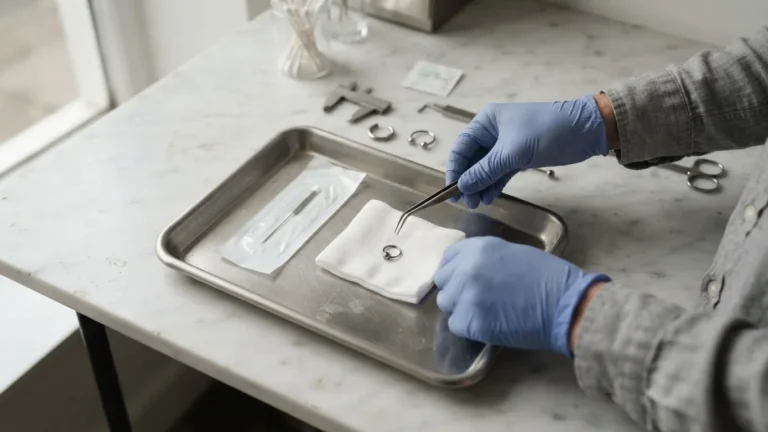
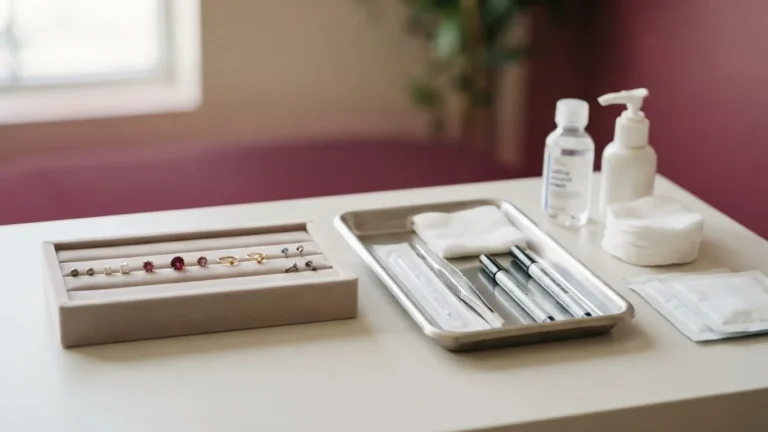
The tool matters more than the pain. The piercing should be done with a sterile, single-use needle, never a gun. Mayo Clinic’s guidance on preventing piercing complications states that reusable piercing guns can’t be properly sterilized, which raises the risk of infection. Mayo also flags a mechanical risk specific to this high-traffic spot: jewelry in piercings can get caught and torn out accidentally, and those injuries may need stitches or another type of repair. That snag risk is the thread tying placement height, jewelry style, and end size together, because every one of those choices changes how easily the piece catches.
A reputable studio also marks before it pierces. Z-Edge describes the step: the piercer cleans the area and marks the planned entry point, and you review the mark in a mirror and can request an adjustment before the procedure begins. Treat that mirror check as your last chance to confirm height and side, not a formality.
Nostril Piercing Placement and Healing Time: The 6-9 Month Range and Why Sources Disagree
Here the sources genuinely diverge, and the disagreement is the useful part. Three of them cluster around the same figure. Loheide puts nostril healing at about 6 to 9 months, up to a year. Pierced Owl gives 6 to 9 months on average. BodyArtForms says 6 to 9 months and sometimes longer. Z-Edge is the outlier at 2 to 6 months, sometimes up to 8.
That gap is not a contradiction to shrug off; it comes from what each source counts as “healed.” Z-Edge’s own text explains the mechanism: initial surface healing may take around 2 to 4 months, while the deeper channel keeps maturing for 6 months or longer. BodyArtForms draws the same two-stage line, noting a nostril can look fine after a couple of months yet usually needs closer to 9 to 12 months or longer to fully heal. So the short ranges describe surface calm, and the longer ranges describe full tissue maturation. Z-Edge’s figure is also a single studio’s number rather than an industry consensus.
The APP’s healing principle resolves which range to trust for decision-making. Its aftercare standard states this type of wound heals from the outside to the inside. The outside going quiet tells you nothing reliable about the inside. Plan around the longer, 6-to-9-month figure the piercer sources agree on, and read a calm-looking nostril at month two or three as surface healing, not permission. Three practical corollaries follow from the APP aftercare guidance: during healing, do not twist, spin, or rotate the jewelry, and use a saline whose ingredients list 0.9% sodium chloride as the only ingredient. None of this is a substitute for your piercer’s instructions or a clinician’s judgment.
Cost and When It Is Safe to Change the Jewelry
Cost splits into a service fee and the jewelry, and the two are quoted separately. Implant-grade titanium and solid 14k-or-higher gold cost more than the steel a cheaper shop might quote, which is precisely why two studios can both be fair and still land far apart. Our guide on nose piercing prices breaks that spread down further.
On changing the jewelry, the rule is a test, not a date. The window opens only when the channel is fully healed, which varies from person to person. Z-Edge’s framing is the one to hold onto: do not treat reduced redness or tenderness as permission to remove the initial jewelry early, because the outside calms before the inside is done. Our timeline on changing your nose piercing works through that two-part test. When you do convert to a ring, get sized in person; Loheide emphasizes that the only reliable way to know your measurement is to be sized and fitted by a piercer, which is why guessing hoops off the internet so often fails.
Is a nostril piercing more painful than a cartilage ear piercing?
Both pass through cartilage, so expect a comparable sharp pinch rather than the softer sensation of a lobe. The sources don’t rank one above the other on a scale, since tolerance differs by person. One nostril-specific quirk: the eye on the pierced side often waters briefly afterward, which is a reflex, not a sign of a problem.
Can I start with a 20g nostril stud if I want the daintiest look?
Two of the sources set the floor at 18g, and 20g (0.8mm) sits below it. A post that thin risks the cheese-wire effect and, per the APP, can be treated by the body like a splinter and migrate or reject. Save 20g for a fully healed channel where the risk of snag-through has dropped, and ask for 18g or 16g initially.
What saline should I use, and can I twist the jewelry to keep it from sticking?
Choose a product whose only listed ingredient is 0.9% sodium chloride; anything with additives is the wrong bottle. Do not twist, spin, or rotate the jewelry to “unstick” it, a habit that tears the forming channel.
My nostril looks completely healed at three months. Can I change it?
Looking calm at three months usually means surface healing only. The wound closes outside-in, so the interior channel may still be fragile even when the outside is quiet. BodyArtForms notes full maturation can run closer to 9 to 12 months. Changing on appearance alone can reopen irritation; have a piercer confirm the channel first.
Which side swells less if I’m prone to irritation?
The thinner, more indented part of the nostril has less tissue to swell, so it tends to be the gentler option for a stud. A thicker, more bulging side has more room to accommodate a hoop’s swelling. If your aesthetic preference and the thinner side disagree, raise it at the marking step so your piercer can judge your specific anatomy.
Gauge in Millimeters: How Much Thinner 20g Really Is Than the 18g Floor
The two piercers in this guide set 18g as the minimum for an initial nostril piercing, yet BodyArtForms records 20g at the thin end of the typical range. The article gives both in millimeters, so you can see exactly how much wire that difference costs and why a 20g post falls short of the safety floor.
- 18g is quoted at 1mm and 20g at 0.8mm, so going from 18g to 20g removes 0.2mm of post thickness.