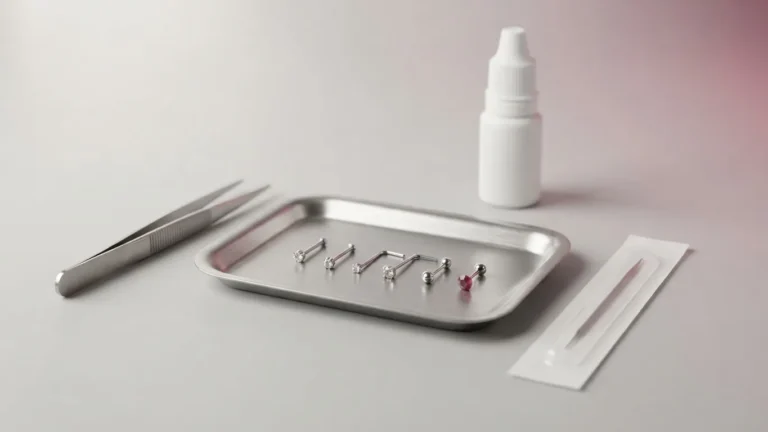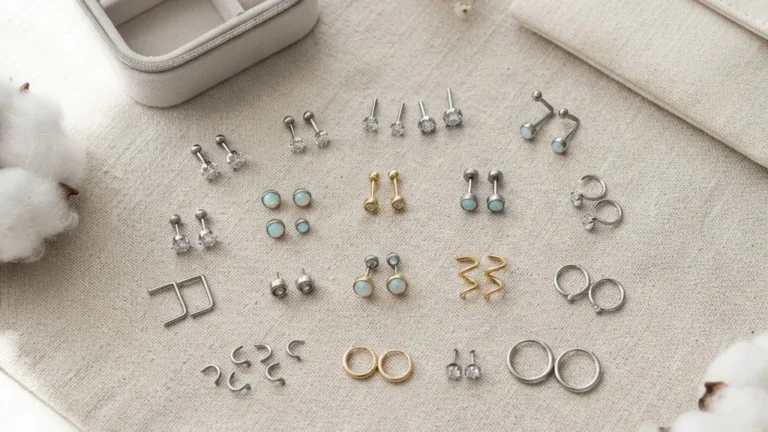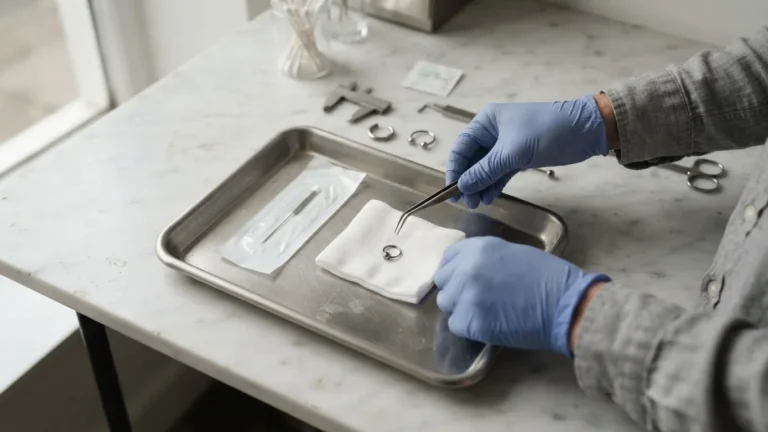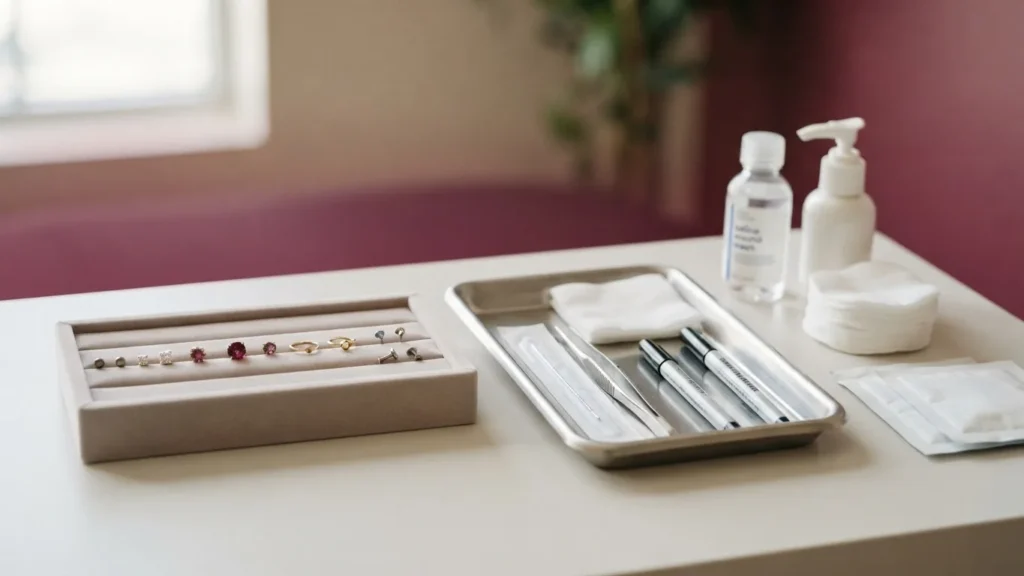
Two studios can both quote a fair price for the same nostril and land far apart, and neither is overcharging. One studio publishes a nostril at a modest service fee plus starting jewelry; another lists a nostril at $60 service fee plus $32 jewelry for a $92 starting total. The gap is not markup – it is what each number includes. That is the first thing to understand about piercing prices for a nose: the procedure and the jewelry are two separate costs, and a single quoted figure may fold them together or quote only one. WebMD states plainly that a nose piercing has two costs, one for the piercing procedure and one for the jewelry, with more expensive metals costing more. Read a quote without knowing which cost it covers and you cannot compare it to anything.
This guide separates those two costs, prices each placement on its own, and flags where a low number signals a risk rather than a bargain.
The quick-answer price map
A basic nostril piercing generally runs $30 to $80 across US studios; one editorial estimate puts a bare basic nostril at $30 to $50. A septum generally costs $40 to $90, and a piercer working with implant-grade jewelry sets a bare-minimum floor near $60. Bridge piercings fall between $30 and $90 depending on the source and whether jewelry is bundled. Double nostrils run $50 to $100, and advanced styles – septril, rhino, nasallang – also run $50 to $100. On top of the sticker, budget a 5% to 15% tip, roughly $12 for a 4 oz aftercare cleanser, and $5 to $20 for future jewelry. Nose piercing prices are a range, not a flat rate.
Procedure fee versus jewelry: what you are actually paying for

Every quote answers two questions at once: what does the piercer charge to perform the piercing, and what does the starting jewelry cost. CostHelper notes that some piercers include jewelry in the total while others charge an additional $10 to $50 for a nose stud or ring. Until you know which model a shop uses, a headline price tells you very little.
Studio price lists make the split explicit. Somatic Body Piercing itemizes its nostril and septum services as a separate service fee plus a starting jewelry charge. Infinite Body Piercing in Philadelphia itemizes a nostril as a $60 service fee plus $32 starting jewelry for a $92 starting total. Same placement, same two-part structure, different numbers – because the service fee and the grade of the included jewelry differ.
A third model bundles without itemizing. Live by the Sword Tattoo lists a nostril piercing at $40 that includes a standard hypoallergenic surgical steel stud, with jewelry upgradable to gold or titanium during the visit. That $40 looks cheaper than a $92 total, but it is buying a steel stud rather than a starting piece of implant-grade titanium. When you compare, ask the shop to break the quote into its procedure fee and its jewelry charge, and match grade to grade. A $40-bundled-steel price and a $92 implant-grade total are not two prices for one thing.
Nose piercing prices by placement, side by side
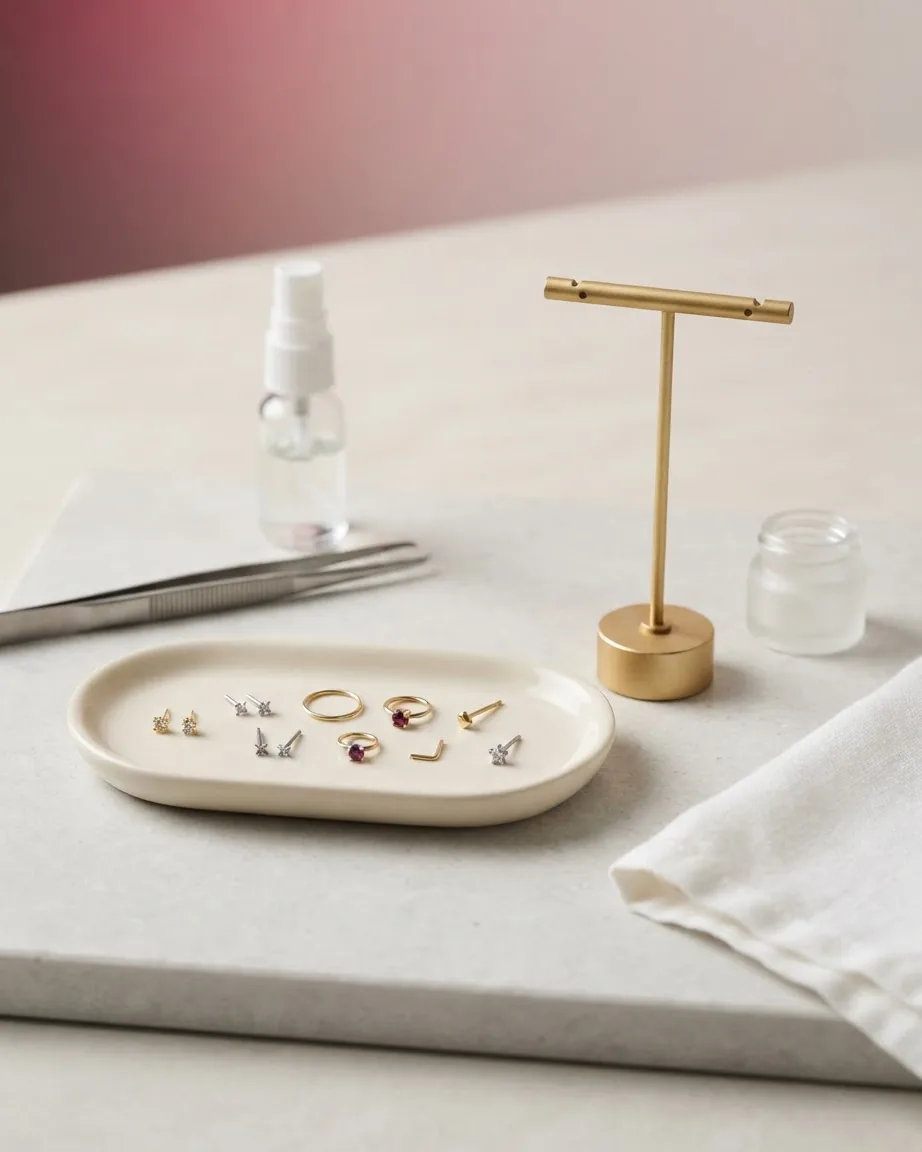
Placement changes both the difficulty and the price. A classic nostril sits in the soft flesh of the nostril wall; which side you choose is a matter of preference, not price. A high nostril sits further up the nasal wall near the bridge of the visible nose, which is why it runs more – it demands an experienced piercer. The table below collects the figures the sources report so you can pick placement with budget as an explicit input.
- Basic nostril: $30 to $80 generally (CostHelper and PlugYourHoles); $30 to $50 for a bare basic (Byrdie).
- High nostril: $40 to $60, because it requires an experienced piercer.
- Septum: $40 to $90 generally; at least $60 with implant-grade plain jewelry.
- Bridge: $30 to $50 (Byrdie) or $40 to $90 (CostHelper), depending on jewelry inclusion.
- Double nostril: $50 to $100, due to the added complexity of two placements.
- Advanced styles (septril, rhino, nasallang): $50 to $100.
The nostril figures diverge for a reason worth keeping straight. Byrdie, which draws on professional piercer and board-certified dermatologist input, describes a bare basic piercing at $30 to $50. CostHelper and PlugYourHoles report $30 to $80 – a range that folds in jewelry and location variation. These are not competing claims about the same thing; one describes the procedure stripped down, the others describe a fuller total. When your own quote lands between them, that is normal.
Why the same septum can cost far more at one shop than another
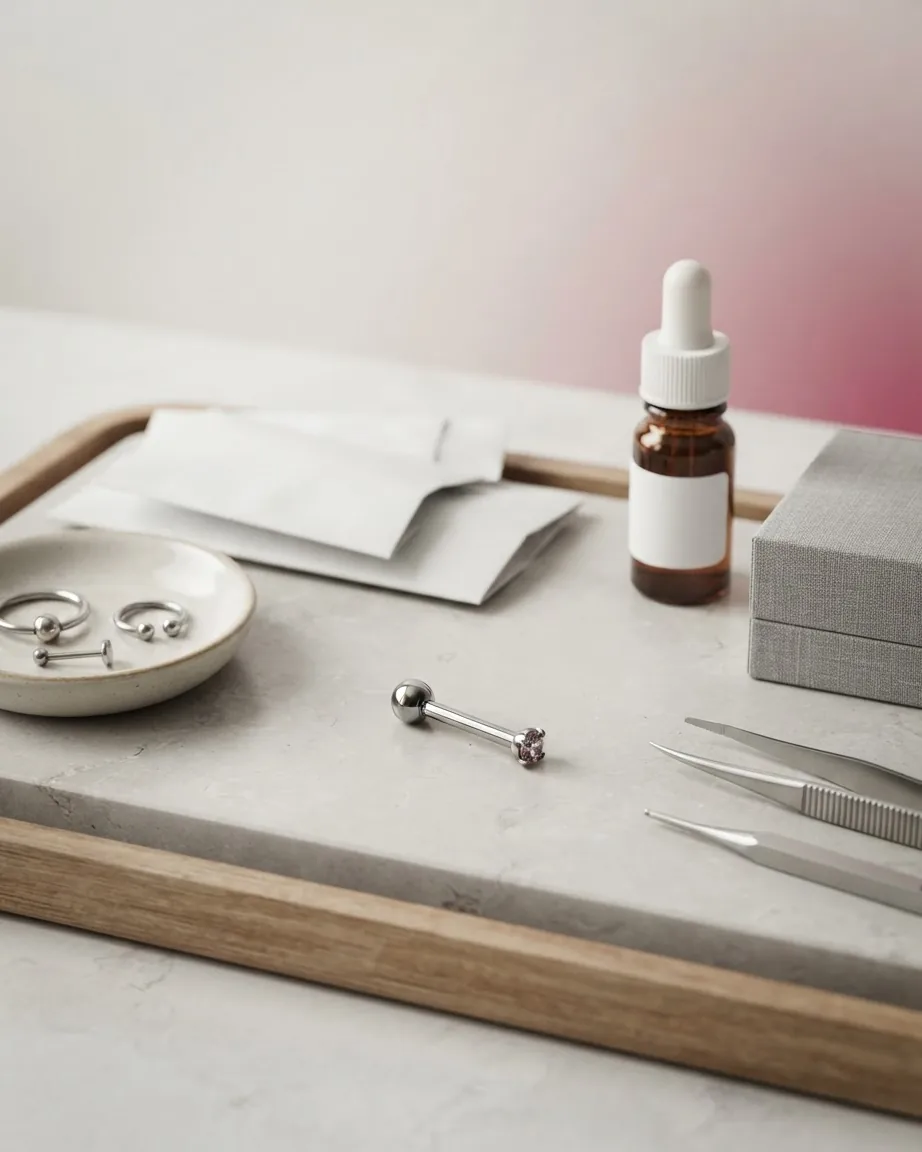
The septum passes through the thin strip of soft tissue just below the cartilage dividing the nostrils – the so-called sweet spot. A piercer who finds it correctly threads below the hard cartilage, which is what keeps the procedure tolerable and the healing predictable. Pricing reflects both the skill of locating that spot and the jewelry seated in it.
The reported numbers span a wide band: $40 to $90 generally, and a stated bare-minimum floor near $60 when the work is done with implant-grade, basic, plain jewelry and proper technique. These figures reflect different studios and different material assumptions rather than a factual dispute. The $60 floor is the one to anchor on if safety is your priority – it is a working piercer’s statement of what competent septum work with acceptable jewelry costs at the very bottom. A quote well under that, for a septum, is a prompt to ask what jewelry and what technique you are getting, not a prompt to book.
How the metal changes the price – and which “gold” is allowed
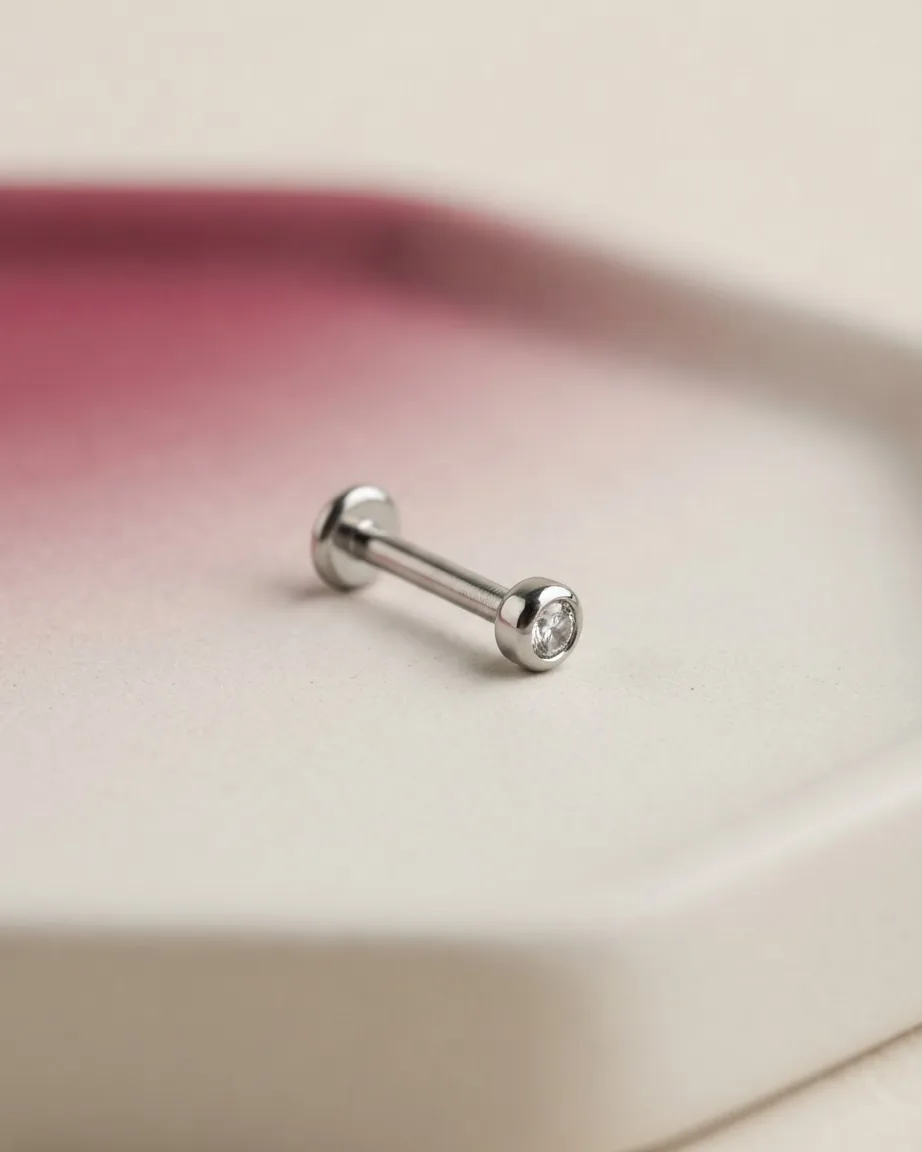
Jewelry grade drives both cost and safety, and the two are linked. The Association of Professional Piercers warns that the body jewelry market is saturated with substandard products and that cost alone should never be the deciding factor in a purchase. For a fresh piercing, the material is not a style choice – it is what the open wound sits against for weeks.
For initial piercings, the APP standards call for implant-certified titanium that is ASTM F-136 compliant (Ti6Al4V ELI), along with ASTM F1295, ISO 5832-3, or commercially pure ASTM F-67 as acceptable titanium specifications. Gold is acceptable for initial piercings only if it is 14k or higher; gold-plated, gold-filled, and gold overlay or vermeil are not acceptable for fresh piercings. That rules out most budget “gold” nose studs sold online. Sterling silver should be avoided for fresh piercings because it tarnishes and may contain nickel. Surgical stainless steel is a robust, corrosion-resistant option, especially the 316L variety.
Studio price lists reflect this directly. Somatic Body Piercing’s listed jewelry figures are for standard implant-grade titanium or stainless steel; jewelry with stones or gold increases the price. So when a quote climbs, the honest question is whether the jump buys a safer or more durable material, or only a decorative one. For a starting piece, the former is worth it; the latter can wait until the piercing has healed.
The red flag: when a cheap quote should worry you
A rock-bottom price can mean two different things, and only one of them is good. It can mean a bundled steel stud at a shop with a modest service fee, which is fine. Or it can mean cut corners on material or method, which is not. The difference shows up in what the low price leaves out.
WebMD is blunt on method: a piercing gun cannot be properly disinfected between uses, which raises the risk of infection, and needles should be used instead. A quote that is cheap because it comes from a gun is cheap because it is riskier. On material, the $60 implant-grade septum floor and the APP’s warning against letting cost decide both point the same way – a price that undercuts the cost of acceptable jewelry is undercutting something you cannot see. For the broader placement decision, our nose septum section sits alongside this pricing read. Treat an unusually low number as a question to ask, not a deal to grab.
The all-in budget: tip, aftercare, and the costs after you leave
The sticker price is not the spend. Four line items regularly sit outside the quote, and planning for them keeps the real total from surprising you.
- Tip: a 5% to 15% gratuity for the piercer is considered standard per CostHelper; Infinite Body Piercing suggests 20% as standard at its shop, with $5 to $10 gracious for a jewelry change.
- Aftercare cleanser: a sea-salt based cleanser runs about $12 per 4 oz can.
- Separate jewelry charge: if the shop does not bundle, add $10 to $50 for the stud or ring.
- Future jewelry: replacement nose jewelry typically costs $5 to $20 per piece for most styles.
There is one way to lower the total rather than raise it. Infinite Body Piercing discounts each service fee by $10 when you get more than one piercing in the same sitting, so pairing placements can trim the per-piercing cost. For cleaning, our note on saline solution covers the product category you will be buying for $12 a can.
Healing time and the “start cheap, upgrade later” plan
Many people buy a plain starting piece and plan a nicer swap once healed. That plan works only if it respects the healing window, so the timeline is a budgeting fact, not just a medical one. A pierced nostril takes 2 to 4 months to completely heal, a pierced septum heals in about 1.5 to 2 months, and a bridge takes roughly 2 to 2.5 months, according to WebMD. The same guidance states that initial jewelry should stay in for 8 to 12 weeks before changing.
So if you are deferring the gold or the gemmed piece to save money now, your re-budget date is not arbitrary – it lands at the 8-to-12-week mark at the earliest for the swap itself, and later than that for full healing. Changing before the channel is ready risks tearing it, which can cost far more than the jewelry you were saving on. For the full decision on timing a swap, see our guide on when to change your nose piercing. If anything looks wrong before then – spreading redness, heat, swelling, discharge, or pain that climbs instead of fading – hold off on changing anything and see your piercer or a clinician. This guide aggregates published figures and standards; it is not medical advice, and only a professional can assess your particular piercing.
Nose gauges and sizing: the number behind the price
Price lists quote “a nostril stud” without saying what size, but gauge is part of what you are buying and what you will replace later. Nose jewelry commonly runs at 18G or 20G, with 18G sitting at roughly 1.0mm in wire thickness. Your piercer fits the gauge to your anatomy; it is not a universal number, and matching it matters when you later shop for that $5 to $20 replacement piece. Buy a ring or stud in the wrong gauge and it will not seat in your channel.
To replace jewelry correctly you need the gauge (the wire thickness) and the length or diameter your piercer used, which is why writing those two numbers down at the appointment saves money and frustration later. See also our 18g nose piercing and average gauge nose piercing guides for how sizing works in practice.
Pain, placement, and what the price reflects about difficulty
Price tracks difficulty, and difficulty tracks placement. A standard nostril is described as a minimal-pain piercing, which is part of why it sits at the low end of the range. A high nostril costs more not because it hurts dramatically more but because it demands an experienced hand to place correctly, and that expertise is what the extra $10 to $20 over a basic nostril pays for.
The septum, placed through that soft sweet spot below the cartilage, is tolerable when the piercer finds the right tissue – which is, again, why technique is baked into the floor price near $60. Advanced styles like the nasallang or rhino pass through more tissue and more anatomy, which is why they top out around $100. When you see a higher number for one of these, the price is reporting on the complexity of the work, not padding. As a point of scale, nose piercing itself is not new: the practice dates back more than 46,000 years.
The $32 nostril gap, decoded: how much is the piercer, how much is the metal
Two studios quote the same nostril piercing $32 apart – $60 starting total at one shop, $92 at the other. Because both lists itemize the service fee and the jewelry separately, you can break that gap into its two parts and see exactly what the higher number is paying for before you decide it is too much.
- Total gap: $32. $92 − $60 = $32 between the two quoted starting totals.
- $20 of the gap is the piercer, not the jewelry. The service fee rises from $40 to $60 ($60 − $40 = $20), so nearly two-thirds of the difference is what the studio charges to perform the work.
- Only $12 of the gap is jewelry. The starting piece goes from $20 to $32 ($32 − $20 = $12) – the smaller half of the difference.
- Both quotes are service-fee-heavy. The fee is about 67% of the $60 total (40 ÷ 60) and about 65% of the $92 total (60 ÷ 92), so in each case you are mostly paying for the hands doing the piercing, not the metal.
The takeaway: the pricier studio is charging more for the procedure itself, with only $12 of the spread tied to the starting jewelry. Ask any shop to split its quote the same way, then compare service fee to service fee and grade to grade.
FAQ
Can I negotiate a nose piercing price down?
Not usefully on the service fee, which covers a trained piercer’s time and sterile setup. The one legitimate way to lower your total is pairing placements: one Philadelphia studio knocks $10 off each service fee when you book more than one in a sitting. Pushing a shop below its implant-grade jewelry floor, by contrast, pressures the part you should not cut.
Why does online nose jewelry cost so much less than a studio quote?
Cheap web studs are often gold-plated, gold-filled, vermeil, or sterling silver – none acceptable for a fresh piercing under professional standards. A studio’s starting jewelry buys implant-grade titanium or 316L steel fit to your gauge. The retail $5 to $20 figure applies to replacement pieces for a healed piercing, not a starting one going into an open wound.
Is $40 too cheap to be safe for a nostril?
Not automatically. One studio’s $40 nostril bundles a surgical steel stud, which is a legitimate starting material. The concern is a $40 quote that relies on a piercing gun or on jewelry below acceptable grade. Ask two questions: needle or gun, and what metal and specification is the starting piece. The answers, not the number alone, tell you whether it is a fair price.
How soon after paying for the piercing will I spend money again?
Almost immediately on a roughly $12 cleanser, and again at your tip of 5% to 15%. The next real outlay is the jewelry swap, which cannot safely happen before the 8-to-12-week initial window, and sits later still for a fully healed nostril. Budget the swap piece at $5 to $20, plus $5 to $10 if the shop changes it for you.