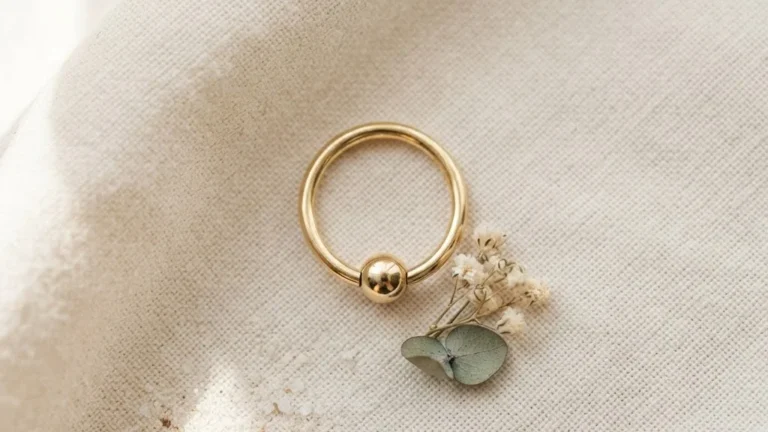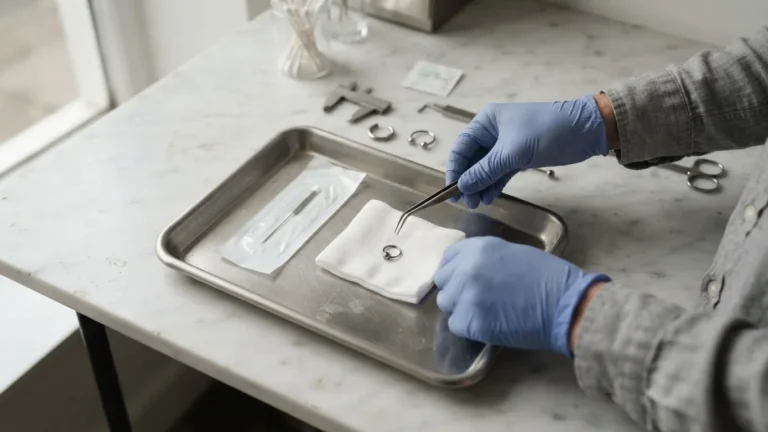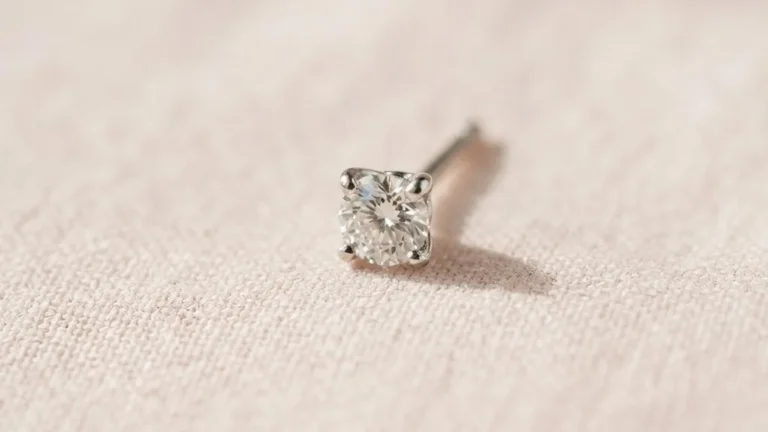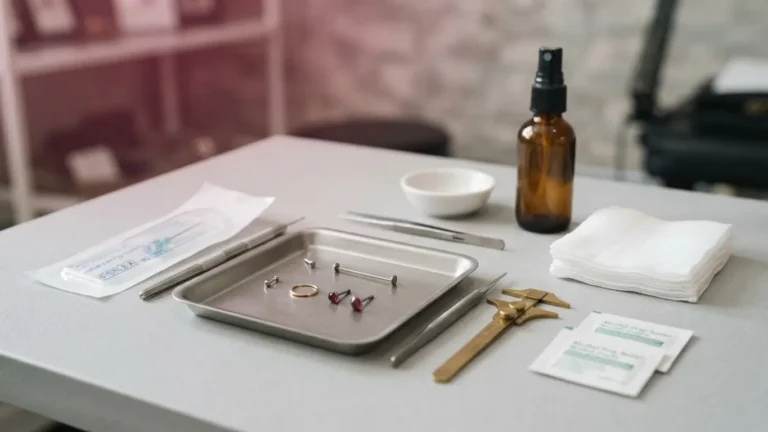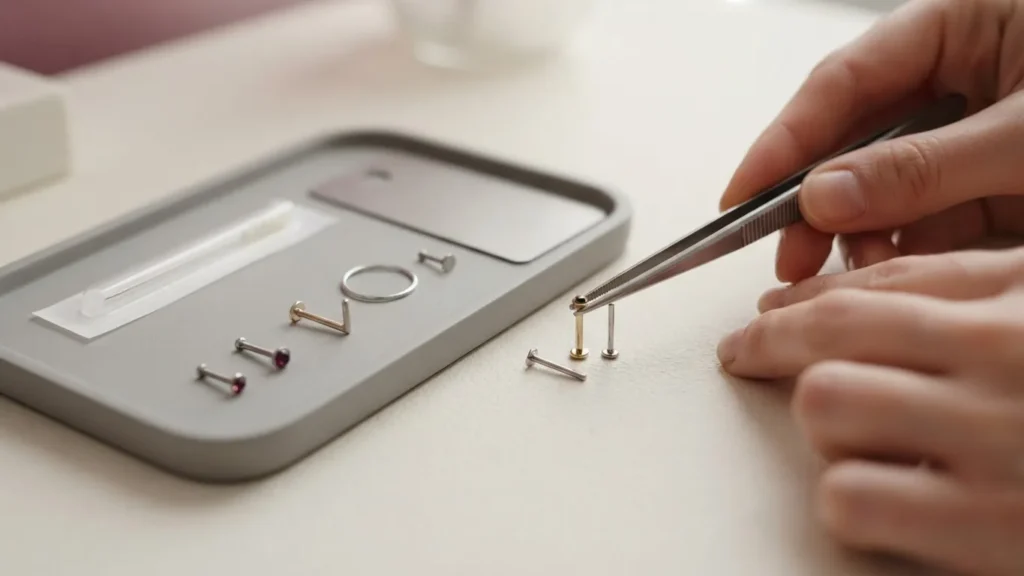
An 18g nose piercing uses jewelry that sits at roughly 1.0mm in wire thickness, and that one measurement decides more than most people shopping for a nose ring expect. Pierced Addiction lists 18g at 1.0mm, placing it a touch thicker than the 20g many studios reach for first. The number matters because gauge controls which jewelry slides into your channel, how the post feels against the tissue, and whether you can swap sizes later without a fight. This guide compiles the documented sizing conventions, the material standards professional bodies publish, and the healing-time estimates retailers give, so you can match a gauge to your own nostril instead of guessing at a product listing.
The “g” is a thickness reading, not a style. The letter stands for gauge, which tells you the thickness of the jewelry and nothing about its length or ring diameter. That distinction trips up buyers constantly, and it is where this guide starts earning its place.
What an 18g nose piercing actually measures
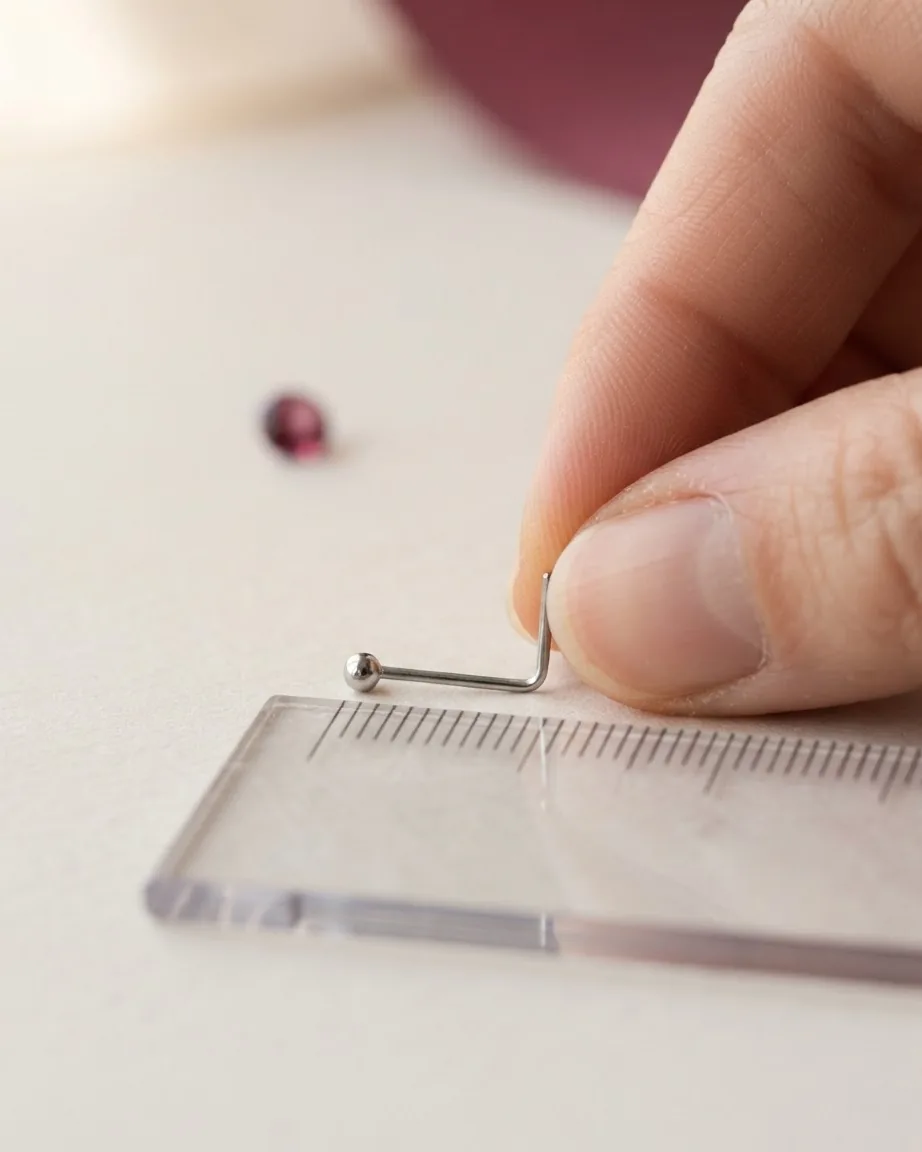
Gauge is an inverse scale: the larger the number, the thinner the wire. An 18g post is thinner than 16g and thicker than 20g. For hard millimeter figures, two sources land on nearly identical readings. Pierced Addiction states 18g equals 1.0mm, and Urban Body Jewelry’s conversion chart lists 18g at 1.0 mm, or 5/128 of an inch.
You will also see 18g quoted as 1.02mm, a reading BodyCandy uses when it calls the size “another industry standard” that is “a bit thicker and more durable.” The two figures, 1.0mm and 1.02mm, are not a contradiction worth losing sleep over. They are the same nominal gauge written at different rounding points. Treat 1.0mm as the working number and 1.02mm as its decimal-rounded twin.
How the scale steps matters when you plan ahead. Gauge sizes move in even numbers, so the next thickness up from 18g is 16g, then 14g, then 12g, and once you reach 0g the next size is 00g, pronounced “double zero gauge.” A nose piercing almost never travels that far, but knowing the ladder tells you that 18g and 16g are only one rung apart, and 18g and 20g are neighbors too.
The standard nose gauge: 18g versus 20g

This is the question most buyers want settled, and the sources only half-agree. Every retailer in this guide names 18g and 20g together as the standard nostril range, a point FreshTrends and the other guides agree on: for most nostril piercings the go-to sizes are 20G or 18G. Where they split is which of the two wins the title of “most common.”
Pierced Addiction calls 20 gauge the most popular choice for nostril piercings, while Monster Piercing pushes the other way, noting that many piercers start with 18g as the default size, which is why a wider variety of styles and designs shows up in that gauge. A separate claim that most initial piercings are done with an 18g needle sits awkwardly against pages naming 20g as the most popular starting size. These are retailer observations, not a single audited standard, so the honest answer is that both gauges are routine for nostrils, 20g skews slightly thinner and more delicate, and 18g gives you the broader jewelry selection. Your studio’s house preference usually decides it. The most reliable move is to ask which gauge your piercer used, not to assume.
Quick answer: An 18g nose piercing uses jewelry about 1.0mm thick, one of two standard nostril gauges alongside the thinner 20g (0.81mm). BodyCandy describes 18g as the “slightly thicker, sturdier sibling” of 20g. You can drop from 18g to a thinner 20g easily, but moving thicker, into 16g, risks irritation if forced. Gauge is only the wire thickness; stud length and hoop diameter are measured separately. For fresh piercings, implant-certified titanium or solid gold is the material standard. If a nose ring sits oddly, the gauge is often right and the diameter is wrong.
How 18g sits between its neighbors, 20g and 16g
Lining up the three gauges that touch a nose piercing makes the choice concrete. On the thin side sits 20G at 0.81mm, “a super common and popular size, offering a great balance of being subtle yet stable.” In the middle sits 18g at 1.0mm. On the thick side, 16g measures about 1.2mm in diameter, and the retailer figures run to the same neighborhood.
Stepoy frames the fine step between the two smaller sizes well: the gap from 20G to 18G is only 0.2mm, “but that small difference changes how the jewellery sits, feels, and looks.” That 0.2mm is the like-for-like step between adjacent gauges on this part of the scale, and the same 0.2mm separates 18g from 16g on paper. The practical read: 18g is the middle option. It carries more jewelry choice than 20g and more presence, without the heavier feel of 16g. If you want subtlety, 20g. If you want a sturdier post or a particular stud style, 18g. The 16g jump is a commitment, not a casual swap.
- 20G – 0.81mm: thinnest of the three, subtle, delicate (BodyCandy).
- 18G – 1.0mm: the middle gauge, widest style selection, sturdier post.
- 16G – about 1.2mm: noticeably thicker, a deliberate step up.
Dropping from 18g to 20g: the easy move and its hidden cost
If you were pierced at 18g and want something daintier, the direction works in your favor. Going from a thicker gauge like 18G to a thinner one like 20G is easy, and “the jewelry will slide right in without any fuss.” Nothing has to stretch, because you are inserting a post narrower than the channel you already have.
The catch shows up later, not during the swap. Wear the smaller jewelry for a long time and your piercing “might shrink a little to hug the new, thinner post.” Your 18g channel is not permanent. Leave a 20g post in for months and the tissue adapts to it, so a day when you want your old 18g jewelry back, the thicker post can feel tight going in. The downsize is free; the return trip is not. If you care about keeping the 18g option open, rotate an 18g piece in occasionally rather than committing to 20g full-time.
Why you can’t force 18g jewelry into a 20g piercing
Going the other direction, thin to thick, is where people hurt themselves. Moving from 20G to 18G is only a 0.2mm step, “but forcing a thicker ring through can tear the channel and cause healing setbacks.” A 0.2mm gap sounds like nothing. Pushed through healed tissue that has not been tapered, it is enough to split the channel and send you back to the start of healing.
Thicker-into-smaller is a job for a gradual taper, done carefully, ideally with a piercer, not a shove at the bathroom mirror. The Association of Professional Piercers frames the related risk from the opposite side: jewelry that is too thin in gauge can be treated by the body like a splinter, resulting in migration or rejection. So the safe window runs one way during casual swaps. You can comfortably step down from 18g to 20g at home; stepping up should be slow, deliberate, and supervised. For the broader context of where these sizes land on the face, our nose septum section collects the placement conventions.
When an 18g fits but the nose ring still sits wrong
This is the misconception that ruins more online purchases than the wrong gauge ever does. Gauge is the wire thickness, full stop. It says nothing about how far the post reaches or how wide a hoop loops. Those are separate measurements, and a piece can be the correct 18g and still sit badly because its length or diameter is off.
For straight studs, your stud jewelry will probably be around 1/4″ to 5/16″ in length. That length has to clear your nostril wall and leave room for a decorative end without pressing in. For hoops, many buyers need a 7mm or 8mm inner diameter for a healed nostril, not just the right gauge. A 7mm ring and an 8mm ring can share the exact same 18g wire and sit completely differently on your nose.
No single product listing usually ties all three numbers together, which is why “right gauge, wrong fit” is so common. When you shop, read three figures, not one: gauge for thickness, length for a stud, and inner diameter for a hoop. See also our standard nose piercing gauge guide and the septum retainer sizing notes.
Is thinner always safer for a nose piercing?
It feels intuitive that a finer post is gentler, but the sources push back. Too thin carries its own failure mode: the “cheese-cutter effect,” where a ring that is too thin for your piercing can slowly irritate and even migrate through the tissue, the jewelry working against the channel like a wire through soft cheese. The professional-body splinter observation is the same problem stated clinically: undersize the gauge and the body may push the jewelry out.
So thinner is not automatically safer. It is safer up to the point where the post stops matching the channel, then it becomes a migration risk. This is a real argument for 18g over 20g for some wearers: the sturdier 1.0mm post is less likely to sit in the channel like something to be expelled. The right gauge is the one that matches your tissue, not the smallest one you can find. Anything that reddens, migrates visibly, or will not settle is a reason to see your piercer or a clinician rather than to keep experimenting with sizes.
The material that belongs in an 18g nostril
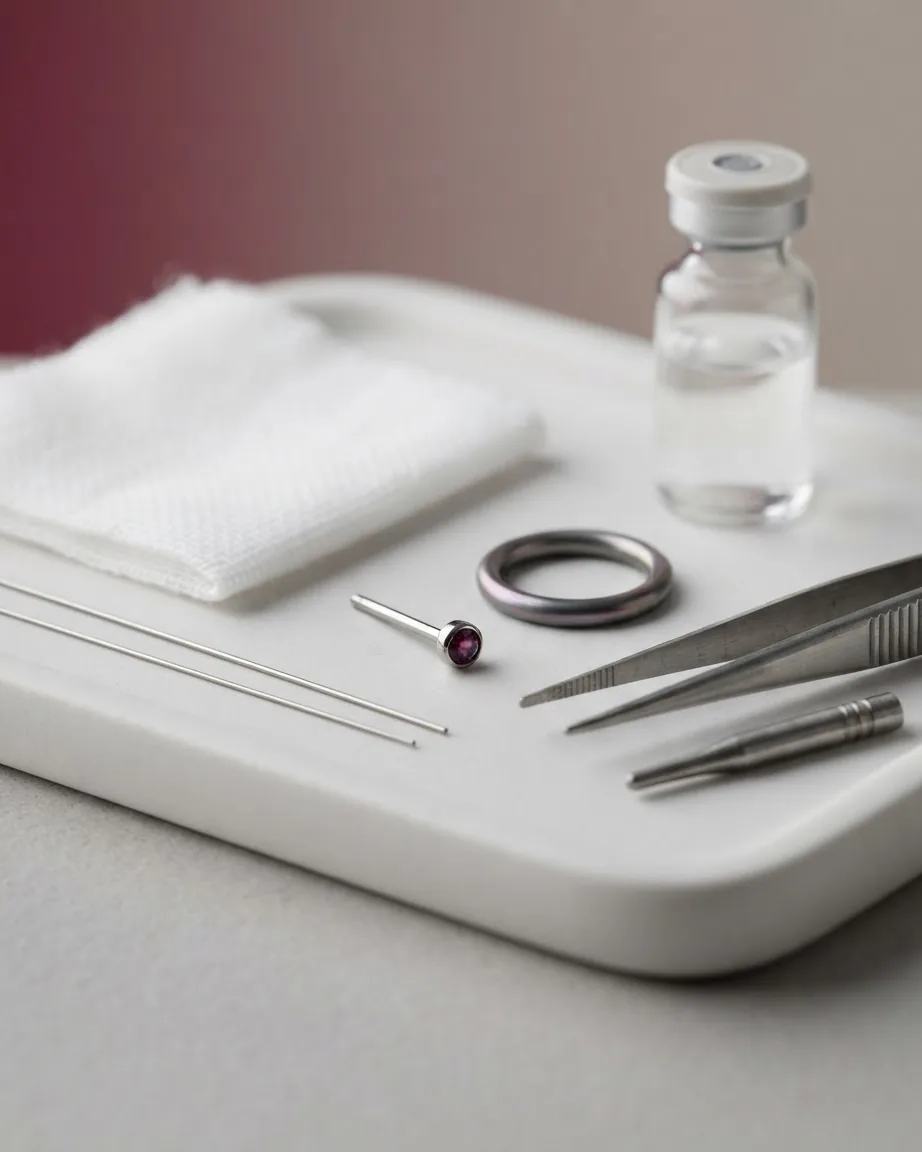
Gauge decides fit; material decides whether a fresh piercing heals or fights you. The Association of Professional Piercers sets the standard for initial jewelry, and it is strict. Their guidance is to look for implant-certified titanium, Ti6Al4V ELI, that is ASTM F-136 compliant. Retailers echo this, calling implant-grade titanium the standard for fresh and sensitive piercings because it is 100% nickel-free.
The exclusions matter as much as the inclusions. Gold-plated, gold-filled, and gold overlay or vermeil jewelry is not acceptable for fresh piercings – the thin precious layer wears and exposes the base metal underneath. If you want gold, the standard is solid 14k or higher, not a coating. This is the desk’s core position compiled from manufacturer specs and published professional standards: for an 18g fresh nostril, implant-certified titanium or solid gold, and nothing plated.
- Accepted for fresh piercings: implant-certified titanium (Ti6Al4V ELI, ASTM F-136), solid 14k or higher gold.
- Not accepted: gold-plated, gold-filled, gold overlay, vermeil.
The placement, pain, and healing you’re planning for
A nostril piercing passes through the fleshy wing of the nose, the ala, rather than through cartilage proper for most placements, which is why it is generally described as more manageable than deeper cartilage work. Relative to a standard earlobe, a nostril is sharper for a brief moment because the tissue is firmer and more nerve-dense, but it is a short, single pass. It is not the throb people report from thicker cartilage sites.
Healing time is where the sources genuinely conflict, and flattening that would be dishonest. Monster Piercing estimates roughly 6 to 8 weeks, Pierced Addiction gives 6 to 12 weeks, Plug Your Holes frames it as 2 to 3 months, and BodyCandy describes full healing at around 4 to 6 months. These are not all measuring the same thing: the shorter figures track surface healing, when the piercing looks and feels settled, while the longer ones track full maturation of the channel beneath. None of these is a clinically cited figure. The cautious plan is to treat the surface as settling in the first couple of months and the channel as still maturing well past that, and to not rush jewelry changes based on how the outside looks.
Aftercare follows the published professional consensus rather than any single clinic: a gentle saline rinse, clean hands only, no twisting or spinning the jewelry, and no swapping the piece before the channel has matured. Anything beyond mild tenderness – spreading redness, heat, pus, or jewelry that starts to migrate – is a reason to see your piercer or a clinician promptly. This guide compiles standards; it does not replace a professional looking at your nose.
When it’s safe to change the jewelry in an 18g nostril
The timing question hangs on the healing conflict above. Because the surface estimates and the full-maturation estimates pull in such different directions, the safe rule is to wait for the long end before a first change, not the short one. A piercing that looks healed at eight weeks can still have an immature channel that reacts badly to a swap.
When you do change it, direction is everything, as covered earlier: an 18g-to-20g downsize goes in easily, while stepping up toward 16g should wait and be done gradually to avoid irritating the area, as Monster Piercing warns about moving to 16g immediately after an 18g piercing. Match the gauge first, then confirm the length or diameter, then confirm the material is implant-grade. If any of the three is off, the piece will not settle, no matter how healed the piercing is. For the tool side of how these channels are formed cleanly, our piercing needle guide sits alongside this one.
Where the nose ring came from
Nose adornment is not a modern fashion cycle. Across many cultures, the nose ring has carried meanings tied to beauty, status, or marriage, and the practice reaches back more than 4,000 years. That long history is part of why the jewelry vocabulary – studs, L-shapes, screws, hoops – is so varied across the 18g and 20g range, and why a piece that reads as subtle in one tradition reads as statement in another. The sizing logic in this guide holds regardless of the style you choose: thickness, length, diameter, and material, decided in that order.
Your 18g stud length in millimetres
The guide quotes stud length in inches (1/4″ to 5/16″) but every gauge and hoop figure in mm, which leaves you comparing two different rulers. The fix is already in the material: Urban Body Jewelry pegs 18g at 1.0mm = 5/128″, so each 1/128″ equals exactly 0.2mm. Scale that up and the inch lengths land on the same scale as the rest of the sizing.
That range lands on the same millimetre scale as the inner diameter many buyers need for a healed nostril hoop. So an 18g stud and an 18g hoop can share the exact same 1.0mm wire yet differ in their fit span once you read length and diameter in the same unit, which is the point the gauge number alone never tells you.
Frequently asked questions about 18g nose piercings
How much does an 18g nose piercing cost?
The sources compiled here document gauge sizing, materials, and healing rather than studio pricing, so this guide cannot give a verified dollar figure without inventing one. Pricing varies by studio, region, and the jewelry metal you choose, with implant-certified titanium or solid gold costing more than base options. Ask your chosen piercer for a quote that separates the piercing fee from the jewelry.
Can I use a 16g ring in my 18g nose piercing?
Not without care. A 16g post is about 1.2mm against an 18g channel built for roughly 1.0mm, and that step must be tapered gradually. Monster Piercing specifically warns that moving up to 16g right after an 18g piercing can irritate the area. Wait until fully healed and, ideally, let a piercer handle the step up.
Does a bigger gauge number mean thicker jewelry?
No, it is the reverse. The gauge scale is inverse: a higher number means a thinner wire. That is why 20g (0.81mm) is finer than 18g (1.0mm), which is finer than 16g (about 1.2mm). The scale steps in even numbers, so sizes get thicker as the number falls toward 0g and then 00g.
Will my piercing close if I leave the 18g jewelry out?
Tissue does adapt to whatever occupies it. A channel that has worn a thinner 20g post for months shrinks to hug it, so your original 18g piece can feel tight afterward. An empty channel, especially a newer one, can begin to close faster than you expect. Keeping jewelry in is the reliable way to hold the size you want.
Is titanium or gold better for a fresh 18g nostril?
Both qualify if chosen correctly. Implant-certified titanium (ASTM F-136) is nickel-free and the documented standard for sensitive, healing piercings. Solid 14k or higher gold is also acceptable, but plated, filled, or vermeil gold is not, because the coating wears and exposes base metal. Titanium tends to be the lower-cost route into a compliant fresh piece.