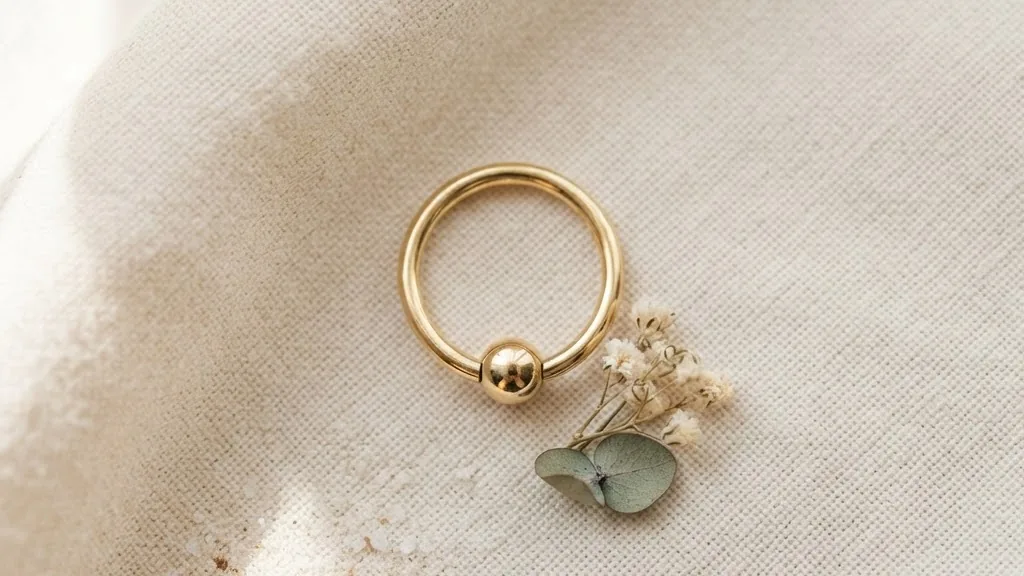
The typical gauge for nose piercings is 20 gauge (0.8 mm) or 18 gauge (1.0 mm), the two sizes that studios treat as standard for a nostril. That is the short answer, but it is not the whole story, because the choice between those two sizes affects how securely the jewelry sits, how the piercing heals, and what you can swap into it later. This guide breaks down what gauge actually means, when a piercer reaches for 20G versus 18G, and how the nostril standard differs from the septum, all framed neutrally with the health details traced back to published medical guidance.
Gauge trips people up because the scale runs backwards: a smaller gauge number means a thicker post. So 18G is thicker than 20G, and a 16G post is thicker still. That inverse scale is the source of most sizing confusion when people order nose jewelry online, so it is worth getting straight before you pick a stud or hoop. The wrong gauge is not a cosmetic mismatch; a post that is too thin for its placement can bend, migrate, or tear out.
Every gauge, millimeter conversion, healing window, and aftercare detail below is drawn from piercing-industry standards and published health guidance, and cross-checked against current retail listings.
Quick answer: For a nostril, the typical gauge is 20G (0.8 mm) or 18G (1.0 mm). Choose 20G for a thinner, more delicate look, and 18G for a sturdier post that is harder to snag or pull out. Septum piercings are thicker, usually 16G (1.2 mm) to 14G (1.6 mm), so do not use the septum size for a nostril. A nostril takes about 2 to 4 months to heal functionally and 4 to 6 months to fully settle. Choose implant-grade titanium, and keep the pierced gauge until it is healed.
What gauge means, and why the number runs backwards
Gauge is simply the thickness of the jewelry post, and it is written with a number followed by the letter G. The scale is inherited from wire manufacturing, where a higher number meant thinner wire, so in body jewelry a higher gauge number also means a thinner post. That is why a 20G nose stud is finer than an 18G one, and why people who assume bigger numbers mean bigger posts end up ordering the wrong size.
Because the numbers are unintuitive, it helps to anchor them to millimeters, which do not lie. The table below converts the gauges you will meet around the nose so you can shop by the measurement rather than the label.
| Gauge | Thickness | Common placement | Feel |
|---|---|---|---|
| 20G | 0.8 mm | Nostril (delicate) | Fine, dainty post |
| 18G | 1.0 mm | Nostril (standard) | Sturdier, harder to pull out |
| 16G | 1.2 mm | Septum | Thicker, holds heavier jewelry |
| 14G | 1.6 mm | Septum (heavier) | Substantial, for larger rings |
Keep this conversion handy when you order online, because listings often label a piece only by gauge. If a product page says 18G and you were pierced at 20G, that stud is thicker than your channel and should not be forced in. Matching the millimeter is the reliable way to avoid a piece that will not seat or that stretches the hole.
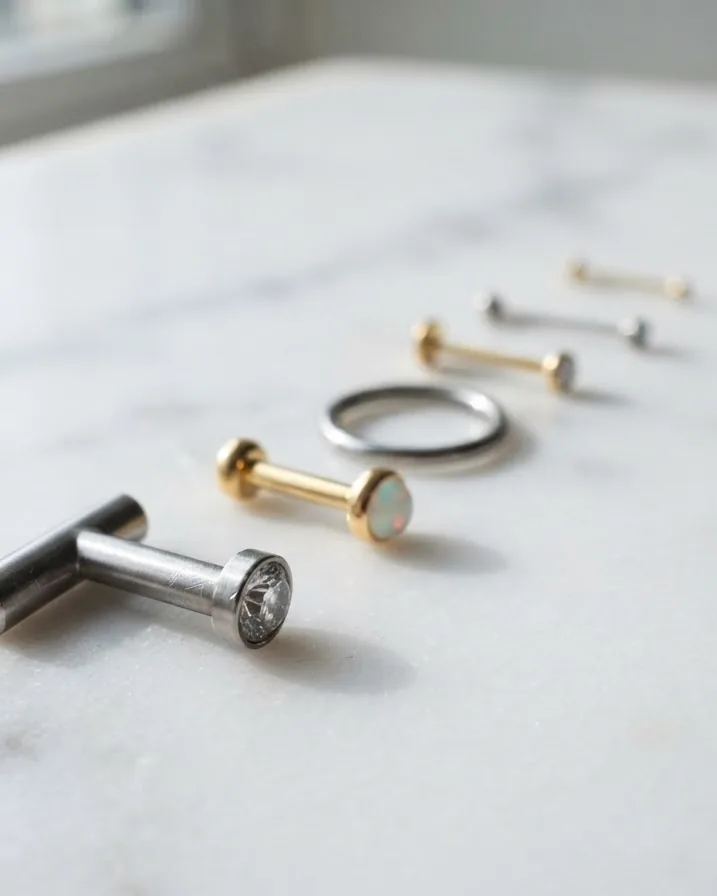
The typical gauge for nose piercings: 20G versus 18G
Within the nostril standard, the real decision is 20G versus 18G, and both are legitimate. Studios differ in which they default to, so it is worth asking your piercer what they use and why. Neither is universally correct; each trades one property for another.
A 20G (0.8 mm) post is the thinner, more delicate option. It reads as understated, suits small studs and fine hoops, and is popular for a dainty look. Its downside is that a finer post is a little easier to bend or, if a fresh piercing is snagged hard, to pull through irritated tissue. An 18G (1.0 mm) post is slightly thicker and sturdier, which makes it harder to accidentally yank out and gives you access to a wider range of thread-style tops if you plan to change the decorative end later. Many piercers favor 18G on a fresh nostril for exactly that durability, while others pierce at 20G to keep the initial channel as small as possible. The safe move is to be pierced at whichever gauge your piercer recommends for your anatomy and to keep that gauge until the piercing has healed.
Nostril versus septum: not the same gauge
People often lump all nose piercings together, but the nostril and the septum are different placements with different standard gauges. The nostril passes through the fleshy wall of the nose and sits at 20G or 18G. The septum passes through the thin strip of tissue between the nostrils, and it is typically pierced thicker, commonly 16G (1.2 mm) up to 14G (1.6 mm), because it carries heavier rings and clickers. If you are comparing placements more broadly, our overview of the types of ear piercings explains the same gauge-by-placement logic that applies across the ear, and the reasoning carries over to the nose.
The takeaway is simple: do not buy a septum-gauge ring for a nostril or vice versa. A 14G ring will not fit a 20G nostril without stretching the hole, and a 20G stud in a septum sized for 16G will sit loose and can migrate. Match the jewelry gauge to the placement you actually have.
It is worth adding that studio practice genuinely varies by region and by piercer, which is part of why people get conflicting answers online. Some studios default to 18G for every nostril on the grounds that the sturdier post is safer during healing, while others pierce at 20G to keep the initial channel minimal and the look delicate. Neither camp is wrong. What matters is that you know the gauge you were actually pierced at, because that single number governs every piece you buy afterward. If you are unsure, your piercer can tell you, and it is worth writing it down.
Jewelry styles that fit a nostril
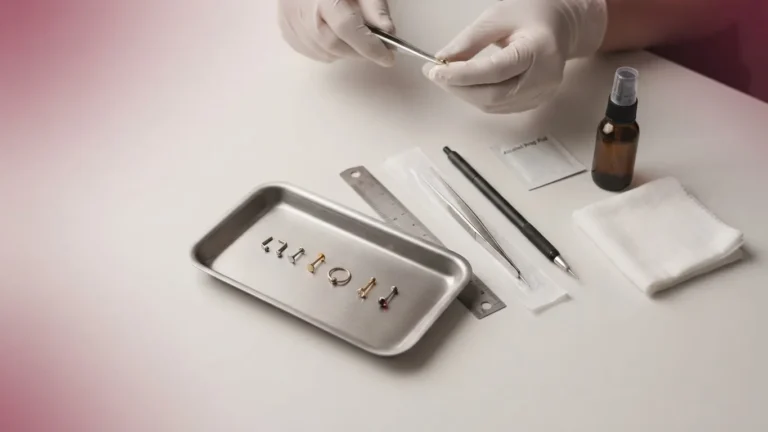
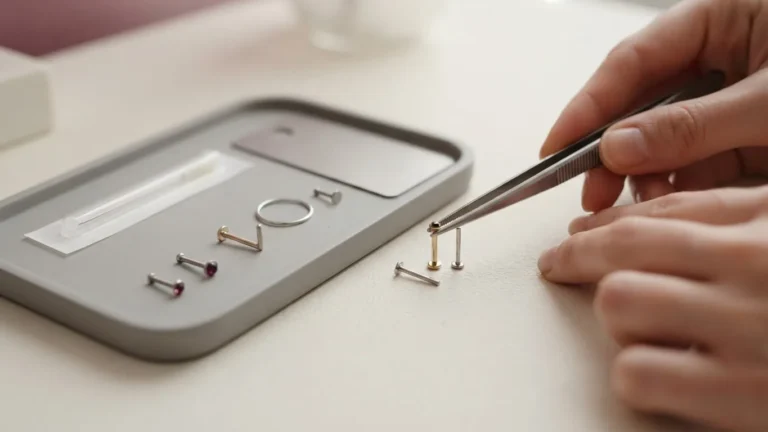
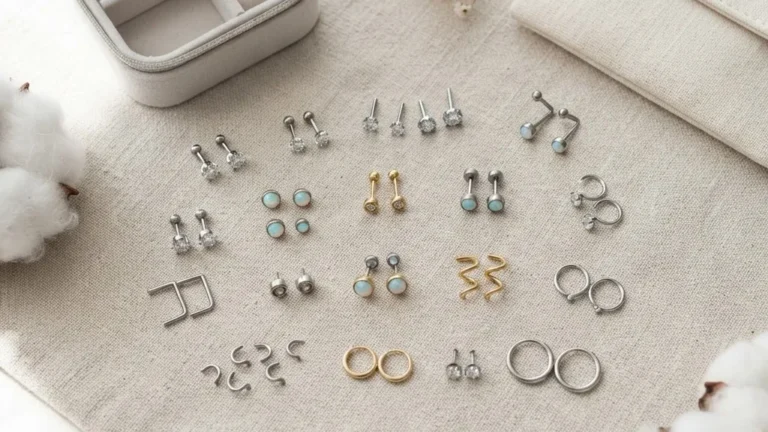
Gauge decides whether a piece fits; style decides how it wears. A nostril supports several jewelry shapes, and the fresh-piercing rules narrow the field. A flat-back labret stud, with a smooth disc on the inside of the nostril and a decorative top outside, is a piercer favorite for healing because nothing sharp or bulky sits against the inner wall. A nose screw has a curved post that hooks into the nostril, a low-profile everyday option once healed. A nose bone has a small fixed ball on the end that holds it in place, but pushing that ball through a fresh, tight piercing can be uncomfortable, so it is better suited to a settled hole. A captive or seamless hoop is a popular healed-piercing look but is generally not the first choice for a brand-new nostril.
Two measurements come with these styles beyond gauge: post length and, for hoops, diameter. A fresh nostril is often fitted with a slightly longer post to accommodate swelling, then downsized later. As with gauge, keep the pieces you buy matched to the size you were pierced at, and let a piercer handle the first change so a fresh channel is not torn by a fiddly swap.
Why gauge matters for healing and safety
Gauge is not just about looks; it affects how well the piercing tolerates daily life while it heals. A post that is appropriately thick resists bending and gives the healing channel a stable shape to form around. A post that is too thin for its placement is more prone to migration, where the body gradually pushes the jewelry toward the surface, and to being torn if it catches on clothing, a towel, or a mask strap. The nose is a high-contact area, so that durability is not trivial.
General guidance from Mayo Clinic on preventing piercing complications stresses keeping the original jewelry in place while a piercing heals and handling it as little as possible. That is easier with a gauge that sits securely. It is also why you should never try to force a thicker gauge into an existing hole to size up; that is stretching, and it has to be done gradually and only after the piercing is fully healed, never as a shortcut.
There is also a subtle relationship between gauge and how the finished piercing looks and lasts. A hole pierced and healed at 18G holds a slightly more substantial channel than one at 20G, which some people prefer because it accommodates a wider range of decorative tops later and is less likely to shrink if the jewelry is left out briefly. A 20G channel is finer and can start to close faster if you go without jewelry, so if you were pierced at 20G, be especially careful about leaving the nostril empty during the first year. Neither is a mistake; they are just different commitments, and knowing which you have helps you plan changes sensibly.
The best metal at nose-piercing gauge
Whatever gauge you choose, the metal matters more than the number, because the post is in constant contact with a healing wound and, in the nose, with a moist environment. Nickel is the most common cause of allergic contact dermatitis, and Mayo Clinic identifies jewelry as a frequent trigger of nickel allergy. A reaction in a fresh nostril can look a lot like an infection, which is one more reason to remove nickel from the equation entirely.
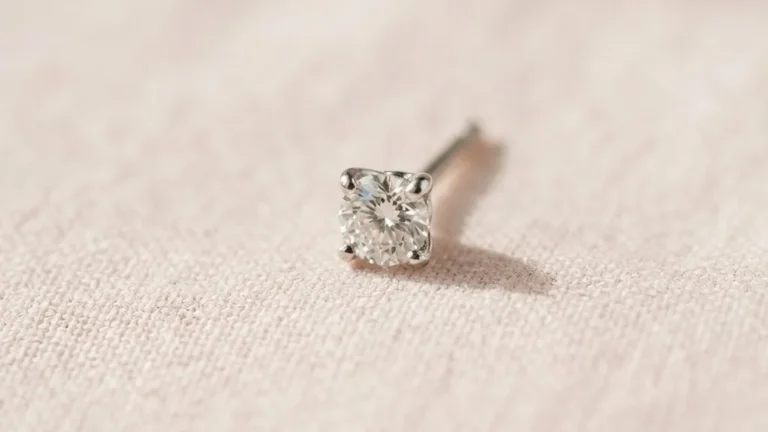
For a fresh nostril at 20G or 18G, implant-grade titanium graded ASTM F-136 is the strong default. It is nickel-free, lightweight, non-corrosive, and biocompatible. Mayo Clinic’s list of safer metals also includes nickel-free stainless steel, surgical-grade stainless steel, solid 18-, 22-, or 24-karat gold, nickel-free white gold, and sterling silver. Avoid gold-plated pieces for a fresh piercing, since plating wears and can expose base metal underneath. A flat-back labret style is a piercer favorite for a healing nostril because the smooth disc sits flush against the inside of the nostril without a protruding ball.
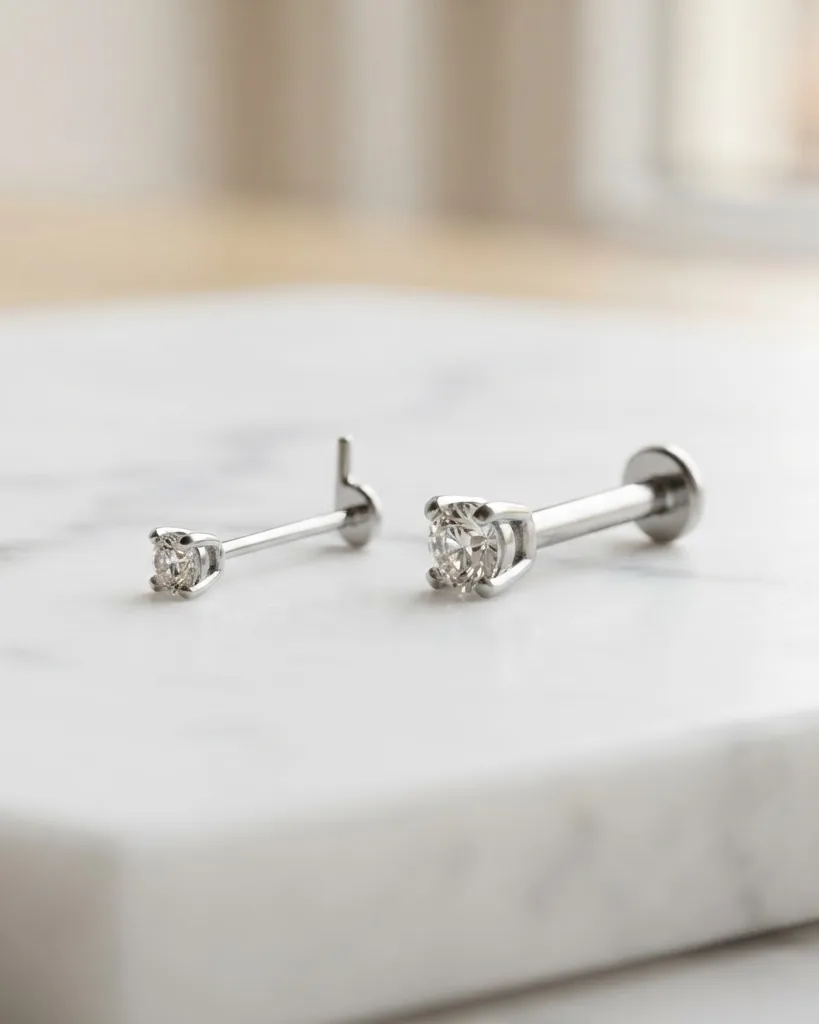
Healing timeline for a nostril piercing
A nostril is cartilage-adjacent tissue near a moist, bacteria-rich area, so it heals on a longer clock than a lobe. Healthline’s guidance on how long a nose piercing takes to heal puts basic healing at about 2 to 4 months, with nostrils often taking 4 to 6 months to fully settle, while a septum heals faster at roughly 2 to 3 months. As with cartilage, the nose heals from the outside in, so it can look done on the surface while the inside is still knitting.
Two practical rules follow. First, keep the original jewelry in for the full healing window; changing it early, or downsizing to a much thinner post before the channel is mature, invites irritation and infection. Second, watch the calendar for infection signs, since redness or discharge that first appears 5 to 10 days after the piercing is more likely to signal an infection than the normal soreness of the first day or two. For a broader view of ear and facial healing timelines, our guide to how long ear piercings take to heal is a useful companion.
Aftercare and downsizing
Nose aftercare is the same disciplined, low-drama routine as any piercing: irrigate with sterile 0.9 percent saline, keep your hands off, and leave the jewelry alone. Avoid hydrogen peroxide and antibacterial soaps, which the American Academy of Dermatology notes can damage healing skin in its guidance on caring for new piercings.
- Step 1 – Wash your hands with soap and water before touching the piercing.
- Step 2 – Saturate clean gauze or a paper towel with sterile 0.9 percent saline and clean the nostril, inside and out, twice a day.
- Step 3 – Gently soften and remove any crust; do not pick at it with bare fingers.
- Step 4 – Pat dry with a fresh disposable product, never a shared cloth towel.
- Step 5 – Leave the original jewelry in and do not rotate or twist it while it heals.
Once the piercing is fully healed, some people downsize the post length or switch styles. If you do, keep the same gauge you were pierced at unless a piercer advises otherwise, and have them handle the first change so the fresh channel is not damaged.
A common goal is switching from a stud to a hoop, and gauge governs that too. A hoop has to match your nostril gauge to sit correctly, and its inner diameter has to suit where the piercing sits on your nose, so a piece that looks right online can gape or dig in on your face. Wait until the nostril is fully healed before making the change, since threading a hoop through a piercing that is still settling risks reopening it. If the hoop feels tight or the piercing gets irritated after the swap, that is a signal to go back to a stud for a while and try again later, or to have a piercer fit the correct diameter. Patience with these transitions is what keeps a healed nostril healthy for years rather than flaring up every time you change jewelry.
Infection warning signs and when to see a professional
Mild soreness, light swelling, and a small amount of clear or whitish crust are normal in the first days. Signs that point toward infection include spreading redness, warmth, increasing pain after the first few days, and yellow or green discharge, especially if they appear several days after the piercing rather than immediately. A fever or feeling unwell alongside a sore piercing is a reason to contact a healthcare provider promptly.
Because the nose sits close to the sinuses and drains into a sensitive area, do not ignore an infection that is escalating. Do not remove the jewelry yourself if you suspect an infection, since taking it out can trap the infection inside as the surface closes; instead, keep it in and see a doctor or an experienced piercer. If a stud has embedded or a ring is too tight against swollen tissue, a professional can help remove it safely.
A separate issue people confuse with infection is a nose piercing bump, a small raised area beside the piercing that is often irritation rather than infection. Bumps are frequently mechanical in origin, caused by knocking the jewelry, sleeping on it, or a poorly fitted piece, and they usually respond to gentle saline care and leaving the piercing alone rather than to any aggressive treatment. Resist the urge to change the jewelry or apply harsh products, both of which tend to make a bump worse. If it persists, grows, or is accompanied by the infection signs above, have a piercer or clinician look at it rather than experimenting at home.
Frequently asked questions
What is the typical gauge for nose piercings?
The typical gauge for nose piercings is 20 gauge (0.8 mm) or 18 gauge (1.0 mm) for a nostril. Both are industry standard. Studios vary in which they default to, so ask your piercer which gauge they use and keep that gauge until the piercing is healed.
Is 18G or 20G better for a nose piercing?
Neither is universally better. A 20G (0.8 mm) post is thinner and more delicate, while an 18G (1.0 mm) post is sturdier and harder to snag or pull out, and it opens up more thread-style tops later. Many piercers favor 18G on a fresh nostril for durability, but 20G is a valid, daintier choice.
What gauge is a septum piercing?
A septum is typically pierced thicker than a nostril, commonly 16 gauge (1.2 mm) up to 14 gauge (1.6 mm), because it carries heavier rings and clickers. Do not use a septum-gauge ring in a nostril; the sizes are not interchangeable.
Can I put a thicker gauge in my healed nose piercing?
Not directly. Forcing a thicker post into an existing hole is stretching, which has to be done gradually and only after the piercing is fully healed. Sizing up too fast can tear tissue. If you want a thicker gauge, talk to a piercer about a safe, staged approach.
What size in mm is a nose piercing?
A standard nostril is 0.8 mm (20G) or 1.0 mm (18G). Shopping by millimeter is more reliable than by gauge label, since the gauge scale runs backwards and a smaller number means a thicker post.
The bottom line
The typical gauge for nose piercings comes down to two sizes: 20G (0.8 mm) for a fine, delicate post and 18G (1.0 mm) for a sturdier one that resists snagging. Remember that the scale runs backwards, so match the millimeter rather than trusting the label, and never confuse the nostril standard with the thicker 16G to 14G septum. Whatever gauge you choose, put implant-grade titanium in a fresh piercing, keep the pierced gauge until the nostril has healed over its 2-to-6-month window, and treat aftercare as a boring daily habit. Get the size and the metal right, and the jewelry style is the fun part you can change once everything is settled.