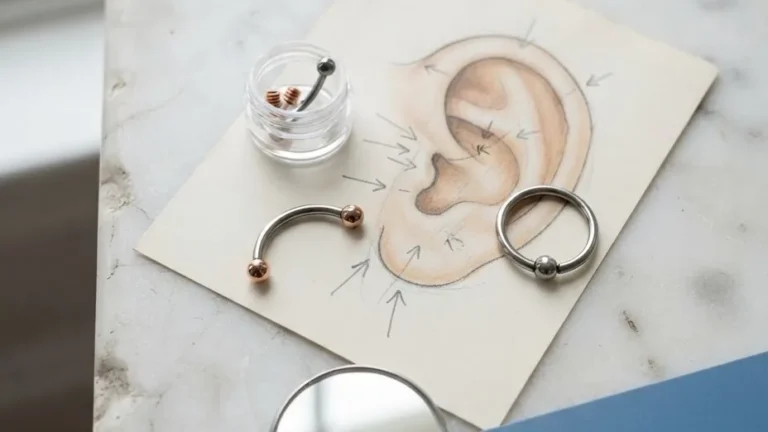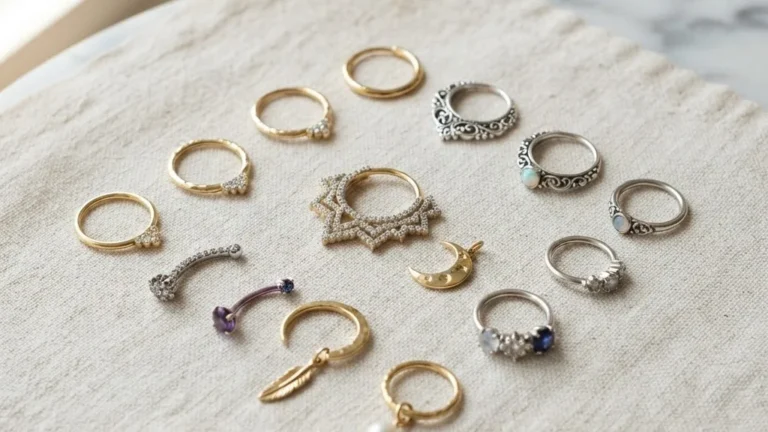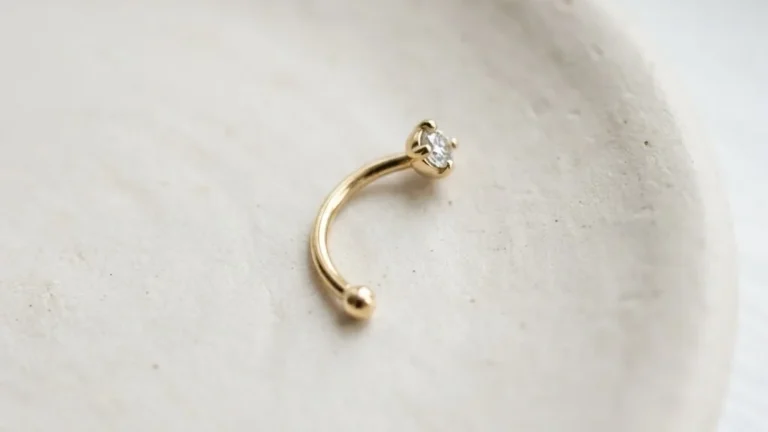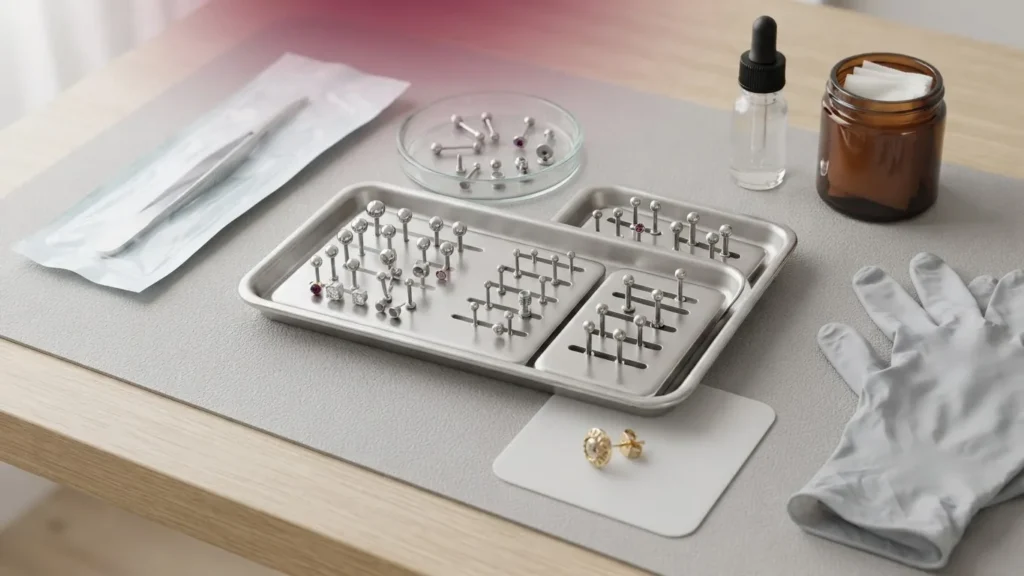
A tragus does not take the same jewelry as an earlobe, and the reason is thickness, not fashion. A standard lobe is pierced with a thinner needle; a tragus goes through cartilage with a thicker one, a difference Maison Miru sets out in its tragus jewelry guide. That single step up in diameter drives every other decision about piercings tragus jewelry: the gauge you order, the post length that leaves room for swelling, the material that will not stall a cartilage wound, and the date you are allowed to swap it out. This guide compiles those decisions from published piercing-jewelry specifications and professional body-modification standards.
The desk here aggregates and verifies piercing terminology and documented aftercare, and cross-references what manufacturers print on their own jewelry against the material rules the Association of Professional Piercers publishes. None of what follows is medical advice. Anything on your ear that looks wrong belongs in front of your piercer or a clinician, not a web page.
Quick answer: For a new tragus, the standard tragus piercing jewelry is a 16 gauge (1.2mm) flat-back labret stud in implant-grade titanium, started at a longer 8mm length so it clears the swelling, then downsized to around 6mm once that swelling settles at roughly 4 to 8 weeks. Hoops and decorative pieces wait until the channel is fully healed. Fully healed tragus piercings commonly take 6mm or 8mm posts; a very daintier channel may hold an 18 gauge (1.0mm) piece. Keep your original jewelry in for the first 12 months before changing it.
Why a normal earlobe stud does not belong in a tragus
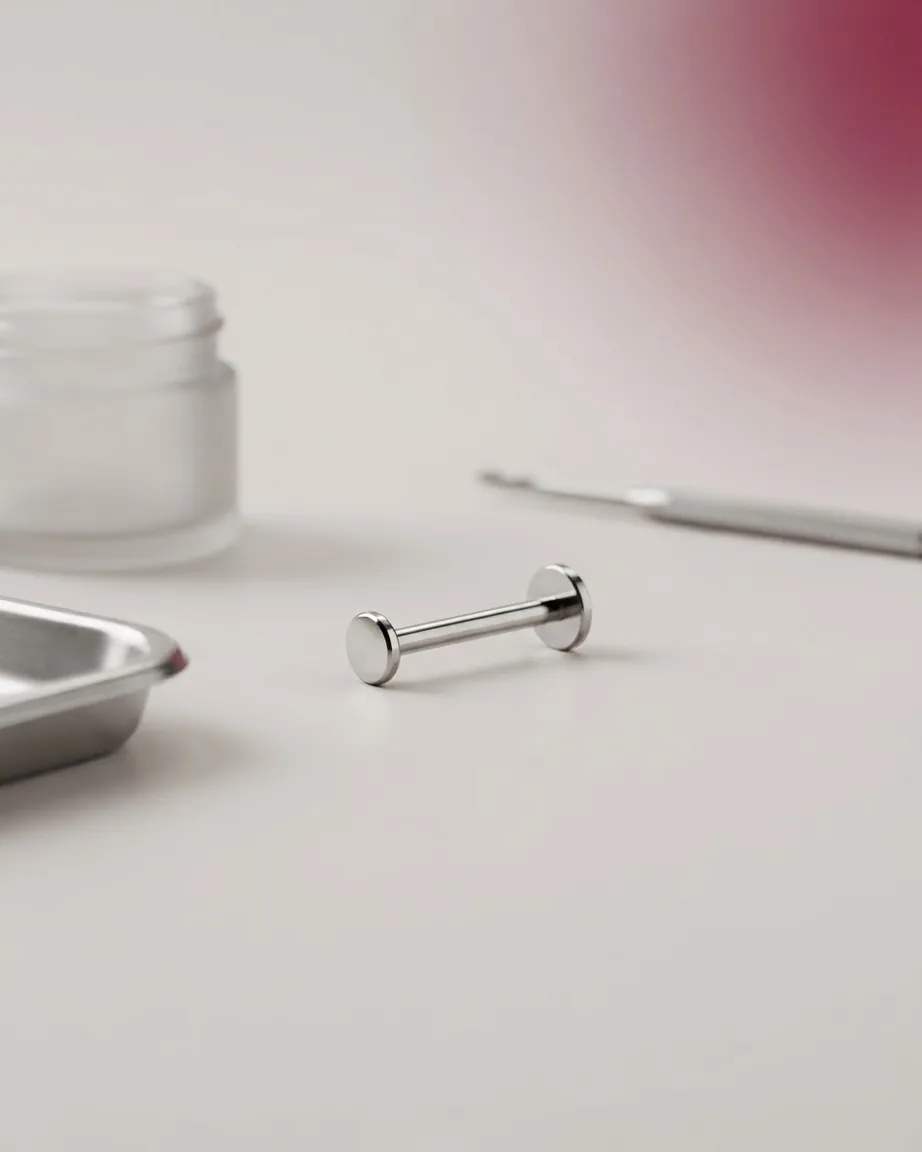
Reach for a spare butterfly-back earring and you reach for the wrong tool. Standard earlobe studs run 20g or 22g, and according to BodyCandy’s tragus sizing guide, that is far too thin for a tragus and the butterfly backs are notorious for trapping bacteria and gunk against the piercing. Thin wire in a cartilage channel also tends to drift and pressure the hole from one side.
There is a second failure mode worth naming. Maison Miru notes that wearing a thin 20g piece in a tragus can let the channel close up or shrink. If that happens, an 18 gauge (1.0mm) earring may be the only thing that still threads through – a smaller hole than you started with, not a style choice. The lesson is simple: a tragus wants a post built for cartilage, and the back matters as much as the gauge.
A flat-back labret is the answer to both problems. A flat disc sits against the inner ear canal with nothing to catch, and a solid internally threaded or threadless post gives the wound something stable to heal around. That is why a piercer fits one at the appointment and why the lobe stud in your jewelry box stays in the box.
What gauge to ask for: 16g standard, and when 14g or 18g appears
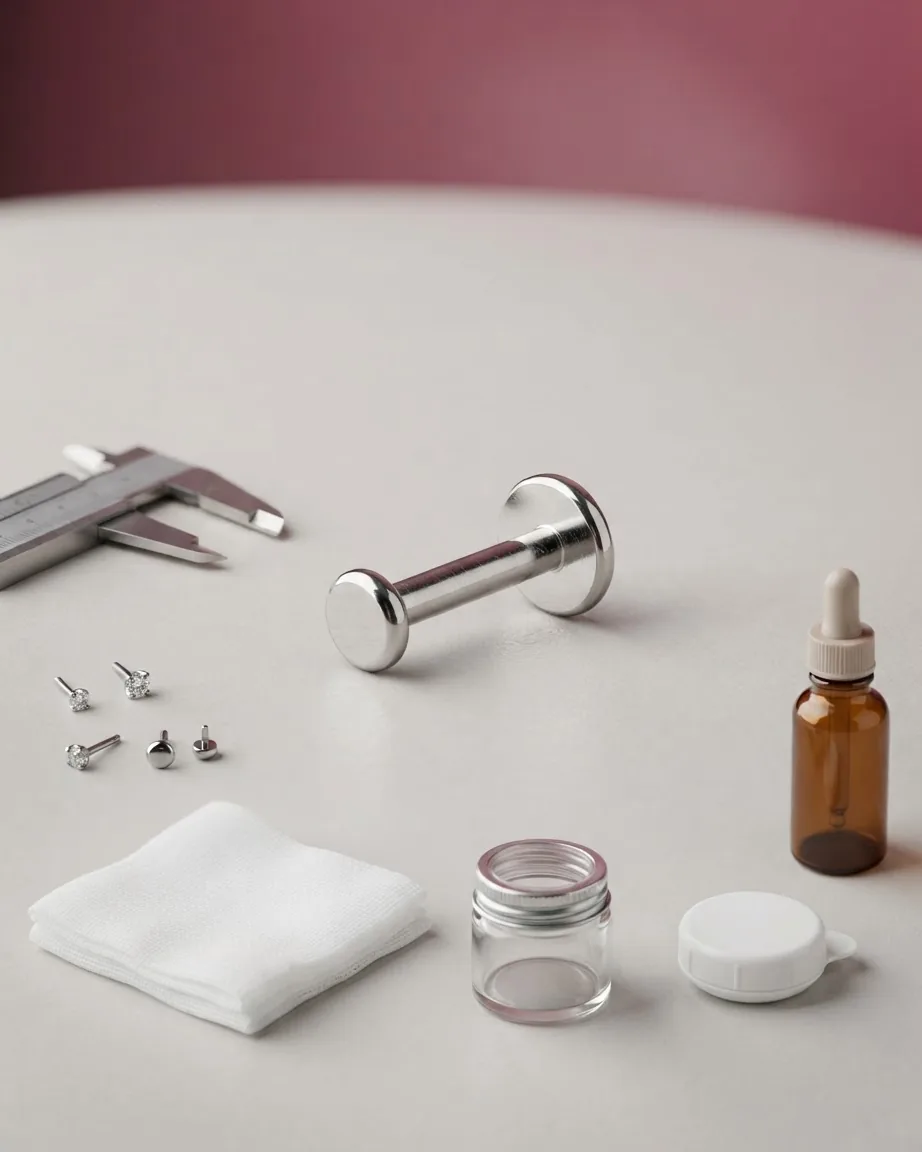
The number you want on the invoice is a gauge, and here the sources point in slightly different directions because they are describing different things. BodyCandy calls 16 gauge (16g) the universal standard for a tragus and says a 16g post gives the cartilage enough stability to heal properly without being too flimsy. Maison Miru agrees that a tragus is typically pierced with a 16 gauge needle at 1.2mm.
Other sources widen the range, and the reason is worth understanding rather than averaging away. Crystal Heaven Jewellery lists the two common labret gauges for a tragus as 16G (1.2mm) and 14G (1.6mm), and notes in its tragus size guide that the thicker 14G is sometimes chosen for the initial piercing for added stability, with 16G common for later jewelry changes. BodyArtForms puts the typical tragus somewhere between 18g and 14g depending on anatomy. Estella Collection, which makes flat backs only in 18g, calls that the standard gauge for its own line.
These are not four answers to one question. One source is describing the pierced channel, one the thicker needle a piercer might use for stability, and one its own product line. The practical read: 16g is the default to ask for, 14g is a stability upgrade your piercer may prefer at the appointment, and 18g shows up mainly on daintier retail pieces and in channels that have already shrunk. The Association of Professional Piercers sets minimum material and threading standards for initial jewelry but does not name a tragus-specific gauge, so the gauge call stays with your piercer and your anatomy.
- 16g (1.2mm) – the standard default for a new tragus; stable in cartilage without being bulky.
- 14g (1.6mm) – thicker; sometimes used for the initial piercing when extra stability is wanted.
- 18g (1.0mm) – thinner; common on healed-piercing retail jewelry, or the fallback if the channel has shrunk.
Post length by healing stage: start at 8mm, downsize to 6mm
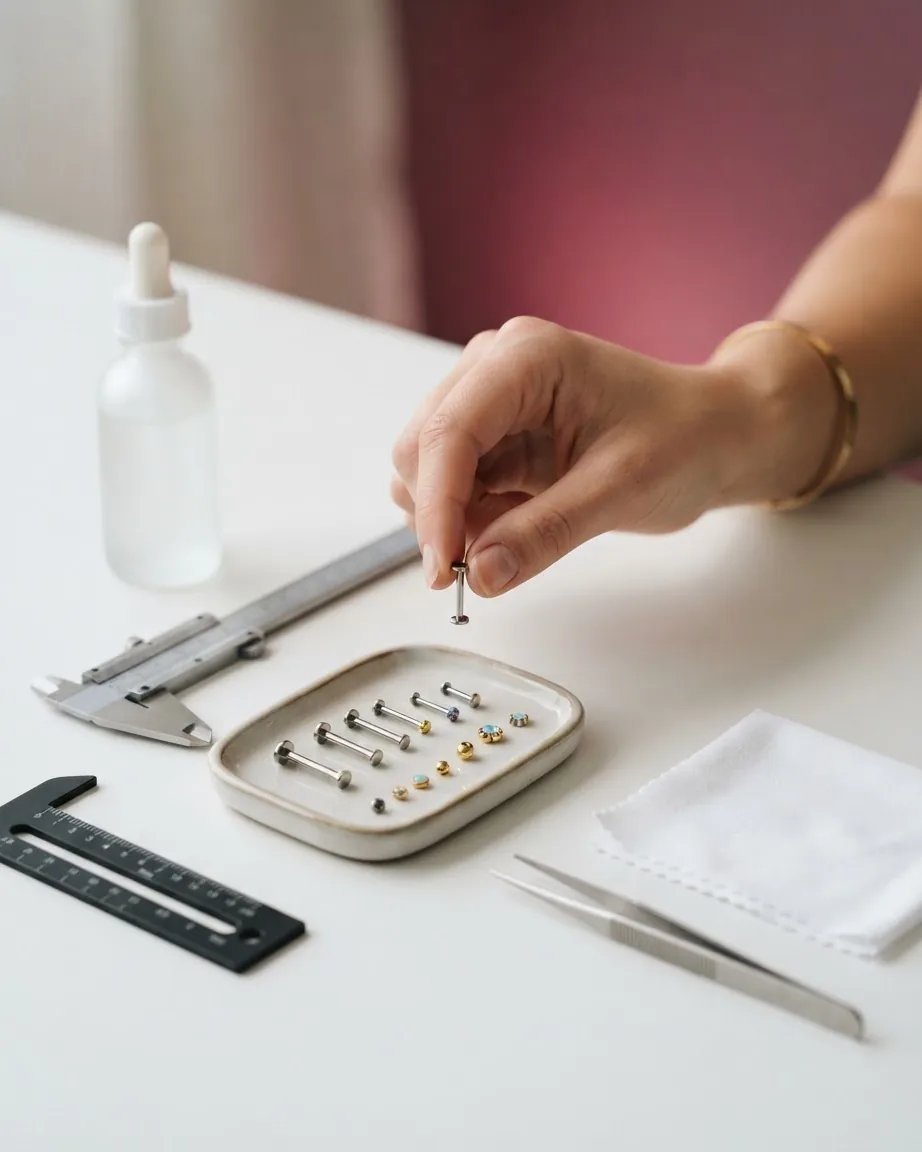
A fresh tragus is not fitted with the jewelry it will keep. BodyCandy explains that a piercer starts you off with a longer post, usually a 5/16 inch (8mm), because the tragus swells and a short post would be squeezed into the swollen tissue. The standard length for a settled, healed tragus is shorter: 1/4 inch (6mm).
The move from long to short is downsizing, and the timing is the part people get wrong. Swap too early and you risk pressing a now-short post into tissue that has not finished swelling; leave the long post in forever and the extra length snags and rocks the wound. BodyCandy puts the downsizing window after the swelling has fully settled, usually around the 4 to 8-week mark. That is a check-in with your piercer, not a self-service job – they confirm the swelling is down and fit the correct length.
Maison Miru’s own guidance lands in the same place, describing tragus jewelry as coming in 6mm and 8mm posts, with a 6mm or 8mm flat back standard for the piercing. So the length question has a clean two-step answer: 8mm out of the gate for swelling room, 6mm once the tragus has calmed down.
Hoop diameter: 5mm, 6mm, or 8mm by distance from the edge
Hoops are a healed-piercing choice, and diameter is set by how far your piercing sits from the edge of the tragus, not by looks. A 1/4 inch (6mm) hoop gives most tragus piercings a snug fit. BodyCandy notes that a piercing sitting very close to the edge can carry a smaller 3/16 inch (5mm) hoop, while a piercing set further back suits a 5/16 inch (8mm). Pick a hoop too large for a close-to-the-edge piercing and it levers on the tissue; too snug on a set-back piercing and it pinches. Matching diameter to distance is how you avoid the irritation bump that follows constant pressure.
Safe materials for a fresh tragus, and the certification labels that prove it
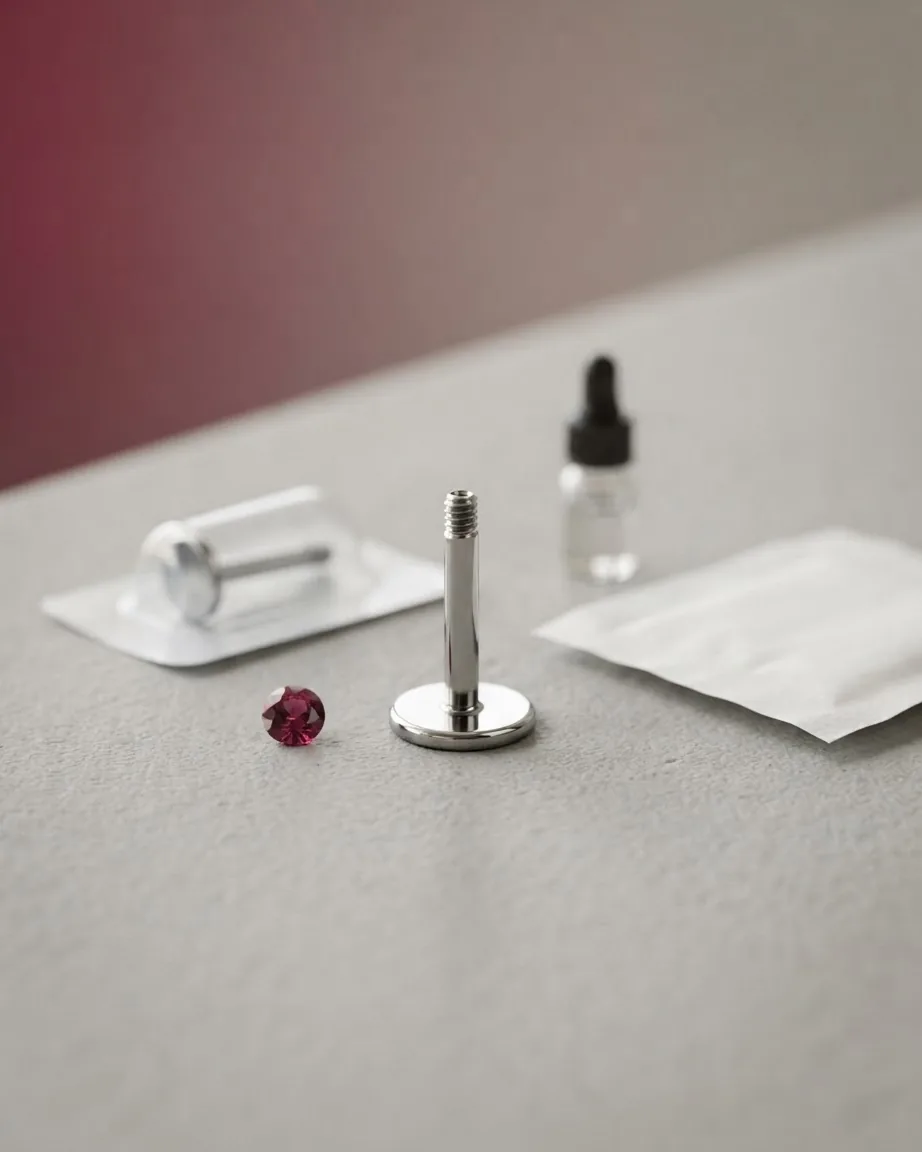
Cartilage is slow to heal and unforgiving of a reactive metal, so for a fresh tragus the material is not a preference – it is a specification you can verify on the listing. The Association of Professional Piercers publishes exactly what qualifies for initial jewelry on its jewelry standards page, and the labels are specific enough to read off a product description.
- Titanium – implant-certified titanium (Ti6Al4V ELI) that is ASTM F-136 compliant, or ASTM F1295 or ISO 5832-3 compliant; or commercially pure titanium that is ASTM F-67 compliant.
- Steel – surgical steel is biocompatible only in specific grades: ASTM F-138 or ISO 5832-1 compliant.
- Gold – acceptable for a fresh piercing only if it is 14k or higher, nickel- and cadmium-free, and alloyed for biocompatibility.
Two of those rules trip shoppers up. First, the APP standard is explicit that gold plated, gold-filled, and gold overlay or vermeil jewelry is not acceptable for fresh piercings – a thin gold skin over a cheaper core does not count. Second, going richer is not safer: gold higher than 18k is too soft for body jewelry because it scratches or nicks easily, and a nicked surface drags on healing tissue.
Internal threading or threadless posts matter too, because an external thread screws past the wound on every insertion. The APP standard treats smooth internal threading as part of what makes initial jewelry safe. When a maker meets the specification, it says so: Maison Miru lists its tragus jewelry as medical-grade titanium (ASTM F-136), hypoallergenic, nickel-free, and safe for new and healing piercings. That is the kind of line you are looking for on a listing – a named standard, not just the word “titanium.”
The “solid gold is automatically safe” trap
Solid 14k gold sounds like it clears every bar, and it often does – but not automatically. Estella Collection’s own caveat is that solid 14k gold is not nickel-free unless the maker specifically designed the alloy that way. Gold on its own is too soft, so it is mixed with other metals, and nickel can be one of them. The APP rule already requires fresh-piercing gold to be nickel- and cadmium-free, which is the same point from the standards side. So a “14k solid gold” tragus stud is a candidate, not a guarantee: look for the maker’s statement that the alloy is nickel-free before it goes into a healing channel.
This also explains why two reputable brands land on different metals without either being wrong. Maison Miru and BodyArtForms steer toward implant-grade titanium (ASTM F-136); Estella works only in 14k solid gold. Both routes are APP-acceptable when the specifics check out. The split is brand preference, not a safety ranking.
Jewelry style by tragus subtype: flat-back first, hoops after
Style follows healing stage before it follows taste. For the initial heal, a flat-back labret stud is the standard across the sources: a flat disc behind the ear canal, a short decorative front, nothing that swings. BodyArtForms, which lays out the subtypes in its tragus guide, recommends implant-grade titanium for the smoother healing a cartilage wound needs, and the flat-back shape is part of that calm start.
Hoops, clickers, and more decorative pieces are a reward for a fully healed tragus, not an option for week two. A hoop moves with the jaw and the pillow, and that motion is tolerable only once the channel is solid. For a vertical or surface-style tragus placement, a piercer may fit a curved barbell or a surface bar instead of a labret, because the jewelry has to follow the angle the tissue was pierced at. Estella makes its flat backs in 18g with post lengths of 5mm, 6.5mm, and 8mm, which gives a sense of how fine the length increments get once you are choosing a healed-piercing piece. Match the style to the stage first, the subtype second, and the look third.
If you are weighing what a fresh channel can hold against what a settled one can wear, our companion piece on what a fresh channel needs runs parallel to this one. The wider jewelry section covers placements beyond the tragus.
When a tragus is safe to change: the 12-month rule versus the healing timeline
Here two true statements sit in tension, and the resolution is the useful part. The tragus mostly heals faster than you are allowed to change its jewelry. Maison Miru advises wearing the jewelry you were pierced with for a full year before switching it out, even though the piercing mostly heals within six months. BodyArtForms gives the same instruction from a separate guide: wear the initial jewelry you originally got pierced with for the first 12 months before removing it.
Why wait past “healed”? Cartilage closes from the outside in. The surface can look settled while the deeper channel is still fragile, and an early change – especially a self-change – can reopen or irritate tissue that has not finished knitting. The 12-month figure is a buffer against that gap between looks and structure. The first stud swap, whenever it comes, is safest done by a piercer who can confirm the channel is ready and fit the right length and gauge.
The healing numbers themselves do not agree, and you should know that before you trust any single one. Maison Miru’s guide carries both “mostly heals within six months” and, elsewhere, “plan on 6 to 12 months to heal fully.” BodyArtForms says 6 to 12 months. Estella Collection puts the average at 3 to 6 months in its healing timeline. These are not errors competing – they are different definitions, because “mostly healed” and “fully healed” are not the same milestone. The practical takeaway ignores the exact month count: expect the surface to feel settled somewhere in the first half-year, treat full healing as closer to a year, and keep your original jewelry in for 12 months regardless of how good the ear looks at month six.
The irritation and embedding signs that send you back to a piercer
Some soreness is expected and some is a signal. Estella Collection describes the early course in stages: in the initial 0 to 2 weeks, redness, swelling, and slight soreness are normal; through the mid-stage of 2 to 8 weeks, the pain subsides but you still avoid touching or sleeping on it. That 2-to-8-week mid-stage overlaps the 4-to-8-week downsizing window for a reason – the swelling easing is the cue your piercer is waiting for.
Trouble looks different from ordinary healing. A post that was never downsized, or one started too short for the swelling, can let the flat disc or the front piece press into the tissue and begin to embed – the jewelry sinking rather than sitting. Growing redness, heat, swelling that climbs instead of settling, discharge that is more than the usual lymph, or jewelry that looks like it is pulling into the ear are reasons to stop adjusting it yourself and see your piercer, and a clinician if there are signs of infection. This desk does not diagnose piercings; the value here is knowing which changes are routine and which are a trip back to the chair.
The one-checkout rule for a new tragus
Pulling the staged decisions into a single buying rule: order a 16g (1.2mm) implant-grade titanium (ASTM F-136) flat-back labret at 8mm for the fresh piercing. Return to your piercer around 4 to 8 weeks for a downsize to roughly 6mm once swelling has settled. Hold that jewelry for the first 12 months before any style change. Save hoops at 5mm, 6mm, or 8mm – chosen by distance from the edge – and any 14k nickel-free gold pieces for after full healing. Reach for an 18g (1.0mm) piece only if the channel has shrunk.
How much thicker a tragus post is than a lobe stud
The whole case against reusing a lobe earring in a tragus comes down to the gauge gap you can read off the figures in this guide. A tragus is pierced at a thicker gauge than a standard lobe. That is a meaningful step up in diameter, and it is why a thin 20g lobe piece sits loose, drifts, and pressures the hole from one side.
The same logic explains the fallback the guide warns about. If a channel shrinks and you have to drop to an 18g (1.0mm) piece, you end up with a thinner post than your original 16g – a smaller hole than you began with, not a style choice.
- 16g vs 20g: the tragus gauge is the thicker of the two per post.
- 16g vs 20g, proportional: the correct tragus post is noticeably thicker than a lobe stud.
- 16g down to 18g fallback: the 18g piece is thinner than the original 16g, leaving a narrower post.
Frequently asked questions
Can I put a 20g lobe earring in my tragus to hold it open overnight?
No – that thin wire is the exact trigger for a shrinking channel. A 20g post under-fills a 16g hole, and once the tissue tightens around it you may find only a 1.0mm (18g) piece will pass. A snug, correctly gauged titanium post holds the channel better than any lobe stud borrowed for the night.
Is an 18g flat back ever the right first choice for a fresh tragus?
Rarely, and it is a brand-specific call. One maker builds its flat-back line in 18g and treats that as its standard, while the broad piercing default for a new tragus is 16g for stability, and some piercers step up to 14g. For an initial piercing, let the piercer set the gauge at the appointment rather than buying 18g off a retail page.
How do I verify a “titanium” listing is actually safe?
Look for a named certification, not the bare metal name. Acceptable initial titanium reads as ASTM F-136, ASTM F1295, or ISO 5832-3 for implant grade, or ASTM F-67 for commercially pure. A listing that says only “surgical titanium” with no standard, or any gold-plated or vermeil piece, does not clear the bar for a fresh cartilage piercing.
My tragus felt healed at four months – why can’t I change it yet?
Because the surface settles before the deep channel does. Cartilage knits from the outside inward, so an ear that looks calm at four months can still have a fragile interior. The 12-month hold is the margin that protects against reopening it. When the first change comes, having a piercer fit it lowers the risk further. Piercing healing, infection signs, and jewelry changes are health matters. This guide compiles published jewelry specifications and professional standards and is not a substitute for care from your piercer or a clinician.