A fresh tragus is pierced with a longer post than it will keep. Z-Edge Tattoo & Body Piercing puts an extra-long bar in at the start, usually 8mm or 10mm, because the body rushes fluid to the cartilage and a snug post would squeeze the swollen tissue. That one detail decides most of what follows about jewelry for a tragus piercing: which tragus piercing jewelry you ask for on day one, when you go back to swap it, and why a hoop bought too early ends up crooked. The tragus is dense, avascular cartilage sitting directly over the ear canal, so it heals slowly and reacts to pressure in a way an earlobe never does.
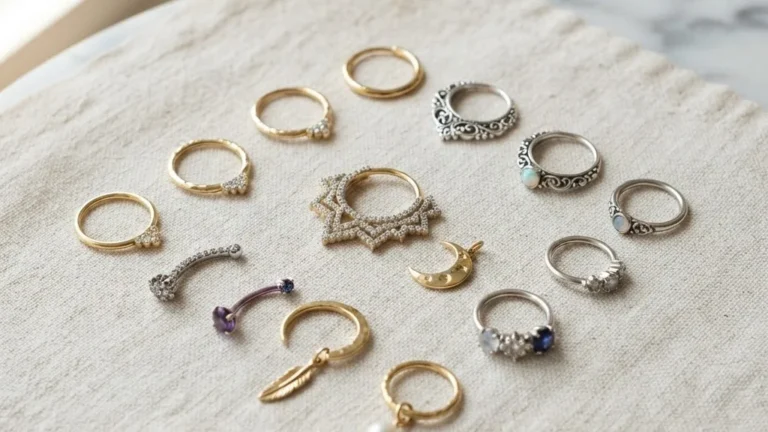
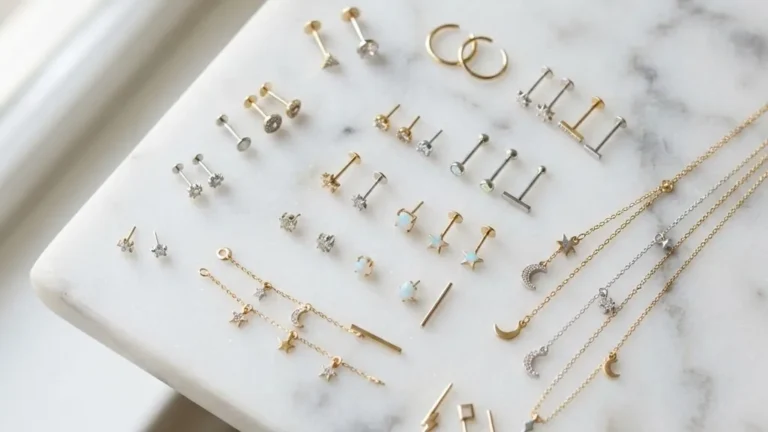
This guide compiles what professional studios, body-jewelry makers, and the Association of Professional Piercers publish on initial jewelry, then flags the places where those sources give different numbers rather than smoothing them into one. For the wider range of what sits in an ear, see our jewelry section.
Quick answer: Start a tragus with a flat-back labret stud in 16G (about 1.2mm), on a long 8mm or 10mm post to leave room for swelling. Material should be implant-certified titanium, solid 14k-or-higher nickel-free gold, or a proven steel grade. Once swelling settles, around 4 to 8 weeks, return to the studio to down-size to a snug 6mm or 8mm post. Save hoops for a fully healed piercing. A tragus piercing runs roughly $25 to $50 before jewelry and aftercare, and most studios advise keeping the original jewelry in for a full 12 months.
Why the First Jewelry Is a Flat-Back Labret Stud, Not a Hoop
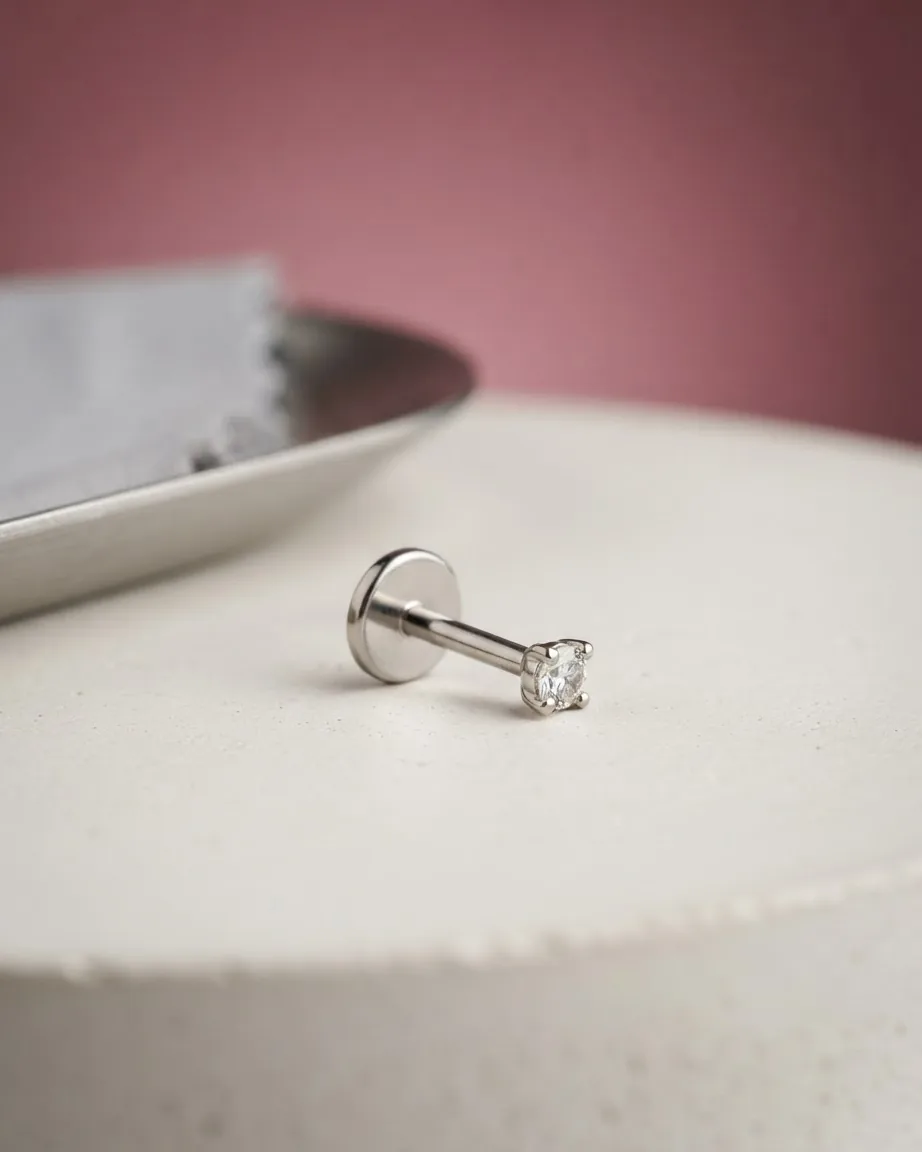
A flat-back labret stud is a smooth, flat disc on one end and a decorative top on the other. The disc sits flush against the inside of the ear canal, and that flat profile is the whole reason piercers reach for it on a new tragus. There are no prongs, ball backs, or crevices for hair, towels, or a sweater collar to snag, and snagging on healing cartilage is what tears the channel and triggers irritation bumps.
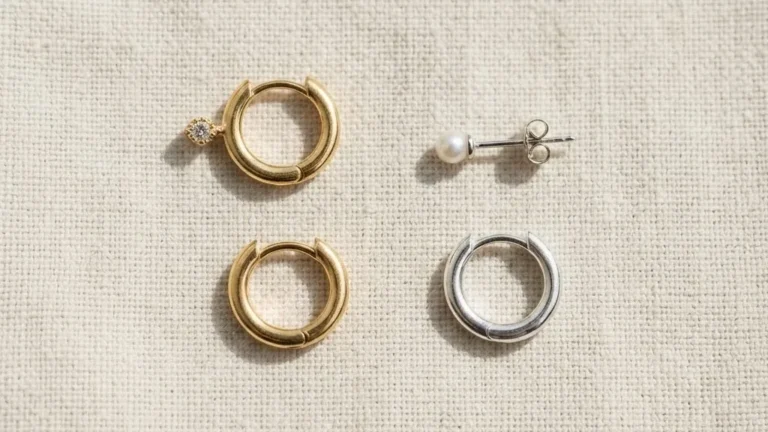
The tragus sits right over the opening of the ear canal, which means anything worn there gets pressed every time you lie on a pillow or push in an earbud. A flat disc tolerates that pressure. A ring does not. According to Z-Edge Tattoo & Body Piercing, a curved ring in a straight, fresh piercing channel puts constant, uneven pressure on the wound, which leads to migration, bumps, and crooked healing. That is why the rule on hoops is not a style preference but a timing rule: healed piercings only.
Barbells raise a different, smaller problem. A straight or circular barbell carries a ball on the inner end, and that ball presses into the ear canal and gets in the way of earbuds. It is a styled-look or occasional piece, not the thing you sleep in. For everyday wear, fresh or healed, the flat back keeps winning on comfort and hygiene because the disc is easy to clean and traps less against the wound.
Fresh vs. Healed: The Long Post, and the Down-Size That Comes 4 to 8 Weeks Later
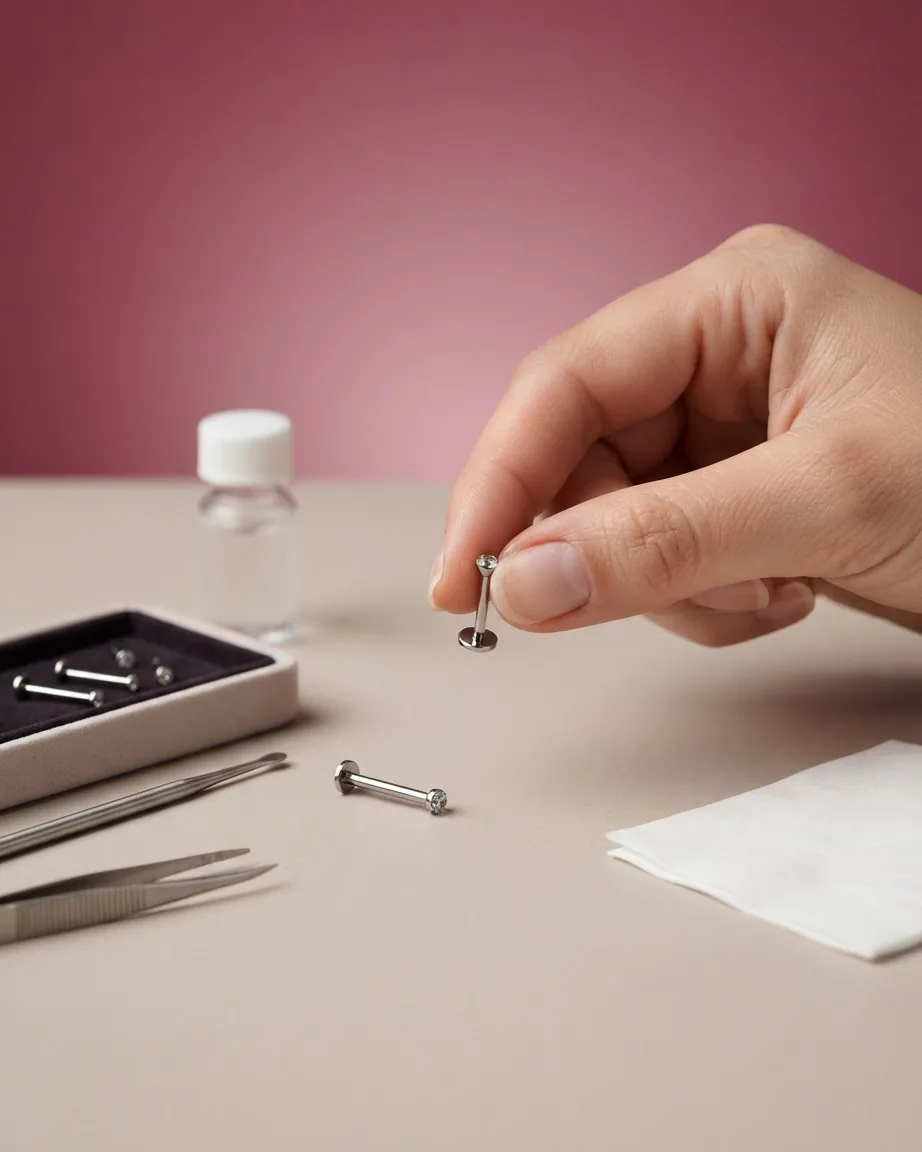
This is where most problems start. Z-Edge Tattoo & Body Piercing states that a fresh tragus piercing requires a longer post, 8mm or 10mm, in 16 gauge to accommodate natural swelling safely. The extra length is deliberate breathing room. If the initial post is too short, the jewelry squeezes the cartilage as it swells, and that pressure can cause severe pain, tissue necrosis, or the stud embedding into the skin. Too short is a genuine failure mode, not a cosmetic one.
Leaving the long post in forever is the opposite error. A bar with extra slack shifts, tilts, and catches, and that motion is exactly what produces irritation bumps. So there are two jobs for two stages. Z-Edge puts the swelling window at around 4 to 8 weeks; once it subsides, you return to the studio to down-size to a snug 6mm or 8mm flat-back post or, if the piercing is genuinely healed, a properly sized cartilage hoop. The down-size prevents migration, snagging, and irritation.
One caution on timing. The 4-to-8-week mark is when swelling typically eases enough to down-size, not when the piercing is healed. Those are separate clocks, and conflating them is a common mistake. Healing runs much longer, which the next sections cover. A down-size swaps the post length; it does not mean the channel is finished or that you can start changing jewelry freely.
If you want the daintier look once everything settles, Maison Miru notes a smaller flat back fits many healed tragus piercings. Save that experiment for after a professional confirms the piercing is healed, not during the first couple of months.
The Gauge to Ask For: 16G Standard, With a Real 18G-to-14G Range
Gauge is the thickness of the bar, and on this point the sources mostly agree while differing at the edges. The standard for a professional tragus is 16G, which Z-Edge Tattoo & Body Piercing puts at approximately 1.2mm. That thickness is chosen on purpose: a bar thick enough to stay stable in dense cartilage, and thick enough that the jewelry does not slowly cut through the tissue the way a thinner wire can.
Maison Miru frames the contrast with an earlobe directly. A tragus is typically pierced with a thicker needle than a standard lobe takes. Z-Edge describes lobes as pierced at 20G or 22G. The two studios use slightly different lobe conventions, but both land on the same point for the tragus: a lobe gauge is too thin for cartilage.
Thin is not a small detail. The Association of Professional Piercers warns that the body may treat jewelry that is too thin in gauge like a splinter, which can cause migration or rejection. Maison Miru adds the practical version: wearing 20 gauge jewelry in a tragus can make the piercing shrink, and a shrunken tragus may then need 18 gauge (1.0mm) jewelry to fit.
The range beyond 16G is where studios and makers diverge, and it is worth knowing before you ask for a number:
- 18G (1.0mm): Z-Edge notes some piercers use 18G for smaller ears. Maison Miru points to 18G as the fallback when a channel has shrunk.
- 16G (about 1.2mm): the common standard across Z-Edge, Maison Miru, and Crystal Heaven Jewellery for labret studs.
- 14G: Crystal Heaven Jewellery notes thicker 14G may be preferred for the initial piercing to add stability, with 16G used for later jewelry changes.
FreshTrends and BodyArtForms describe the whole span as 18G to 14G. None of these contradict each other so much as reflect different studio habits and different stages, initial versus subsequent. The safe move is not to pick a number from a chart but to ask your piercer which gauge they use and why for your ear. If you arrive wanting a specific look, tell them, and let anatomy set the thickness.
Post and Hoop Length: 6mm and 8mm, and What Each Does

Length is the second measurement, separate from gauge, and it is what keeps the jewelry sitting flat instead of drooping or tilting. For a healed tragus, Maison Miru states that a 6mm or 8mm hoop or flat-back earring is standard, and that tragus jewelry comes in 6mm and 8mm posts. Crystal Heaven Jewellery gives the same window for labret bars, 6mm (1/4 inch) to 8mm (5/16 inch), with 8mm often used.
The correct length lets the flat back rest comfortably inside the ear canal while the gem sits neatly against the front of the tragus. Too long and it snags and tilts; too short and it presses. This is why the fresh-piercing post, 8mm or 10mm, is longer than the healed-piercing post, 6mm or 8mm: swelling needs the extra few millimeters, and a settled channel does not.
Ears vary, so these are starting points rather than guarantees. A studio measures your anatomy and your swelling before committing to a length, and the down-size appointment is where the final number gets confirmed.
Safe Materials: Grade Designations Over the “Surgical Steel” Label
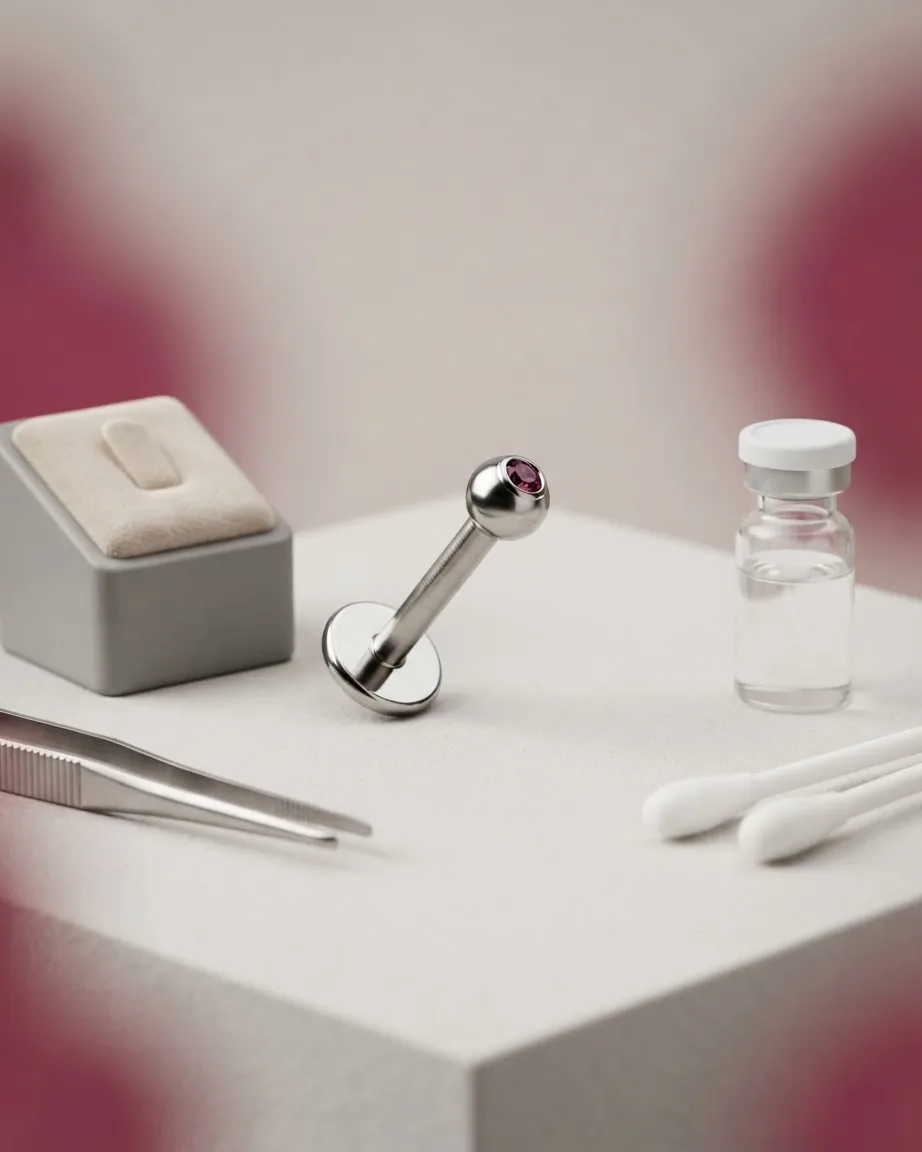
The material matters more than the shape, because it sits in a slow-healing wound for months. The useful skill here is reading a grade designation rather than trusting a marketing word, and the Association of Professional Piercers publishes the specifics that let you do that.
On titanium, the APP accepts two routes: an implant-certified Ti6Al4V ELI alloy meeting ASTM F-136, ASTM F1295, or ISO 5832-3, and, separately, commercially pure titanium meeting ASTM F-67. Titanium is the usual recommendation for anyone with nickel sensitivity because it contains no nickel. On gold, the standard is solid 14k or higher, nickel- and cadmium-free. Gold above 18k is too soft for body jewelry, and gold-plated, gold-filled, or vermeil pieces are not acceptable for fresh piercings, because that gold layer is measured in millionths of an inch and can wear or chip off to expose the base metal underneath.
Steel is where the sources genuinely disagree, and the disagreement is worth keeping rather than resolving. Healthline describes surgical stainless steel as safe for most people, inexpensive, and tolerable even for many with a nickel allergy because of its low nickel-release rate, while noting a severe nickel allergy is a reason to skip it. Z-Edge argues the other way for cartilage, steering clients toward titanium or gold and away from steel. The APP sits in between with the precise answer: only specific steel grades are proven biocompatible, those that are ASTM F-138 compliant or ISO 5832-1 compliant (and compliant with ISO 10993-6, 10, or 11, or the EEC Nickel Directive). The practical takeaway is that “surgical steel” on a tag tells you very little. A grade designation on a mill certificate tells you what you actually need to know.
Why does nickel keep coming up? Z-Edge notes that jewelry is the most common source of nickel-related contact dermatitis regardless of sex or piercing status, which is the reason nickel content drives these standards at all. Niobium offers a lower-cost route: Healthline describes it as similar to titanium and safe for almost everyone, lacking only the implant-grade designation, which matters little for an ear piercing.
The APP puts the buying rule plainly: “Because body jewelry is worn inside a wound and is in contact with your internal tissues, only certain products are suitable. The look of the jewelry that is placed in your fresh piercing must be secondary to aspects that affect safety and compatibility with your body.”
Threadless vs. Internally Threaded vs. Externally Threaded
How a stud’s parts connect is a safety question most shoppers never think to ask, and the Association of Professional Piercers draws a sharp line. The part of the jewelry that passes through your skin should be smooth.
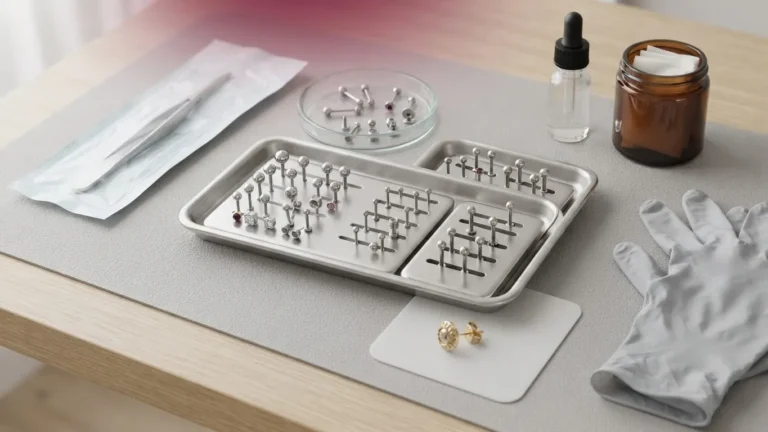
- Internally threaded: the screw threads live on the removable end, such as a ball or gem, so the post that passes through healing tissue is smooth. This is part of the APP standard for initial jewelry, because it removes any chance of sharp threads scraping the channel.
- Threadless (press-fit): an acceptable alternative with no screw threads at all. The ornamental end uses a pin coupling. These are easy to swap once you understand the fit.
- Externally threaded: the screw pattern is cut into the post itself, so that comparatively rough surface drags through the tissue on insertion and removal. For a fresh piercing, this is the one to avoid.
Whatever the closure, check threaded ends for tightness daily with clean hands. A loose end means a lost top and, potentially, a closed piercing channel, so a piece that keeps coming loose is likely defective and worth taking back to your piercer.
Gemstone Settings: Prong or Bezel, Never Glued
A gem on a stud can be held by the metal or stuck on with adhesive, and the difference is not cosmetic. The Association of Professional Piercers specifies that stones should be set securely into the metal, in a prong or bezel setting, rather than attached with glue. The reason is concrete: a glued stone is common on lower-priced goods and tends to fall out, and when it does, the entire piece needs replacing, because the empty hole left behind can harbor bacteria and raise infection risk.
So when you pick a decorative top, especially one you will wear through healing, ask how the stone is set. A prong or bezel setting is a quality signal; “glued” or no answer at all is a reason to choose something else.
What a Tragus Piercing Costs, and Where the Money Goes
Healthline puts the price of a tragus piercing at $25 to $50. That figure covers the piercing itself and is shaped by the piercer’s experience, the studio’s location and popularity, and the type of jewelry used. Two numbers to hold onto: that range usually excludes aftercare products and a tip, and it may or may not include the jewelry, so ask before you book whether the quote is for the service alone.
Because material and style change the total, a titanium or solid-gold flat back will sit higher than a basic option, and the standards above are the reason not to choose on price alone. For how a cartilage fee tends to break apart in practice, see our how much is a helix piercing guide.
Healing Time and When It Is Actually Safe to Change the Jewelry
This is the section where the numbers scatter most, and the scatter is the point rather than a problem to average away. Different reputable sources give different full-heal figures for the same piercing:
- Healthline: typically 3 to 6 months, but it can take up to a year depending on care and complications.
- Maison Miru: plan on 6 to 12 months to heal fully, and the tragus mostly heals within six months.
- BodyArtForms: 6 to 12 months to completely heal, regardless of the tragus style.
- FreshTrends: most often 2 to 3 months, while noting cartilage healing varies widely.
The honest read: cartilage heals on its own schedule, affected by aftercare, medications, existing conditions, and smoking, so a single number would mislead you. Treat the short end as optimistic and the longer 6-to-12-month window as the safer planning horizon, and let your own piercing, not a calendar, tell you where it is.
Separate from heal time is a jewelry rule that is easy to confuse with it. Both Maison Miru and BodyArtForms advise wearing the jewelry you were originally pierced with for a full 12 months before switching it out. That is a stability recommendation, not a claim that the piercing needs 12 months to heal. Mentally keep them apart: healing may finish earlier, but the guidance is still to leave the initial piece in for the first year.
So when can you safely change it? Healthline’s checklist is the clearest: the piercing is no longer tender, the minimum healing time your piercer advised has passed, and any weeping, discharge, or crusting has stopped. If you must change it before then for some reason, have a piercer do it rather than forcing jewelry through an unhealed channel. And because the tragus is cartilage, the down-size appointment around 4 to 8 weeks is a studio job too, not a bathroom-mirror one.
When to Stop Treating It as Normal and See Someone
Some tenderness, swelling, watery discharge, and crusting in the first days is expected after any piercing. The judgment call is telling that apart from trouble, and Healthline lists the signs that mean a problem rather than ordinary healing, from pain and persistent redness through discharge, bleeding, and other changes around the site.
Allergen warning
Several of those point to specific issues. A contaminated needle can transmit bloodborne infections, which is why an experienced piercer using a sterile, single-use needle matters. Itching, redness, and blisters suggest an allergic reaction, often to nickel, which loops straight back to choosing a proven material. A hole that grows, or skin flaking and thickening around it, can signal rejection.
None of this is a diagnosis you should make at home. If symptoms persist or worsen, Healthline’s own guidance is to talk to a healthcare provider, and if you suspect an infection, the Association of Professional Piercers says plainly to seek medical attention. A piercer can tell you whether what you are seeing is normal irritation or something that needs a clinician; a doctor settles anything that looks like infection. When in doubt, ask the person who did the work, and escalate to a medical professional for anything beyond ordinary healing.
Can you put a hoop in a fresh tragus piercing?
No. A ring’s curve forces uneven load on a straight, unhealed channel, which pulls the piercing toward migration, bumps, and a crooked final angle. Wait until a piercer confirms full healing, which runs anywhere from a few months to a year, then fit a hoop sized to your ear’s diameter rather than guessing.
A tragus shrank after a thin earring went in. What now?
A channel can tighten when it carries jewelry thinner than it was made for. If that has happened, an 18 gauge bar at 1.0mm may fit the reduced opening. Rather than wrestling jewelry back in yourself, let a piercer assess the channel and re-stretch or re-fit it.
Why does my stud keep tilting and catching after a few weeks?
Usually the long initial post has outlived its job. Once swelling eases, that extra 8mm-to-10mm length leaves slack, so the bar shifts and snags, which is precisely what seeds irritation bumps. The fix is the scheduled down-size to a snug post, done at the studio, not leaving the long bar in indefinitely.
Is titanium or gold the better pick for a first tragus stud?
Both qualify when the grade is right. Implant-certified titanium carries no nickel and is the common choice for sensitive skin. Solid 14k-or-higher nickel-free gold works equally well but costs more and must never be plated or vermeil, since that thin coating can wear through to the base metal beneath.
How Much Thicker a Tragus Bar Is Than a Lobe Bar
A 16G tragus bar sits at about 1.2mm, while a lobe is pierced far thinner, which is why a lobe gauge reads as too thin for dense cartilage. That difference is the margin between jewelry that stays stable in dense cartilage and jewelry the body may treat like a splinter and push toward migration or rejection.
- Tragus standard: a 16G bar at about 1.2mm, chosen to stay stable in dense cartilage.
- Lobe convention: a thinner gauge, which both studios agree is too light for a tragus.
- Why it matters: that margin is why swapping in a 20G lobe-style piece can let a tragus shrink until only 18G (1.0mm) jewelry fits.