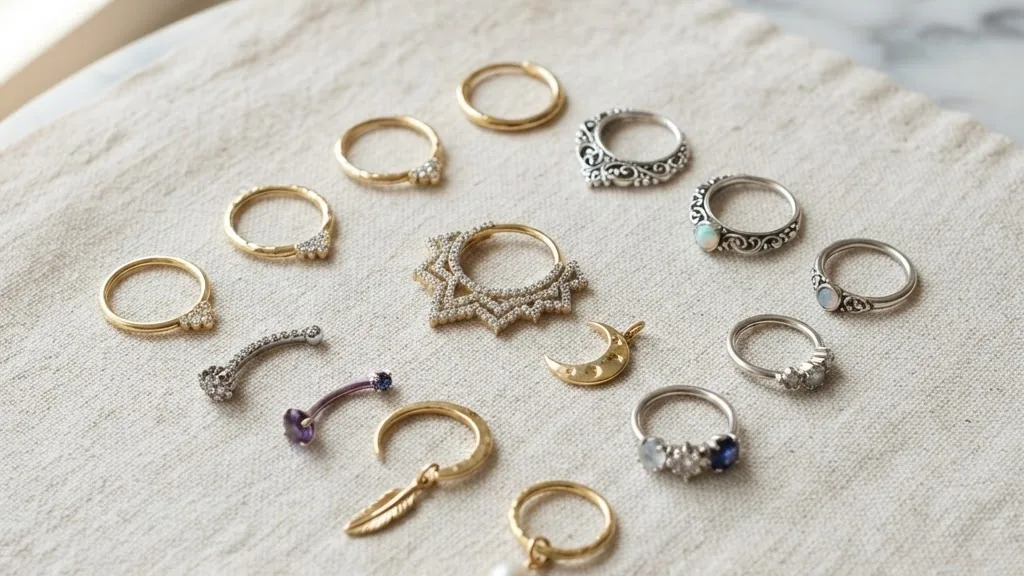
Daith jewelry is the ring or curved bar that sits in the daith, the innermost fold of ear cartilage that arches just above the opening of your ear canal. Because that fold is small, curved, and made of dense cartilage rather than soft lobe tissue, the piece you put in it is not a cosmetic afterthought. The gauge, the diameter, and above all the metal decide whether the piercing heals cleanly or fights you for months. This guide explains how to pick daith jewelry that fits your anatomy and your healing, and it does so neutrally, with every health claim traced back to published medical guidance rather than marketing.
A daith piercing is a cartilage piercing, and cartilage has a poor blood supply, which is why it heals slowly and reacts strongly to the wrong jewelry. That single fact shapes almost every recommendation below. The wrong metal can drive an allergic reaction that looks like an infection, and a piece that is too tight or too thin can trap fluid or migrate. So while daith rings come in a tempting range of styles, the priorities here are size and material first, sparkle second.
Every gauge, diameter, healing window, and aftercare detail below is drawn from piercing-industry standards and published health guidance, and cross-checked against current retail listings.
Quick answer: Standard daith jewelry is 16 gauge (1.2 mm), with 18G (1.0 mm) used on smaller anatomy. The most common hoop or clicker diameter is 5/16 inch (8 mm), within a usual range of 1/4 inch (6 mm) to 3/8 inch (10 mm). Choose implant-grade titanium graded ASTM F-136 for a fresh or healing daith, because nickel is the most common contact allergen. A daith takes roughly 4 to 12 months to heal, and you should not change the jewelry until it is fully healed. Daith jewelry is not a proven migraine treatment.
What daith jewelry is and where it sits
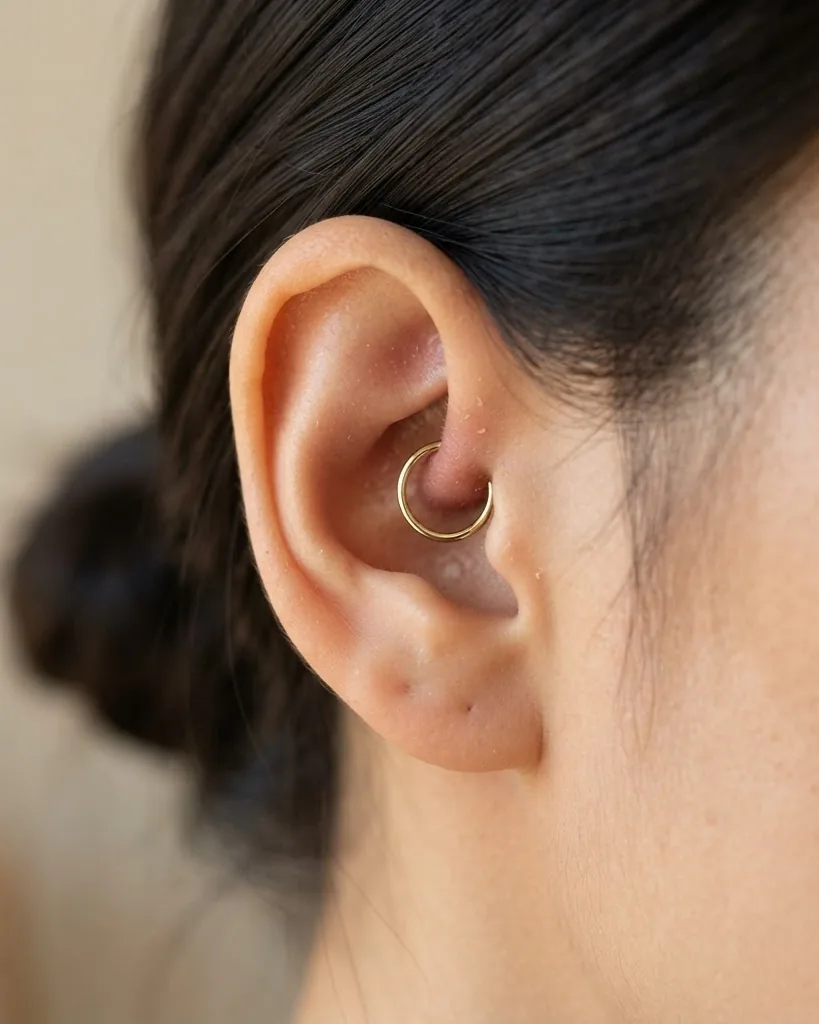
The daith is the ridge of cartilage directly above the ear canal, formed by the innermost curve of the helix as it folds back into the ear. It is one of the more hidden ear placements, which is part of its appeal: a small hoop tucked into that fold reads as understated even though the location is anatomically tricky to reach. A piercer uses a curved needle and steady angle to pass through the fold, and the jewelry then curves with the cartilage rather than sitting flat.
Because of that geometry, not every style of body jewelry works in a daith. The piece has to follow the curve of the fold, which is why rings and curved bars dominate and straight barbells do not belong here. It also means the diameter has to match your individual fold; too large and the ring hangs and snags, too small and it presses on swollen tissue. Understanding the placement is the first step to understanding why the sizing rules that follow are not arbitrary. If you are still deciding between ear placements, our overview of the types of ear piercings shows where the daith sits relative to the rook, tragus, and helix.
It also helps to know how the piercing is performed, because that shapes the jewelry fitted at the start. A piercer works with a fine curved needle to follow the arc of the fold, then threads the initial jewelry through the fresh channel. Most studios fit a hoop or curved bar sized slightly larger than the final piece will be, because a fresh daith swells and a snug ring can trap that swelling against the cartilage. That is why the first ring you leave the studio with is not necessarily the size you will settle into once the piercing has calmed down, and why any downsizing is a later step done under a piercer’s eye.
Gauge and diameter: the sizes that fit
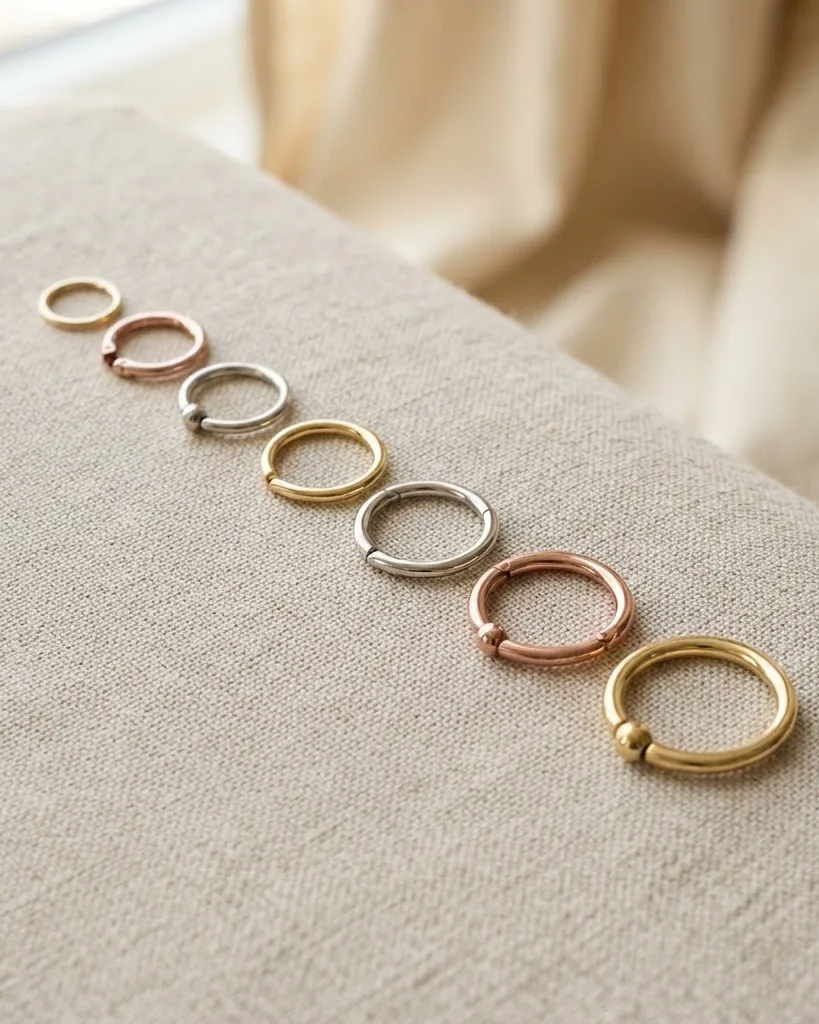
Two measurements define daith jewelry: gauge, which is the thickness of the metal, and diameter, which is the width of the ring. Gauge runs on a counterintuitive scale where a smaller number means a thicker post, so 16G is thicker than 18G. Getting both numbers right matters, because a post that is too thin for cartilage is prone to bending and migration, and a diameter that is off will either strangle a swelling piercing or dangle loose enough to catch on hair and hats.
The industry standard for a daith is 16 gauge, which is 1.2 mm thick. That thickness supports cartilage without cutting a channel wider than needed. Some smaller ears are pierced at 18G (1.0 mm), but going thinner than that in cartilage is generally discouraged because a delicate post does not hold a heavy cartilage piercing well. On diameter, daith hoops and clickers commonly range from 1/4 inch (6 mm) to 3/8 inch (10 mm), and 5/16 inch (8 mm) is the size most people land on. Your piercer measures your fold to confirm, because the right diameter is the one that clears your swelling during healing yet still sits snug once settled.
| Measurement | Standard | Range | Notes |
|---|---|---|---|
| Gauge (thickness) | 16G (1.2 mm) | 16G to 18G (1.0 mm) | Never thinner than 18G in cartilage |
| Diameter (ring width) | 5/16 in (8 mm) | 1/4 in (6 mm) to 3/8 in (10 mm) | Measured to your individual fold |
| Post threading | Internally threaded or threadless | n/a | Smoother than external threads |
One practical note on threading: internally threaded and threadless jewelry keep the screw threads off the surface that passes through your ear, so they slide through the channel more smoothly than externally threaded pieces. For a fresh cartilage piercing, that smaller amount of friction is worth choosing.
Daith jewelry styles, and what each one does
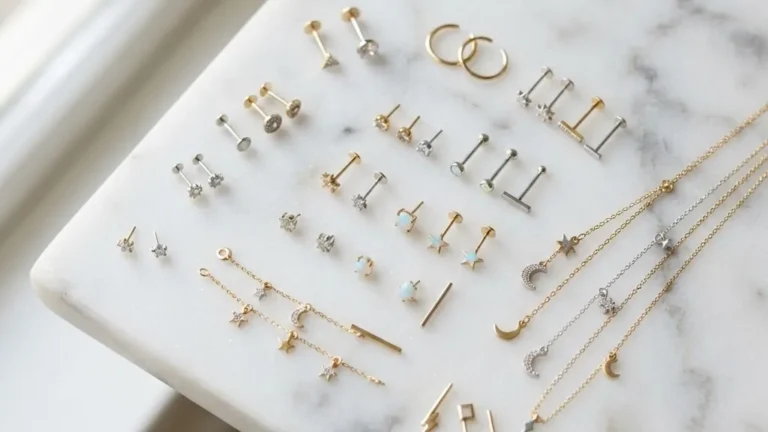
Once the gauge and diameter are set, style is where personal taste comes in, and the daith supports several. Each has a different closure and a different feel to live with.
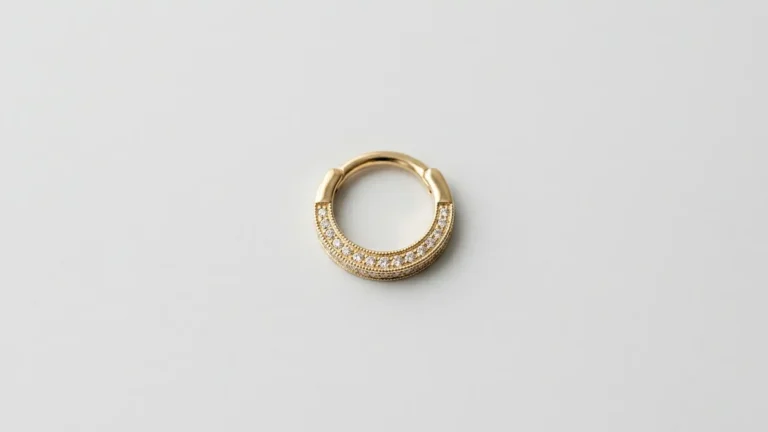
- Clicker ring: a hinged segment ring that clicks open and shut, the easiest style to insert and remove without tools once you are healed.
- Captive bead ring (CBR): a continuous ring held closed by a small captive bead under tension, a classic look that can be fiddly to change yourself.
- Seamless or continuous ring: a smooth ring with no visible closure, minimal and clean, opened by gently twisting the ends apart.
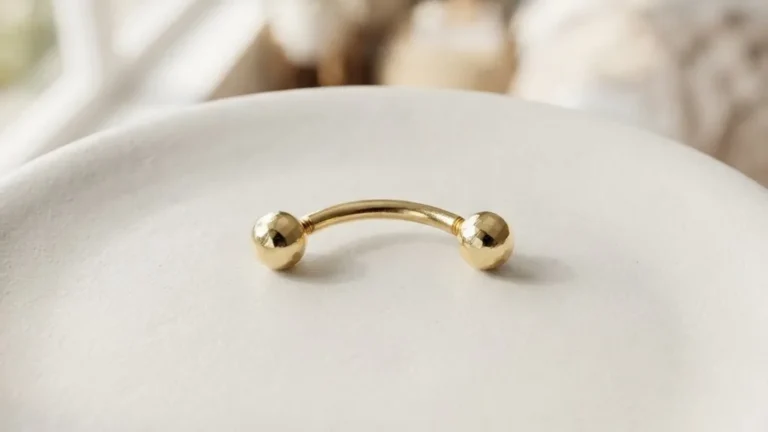
- Curved barbell: a curved bar with a bead on each end, which follows the fold and is a common alternative to a hoop.
- Heart-shaped daith ring: a decorative hinged ring that frames the fold as a heart, one of the most popular daith looks.
Whatever the shape, the safe rule holds: the closure and finish should be smooth, the metal should be implant grade, and the size should match the numbers above. A pretty ring in the wrong metal is still the wrong ring.
Hoop or curved barbell: which to start with
For a fresh daith, the two practical starters are a hoop, usually a clicker or captive bead ring, and a curved barbell. Both follow the fold, so the choice comes down to fit, healing, and how much you plan to handle the jewelry. A curved barbell is compact and sits close to the fold, which can mean less to catch on hair or a pillow while the piercing is new, and the beads unscrew for cleaning access. A hoop gives the classic daith look many people want from the start, and a hinged clicker is the easiest to open and close once you are allowed to change it.
There is no single correct answer, and many piercers will fit whichever seats best in your particular fold at the initial appointment. The one thing not to do is decide by looks alone and ask for a ring that is too small to clear the swelling, or a novelty piece in a questionable metal. Start with a smooth, correctly sized, implant-grade piece, let it heal, and treat the decorative upgrade as something you earn once the daith is mature.
The best metals for daith jewelry
Metal is the single most important choice you make, because it is the part of the jewelry in constant contact with a healing wound. Nickel is the most common cause of allergic contact dermatitis, and cheap plated or low-grade pieces can leach it into the channel, driving redness and irritation that is easy to mistake for infection. Mayo Clinic notes that nickel allergy is a leading cause of contact dermatitis and that jewelry is a frequent trigger. Nickel sensitivity is estimated to affect somewhere around 10 to 20 percent of people, and once it develops it is lifelong, so avoiding nickel exposure in a fresh piercing is simple prevention.
For a fresh or healing daith, implant-grade titanium is the strong default. It is lightweight, nickel-free, non-corrosive, and biocompatible, and its non-porous surface gives bacteria fewer places to hide. Look for the material designations ASTM F-136, ASTM F-67, or ISO 5832-3, which identify titanium alloys held to implant standards. Mayo Clinic’s general guidance on preventing piercing complications lists titanium, nickel-free stainless steel, surgical-grade stainless steel, 18-, 22-, or 24-karat yellow gold, nickel-free white gold, and sterling silver among the safer metal choices. Note that solid gold means solid, not a thin gold-colored coating over a base metal, because plating wears and can expose whatever is underneath.
The FDA regulates body jewelry as a consumer product but does not certify any specific piece as safe to place in a fresh wound, so the burden of verifying the metal spec falls on you and your piercer. When in doubt, ask to see the mill certificate or material grade before anything goes into a healing daith.
Healing time and when you can change daith jewelry
Patience is the theme of any cartilage piercing, and the daith is no exception. Healing commonly runs 4 to 12 months, and many piercers cite 6 to 12 months for a daith specifically because the fold is dense and slow to knit. The most important thing to understand is that cartilage heals from the outside in: the surface can look calm and settled while the channel underneath is still immature. That is exactly why swapping jewelry too soon is such a common setback.
As a rule, you should not change your first piece of daith jewelry until the piercing is fully healed, which usually means waiting at least 6 to 8 months and confirming with your piercer. Removing starter jewelry early can let the channel narrow or close, and forcing a fresh piece back through irritated tissue reopens the wound. If you want a full location-by-location breakdown of timelines, our guide to how long ear piercings take to heal covers the daith alongside every other spot on the ear.
Aftercare for a healing daith
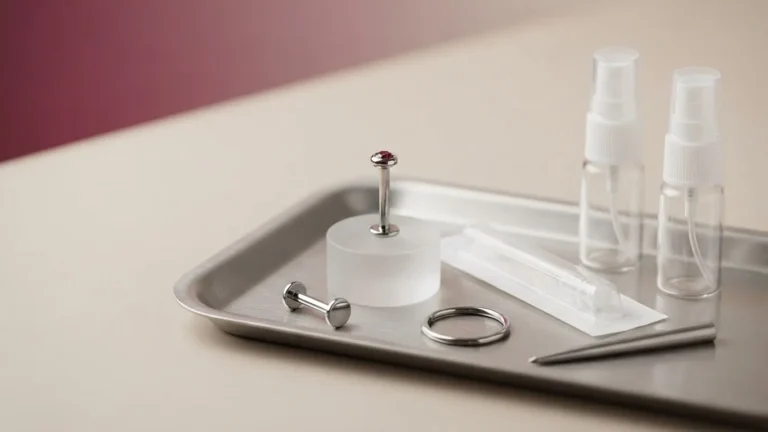
The aftercare for daith jewelry is simple, cheap, and consistent, which is what makes it work. The standard piercers recommend is sterile saline that lists 0.9 percent sodium chloride as its only ingredient, used to irrigate the piercing rather than scrub it. Skip alcohol and hydrogen peroxide, which are too harsh for healing tissue, and avoid antibacterial soaps, which the American Academy of Dermatology notes can damage healing skin. Guidance from the AAD on caring for pierced ears also stresses leaving jewelry in place for at least the first several weeks so the channel does not close.
A simple daily routine looks like this:
- Step 1 – Wash your hands thoroughly with soap and water before you touch the piercing.
- Step 2 – Spray or dab sterile 0.9 percent saline over the front and back of the daith, once or twice a day.
- Step 3 – Let it sit briefly, then gently loosen any crust that has formed against the jewelry.
- Step 4 – Pat dry with clean disposable gauze or a paper product, never a shared cloth towel.
- Step 5 – Leave the jewelry alone; do not twist, rotate, or remove it while it heals.
Beyond cleaning, the biggest favors you can do a daith are mechanical: sleep on the other side or use a travel pillow with a hole so the ear is not crushed all night, keep earbuds and over-ear headphones off the fresh piercing, and keep hair products and cosmetics away from it. A daith that is left undisturbed heals far more predictably than one that is fussed with.
The migraine question, answered honestly
Daith jewelry became popular in part on the claim that a daith piercing relieves migraines by hitting a pressure point tied to the vagus nerve. It is worth being direct about the evidence here, because this is a health claim. There are currently no controlled research studies confirming that daith piercings prevent or treat migraine; the reports are anecdotal, and reviewers have concluded that the lack of evidence prevents them from recommending the piercing for that purpose. Healthline’s summary of the research on daith piercings for migraines reaches the same conclusion.
None of that means you cannot get a daith. It means you should choose one because you like how the jewelry looks, not as a substitute for medical care. If you live with migraines, the responsible path is a clinician, not a piercing, and any piercing you do get should still follow the same sizing and aftercare rules as any other cartilage piercing.
Infection warning signs and when to see a professional
Some tenderness, mild redness, light swelling, and a little clear or whitish crust are normal in the first days after a daith piercing. The harder job is telling ordinary healing apart from an infection or an allergic reaction. Persistent redness that spreads, warmth, throbbing pain that worsens after the first few days, and yellow or green discharge point toward a problem rather than normal healing.
Mayo Clinic advises applying a clean, warm, damp compress to an irritated piercing for about 15 minutes at a time, up to four times within 24 hours, and seeking care if the skin becomes sore, red, or puffy, or the site oozes yellowish fluid. Because cartilage has a poor blood supply, an infection that takes hold in a daith can be harder to clear than one on the lobe, so do not wait it out if symptoms escalate or you develop a fever. If your daith jewelry seems too tight against swollen tissue, do not force it out at home; a professional piercer can help safely, and a doctor should evaluate a suspected infection.
Frequently asked questions
What gauge is daith jewelry?
Standard daith jewelry is 16 gauge, which is 1.2 mm thick. Smaller anatomy is sometimes pierced at 18G (1.0 mm), but cartilage should not be pierced thinner than 18G because a delicate post does not support the piercing well and is prone to bending or migration.
What size hoop for a daith piercing?
Daith hoops and clickers commonly range from 1/4 inch (6 mm) to 3/8 inch (10 mm) in diameter, and 5/16 inch (8 mm) is the most common size. The right diameter depends on your individual fold, so have a piercer measure it rather than guessing from a photo.
What is the best metal for daith jewelry?
Implant-grade titanium graded ASTM F-136 is the strong default for a fresh or healing daith. It is nickel-free, lightweight, and biocompatible, which lowers the chance of an allergic reaction. Nickel-free surgical steel and solid 14k or higher gold are also accepted; avoid plated pieces, which can wear and expose base metal.
Can I change my daith jewelry after a month?
No. A daith takes roughly 4 to 12 months to heal, and cartilage heals from the outside in, so it can look settled while the channel is still immature. Changing at one month risks narrowing or reopening the piercing. Wait until it is fully healed, usually at least 6 to 8 months, and confirm with your piercer.
Does daith jewelry help migraines?
There is no scientific evidence that daith piercings prevent or treat migraines; the reports are anecdotal, and researchers do not recommend the piercing for that purpose. Choose a daith because you like the jewelry, and manage migraines with a qualified clinician rather than a piercing.
The bottom line
Daith jewelry looks simple, but the choices behind it are what keep the piercing healthy. Start with the sizing that fits cartilage: 16G (1.2 mm) thickness and a diameter near 8 mm, measured to your own fold. Choose implant-grade titanium so a nickel reaction never gets a foothold, pick an internally threaded or threadless closure so the piece slides through cleanly, and then be patient, because a daith needs 4 to 12 months and does not tolerate early jewelry changes. Keep the aftercare boring and consistent with sterile saline, watch for the infection signs that warrant a professional, and treat the migraine claim as folklore rather than medicine. Get those fundamentals right and the style, whether a clicker, a seamless ring, or a heart, is the easy part.