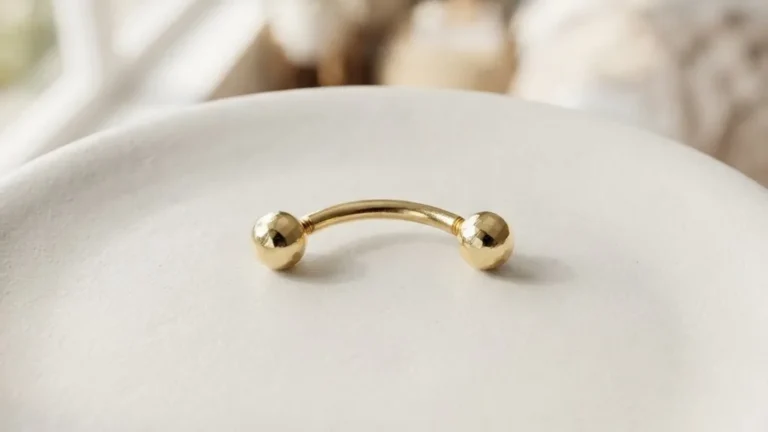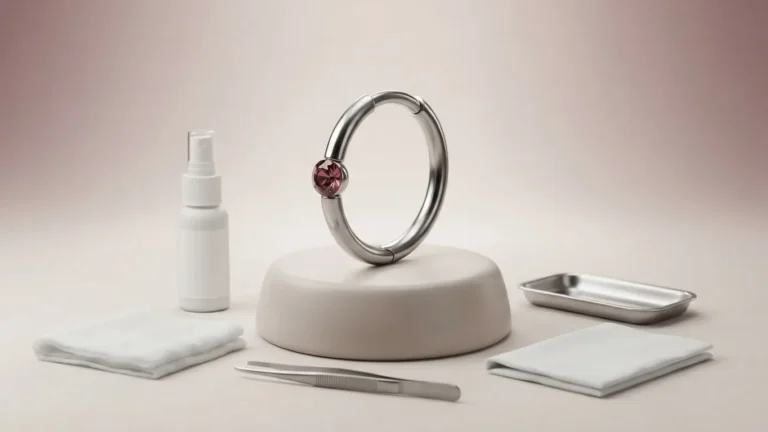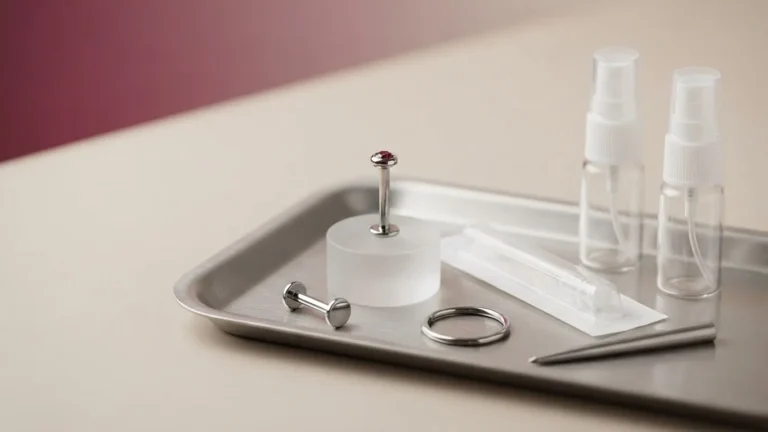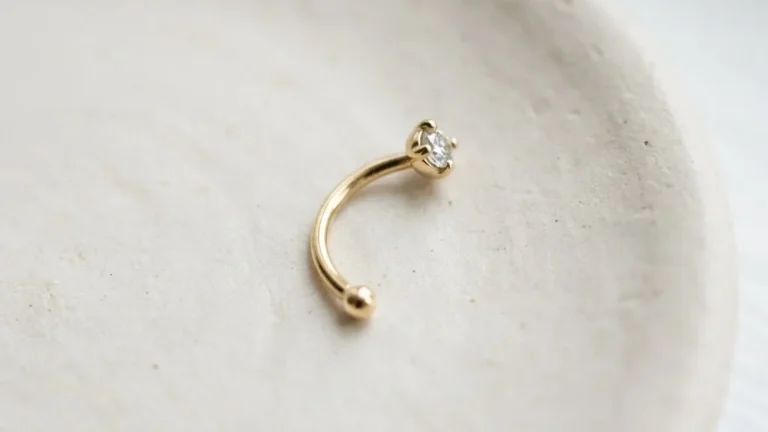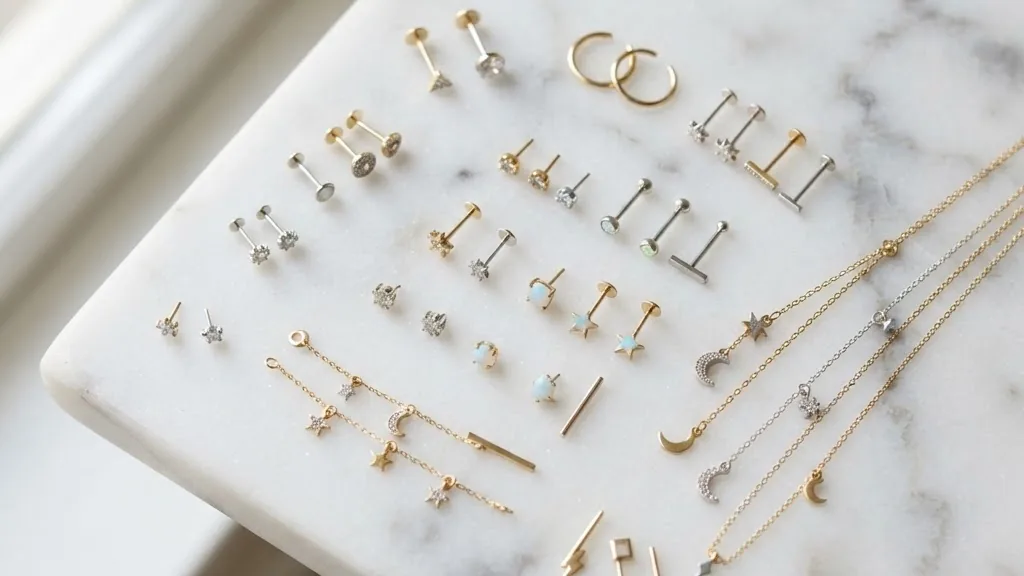
Flat piercing jewelry almost always means one thing done well: a flat-back labret stud, sized in an appropriate gauge and made from implant-grade metal. The flat is a cartilage piercing that sits on the broad, upper-inner surface of the ear, between the outer helix rim and the inner ridge, and its location has a big say in what you can safely wear. Because that surface presses against a pillow every time you sleep on your side, the wrong style of jewelry does not just look off, it creates a nightly pressure point that can stall healing. This guide explains why the flat-back stud is the standard, what gauge and length to look for, and which metals belong in a healing flat, with the health details traced to published guidance.
The flat is a straightforward, moderate placement to get, but like all cartilage it is unforgiving about jewelry. Cartilage has a poor blood supply, heals slowly, and reacts strongly to mechanical trauma. That is why the choice between a flat disc back and a raised back is not a style preference here; it is the difference between a smooth heal and a stubborn irritation bump.
Every gauge, length, healing window, and aftercare detail below is drawn from piercing-industry standards and published health guidance, and cross-checked against current retail listings.
Quick answer: The right flat piercing jewelry is a flat-back labret stud in 16 gauge (1.2 mm), with a post length usually between 6 mm and 8 mm to allow for swelling. Choose implant-grade titanium graded ASTM F-136, because nickel is the most common contact allergen. A flat takes about 6 to 12 months to heal, so keep the original jewelry in until it is settled. Avoid butterfly and screw backs, which press into the cartilage against a pillow and cause irritation bumps.
What the flat piercing is and where it sits
The flat piercing is named for its location: the flat expanse of cartilage on the upper-inner ear, inside the outer rim of the helix and above the conch. It is a popular spot because it offers a broad, even surface that can hold a single stud or anchor a curated cluster of studs across the upper ear. It is also a true cartilage piercing, which means it behaves nothing like a soft, quick-healing lobe.
Because the flat sits high on the ear where the head meets a pillow, jewelry choice is dominated by one practical fact: this surface takes pressure every night. That is different from a lobe, which hangs free, or even a daith, which is tucked into a protected fold. The flat is exposed to contact, so the jewelry has to be as low-profile and smooth on the back as possible. If you are still choosing between upper-ear placements, our overview of the types of ear piercings shows where the flat sits relative to the helix, conch, and rook.
The broad, even surface is also why the flat has become a favorite for curated-ear designs. Because there is room to place more than one piercing across it, people often build a cluster of small studs on the flat, sometimes over several appointments. That styling potential is a big part of the appeal, but it raises the stakes on jewelry choice, because each of those studs sits in cartilage that presses against a pillow. Get the back and the metal right on every one of them, or a single poorly chosen piece can be the one that develops a bump.
Why flat piercing jewelry means a flat-back labret
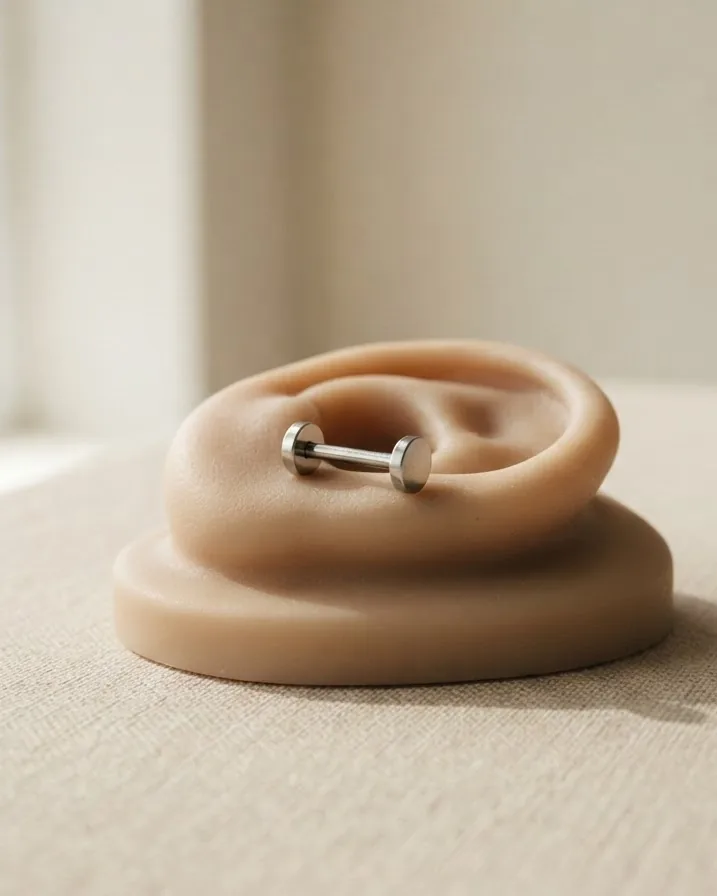
The reason studios standardize on the flat-back labret for the flat, and for upper-ear cartilage generally, comes down to mechanics. A flat-back labret is a straight post with a flat, smooth disc on the internal end and a decorative top on the external end. The disc sits flush against the back of the ear, creating no protrusion and no pressure point. When you sleep on that side, there is nothing raised digging into the cartilage.
Contrast that with a traditional butterfly back or a screw back, which leaves a raised knot of metal sticking out behind the ear. On a lobe that is a minor annoyance, but on a healing flat it is a real problem: every night the raised back presses the jewelry into the cartilage, and even moderate pressure repeated over weeks of healing is exactly the kind of mechanical trauma that produces the irritation bumps people dread. The flat disc removes that pressure point entirely, which is why the flat-back is not a fashion choice here but the healing-safe default.
The flat back does one more quiet favor: it keeps the jewelry from snagging. A butterfly back has open prongs that catch on hair, scarves, and towels, and every snag on a fresh cartilage piercing is a small trauma that can set healing back. A smooth disc has nothing to grab, so the piece stays put through daily life. That is also why piercers reach for the same flat-back design across the whole upper ear, from the helix to the conch to the flat, rather than treating each placement differently. Once you understand the mechanics, the recommendation stops feeling like an upsell and starts looking like the obvious engineering answer to a piece of jewelry that has to survive sleep, hair, and clothing while a slow-healing wound closes underneath it.
Gauge and post length: the sizes that fit
Two numbers define a flat-back stud: gauge, the thickness of the post, and length, the distance from the disc to the top. The standard gauge for a flat piercing is 16G, which is 1.2 mm thick, sturdy enough to support cartilage without cutting an unnecessarily wide channel. Post length usually runs between 6 mm and 8 mm, and a fresh piercing is fitted on the longer side to leave room for swelling. Once the swelling subsides and the piercing matures, many people downsize to a shorter post so the top sits closer to the ear.
| Spec | Standard | Notes |
|---|---|---|
| Gauge | 16G (1.2 mm) | Standard for a flat cartilage piercing |
| Post length (fresh) | 6 mm to 8 mm | Longer at first to allow for swelling |
| Back style | Flat disc (labret) | Sits flush; no butterfly or screw back |
| Threading | Internally threaded or threadless | Screw threads kept off the channel |
Getting the length right matters as much as the gauge. Too short on a fresh, swelling piercing and the disc can press into the tissue; too long once healed and the stud snags and wobbles. Have your piercer fit the initial length and handle the first downsize, which is usually done once the swelling has clearly settled.
Threaded versus threadless flat-backs
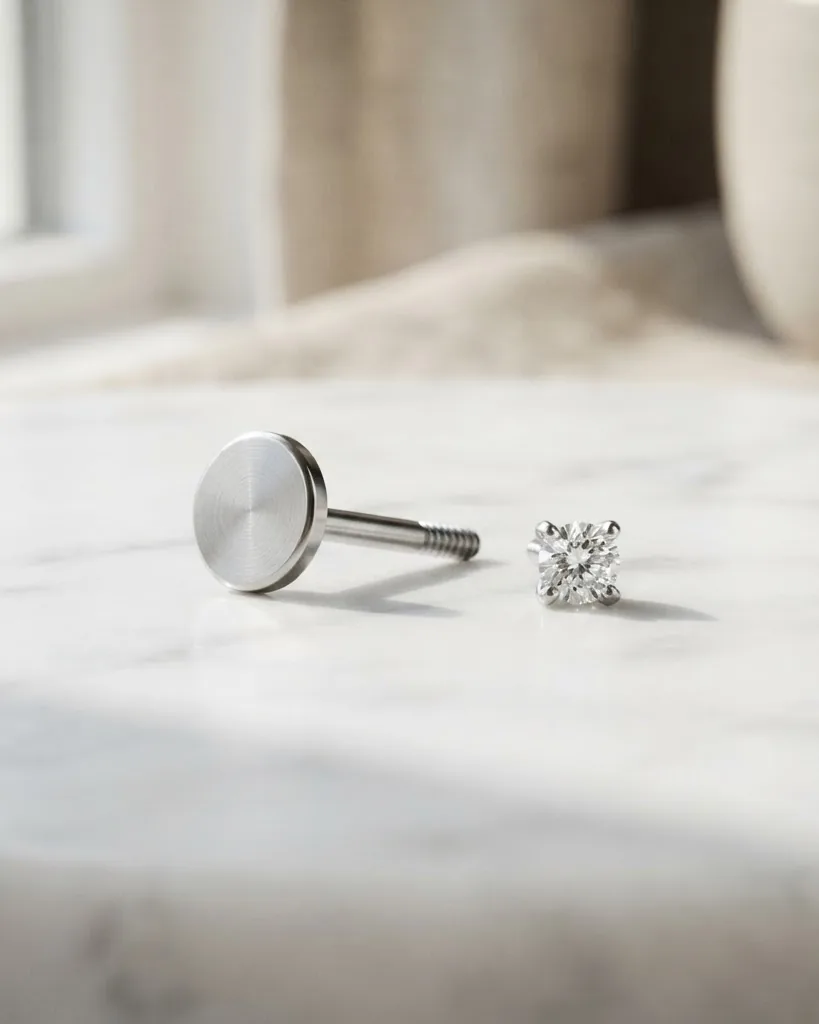
Flat-back studs come in two closure systems, and both are fine when they are internally threaded or threadless. An internally threaded labret has the screw threads on the removable top, so the post that passes through your ear is smooth. A threadless labret uses a small press-fit top held by tension, which is quick to change and also keeps the channel surface smooth. Either way, the point is to keep threads off the part of the post that slides through healing cartilage, because external threads drag against the channel and add friction.
What you want to avoid is an externally threaded post, where the threads are on the shaft itself. Pulling that ridged surface through a fresh piercing is needlessly abrasive. For a healing flat, smooth-through is the rule.
Between the two smooth options, the choice is mostly about how you like to change jewelry. Internally threaded tops screw on and stay put, which some people find more secure for daily wear, while threadless tops press in and pop off quickly, which makes swapping decorative ends fast and tool-free once the piercing is healed. Both keep the channel surface smooth, so either is a sound pick for a flat. What you should not do is change the top yourself in the early weeks; leave the initial piece undisturbed and let a piercer handle the first swap.
The best metals for flat piercing jewelry
Metal is the highest-stakes choice because the post is in constant contact with healing cartilage. Implant-grade titanium is the professional standard for both healing and healed upper-ear piercings. It is nickel-free, lightweight, and corrosion-resistant thanks to a stable oxide layer, and it does not tarnish or shed plating. Look for the designation ASTM F-136, which identifies a titanium alloy held to implant standards.
The reason to insist on nickel-free metal is straightforward. Nickel is the most common cause of allergic contact dermatitis, and Mayo Clinic identifies jewelry as a frequent trigger of nickel allergy, which is estimated to affect somewhere around 10 to 20 percent of people. A nickel reaction in a fresh flat can look like an infection and stall healing, so removing nickel from the equation is simple prevention. Mayo Clinic’s general guidance on preventing piercing complications also lists nickel-free stainless steel, surgical-grade stainless steel, solid 18-, 22-, or 24-karat gold, nickel-free white gold, and sterling silver among safer options. If you want gold, choose solid nickel-free gold rather than plating, since the FDA regulates jewelry as a consumer product but does not certify any piece as safe for a fresh wound, and plating can wear to expose base metal.
Healing time and when to change flat piercing jewelry
A flat is a cartilage piercing, so it heals on a long clock: roughly 6 to 12 months to fully heal, depending on the individual. As with all cartilage, it heals from the outside in, meaning the surface can look calm while the channel underneath is still immature. That gap is exactly why changing jewelry too early is such a common way to set a flat back and trigger a bump.
The practical rule is to keep the original flat-back stud in until the piercing is fully healed, and to have your piercer handle the first change or downsize rather than forcing a new piece through yourself. Downsizing the post length once swelling has settled is often worthwhile because a shorter, snugger post is less prone to being knocked, but timing it is a judgment call best made with a professional. For a placement-by-placement breakdown of timelines, see our guide to how long ear piercings take to heal. If you are curious how the flat compares to other spots on the pain scale before you commit, our ear piercing pain chart ranks it alongside the rest of the ear.
Downsizing deserves a little more attention because it is where a lot of flat piercings quietly go wrong. When a fresh piercing is fitted with a longer post to leave room for swelling, that extra length is exactly right at first but becomes a liability once the swelling goes down, because a long post lets the stud rock and catch on hair, masks, and pillows. That movement is a common trigger for irritation bumps weeks into an otherwise smooth heal. Booking a downsize appointment once your piercer confirms the swelling has settled, often somewhere in the first couple of months, swaps in a shorter post that sits snug and still. It is a small, inexpensive step that prevents a frustrating problem, and it is one more reason a flat is a relationship with a studio rather than a one-time purchase.
Aftercare for a healing flat
The aftercare is the same disciplined routine that serves every cartilage piercing, with one location-specific priority: protect it while you sleep. Irrigate with sterile 0.9 percent saline, keep your hands off, and avoid hydrogen peroxide and antibacterial soaps, which the American Academy of Dermatology notes can damage healing skin in its guidance on caring for new piercings.
- Step 1 – Wash your hands with soap and water before touching the piercing.
- Step 2 – Spray sterile 0.9 percent saline over the front and back of the flat, once or twice a day.
- Step 3 – Let it sit, then gently loosen any crust that has formed against the disc.
- Step 4 – Pat dry with clean disposable gauze, never a shared cloth towel.
- Step 5 – Leave the jewelry alone; do not twist, rotate, or remove it while it heals.
Beyond cleaning, sleep is where a flat is won or lost. Sleep on the opposite side, or use a travel pillow with a hole in the center so the ear is not compressed all night, and keep hair products, shampoo residue, and over-ear headphones off the fresh piercing. Even with a flat-back stud, repeated nightly pressure is the enemy, so the flat disc and good sleep habits work together.
Irritation bumps versus infection
The most common complaint with a flat is a small bump beside the piercing, and it is worth understanding that not every bump is an infection. Many are irritation bumps, a localized response to mechanical stress, often from a raised jewelry back, a snag, or sleeping on the piercing. The fix is usually mechanical too: switch to a properly fitted flat-back stud if you were not wearing one, protect the piercing at night, and be patient.
An infection is different and more urgent. Watch for spreading redness, warmth, throbbing pain that worsens after the first few days, and yellow or green discharge. Mayo Clinic advises a warm compress for about 15 minutes up to four times in 24 hours for irritation, and seeing a professional if the skin becomes sore, red, or puffy, or the site oozes yellowish fluid. Because cartilage has a poor blood supply, an infection here can be harder to clear than one on the lobe, so do not wait it out if symptoms escalate or you develop a fever. Do not remove the jewelry yourself if you suspect infection; keep it in and see a doctor or an experienced piercer.
The most reassuring thing to understand about flat piercing bumps is that the fix is usually about mechanics, not medicine. Before assuming the worst, run through the checklist: is the back a flat disc or a raised one, is the post the right length now that swelling has gone down, and are you sleeping on it or dragging a brush past it. Correcting those, with a piercer’s help if needed, resolves a large share of bumps on its own. Reserve stronger concern, and a professional or medical visit, for the true infection signs, and let time and gentle saline handle the ordinary irritation that comes with healing a cartilage piercing.
Frequently asked questions
What jewelry goes in a flat piercing?
A flat-back labret stud is the standard flat piercing jewelry: a straight post with a smooth flat disc on the back and a decorative top on the front. The flat disc sits flush against the ear so nothing raised presses into the cartilage when you sleep, which is why studios use it for the flat and other upper-ear placements.
What gauge is a flat piercing?
The standard gauge for a flat piercing is 16 gauge (1.2 mm), with a post length usually between 6 mm and 8 mm. A fresh piercing is fitted on the longer side to allow for swelling, and many people downsize to a shorter post once it has settled.
Why can’t I wear a butterfly-back earring in my flat?
A butterfly or screw back leaves a raised knot of metal behind the ear that presses into the cartilage every time you sleep on that side. Repeated nightly pressure during healing is a leading cause of irritation bumps. A flat-back labret removes that pressure point.
What metal is best for flat piercing jewelry?
Implant-grade titanium graded ASTM F-136 is the professional standard. It is nickel-free, corrosion-resistant, and does not shed plating. Nickel-free surgical steel and solid 14k or higher gold are also acceptable. Avoid gold-plated pieces on a fresh piercing, since plating can wear and expose base metal.
How long before I can change my flat piercing jewelry?
A flat takes about 6 to 12 months to fully heal, and cartilage heals from the outside in, so it can look done while the channel is still immature. Keep the original stud in until it is fully healed, and have your piercer handle the first change or downsize.
The bottom line
Flat piercing jewelry is a case where the right answer is refreshingly specific: a flat-back labret stud in 16G (1.2 mm), fitted at 6 to 8 mm to start, in implant-grade titanium. The flat disc is not a style detail, it is the feature that keeps the cartilage free of the nightly pillow pressure that causes irritation bumps, which is why butterfly and screw backs have no place here. Choose nickel-free metal to head off an allergic reaction, keep the original stud in through the 6-to-12-month healing window, and protect the piercing while you sleep. Get the back, the gauge, and the metal right, and the decorative top on the front is the part you get to enjoy choosing.