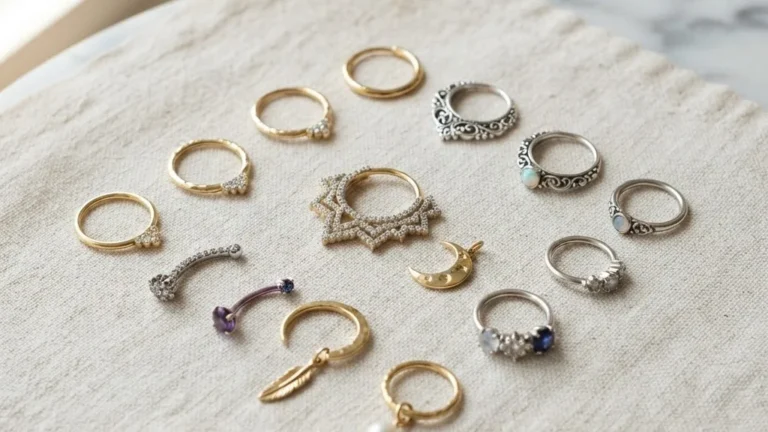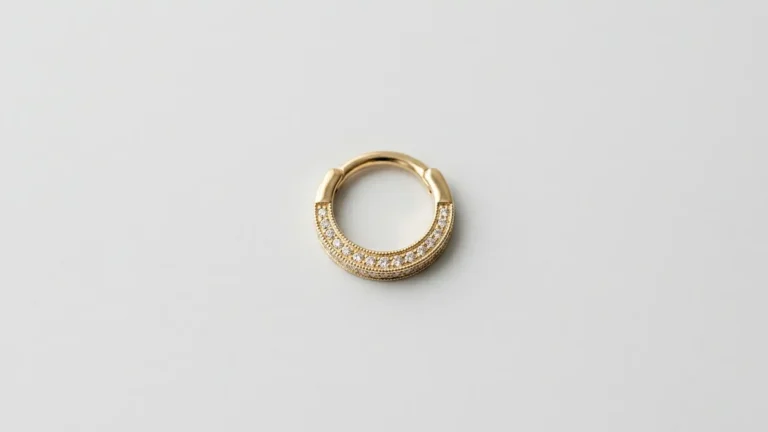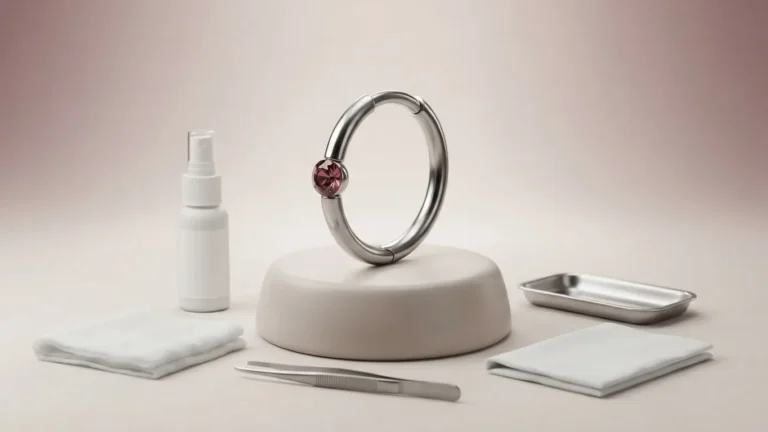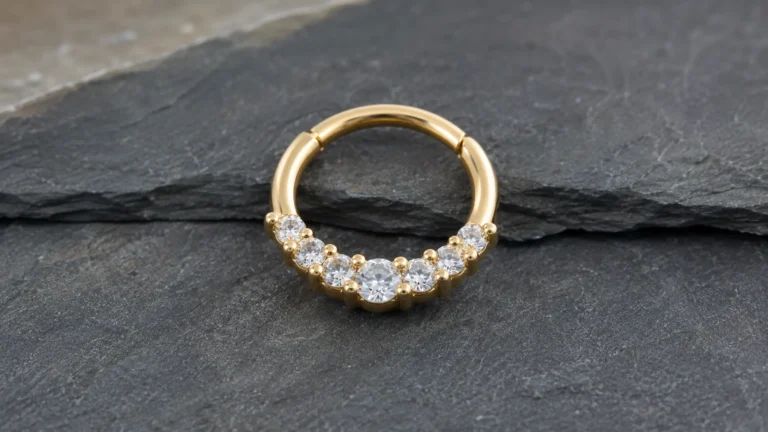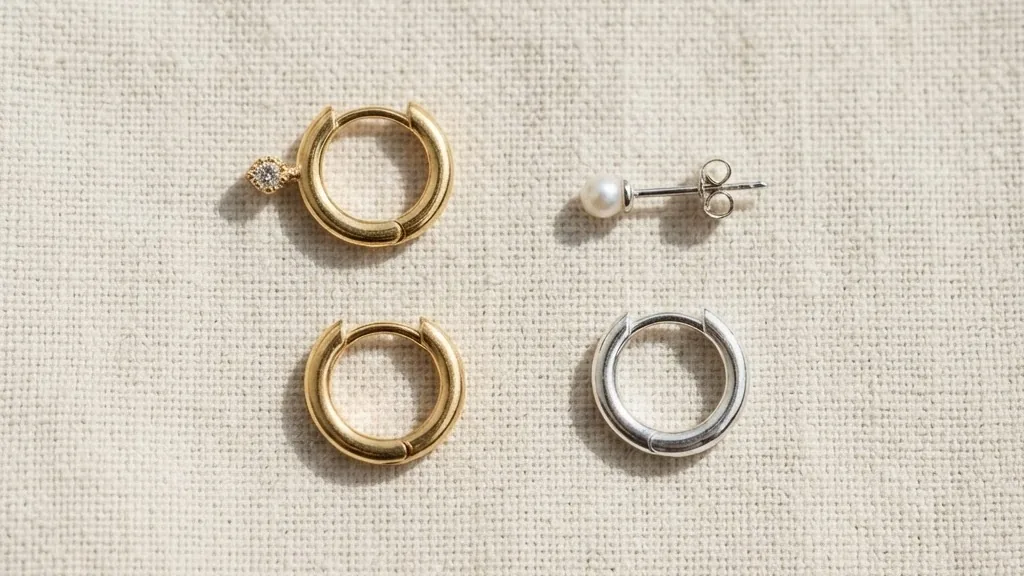
Earrings for double pierced lobes trip up more people than almost any other request I get at the counter, because a second hole quietly changes what fits, what touches, and what feels good after an hour. Most folks show up thinking a second lobe is just a copy of the first. It is not. The two holes usually sit only a few millimeters apart, so the earring you pick for one now has to share space with its neighbor. Get the math right and the pair reads as one clean look. Get it wrong and you have two earrings fighting over the same patch of skin.
The short version: for two lobe holes spaced about 5 to 8 mm apart, pair a small flat-back stud in the lower hole with a snug huggie or a second small stud above, keep both at your pierced gauge (usually 20g at 0.8 mm or 18g at 1.0 mm), and choose implant-grade titanium or solid 14k gold so the metal never fights your skin. If the second hole is fresh, wear only that safe metal, leave it alone for 6 to 8 weeks of surface healing, and hold off on hoops until the channel is settled. Everything below is how I make those calls in the studio.
What “double pierced lobes” actually means
A double lobe means two separate holes through the fleshy part of the ear, stacked roughly vertically. The first is your original lobe piercing; the second usually sits a little above it, toward the ear canal, though some people stack theirs lower or to the side. What matters for jewelry is the gap between the two. In most ears that gap runs 5 to 8 mm center to center, and around 8 mm is the common default because it leaves enough room that the jewelry in each hole does not physically touch.
That spacing decision belongs to your piercer, who should mark both dots before any needle comes out. Ear anatomy varies more than people expect, and a lobe that looks generous can still crowd two studs if they are placed carelessly. If you are still deciding where a second hole should live, it helps to understand the full map of the ear first. Our overview of the main types of ear piercings shows where the lobe sits relative to cartilage placements, which is useful when you are planning how a stack will grow later.
Studs, huggies, or hoops for the second hole
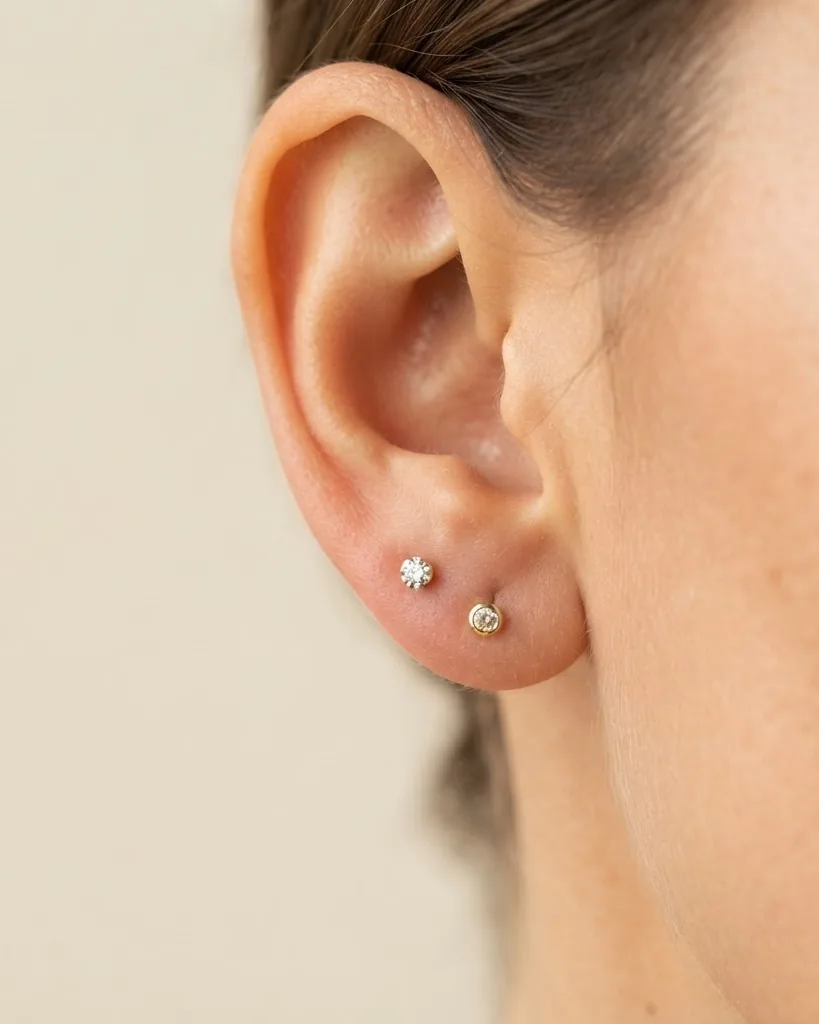
For a fresh second lobe, a small flat-back stud is the safest and most comfortable choice. Once healed, your realistic options are studs, huggies, and small hoops, and the trick is matching the earring’s footprint to that tight 5 to 8 mm gap. Studs win when the holes are close, because a flat disc sits against the lobe without swinging into its neighbor. Huggies work beautifully in the upper hole as a second layer. Full hoops need clearance, so they belong in the lower hole or on wider-spaced ears.
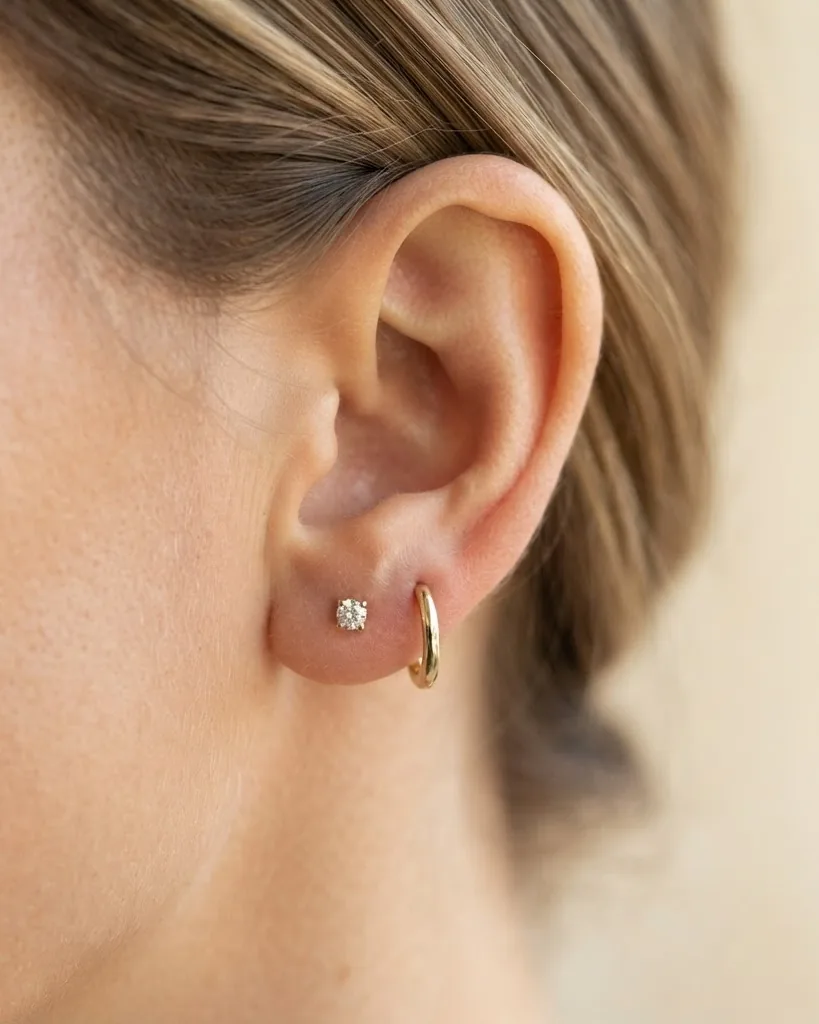
Flat-back studs, sometimes called labret studs, deserve special mention. The post threads or press-fits from the front, and the flat disc rests behind the lobe, so nothing digs in when you sleep or press a phone to your ear. That flat back is why I steer nearly every double-lobe client toward them for the lower hole. In the upper hole, a hinged huggie that clicks shut around a 6 to 8 mm inner diameter hugs the lobe tightly and will not tangle with the stud below it. Two mismatched hoops, by contrast, love to catch on each other and on hair.
If you want the pair to feel deliberate, treat the lower hole as the anchor and the upper hole as the accent. A slightly larger stud below with a tiny huggie or micro-stud above draws the eye up the ear in a clean line. Reverse it and put the bigger piece up top and the arrangement tends to look top-heavy on most lobes.
Earring style comparison for double lobes
Once you know which hole is doing what job, it helps to see the main styles side by side. This is the same shortlist I run through with clients at the counter when they are staring at a jewelry case trying to pick two pieces that will actually work together.
| Style | Best For | Typical Gauge | Healing-Friendly | Styling Note |
|---|---|---|---|---|
| Flat-back stud | Lower hole, fresh or healed | 20g (0.8 mm) or 18g (1.0 mm) | Yes, safe from day one | Anchor piece; pairs with almost anything above it |
| Hinged huggie, 6 to 8 mm | Upper hole, once fully healed | 20g or 18g | No, healed lobes only | Wraps tight to the lobe and will not tangle with the stud below |
| Small hoop, 8 to 10 mm | Lower hole on wider-spaced ears | 18g | No, healed lobes only | Needs clearance; skip on tight 5 to 6 mm gaps |
| Chain or connector double stud | Both holes at once, decorative link | 20g or 18g on each post | No, healed lobes only | Fixes the spacing permanently, so it only fits ears already sized to the chain |
| Threadless flat-back with gem top | Either hole, fresh-safe starter | 20g or 18g | Yes, safe from day one | Swap the decorative top without removing the post |
| Plain ball or CZ stud | Either hole, budget starter | 20g | Yes, if titanium or 14k gold | Simple accent, least likely to snag hair or clothing |
Tip: Before you shop, measure the gap between your two holes with a flexible ruler or ask your piercer to write the millimeter spacing on your aftercare card. A chain or connector style locks that spacing in place permanently, so knowing the number ahead of time saves you from ordering a piece that will not sit right on your lobe.
Gauge and post length: the fit math
Gauge is the thickness of the bar that passes through your ear, and standard lobes are pierced at 20g or 18g. In real numbers, 20g is 0.8 mm and 18g is about 1.0 mm, and the counterintuitive part is that a smaller gauge number means a thicker bar. Most gun piercings and dainty studs default to 20g, while many professional piercers prefer 18g because the slightly thicker post is sturdier and holds a hole open more reliably.
Your earrings need to match the gauge you were pierced at. Push a thinner 20g post through a hole that was stretched by an 18g piercing and it will wobble; force a thicker bar into a smaller channel and you irritate the tissue. If you do not know your gauge, your piercer can tell you exactly which needle they used. When you buy jewelry online, the gauge is almost always listed, and for double lobes I keep both holes at the same gauge so a single set of earrings can rotate between them.
Post length is the other half of the fit. A standard lobe stud post runs roughly 6 to 8 mm, which suits most lobe thickness. A post that is too long leaves the earring sitting loose and spinning; too short and the back pinches. Because a second hole often sits on a slightly different part of the lobe, check that both posts clear comfortably rather than assuming the length that fit the first hole automatically fits the second.
Metals that survive a fresh second hole
Metal choice is where a good pair of earrings for double pierced lobes either heals clean or turns into a months-long headache. For any hole that is not fully healed, I only put in implant-grade titanium or solid 14k gold and higher. Those two are the materials the piercing world trusts inside fresh tissue, and everything else is a gamble you do not need to take on a brand-new hole.
Implant-grade titanium means ASTM F136, the Ti-6Al-4V ELI alloy. It is nickel-free by any meaningful measure, with nickel content below 0.05%, and it is light, which matters when two earrings share one lobe. Titanium also forms a stable oxide layer only 1 to 10 nanometers thick within milliseconds of hitting air, and that skin is what keeps it inert against your body. The Association of Professional Piercers names ASTM F136 titanium as its recommended material for initial piercings, and their standards are the reference I hand clients who want to read it themselves.
Solid gold is the other safe route, but only if it is 14 karat or higher and confirmed nickel- and cadmium-free. Higher karat is softer, so 14k is the sweet spot of durability and safety for earrings. What you must avoid on a fresh hole is anything labeled “gold-plated,” “gold-filled,” or “titanium-plated,” because plating is a thin skin of good metal over a cheaper base that often contains nickel. Once that layer wears, the nickel underneath meets your skin.
316L surgical steel is the common wall-of-jewelry default, and while plenty of healed ears tolerate it, it does contain nickel and can flare a nickel-sensitive lobe. If you already know cheap earrings make your ears itch, red, or crusty, that is your body flagging nickel, and titanium or 14k gold solves it. The American Academy of Dermatology and general guidance from Mayo Clinic both point nickel-reactive people toward hypoallergenic metals, which lines up with what I see across the chair every week.
One more detail from the APP standard: for initial jewelry the post should be internally threaded or threadless (press-fit), so no screw threads drag across the inside of the channel as the piece goes in. Externally threaded posts have tiny ridges on the part that passes through skin, and on a raw second hole those ridges scrape. Threadless flat-backs are my default recommendation for exactly this reason.
Curating a pair that reads as intentional
The difference between “I have two holes” and “this looks styled” comes down to scale, metal, and spacing working together. When the two holes sit close, matched metal is the fastest win: two titanium pieces or two gold pieces read as a set, while a silver-tone stud under a gold huggie looks accidental. Keep the finishes in the same family and the pair instantly looks planned.
Scale is the next lever. On close-spaced lobes, a graduated look tends to flatter: a slightly larger anchor in the lower hole and a smaller accent above, or a plain stud paired with a stone of a similar size. Because the gap is only 5 to 8 mm, oversized pieces in both holes crowd fast, so at least one of the two should stay small. This is also why huggies pair so well with studs; the huggie wraps tight to the lobe instead of projecting outward into the stud’s space.
If you plan to keep building up the ear, think in vertical lines now. A double lobe is often the base of a longer curated ear that later climbs into cartilage. Studies of ear layouts and the way people combine placements are worth a look before you commit to a style you will want to extend. Our detailed ear piercing placement chart maps how lobe stacks connect visually to helix and other spots, which saves you from buying pieces that clash with a future plan.
Healing a second lobe hole
A second lobe heals on the same clock as the first: about 6 to 8 weeks of initial surface healing, and up to 6 months for the channel to fully mature inside. That gap between “looks healed” and “is healed” is the part people underestimate. Tissue closes from the outside in, so the surface can look calm while the inner channel is still fragile, which is exactly why swapping jewelry too early can set you back.
Aftercare is boring on purpose. Clean the piercing twice a day with sterile saline, and skip rubbing alcohol and hydrogen peroxide entirely, because both dry out and irritate the tissue and actually slow healing. Do not twist or rotate the jewelry, an old habit that does nothing but agitate the wound. Stay out of pools, hot tubs, and lakes while healing, since standing water is a bacteria source. And leave the starter jewelry in: on a fresh hole, taking it out can let the channel shrink or close within minutes.
Because a second hole so often sits right next to a fully healed first one, people forget it needs the same patience. Treat it as a new wound, not a bonus hole. If you want the full week-by-week picture of what normal progress looks like, our guide on how long ear piercings take to heal walks through the milestones and the signs that mean you should slow down or check in with a professional.
Troubleshooting the common second-hole problems
Most second-lobe complaints trace back to three things: jewelry that touches, metal that reacts, or a piece that is too heavy. When two earrings physically rub, the constant friction keeps a hole irritated, so the fix is usually smaller pieces or a stud with a flat back instead of a hoop. When the skin goes itchy, red, and weepy, suspect nickel and switch to titanium or 14k gold. When a lobe feels dragged down or the hole looks like it is stretching, the earring is too heavy for a healing channel.
Irritation bumps are the most common thing I see on new double lobes. They are usually not infection; they are the tissue reacting to trauma, pressure, or bad metal. The answer is rarely more cleaning and often less handling: leave it alone, keep to twice-daily saline, and make sure the two earrings are not pressing into each other. If a bump grows, weeps colored discharge, or the ear gets hot and swollen, that is when you stop guessing. Guidance from Cleveland Clinic on infected piercings is a solid reference for telling normal healing from a problem that needs a doctor.
Pain that lingers past the first couple of weeks is worth paying attention to. A settling piercing gets steadily less tender, not more. If you want a sense of how different placements compare and what level of soreness is normal for a lobe, our ear piercing pain chart by placement gives a realistic baseline so you can judge whether your second hole is behaving or acting up.
How to choose your first set
When someone asks me what to actually buy, I run the same short checklist. First, confirm your gauge, 20g or 18g, and match it. Second, pick your metal before your style: implant-grade titanium or 14k-plus gold if the hole is anywhere near fresh, and only branch out once it is fully healed. Third, choose a flat-back stud for at least the lower hole. Fourth, keep one of the two pieces small so the pair does not crowd. That is the whole decision, in order.
On cost, a professionally done lobe piercing usually runs about $20 to $50 per hole, and a needle studio often lands in the $50 to $85 range with a basic stud, sometimes with jewelry priced separately. A needle beats a gun every time: it is sterile, precise, and gentler on the tissue, whereas a gun blunt-forces the hole and can cause more trauma and scarring. If you are pairing a second lobe with cartilage down the line, the same metal rules carry over. Our breakdown of what to know about a helix piercing is a useful next read once your lobes are settled and you want to climb the ear.
For starter jewelry specifically, threadless titanium flat-backs are hard to beat: safe metal, flat back, easy to swap tops later without changing the post. Buy from a seller that lists the gauge, the post length, and the material grade in plain terms. If a listing will not tell you whether it is ASTM F136 titanium or solid 14k gold, treat that silence as a no for a healing hole.
Frequently asked questions
How far apart should double lobe piercings be?
Most double lobes sit 5 to 8 mm apart, center to center, with about 8 mm the common default so the two earrings do not touch. Tighter stacks use 5 to 6 mm for a closer look. Your piercer should mark both dots to fit your specific lobe, since anatomy varies from ear to ear.
What gauge earrings do double pierced lobes need?
Match the gauge you were pierced at, which for lobes is almost always 20g (0.8 mm) or 18g (1.0 mm). Remember the number counts backward: 18g is thicker than 20g. If you are unsure, ask your piercer which needle they used, and keep both holes at the same gauge so earrings can rotate between them.
Can I wear hoops in a fresh second lobe piercing?
Not yet. A fresh second hole needs a flat-back stud in safe metal for its full 6 to 8 weeks of initial healing, ideally longer. Hoops move, snag, and put uneven pressure on a raw channel, which slows healing and invites irritation bumps. Save hoops and huggies for once the hole is settled, and even then size them so they clear the neighboring earring.
Which metal is safest for double lobe earrings?
Implant-grade titanium (ASTM F136) and solid 14k gold or higher are the safest, both nickel-free and endorsed for initial piercings by the Association of Professional Piercers. Titanium is light, which helps when two earrings share a lobe. Avoid anything plated or filled, and be cautious with 316L surgical steel if your skin reacts to nickel.
How long until I can change my second lobe earrings?
Wait for surface healing, roughly 6 to 8 weeks, before your first swap, and know the channel keeps maturing for up to 6 months. Change too early and the hole can shrink or get irritated. When you do swap, use clean hands and a safe-metal piece, and if the hole still feels tender, give it more time before switching again.
Why does my second lobe hole hurt more than the first?
Usually because it is newer, or because the two earrings are touching and rubbing. A settling piercing should feel less sore each week, not more. Check that neither piece presses into the other, confirm your metal is titanium or 14k gold, and keep to twice-daily saline. Growing pain, heat, or colored discharge means it is time to see a professional.
The bottom line
Earrings for double pierced lobes come down to four numbers and one habit: space the holes 5 to 8 mm apart, match your 20g or 18g gauge, keep posts around 6 to 8 mm, wear implant-grade titanium or 14k gold, and be patient through the 6 to 8 week heal. Anchor the lower hole with a flat-back stud, accent the upper with a small huggie or micro-stud, and keep both pieces in the same metal family so the pair looks styled instead of stacked by accident. Do that and your second lobe stops being a complication and becomes the start of a clean, buildable ear.