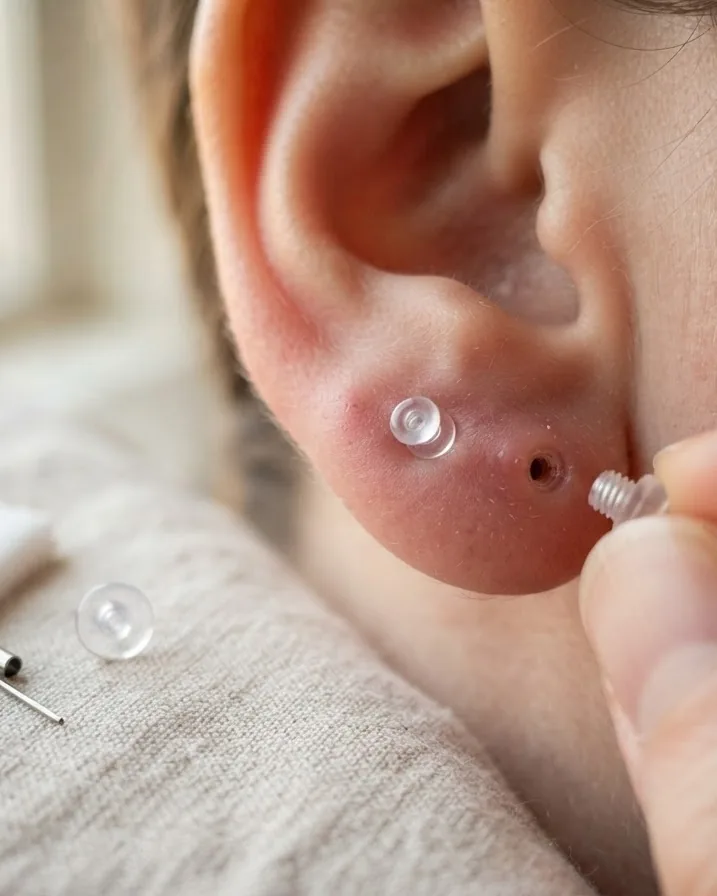
Piercing retainers are the quiet workaround for anyone who needs a piercing to disappear for a shift, a game, or a scan without letting the hole close. In the studio I reach for them constantly: the new hire whose dress code bans facial jewelry, the swimmer who cannot risk a snag, the client with an MRI booked on Thursday. A retainer does two jobs at once. It hides the piercing so nobody clocks it, and it keeps the channel propped open so your regular jewelry still slides back in afterward. It is the least glamorous piece in the case, and one of the most useful.
Quick answer: A piercing retainer is a low-profile, usually clear or skin-tone piece of jewelry that holds a piercing open while your visible jewelry is out. The best ones are made from PTFE (also sold as bioflex or bioplast) or glass, because both are inert, comfortable, and safe to leave in. PTFE is flexible and non-magnetic, so it can stay put for most X-rays and often for an MRI, while glass is rigid and crystal clear. Skip cheap acrylic and nylon for anything but a brief emergency. Match the retainer to your piercing’s gauge and placement, and change a healing piercing only after it has had time to settle.
What a piercing retainer actually does
A retainer solves one problem: an empty piercing shrinks. The channel your piercer made, the fistula, is a healed or healing tube of skin, and skin wants to contract when nothing holds it open. On a fresh piercing that can happen in minutes. Even a piercing you have had for years can tighten within hours, enough that reinserting jewelry becomes a fight or turns impossible. A retainer sits in that channel doing nothing flashy, just keeping the door from swinging shut.
The second job is disguise. Retainers are built to vanish. A nostril retainer has a tiny flat front the color of glass or your skin, so at arm’s length there is nothing to see. That is why people ask for them before a job in a conservative office, a stint in the military, a school with a strict policy, or a wedding where they would rather the photos not feature a septum ring. The piercing stays intact; it just goes undercover for as long as you need.
The materials that matter, and the ones to skip
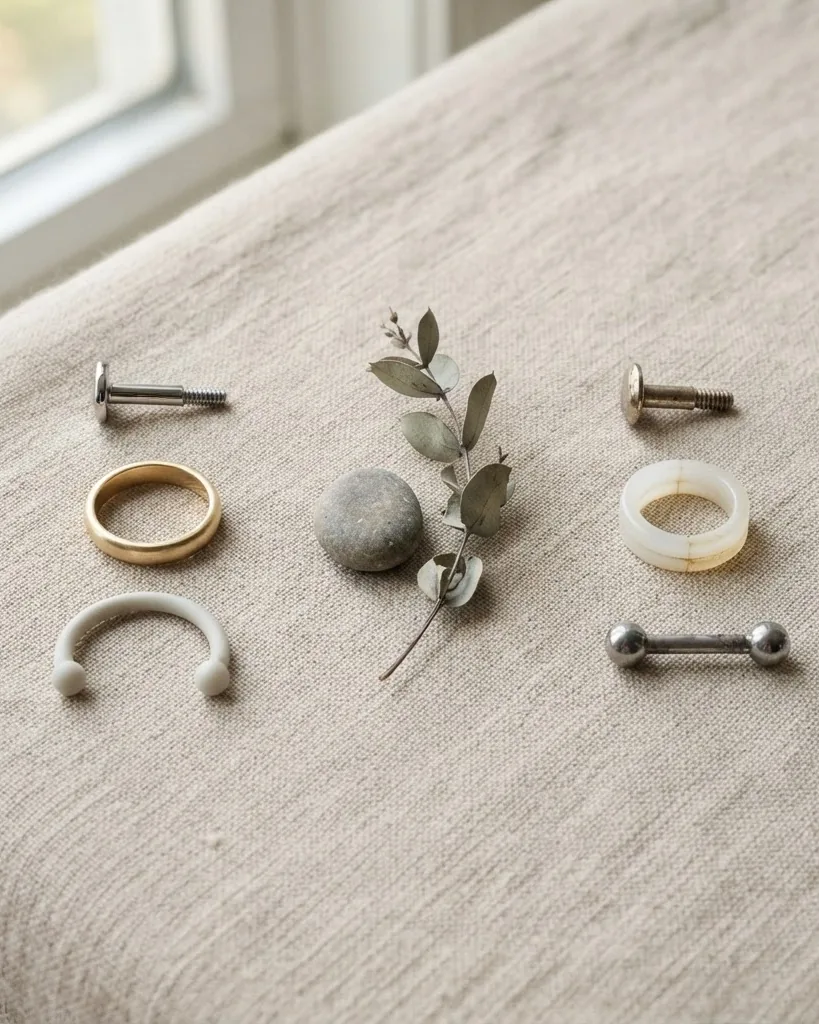
Material is where most retainer decisions are won or lost. Here is how I rank them for real use, from the versatile to the avoid-it.
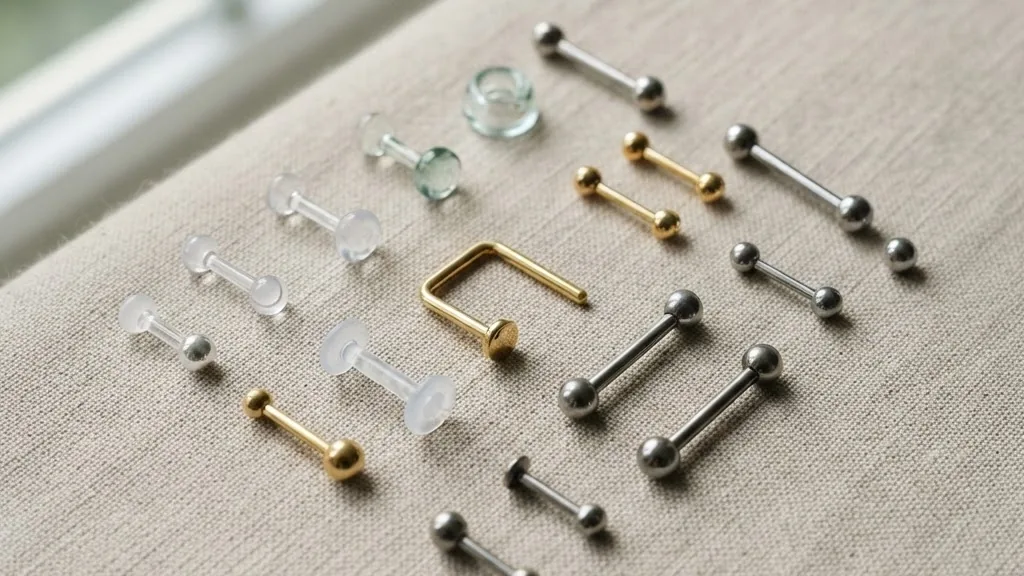
PTFE (bioflex, bioplast). PTFE is polytetrafluoroethylene, the same inert polymer family as Teflon, and it is my default clear retainer. It is flexible, so it moves with your body instead of pressing on the piercing, and it is biocompatible and non-magnetic. That last part matters: PTFE can stay in for X-rays and often for an MRI. It is also autoclavable, meaning a studio can steam-sterilize it, and it can be trimmed to length and capped with a ball. Of the see-through options, it is the one I trust on a piercing that is still healing.
Glass. Good glass retainers use fused quartz or lead-free borosilicate, the Pyrex-style glass. Glass is inert, nonporous, and beautifully clean, and it wipes down without holding onto gunk. The Association of Professional Piercers lists lead-free glass among materials acceptable even for initial piercings. It is crystal clear or comes in skin tones, and it leaves no afterimage on imaging. The catch is that glass is rigid and can shatter if you take a solid knock, so it is a poor pick for contact sports or anywhere your face gets hit.
Nitrile and soft silicone-style hiders. These bend easily and blend to skin tone, which makes them handy as a quick, short-term cover on a fully healed piercing. I do not treat them as a healing-phase or long-term material. They are a stopgap for a day, not a home for the piercing.
Titanium. Implant-grade titanium (ASTM F-136, the Ti6Al4V ELI alloy the APP accepts) shows up in low-profile retainers like a labret with a clear or flat top. It is nickel-safe and forms a stable titanium dioxide layer only about 1 to 10 nanometers thick, which is why it sits so well in skin. But it is still metal. A titanium retainer hides a piercing nicely; it does not get you out of removing metal for an MRI or many X-rays. Use it for discretion, not for scans.
What to avoid. Cheap acrylic and nylon retainers are the trap. They are porous, they can degrade and leach over time, and they give bacteria somewhere to hide. On a healing piercing they are a genuine irritation risk. Keep one in a drawer as a last-ditch, few-hours emergency on a healed piercing if you must, and replace it with PTFE or glass as soon as you can.
Retainers by placement
Shape follows placement. A retainer that works beautifully in a nostril will not sit in a septum, so match the style to where the piercing lives. Gauge matters just as much as shape, so I have noted the sizes I hand out most.
Nostril. Nostril retainers come as a nostril screw with a curled tail, an L-bend, or a straight post with a tiny flat front disc. Most nostrils run 20 g or 18 g, and the wearing-surface lengths I stock cover 1/4 in (6.5 mm), 5/16 in (8 mm), and 3/8 in (9.5 mm) so the front sits flush without pressing in or sticking out. Clear glass or PTFE both disappear here. Because nostrils pass through tissue that can take 4 to 6 months to heal, or 6 to 12 months for a high nostril through thicker cartilage, get the gauge exactly right.
Septum. A septum retainer is usually a small U-shaped staple or a keeper you can flip up out of sight inside the nose. Septums commonly sit at 16 g or 14 g. Flipping the retainer up is the whole trick: from the front there is nothing to see at all. If you want the visible-jewelry side of this piercing, our guide to septum rings and keepers walks through clickers, circular barbells, and staples. A well-placed septum through the thin sweet spot heals in about 6 to 8 weeks, so many people are swapping to a retainer fairly early.
Ear and cartilage. Lobes take a clear stud-style retainer easily. Cartilage placements like the helix, conch, and daith are trickier because they heal slowly, often 6 to 12 months, and they do not forgive an empty channel. A clear PTFE labret-style retainer or a flat disc works for many of these. If you are still learning the map of the ear, our rundown of the types of ear piercings shows what sits where. Do not force a downsize on cartilage before it is ready.
Two cartilage spots deserve a specific word. A conch sits in the wide bowl of the ear and takes a labret post, so a clear flat-back retainer at 16 g or 14 g conceals it well; our page on choosing conch piercing jewelry covers the fit. A daith curls through the fold above the ear canal and usually wears a ring, which is harder to hide, so many people simply remove it for a scan rather than retain it; the daith piercing jewelry options guide explains why the shape is fussy. When a piece cannot be discreetly retained, taking it out and reinserting later is a legitimate choice.
Lip and labret. Lip, labret, and Monroe piercings use a flat-back retainer with a clear or skin-tone top, usually at 16 g or 14 g. The flat back keeps it comfortable against the gums, and a clear PTFE disc on the outside reads as nothing at a glance. These see a lot of movement from talking and eating, so a flexible PTFE piece tends to feel better than a rigid one.
Retainers, MRIs, and surgery: the part people get wrong
This is the reason a lot of my clients walk in stressed, and it is worth getting right. Metal jewelry can heat up, tug, or blur the image during an MRI, and it can interfere with X-rays and some surgeries, so it usually has to come out. A retainer solves the empty-hole problem, because glass and PTFE are non-metallic and often perfectly acceptable to keep in. Both Cleveland Clinic and hospital MRI departments generally allow non-metal materials, which is the whole point of a glass or PTFE piece.
Here is the honest caveat: the radiographer, technologist, or surgical team has the final say. Protocols differ by facility and by the exact scan, and some teams will still ask you to remove everything to be safe. So the move is simple. Call the department before your appointment, tell them you have a piercing you cannot easily let close, and ask what they allow. Carry a spare PTFE retainer with you either way. If the piercing is too new to sit empty, book a few minutes with your piercer to swap in a non-metal retainer before the appointment rather than gambling at the front desk.
Can you wear a retainer on a healing piercing?
Sometimes, and only carefully. A retainer is not a license to start swapping jewelry the week you got pierced. Every placement has a minimum, and rushing it is how people lose piercings or earn an infection. As a floor, wait at least 6 to 8 weeks before any change on most piercings, and know that giving it a full 6 months dramatically cuts the risk of trouble. Cartilage in particular wants the long end of that window.
If you do need a retainer in early, the material rules get stricter, not looser. It should be quality PTFE, never bargain acrylic or nylon, because a healing channel is far more sensitive to a porous, leaching surface. Ideally your piercer does the swap so the gauge and length are right and the channel is not stressed. Keep up your aftercare: clean with a sterile saline rinse, and our note on sterile saline solution for a nose piercing covers what that should be. For the timing question specifically, see when you can change a cartilage piercing.
Watch for the warning signs while a piercing is settling. The Mayo Clinic and the American Academy of Dermatology both flag spreading redness, warmth, swelling that gets worse instead of better, yellow or green pus, and fever as reasons to stop and get seen. A retainer will not fix an angry piercing, so treat those symptoms first and worry about hiding it later.
How to choose the right retainer
When someone asks me to pick for them, I run the same short checklist. It takes about a minute and it saves a lot of returned jewelry.
Start with why. Are you hiding a piercing for work or school, getting metal out for a medical scan, or trying to protect a healing piercing? That answer already narrows the material. Discretion alone opens up titanium and glass; a scan pushes you to PTFE or glass; a healing piercing means quality PTFE and a piercer’s hands.
Then placement, then size. Placement sets the shape: nostril screw, septum staple, labret flat-back, or a cartilage disc. Size is the part people botch. Match your current gauge exactly, because a retainer that is too thin can slip out or let the channel tighten around it, and one that is too thick will not seat. If you are unsure, measure your existing jewelry or ask your piercer rather than guessing between 18 g and 16 g.
Finish with material and situation. PTFE is the most versatile and the only clear piece I trust for scans and healing. Glass wins on comfort and clarity but is fragile, so it stays home during contact sports; there, wear flexible PTFE or take the piercing out entirely if a hit is likely. Titanium is for looking bare, not for imaging. Line those three factors up and there is usually one obvious answer.
Getting a retainer in and out without losing the piercing
Insertion is where nerves cause damage. Wash your hands first, every time. If you are removing metal jewelry to swap in a retainer, have the retainer out of its packet and lined up before you take anything out, because the channel starts tightening the moment it is empty. For a nostril screw or L-bend, ease the tail in and rotate gently to follow the curve; do not jab straight. A septum retainer slides through and then flips up. A labret threads its flat back through from inside.
If the retainer will not go, stop. Do not force it, and do not ream the channel with the sharp end. A little sterile saline and a warmer piercing (after a shower, when tissue is relaxed) often makes the difference. If it still resists, the gauge may be wrong or the piercing may have tightened more than you expected, and that is a five-minute job for a piercer. Losing a piercing usually comes from panic and force, not from the retainer itself. When you take the retainer out to put your regular jewelry back, do it in the same calm, hands-clean way.
Care for the retainer like any other jewelry while it is in. Rinse it and the piercing with sterile saline, dry with a clean paper product rather than a fuzzy towel that can snag, and inspect a PTFE or acrylic piece now and then for scratches or cloudiness, which are cues to replace it. Glass and quality PTFE hold up for a long time; the softer plastics do not. If a retainer starts to feel loose, the gauge has probably drifted or the piece has worn, and it is worth sizing up before the channel takes advantage of the slack.
Retainers versus taking the jewelry out entirely
Not every situation calls for a retainer. If a piercing is fully healed and mature, has been in for a year or more, and only needs to be bare for an hour or two, some people simply remove the jewelry and put it back afterward. Mature lobes and long-established nostrils often tolerate that. The risk climbs fast on anything younger, on cartilage, and on placements that tighten quickly, which is exactly where a retainer earns its keep. When you are unsure whether your piercing can be left empty even briefly, assume it cannot and retain it; reopening a shrunken channel is far more hassle than keeping a discreet piece in.
Retainer materials compared side by side
All five materials show up in a piercer’s case for different reasons, and the fastest way to see why is to line them up. Use this table to match a material to your actual situation instead of grabbing whatever is cheapest on the rack.
| Material | Discreetness | MRI-safe | Safe on a healing piercing | Best for | Notes |
|---|---|---|---|---|---|
| Glass (fused quartz or borosilicate) | Crystal clear, the most invisible option up close | Yes, non-metallic | Only once fully healed | Everyday discretion on a mature piercing | Rigid and can shatter on a hard knock; skip it for contact sports |
| PTFE (bioflex, bioplast) | Clear or skin-tone, disappears well | Usually, but confirm with the facility first | Yes, the safest pick for a fresh piercing | Healing piercings, scans, active days | Flexible, autoclavable, and can be trimmed to length |
| Titanium (ASTM F-136) | Low profile but still metal, so it can catch light up close | No, it must come out for a scan | Yes, once initial swelling has settled | Discretion only, not imaging | Nickel-safe and very durable, but never a substitute for a non-metal retainer |
| Nitrile or soft silicone hider | Blends to skin tone well | Yes, non-metallic | Not recommended, short-term use only | A few hours of cover on a fully healed piercing | Bends easily but is not a home for the piercing long-term |
| Acrylic or nylon | Clear or tinted, middling | Yes, non-metallic | No, avoid on a healing piercing | Emergency use only, a few hours at most | Porous, can degrade and leach, and gives bacteria somewhere to hide |
Tip: Keep one spare PTFE retainer in your bag, car, or desk drawer year-round. It covers the two moments that always show up without warning, a same-day MRI order or a dress-code check at work, and it means you are never stuck reaching for acrylic out of a drawer at the last minute.
Frequently asked questions
Will a clear retainer really be invisible?
At normal talking distance, yes. Glass and PTFE fronts are made to catch no attention, and skin-tone versions blend even closer. Up close in bright light someone might notice a faint dot, but for work, school, or photos it reads as bare skin. Septum retainers that flip up inside the nose are the most completely hidden of all.
Can I keep a retainer in for an MRI?
Often, but not always. Glass and PTFE are non-metallic and many imaging teams allow them, which is why non-metal retainers exist. The technologist has the final say, so call the department ahead, ask what they permit, and bring a spare PTFE piece. Any metal, including titanium, usually has to come out for the scan.
How long can I leave a retainer in?
Quality PTFE and glass are inert, so on a fully healed piercing you can wear them for extended stretches without trouble. Nitrile, silicone, acrylic, and nylon are short-term only; treat those as a day or two at most. Whatever the material, clean it and the piercing regularly and check that the gauge still fits snugly.
What gauge retainer do I need?
Match your current jewelry exactly. Nostrils are usually 20 g or 18 g, septums and labrets tend to run 16 g or 14 g, and ear cartilage sits around 16 g or 18 g. A retainer that is too thin lets the channel shrink; too thick will not seat. If you are between sizes, measure or ask your piercer instead of guessing.
Are acrylic retainers safe?
Only as a brief emergency on a healed piercing. Acrylic and nylon are porous, can degrade and leach, and give bacteria a foothold, which makes them a poor choice for anything ongoing and a real risk on a healing piercing. Switch to PTFE or glass as soon as you can, and never put acrylic in a fresh piercing.
Can I put a retainer in a piercing that just closed a little?
If it went snug but the channel is still there, a warm shower, clean hands, and gentle pressure with the right gauge often work. If it truly closed, do not force a retainer through scar tissue; see a piercer, who can tell whether it can be reopened or needs redoing. Forcing it is how people cause tears and infection.
The bottom line
Piercing retainers are the tool that lets a piercing survive the parts of life that do not welcome jewelry, whether that is a strict dress code, a swim meet, or an MRI. Reach for PTFE when you want flexibility, healing safety, and something that can ride along through most scans; reach for glass when you want clarity and comfort on a healed piercing that will not take a hit; and leave acrylic and nylon out of anything that matters. Match the gauge, respect your healing timelines of weeks to months, and when in doubt let a piercer do the swap. Hidden for now does not have to mean gone.