Glass piercing retainer wearers usually buy the piece for one moment: a hospital gown, a metal-detector, or a manager who dislikes visible jewelry. The clear post keeps the channel open while staying discreet, and it does something metal cannot always do in a scanner. The problem is that most product pages sell it as a cure-all. It is not. A glass piercing retainer solves some situations cleanly and creates a false sense of security in others, and the difference matters most on the exact day you need it.
The Association of Professional Piercers lists exactly three glasses as inert and acceptable even for fresh piercings: fused quartz, lead-free borosilicate, and lead-free soda-lime. That single fact separates a real retainer from a gift-shop lookalike. Everything below is built on named sources, real gauges, and the parts sellers leave out.
Quick answer: A glass piercing retainer is a clear placeholder that holds a piercing open with minimal visibility. It is non-ferromagnetic and non-conductive, so it does not torque or heat in an MRI bore, which is why clinics prefer it over metal. It is not invisible on imaging: glass is radiopaque and shows on X-ray and CT. Fused quartz, lead-free borosilicate, and lead-free soda-lime are the accepted types. Thin gauges can chip, so inspect before every insertion and confirm the rules with your facility first.
What a glass retainer actually is, and how it differs from a plug or hider
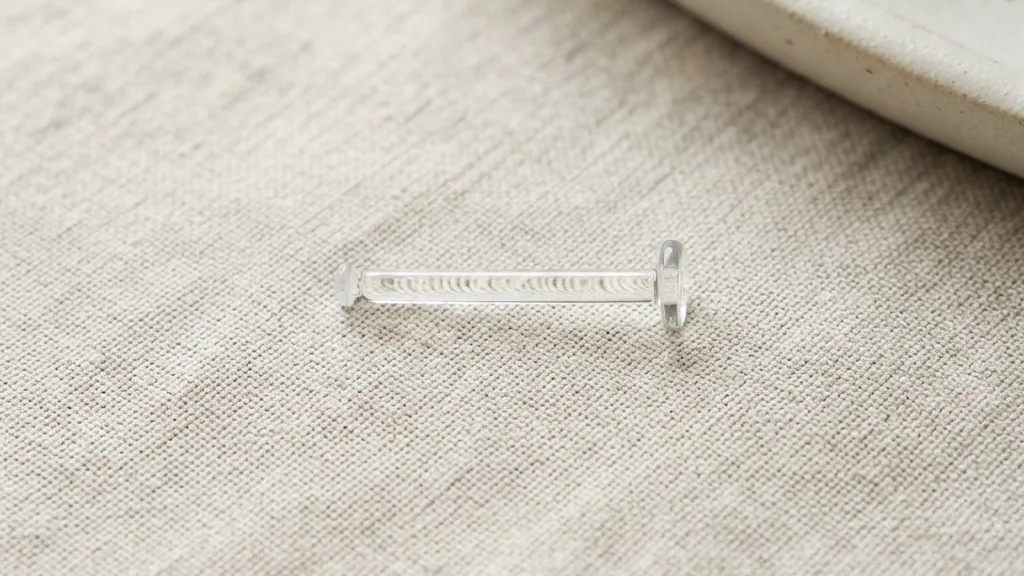
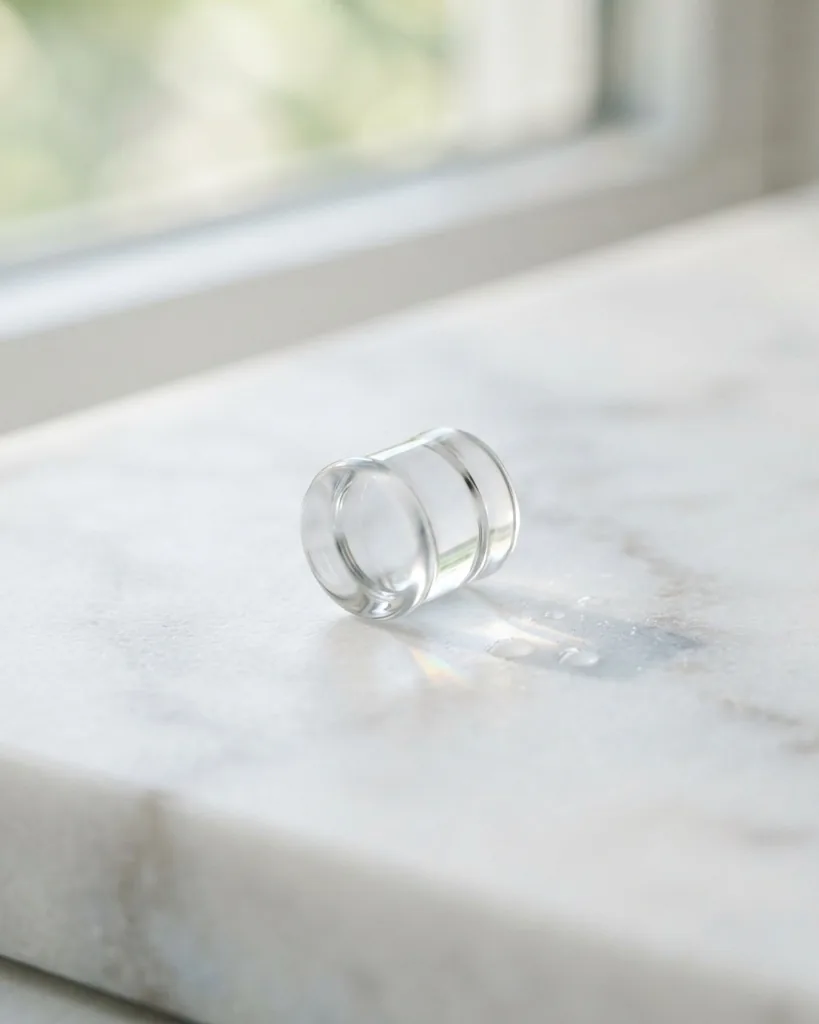
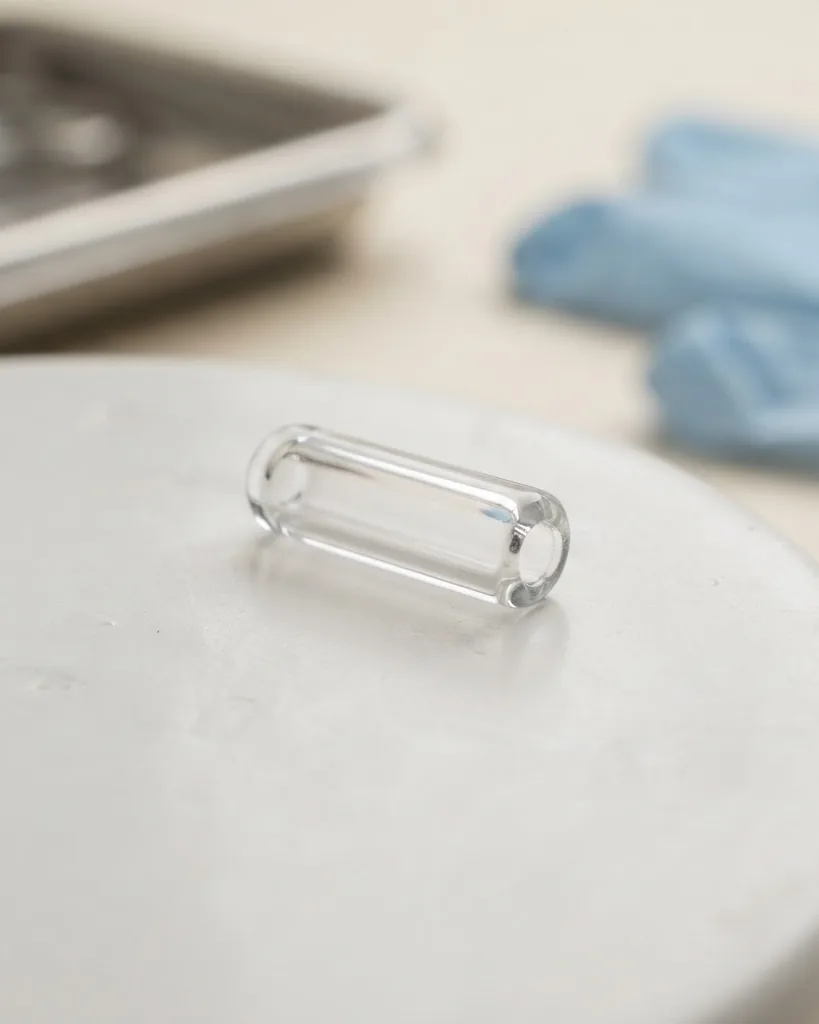
A retainer is placeholder jewelry. Its job is to keep the fistula, the healed skin tube through the piercing, open and patent while drawing as little attention as possible. It is not decorative. Clear glass wins that role because it reads as skin-adjacent and because, unlike acrylic, it can be autoclaved. The word “hider” gets used loosely, but a true hider bends the visible end flush to the skin, while a plug fills a stretched lobe and is a different tool entirely.
Form factors track the piercing. Common shapes include:
- Straight or flatback labret style for lips, ears and Monroe placements.
- Curved barbell for navel and some eyebrow piercings.
- U-shaped septum retainer, sometimes called a keeper, that flips up inside the nose.
- Nostril screw or bone for a nostril channel.
Each shape solves a different mechanical problem, not just a cosmetic one. A labret style needs a flat back disc so it does not rotate against the lip mucosa. A curved barbell needs enough bend to clear the navel without pressure at either end. A septum keeper needs to flip fully inside the nostrils so nothing shows from the front, which is the whole point of the shape. Picking the wrong form factor for a placement is a common reason a “retainer” still shows in a mirror or still catches on clothing, even when the material itself is correct.
If your goal is a nose piece that disappears at work, the shape logic in our guide to hiding or holding a piercing open maps neatly onto glass. Discretion is the honest promise here. Invisible is not.
Fused quartz, borosilicate or soda-lime: what the material really means
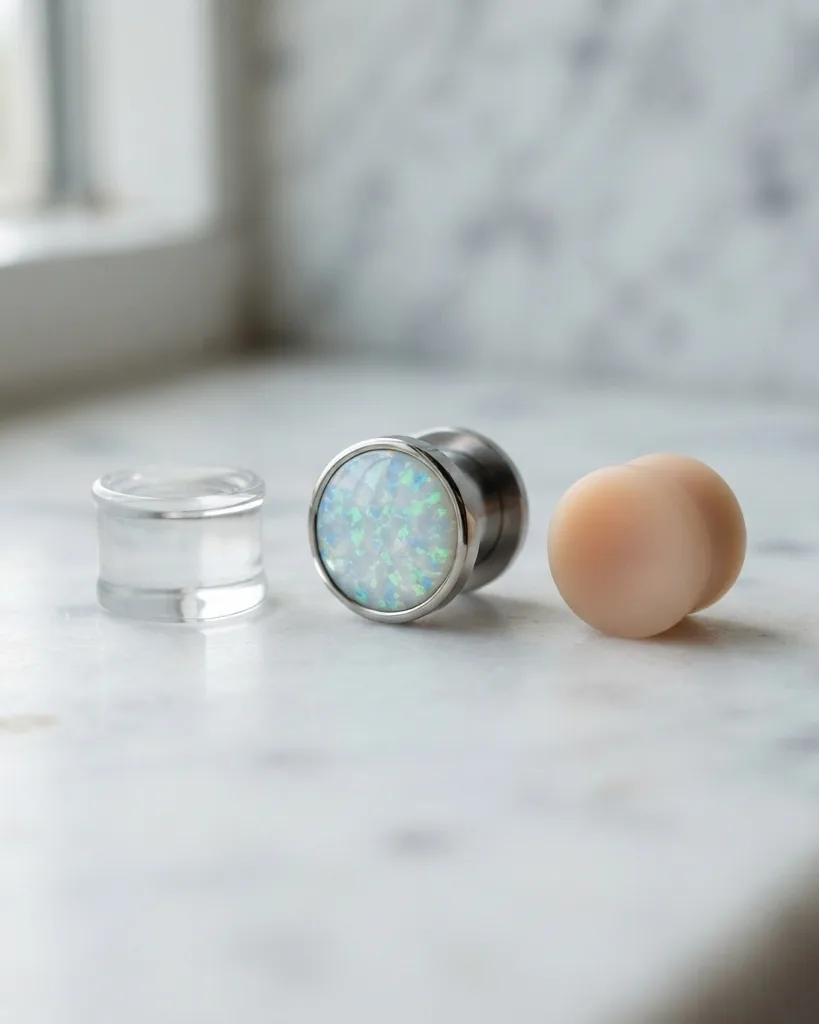
Glass is not one material, and that is the gap almost every shop leaves open. The three types the Association of Professional Piercers accepts behave differently in practice. Fused quartz is the glass chosen most often specifically for retainers, valued for strength, clarity and biocompatibility, while lead-free soda-lime and lead-free borosilicate get picked more often when color is the point. All three are inert and all three tolerate autoclave sterilization, which is exactly why they clear the bar that acrylic cannot.
Acrylic, or PMMA, is the material to avoid in anything healing. It is porous, it crazes into fine surface cracks, and it cannot survive an autoclave cycle. That combination lets bacteria settle in and rules it out of a fresh channel. Silicone sits in a similar category for initial piercings: it flexes well and is comfortable, but it is not on the APP’s accepted-glass list and it is not what a hospital means when it asks for a “retainer” before a procedure. If a seller lists silicone or acrylic as a substitute for glass in a fresh piercing, that is a sign the copy was written for search terms rather than for safety.
One marketing phrase deserves a flag. Some sellers advertise “implant-grade quartz.” There is no implant-grade designation for quartz body jewelry the way ASTM F136 defines implant titanium. The relevant glass standard, ASTM F1538, the Standard Specification for Glass and Glass-Ceramic Biomaterials for Implantation, is maintained by ASTM Subcommittee F04.13, with the current edition listed as F1538-24. That standard governs implanted glass biomaterials, not a labret you swap in for a scan. Treat “implant grade quartz” as a slogan, not a certification, and ask the seller directly which glass type is used and whether it matches the APP’s list.
If nickel is your real concern, glass sidesteps it entirely, but so do the metals covered in our breakdown of nose jewelry metals that keep nickel out. Choosing between the two options usually comes down to how long you need discretion: glass for a single appointment or a strict dress code, metal for permanent daily wear once the piercing is fully healed.
How to tell a real glass retainer from a marketing label
A genuine spec sheet names the glass type, the gauge range, the length, and the disc or o-ring dimensions, because those are the numbers a piercer needs to fit it correctly. A page that just says “glass” or “surgical glass” with no gauge listed is not giving you enough information to buy safely, whatever the price tag says. Watch for these red flags before ordering:
- No named glass type: “clear glass” alone does not tell you if it is fused quartz, borosilicate, or soda-lime.
- No gauge or length listed, which makes it impossible to confirm fit against your existing jewelry.
- “Surgical steel” used as a description for a glass product, a mismatch that suggests copy-pasted listing text.
- Claims of “implant grade” glass with no reference to ASTM F1538 or any other named standard.
A page that states the glass type, gives a gauge range, lists a length in both inches and millimeters, and names the o-ring material is doing the bare minimum right. That level of disclosure is rare among the pages competing for this exact search, which is itself a useful filter: if the seller will not tell you what the glass is, assume it has not been checked against the APP list at all.
Initial versus healed piercings: the trade-off nobody advertises
The Association of Professional Piercers accepting fused quartz, lead-free borosilicate and lead-free soda-lime for initial piercings is the headline fact, and it is true. What gets left out is the trade-off that comes with it. Glass is rigid and brittle in a way titanium is not, and thin gauges chip or crack more easily than a comparable metal post, especially with repeated insertion and removal during the early weeks of healing when swelling changes daily. A chip you cannot feel with a fingertip can still scratch a healing channel on the way in.
That is the honest counterweight no competing page states plainly. Glass earns its place in a fresh piercing through non-porosity and autoclavability, not through toughness. If you are swapping jewelry frequently during healing, inspect the piece under good light every single time, and if in doubt, ask your piercer to check it rather than guessing.
Will a glass retainer show up on an X-ray, CT or MRI?
A glass retainer is friendly to an MRI magnet but not hidden from imaging. Because glass is non-ferromagnetic and non-conductive, it does not twist, migrate or form a radiofrequency heating loop inside the bore, which is why staff often prefer it to metal. It is still radiopaque. On imaging it appears clearly, and a retainer near the field of view can obscure the anatomy a radiologist is trying to read. Do not assume clear glass means clear film.
The radiology numbers are specific. On two-view plain radiography, glass fragments were detected at 99 percent when 2.0 mm across, 83 percent at 1.0 mm, and 61 percent at 0.5 mm. That study is indexed at the National Library of Medicine. On computed tomography the picture is starker: per Radiopaedia’s reference on glass foreign bodies, all glass is visible on CT and generally easier to see than on plain film, with density in the 500 to 1900 HU range, and on MRI all forms of glass are seen but with considerable artifact on most sequences.
The MRI question splits into two answers. Physics permits a glass retainer in the room. Policy still governs the appointment. The American College of Radiology’s MR safety guidance states that anyone undergoing an MR procedure must remove all readily removable metallic personal items and devices, with body piercings explicitly named; the full guidance text sits at the ACR document hosted on Wiley Online Library.
The practical rule is short. Call the imaging department before the appointment, not on arrival. Ask two things: whether the retainer can stay, and whether it sits inside the scan field. If it is in the field, expect to remove it regardless of material, because artifact and anatomy matter more than convenience.
A worked example: prepping a glass retainer for an MRI or CT appointment
Say you have a nostril piercing with a glass retainer in place and an MRI of the head scheduled next week. Start by calling the imaging center at least a few days ahead rather than assuming the front desk will know the rule. Tell them specifically that it is a glass, non-metallic piercing retainer and ask whether it needs to come out for a head or facial scan, since the nostril sits inside the field of view for that exam. For a knee or lower-limb MRI, the same nostril retainer is unlikely to matter at all, because it sits far outside the imaged region.
For a dental panoramic X-ray or a CT of the sinuses, expect a different answer. Because glass is radiopaque and shows clearly on both modalities, a nostril or lip retainer sitting near the imaged anatomy is likely to be asked to come out, even though the same piece would be perfectly fine to leave in during an MRI of the ankle. The rule of thumb is proximity, not material: the closer the jewelry sits to what is being imaged, the more likely it needs to be removed, and glass does not get a pass just because it will not heat up.
The surgery and electrosurgery myth, corrected with 2026 guidance
Retailer copy often sells glass retainers as burn protection during surgery. Current operating-room guidance does not support that framing. The Association of periOperative Registered Nurses, in its 2026 surgical-energy-device guideline update, reports no definitive evidence of alternate-site burns associated with jewelry, metal orthopedic implants or tattoos during standard electrosurgery with modern electrosurgical units. Where jewelry cannot be removed, the recommendation is to notify the team, assess the risk and benefit, and consider an alternative energy source rather than to rely on a material swap.
That does not make jewelry welcome in the OR. It just changes the reason it comes out. Jewelry is removed for practical hazards, not a burn scare:
- Loss and entanglement during positioning and draping.
- Pressure injury under a body that will not move for hours.
- Airway and dental-trauma risk when the piece is oral or in the tongue.
You can read the update straight from the source at the AORN summary of the 2026 energy-device guideline. For anesthesia and intubation the norm is removal, because oral and tongue jewelry is an airway and dental issue first. Glass is a good discretion tool and a poor safety talisman. Bring it to reinsert after the procedure, not to keep during it, and mention it to the pre-op nurse the same way you would mention any other implant or metal object, even though it is not metal.
Material and standards comparison, scored on what matters
A single sourced table beats a page of adjectives. This one scores the common retainer and jewelry materials on the properties that decide safety, comfort and imaging behavior. APP acceptance refers to the three glasses the Association of Professional Piercers lists for initial piercings; autoclavability follows the same source; nickel relevance ties to the REACH restriction that only bites on metal.
| Material | APP-listed for initial | Autoclavable | Fragility risk | Nickel-release relevant |
|---|---|---|---|---|
| Fused quartz glass | Yes | Yes | Chips in thin gauges | No |
| Lead-free borosilicate | Yes | Yes | Chips in thin gauges | No |
| Lead-free soda-lime | Yes | Yes | Chips in thin gauges | No |
| Titanium ASTM F136 | Yes | Yes | Low, visible on MRI | No |
| Niobium | Yes | Yes | Low | No |
| PTFE / bioflex | Yes | Limited, check manufacturer | Low, flexes rather than chips | No |
| Acrylic (PMMA) | No | No | Crazes and cracks over time | No |
The honest caveat no seller volunteers: thin-gauge glass breaks. A hairline chip you cannot feel can score the channel on insertion. That fragility is the trade-off you accept for non-porous, autoclavable clarity, and it is why inspection is non-negotiable. Titanium is the metal comparison most people weigh against glass, and it clears APP for initial wear when it meets ASTM F136 (Ti6Al4V ELI). PTFE and bioflex trade rigidity for flexibility, which suits swollen or curved piercings but sacrifices the glassy clarity people want for discretion. Both belong in the family of safe options covered across our guide to choosing and sizing tragus jewelry.
Sizing, fit and the o-ring problem
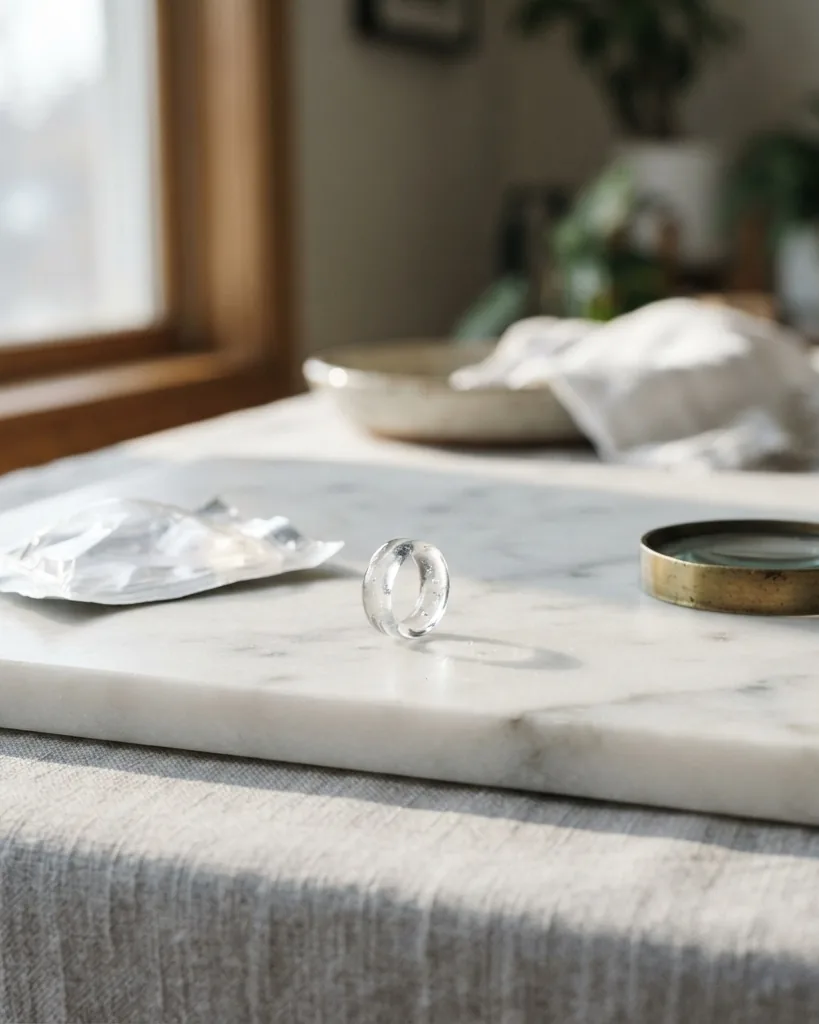
Fit failures cause more retainer complaints than material ever does. A glass retainer is sized by gauge, length and disc diameter, and the o-ring position decides whether it stays put or presses the skin. Commercially available clear borosilicate flatback labret retainers are sold in 20G, 16G, 14G, 12G, 10G and 8G, at a half-inch (12 mm) length, with flat-back discs from 2 mm to 8 mm, supplied with clear o-rings and marketed for healed piercings. A typical U-shaped Pyrex septum retainer runs a quarter-inch (6 mm) long.
Match your gauge, do not guess it. Retail gauge-to-metric conversions run 14G at 1.6 mm, 12G at 2 mm, and 10G at 2.4 mm. If your current jewelry is labeled in one system and the retainer listing uses the other, convert before you order rather than assuming “medium” or “standard” means the same thing across two different shops.
The o-ring is where people go wrong. Gorilla Glass straight retainers ship with two clear silicone o-rings, and the retailer states plainly that they are not intended for long-term wear and that the o-rings should not be pressed tightly against the skin. Leave clearance. An o-ring biting into tissue traps secretions and irritates the channel. If a retainer feels tight the moment it goes in, move the o-ring outward slightly rather than forcing the post itself deeper, since the post length is fixed but the o-ring position is adjustable.
Never downsize into a fresh channel to force discretion. Swelling needs room, and a septum specifically needs breathing space; our notes on how long a septum piercing takes to heal explain why premature tightening backfires.
Troubleshooting: what to do if a retainer will not seat or falls out
Two problems account for most retainer complaints: the piece will not go in, or it will not stay in. If a retainer will not seat, stop pushing. Forcing a rigid glass post into a tight or swollen channel is how chips and micro-tears happen. Warm the area gently with a clean, damp cloth for a minute, relax the surrounding muscle if it is an oral or lip piercing, and try again with light, steady pressure rather than a quick push. If it still will not go in after a second attempt, the channel may have contracted slightly, which is common after even a day or two without jewelry, and a piercer can reopen it safely with a taper rather than risk a forced insertion.
If the retainer keeps falling out, check three things in order: whether the gauge actually matches the channel, whether the o-ring has degraded or lost grip, and whether the piercing itself has widened during healing. A retainer that fit snugly a month ago can feel loose later simply because swelling has gone down. Swapping in a slightly larger o-ring, if the manufacturer supplies one, is usually a safer fix than switching to a thicker gauge post without professional advice.
Cleaning, sterilization and handling without wrecking the glass
Glass earns its place by tolerating real sterilization, so use that correctly rather than improvising. Home boiling is not sterilization; it is a warm rinse that leaves spores alive. Valid steam sterilization, per the US Centers for Disease Control and Prevention guideline, means 30 minutes at 121 degrees C (250 degrees F) in a gravity-displacement sterilizer, or 4 minutes at 132 degrees C (270 degrees F) in a prevacuum sterilizer. Those cycles happen in an autoclave at a studio, not on a stovetop.
Between wears, keep it simple and keep it gentle:
- Rinse and clean with sterile saline rather than harsh alcohol soaks that dry surrounding skin.
- Inspect for chips, cracks and clouded surfaces before every single insertion.
- Retire any piece with a visible flaw instead of “using it one more time.”
Handling is where fragility bites. Set the retainer down on a soft surface, not a hard sink edge, and never carry two glass pieces loose in the same pocket, since glass on glass contact is exactly the kind of impact that starts a hairline crack you will not notice until it fails. If you smell anything off after reinsertion, that is a cleaning and channel signal worth reading in our piece on what a nose piercing odor really means, not a reason to scrub the glass with anything abrasive.
Regulation, hygiene rules and why metal-free matters to allergic wearers
The rules around body jewelry are stricter than the retail experience suggests, and they explain why material claims deserve scrutiny. The Association of Professional Piercers sets the industry minimum standards for jewelry in initial piercings, and that document is the one most often written into legislation; the glass acceptance list lives on the APP jewelry-for-initial-piercings brochure. For glass biomaterials intended for implantation specifically, ASTM F1538 under Subcommittee F04.13 is the governing specification, with F1538-24 as the current edition.
Nickel is the reason metal-free wear matters to a large group of people, and it is where glass has a quiet advantage. Under REACH Annex XVII, entry 27, nickel may not be used in post assemblies inserted into pierced parts of the body unless nickel release stays below 0.2 microgram per square centimeter per week, with a 0.5 microgram per square centimeter per week limit for other articles in prolonged skin contact. That framework is administered by the European Chemicals Agency and set out in the ECHA entry-27 document. The limits are not EU-only: China’s GB 28480-2012 applies the same 0.2 and 0.5 microgram per square centimeter per week thresholds to body-piercing jewelry and prolonged-contact items.
National hygiene codes add another layer for operators. In France, the Arrete du 11 mars 2009 sets the general hygiene and sanitation rules for body piercing, covering all techniques except the ear-piercing gun, under articles R. 1311-1, R. 1311-4, R. 1311-5 and R. 1312-9 of the Code de la sante publique. Glass never releases nickel, which is why an allergic wearer can lean on it while a metal wearer has to trust a mill certificate, and it is one reason glass retainers get recommended for people who have already had a reaction to a metal post.
Everyday, non-medical uses: work, school and travel
Most glass retainer purchases have nothing to do with a hospital at all. Workplace dress codes, school policies, food-service hygiene rules and some military or uniformed-role standards restrict visible facial jewelry, and a glass retainer is the standard workaround because it keeps the channel open without violating the letter of the policy. Contact sports are the exception worth naming clearly: a retainer is not a substitute for full removal when there is a real risk of impact, since a broken glass piece in a lip or eyebrow piercing during a collision is a worse outcome than a temporarily closed channel. For a match or practice, take it out entirely rather than trusting a retainer to survive contact.
Airport and building security is a lower-stakes case. Glass sets off nothing at a standard metal detector, which is why it works well for anyone who wants a piercing to read as unremarkable at a checkpoint. That is a genuinely different situation from a medical scanner, and the two get conflated constantly in casual advice. A metal detector cares about metal content; an MRI or CT cares about material behavior in a magnetic field or under radiation, and glass answers to different rules in each context.
Risks, contraindications and when to stop and call someone
Glass is safe enough for fresh piercings and still capable of causing trouble if you ignore its limits. The dominant hazard is mechanical: thin-gauge and oral retainers chip, and a broken oral piece carries a real swallowing or aspiration risk. Over-tight o-rings irritate. And no retainer, glass or otherwise, belongs in a swollen or infected piercing that needs to drain, not to be plugged shut.
Piercing complications are common enough to take seriously. In a cross-sectional survey of 10,503 adults in England, non-earlobe piercing prevalence was 10 percent (95 percent CI 9.4 to 10.6). Among 754 piercings in 16-to-24-year-olds, complications reached 31.0 percent, professional help was sought in 15.2 percent of cases, and hospital admission occurred in 0.9 percent; the data sits in the population study archived at PubMed Central.
Oral placements carry their own bill. In an Italian study, of 70 oral-piercing wearers clinically examined, 22 percent had one or more tooth fractures attributable to the piercing, 42 percent showed generalized gingivitis, and 20 percent had 3 to 4 mm gingival recessions; among 387 questionnaire respondents, 46.8 percent said they had never been informed of these risks. The American Dental Association’s patient position on oral piercing echoes those concerns, as does the College of Dental Hygienists of Ontario, which flags Ludwig’s angina among the acute dangers.
Stop and see a piercer or a clinician when a retainer will not seat without force, when pain or discharge persists, or when you spot any chip. When in doubt, the mapping of jewelry to placement in our honest guide to matching jewelry to your face is a safer starting point than a forced fit.
Frequently asked questions
Can I put a glass retainer in a fresh piercing?
Only the right glass. The Association of Professional Piercers accepts fused quartz, lead-free borosilicate and lead-free soda-lime for initial piercings, and all three autoclave properly. Skip acrylic entirely, since it is porous and crazes. Even accepted glass should be sized with clearance for swelling, and any chipped piece must be retired before it touches a healing channel.
Will a glass retainer show up on an X-ray?
Yes. Glass is radiopaque and appears on plain film, with detection reaching 99 percent at 2.0 mm and 61 percent at 0.5 mm. On CT it is even easier to see, at 500 to 1900 HU. Clear to your eye does not mean clear on imaging, so tell the radiographer it is there before the scan begins.
Does it need to come out for a dental X-ray?
Ask the office, but expect yes if the retainer sits in a lip, nostril or tongue placement close to the imaged jaw or sinus. Because glass is radiopaque, it can sit right in the path of a panoramic dental X-ray and obscure the area being checked, the same way it can on a facial CT. It is far less likely to matter for a scan of a distant body part.
Is a glass retainer safe for an MRI?
Physically it is friendly, because glass is non-ferromagnetic and non-conductive, so it does not torque or heat in the bore. Policy still rules. The American College of Radiology guidance directs removal of readily removable metallic items and names body piercings. Call the imaging department first and ask whether it can stay and whether it sits in the scan field.
Can I autoclave a glass retainer at home?
Not with boiling water. Valid steam sterilization needs 30 minutes at 121 degrees C in a gravity-displacement sterilizer or 4 minutes at 132 degrees C in a prevacuum sterilizer, per the Centers for Disease Control and Prevention. That is autoclave territory, done at a studio. At home, clean with sterile saline and inspect closely, but do not confuse a hot rinse with sterilization.
Will a glass retainer set off a metal detector?
Glass contains no metal, so it will not trigger a standard walk-through metal detector the way a steel barbell can. That is one reason travelers and workers choose it. Discretion, not invisibility, is the realistic promise: it stays quiet at a checkpoint but remains fully visible on medical imaging like X-ray and CT.
Can it replace jewelry during surgery?
Bring it to reinsert afterward, not to wear through the procedure. The 2026 AORN guideline update found no definitive evidence of alternate-site burns from jewelry with modern electrosurgical units, so glass is not a burn-prevention device. Jewelry still comes out for loss, entanglement, pressure injury and, for oral pieces, airway and dental-trauma risk.
Piercing complications and oral-health outcomes are genuinely sensitive, and the figures above describe populations, not your specific body. If a piercing looks infected, if a retainer will not seat, or if you have a procedure coming up, talk to a qualified piercer or a clinician who can see the piercing in person before you decide anything.