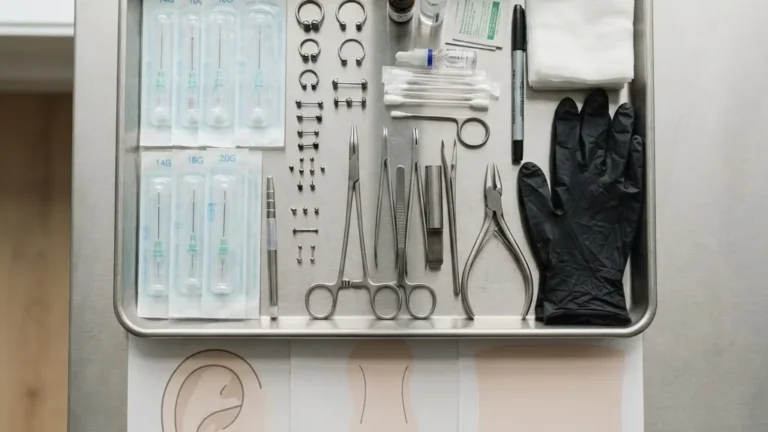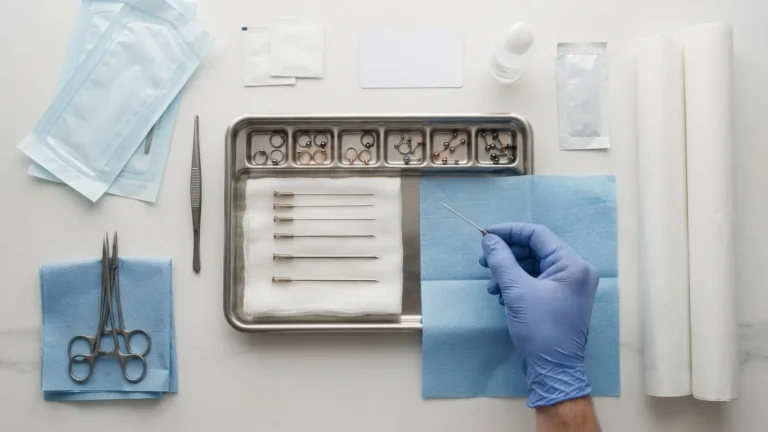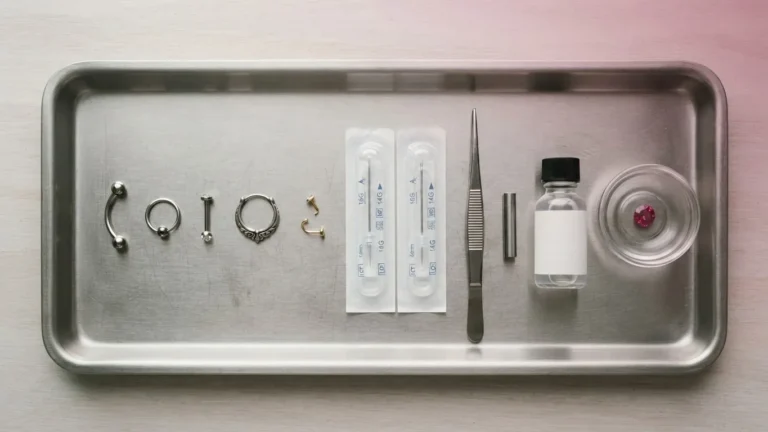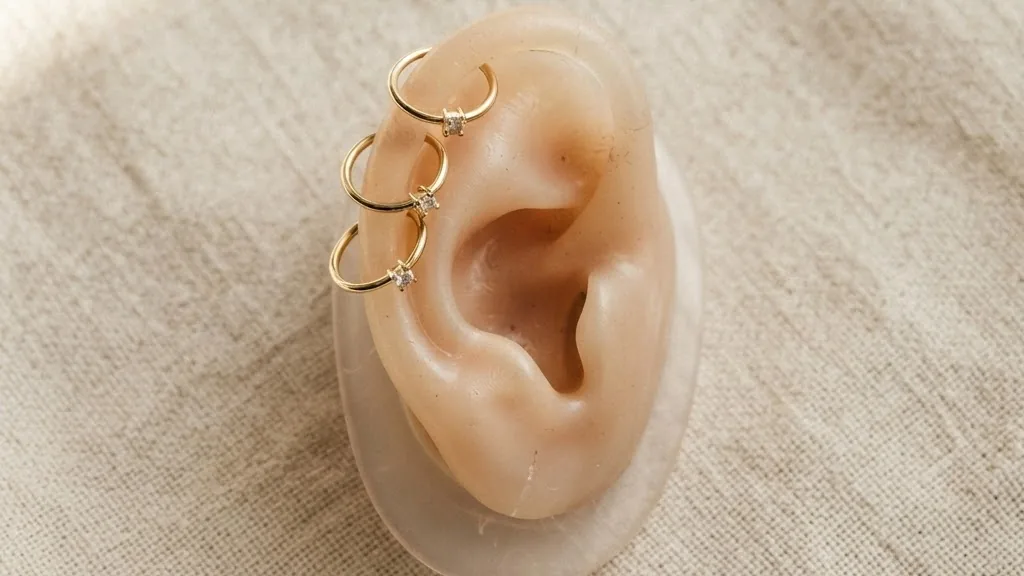
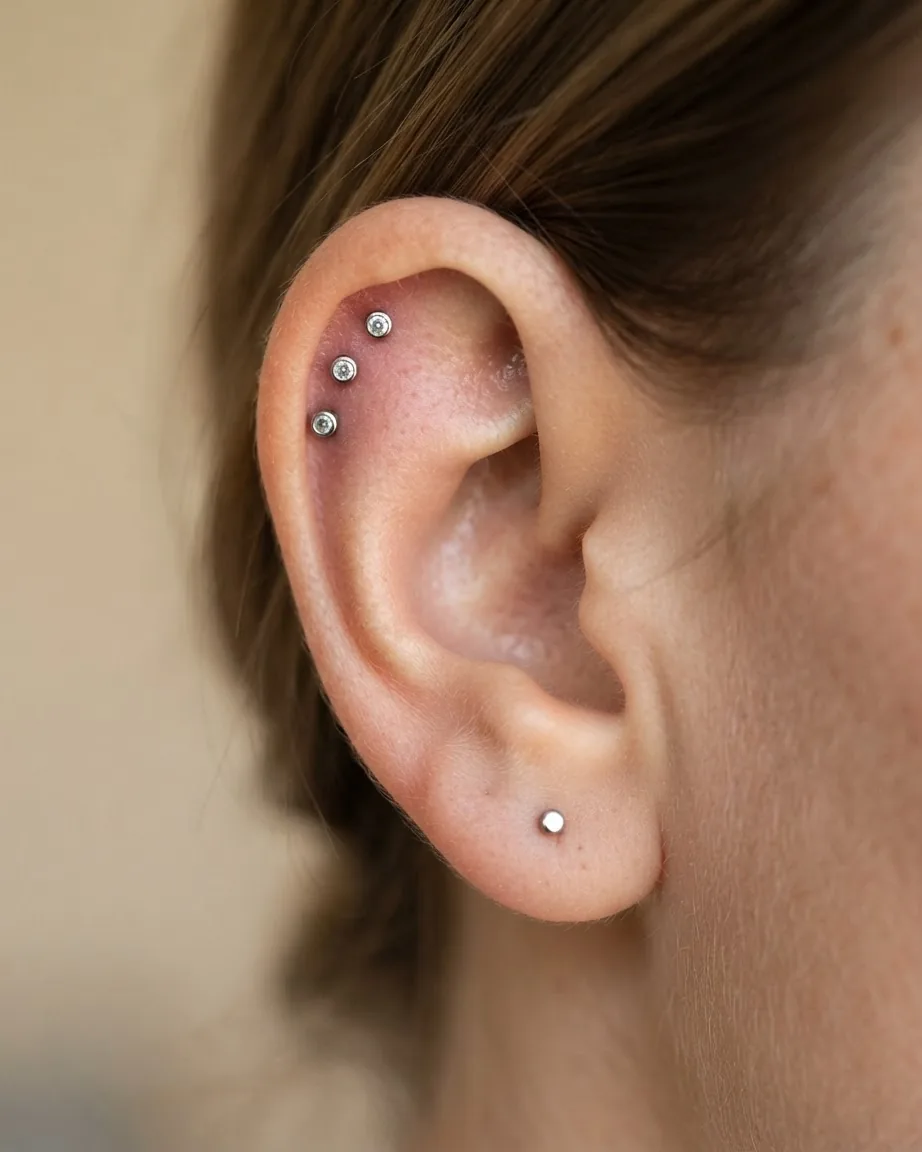
A triple helix cartilage piercing is three helix piercings placed in a row along the upper curve of the ear, and it is one of the most requested cartilage looks in a studio right now. Instead of one point on the outer rim, the piercer sets three, stacked so they follow the natural line of the ear. It reads as a single design, but each hole is a separate wound with its own healing to do.
That distinction matters more than the styling does. Cartilage is firm, has a limited blood supply, and repairs itself slowly, so three piercings on the same rim means three long recoveries happening at once. Rushing any part of it – the jewelry, the aftercare, the decision to get all three in one sitting – is where most problems start. This guide walks through placement, pain, healing time, jewelry, aftercare, cost, and the risks worth taking seriously, using guidance from the Association of Professional Piercers and the Mayo Clinic.
Every healing window, gauge size, and safety note below reflects current professional piercing standards and mainstream medical guidance, not personal claims.
Quick answer: A triple helix is three separate cartilage piercings on the upper ear. Each one typically takes 6 to 12 months to fully heal, and most people rate the pain around 5 to 7 out of 10, sharper than a lobe. Starter jewelry is usually a flat-back stud in 16g or 18g. Budget roughly three times a single helix fee, since a single helix commonly runs about $30 to $100. Clean twice daily with sterile saline, sleep off the ear, and see a professional if a piercing stays swollen, hot, or oozing.
What a triple helix cartilage piercing actually is
The helix is the outer rim of your ear, the curved edge of cartilage that runs from the top down toward where the lobe begins. A standard helix piercing puts one hole through that rim. A triple helix simply repeats that three times in a line, with the piercings spaced so they curve along the ear’s edge and sit as an even trio.
Because it lives entirely in cartilage, a triple helix behaves very differently from a set of lobe piercings. Cartilage is dense connective tissue with far less blood flow than the fleshy lobe, and blood flow is what carries the cells that close a wound. That is the whole reason cartilage work asks for patience the lobe never does.
People often confuse the triple helix with two neighbors. A forward helix sits at the front of the ear near the face, versus the standard helix which runs along the outer top edge; a mid helix is just a helix placed lower on that same rim. All three go through the same type of tissue, so the pain and healing are broadly similar, but the placement and the jewelry that suits each spot are not. If you are still mapping out where everything sits, our overview of the types of ear piercings lays the ear out piece by piece, and the dedicated helix piercing guide covers the single version in more depth.
Placement is not something to freehand at home. A good piercer marks all three dots first, has you look in a mirror, and adjusts for how your ear actually curves and how the jewelry will hang before a needle ever touches you. Spacing that looks even on a flat drawing can read crooked on a three-dimensional ear, which is one more reason this is studio work.
How much it hurts, and why cartilage is different from the lobe
Most people describe a helix piercing as a sharp, quick pinch followed by a dull pressure, and rate it somewhere around 5 to 7 on a 10-point scale. That is noticeably more than a lobe piercing, which many barely register. The difference comes down to the tissue: the lobe is soft and cushioned by fat, while cartilage is firm and has to be pushed through with more resistance.
With a triple helix, the discomfort tends to build. The first piercing is a clean pinch, but by the second and third your ear is already tender and a little inflamed, so each one can feel slightly more intense than the last. The actual piercing is over in a second or two per hole; it is the pressure and throb of the hours afterward that most people remember. A steady, experienced piercer using a single sterile needle per hole makes the moment itself faster and cleaner.
Pain tolerance is personal, and it is not a reason to numb yourself into a bad decision. Some studios offer topical options, and if you are anxious about the sensation it is worth reading up on numbing cream for piercings and, more importantly, talking to your piercer about what they allow. The short, sharp pain is temporary; the months of healing that follow are the part that really tests your patience.
Healing time: three clocks running at once
Here is the number people underestimate most. A single helix cartilage piercing takes roughly 6 to 12 months to fully heal. It may look calm and feel fine after a couple of months, but the inside of the channel is still knitting together long after the surface settles. Roughly 70 to 80 percent of people are fully healed somewhere in the 6 to 9 month window when they follow aftercare consistently; the rest run longer.
Now multiply that by three. A triple helix is three of those healing timelines running side by side on the same stretch of ear. Even if you get all three at once, you are committing to the better part of a year before the full set is stable enough to change jewelry freely or sleep on without a second thought. Treating a cartilage piercing like a lobe – swapping jewelry at six weeks, sleeping on it, touching it constantly – is the fastest way to stall healing or trigger a bump.
| Stage | Rough timeframe | What is happening |
|---|---|---|
| Fresh | Week 0 to 2 | Swelling, tenderness, some redness and clear crusting are normal |
| Early healing | Week 2 to 8 | Swelling settles; a downsize to a shorter post is often due |
| Mid healing | Month 2 to 6 | Looks calm on the surface, but the channel is still fragile inside |
| Late healing | Month 6 to 12 | Tissue fully matures; most piercings are stable by the end of this window |
If you want a fuller breakdown of why ear cartilage lags so far behind the lobe, our guide on how long it takes for ear piercings to heal compares the timelines spot by spot. The one-line version: plan for the long end of the range, not the short one.
All three at once, or one at a time
This is the real decision, and there is no universal right answer. Getting all three piercings in a single appointment means one recovery period, matched placement done in one sitting, and the finished look right away. The trade-off is that you have three fresh wounds clustered on the same rim, which usually means more swelling, more tenderness, and one side of your head you simply cannot sleep on for weeks.
Staggering the piercings – doing one, letting it heal, then adding the next – spreads the discomfort out and makes aftercare far easier, since you are only nursing one wound at a time. The cost is time and planning: you might stretch the full project across a year or more, and the piercer has to map later placements to line up with what is already there. Getting three at once versus spacing them out is a trade between convenience now and comfort during healing.
A few honest factors to weigh before you choose:
- Which side you sleep on – three fresh piercings on your dominant sleep side is genuinely hard to manage
- Your pain tolerance and how you handled any past cartilage piercing
- Whether you tend to form bumps or scars, in which case one-at-a-time limits the damage if something reacts
- Your budget and schedule, since staggering means multiple appointments and jewelry over time
- Your piercer’s read on your ear anatomy, which can make one approach clearly better than the other
Whatever you decide, let a qualified piercer mark the full trio first, even if you only get one done that day, so the final line stays even.
Jewelry: gauge, studs, hoops, and downsizing
Fresh cartilage wants simple, stable, high-quality jewelry. The two gauges you will see most are 18g, which is 1.0 mm thick, and 16g, which is 1.2 mm. Eighteen gauge is the most common ear gauge overall, while many piercers start cartilage at 16g because a slightly thicker post is more stable in the tissue and tends to heal more reliably. Thinner jewelry can move around too much in a fresh cartilage channel.
For the starter piece, a flat-back stud – sometimes called a labret-style stud – is the standard for a reason. The flat disc sits behind the ear, so there is nothing to snag on a pillow or a hairbrush and less to press into the healing hole. A common post length at first is around 6 to 8 mm, deliberately a little long to leave room for early swelling.
| Jewelry detail | Typical for a fresh triple helix |
|---|---|
| Gauge | 16g (1.2 mm) or 18g (1.0 mm) |
| Starter style | Flat-back stud (labret style) |
| Post length | About 6 to 8 mm, downsized after swelling |
| Recommended metal | Implant-grade titanium or solid 14k gold |
| Hoops and rings | Better saved for a fully healed piercing |
Hoops are the look most people picture on a triple helix, but a fresh cartilage piercing is not the time for one. A ring moves with every touch, snags easily, and keeps the wound in motion, all of which can drag out healing or push a piercing off course. Wait until the set is healed, then switch. The APP also notes that many piercings need a downsize to a shorter post before they are fully healed, and that jewelry changes during healing should be done by a qualified piercer, not at your bathroom sink.
Aftercare that actually helps
Good aftercare for cartilage is mostly about doing less, cleanly and consistently. The Association of Professional Piercers recommends cleaning with a sterile saline wound wash whose only ingredient is 0.9 percent sodium chloride – not homemade salt water, and not harsh products like rubbing alcohol or hydrogen peroxide, which are too aggressive on healing tissue. Here is a simple daily routine that follows that guidance:
- Step 1 – Wash your hands thoroughly before you go anywhere near the piercings.
- Step 2 – Spray or soak each piercing with sterile 0.9 percent saline, once or twice a day, and let it sit briefly to loosen any crust.
- Step 3 – Pat the area dry with clean non-woven gauze or a fresh paper towel, never a cloth towel that harbors bacteria and snags.
- Step 4 – Leave the jewelry alone. Do not twist, spin, or rotate it, which the APP says only irritates the wound.
- Step 5 – Sleep on the opposite side, or use a travel pillow with a hole in the middle so your ear is not pressed all night.
Just as important is the list of things not to do while three cartilage piercings heal:
- Do not touch or fiddle with the jewelry throughout the day
- Do not change or remove the jewelry early – wait for your piercer’s go-ahead
- Do not sleep directly on the piercings or let earbuds and phone screens press on them
- Do not use alcohol, peroxide, ointments, or homemade saline
- Do not submerge fresh piercings in pools, hot tubs, or lakes while healing
Twice-daily saline, hands off, and a clean pillowcase will carry most people through. If crusting, mild swelling, or occasional tenderness show up in the first weeks, that is normal healing, not a crisis.
What a triple helix costs
Pricing varies a lot by city and studio, but the useful anchor is the per-piercing fee. A single helix piercing commonly runs about $30 to $100, and often lands near $40 to $50 at a reputable shop, before jewelry. Because a triple helix is three separate piercings, plan for roughly three times that piercing fee, plus the cost of three quality pieces of jewelry.
Jewelry is where the total can climb, and it is not the place to cut corners. Implant-grade titanium or solid gold costs more than cheap plated metal, but it is far less likely to irritate a fresh cartilage wound. Some studios quote the piercing and jewelry together, others separately, so ask for the full number first. A higher bill at a clean studio using sterile single-use needles is money well spent against treating a complication later.
Getting all three at once may come with a small package discount, while staggering means separate appointment fees over time. Either way, the piercing fee is the smallest part of the real cost, which is the year of care that follows.
Risks: bumps, keloids, migration, and infection
Cartilage piercings carry a meaningfully higher complication rate than lobe piercings. One study of piercings through the upper ear cartilage found a complication rate around 35 percent, driven largely by that slow-healing, low-blood-flow tissue. Knowing what can go wrong, and what is simply normal healing, keeps you from panicking over a stray bump or ignoring a real problem.
The most common worry is a bump next to the piercing. Most of these are irritation bumps or hypertrophic scars: they stay right at the piercing site, tend to appear in the first weeks, feel relatively soft, and often shrink once the trigger is removed, whether that is pressure from sleeping on it, a snagged hoop, the wrong metal, or over-cleaning. A true keloid is different. It is a firm, rubbery scar that grows beyond the original wound, keeps enlarging over months or years, and is strongly tied to genetics. The American Academy of Dermatology notes that keloid risk is highest in people with darker skin and a personal or family history of them, with the greatest risk in people between roughly 10 and 30 years old. If keloids run in your family, that is a genuine reason to think hard before piercing cartilage, and to raise it with your piercer.
Migration and rejection are separate issues, where the body gradually pushes the jewelry toward the surface or out entirely. They are more likely with jewelry that is too thin, poor placement, low-quality metal, or constant trauma from snagging and sleeping on the piercing – another argument for a proper gauge and a flat-back stud during healing.
Infection is the risk that needs a clear line on when to get help. According to the Mayo Clinic, signs of an infected piercing include spreading redness, ongoing pain, swelling, warmth, and pus that can look white, green, or yellow. Do not try to fix a suspected infection by yanking the jewelry out; removing it can trap the infection inside. Instead, keep the area clean and contact a healthcare professional. You can read the Mayo Clinic’s own guidance on how to treat a piercing infection for the specifics. As a general rule, if a piercing is not improving within about 5 to 7 days, or if symptoms are getting worse, see a clinician, since some infections need antibiotics.
Frequently asked questions
Does a triple helix hurt more than a single helix?
The pain of each individual piercing is about the same as a single helix, roughly 5 to 7 out of 10. What makes a triple feel like more is getting three in a row: by the second and third, the ear is already tender and inflamed, so the discomfort stacks. The actual piercing of each hole still takes only a second or two.
How long until I can sleep on that side?
Expect to keep pressure off the piercings for at least the first several weeks, and often a few months, because pressure is a leading cause of irritation bumps. Many people find sleeping comfortably on that side does not return until the piercings are well into healing. A travel pillow with a hole in the center helps take the weight off the ear at night.
Should I get all three piercings at once?
Both approaches are valid. All at once gives you one recovery and matched placement but more swelling and one unsleepable side; staggering spreads out the discomfort and is gentler if you scar easily, at the cost of extra time and appointments. Talk it through with your piercer, who can factor in your ear anatomy and your history with cartilage.
Can I start with hoops?
It is better not to. A fresh cartilage piercing heals best with a stable flat-back stud, because a hoop moves with every touch, snags easily, and keeps the wound in motion, which can slow healing or cause migration. Once all three are fully healed, usually after 6 to 12 months, you can switch to hoops safely.
Is that bump a keloid?
Usually not. Most piercing bumps are irritation bumps or hypertrophic scars that stay at the site, feel softer, and improve when the trigger is removed. A true keloid grows beyond the wound, feels firm and rubbery, and keeps enlarging over months. If a bump is spreading, hardening, or growing, or if keloids run in your family, see a dermatologist or your piercer rather than guessing.
How much does a triple helix cost?
Budget for three separate piercing fees plus three pieces of jewelry. A single helix commonly runs about $30 to $100, often near $40 to $50, so a triple is roughly three times that plus quality metal. Implant-grade titanium or solid gold costs more but is far kinder to fresh cartilage than cheap plated pieces.
The bottom line
A triple helix cartilage piercing is a striking look built on three real wounds, each needing 6 to 12 months of patient care, not the quick turnaround a lobe allows. Choose a reputable studio, let them mark and place all three, and start with a stable flat-back stud in 16g or 18g rather than a hoop. Clean twice daily with sterile 0.9 percent saline, keep your hands and your pillow off the ear, and plan to downsize the posts with your piercer once early swelling settles. Watch for the difference between a harmless irritation bump and a spreading keloid, take family scarring history seriously, and treat any warmth, spreading redness, or pus as a reason to see a professional. Get those basics right, and the year of healing pays off in a set of piercings that stays put and looks the way you pictured it.