A healed-looking lobe at six weeks is not the same as a healed lobe, and that gap decides whether an early jewelry change goes smoothly or tears the channel. When can i change my ear piercing? The honest answer is that no single date applies to every placement. A lobe can usually accept a different earring around 6-8 weeks, while cartilage sits on a far longer schedule, and the figure you can trust depends on which milestone you mean: the first elective change, the professional downsize, or full maturation. This desk compiles the published guidance from professional piercing bodies and studio aftercare documents, holds the numbers against each other where they disagree, and flags where a source contradicts itself so you are not swapping jewelry on a date that only looks safe.
The short answer: lobe at 6-8 weeks, cartilage at 3 months to a year
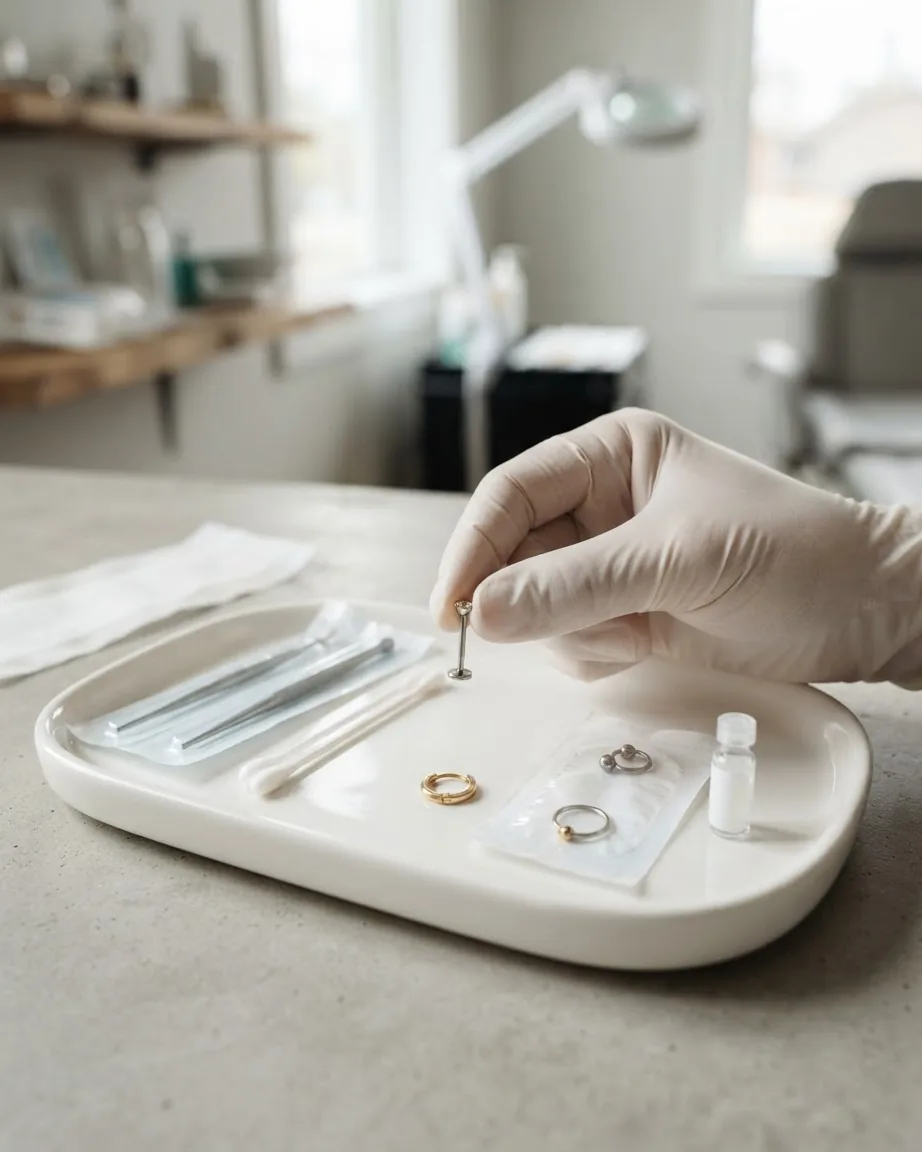
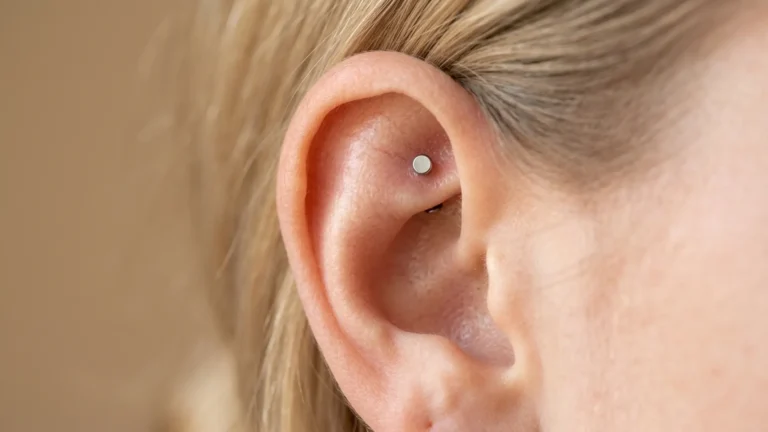
Lobe piercings are generally said to heal enough for a first earring change at about 6-8 weeks, provided there is no redness, pain, or discharge. Cartilage placements (helix, tragus, conch and the rest) run far longer, roughly 3 to 6 months, with some needing up to a year before a change is safe. “Looks healed” from the outside is not the signal to use, because an ear heals outside-in and the interior of the channel stays fragile after the surface settles. Changing too early can seed infection, tear the tissue, or let the hole shrink. The safest move for a first swap, especially on cartilage, is to have a qualified piercer do it rather than forcing jewelry in at home.
How long until a lobe piercing can be changed
The lobe is soft tissue with its own blood supply, which is why it closes a piercing wound faster than any cartilage site and why it tolerates an early change better. Mantra Tattoo puts the earliest change at about 6-8 weeks, conditional on the piercing being calm: no redness, no pain, no discharge. Clean Origin lands on the same window, recommending a wait of up to 6-8 weeks for earlobes before swapping jewelry.
That 6-8 week figure is an earliest-change marker, not a full-healing one, and the distinction matters. STUDS treats lobe full healing as a separate, longer milestone at 4-6+ months, with an interim downsize step at 2-3 months. In practical terms: your lobe may accept a careful stud change near the two-month mark, but the tissue is still remodeling for months afterward. The condition, not the calendar, governs. If redness or discharge is present at eight weeks, the piercing is telling you to wait.
For a layered lobe setup, each hole runs its own clock. See also: our second lobe piercing guide.
Cartilage timelines by placement: helix, tragus, conch and the long healers

Cartilage has poor blood supply, so it heals slowly and unevenly. Applying a lobe schedule to a helix is the error that lands people with irritated, bumpy piercings. STUDS publishes distinct per-type full-healing frames in its ear-piercing aftercare guide: lobe 4-6+ months; helix, tragus and conch 6-9+ months; and the longest group – anti-tragus, rook, daith and industrial – at 8 months to 12+ months.
Ranked by how long you should plan to wait before a change, the order is:
- Lobe – shortest, first change around 6-8 weeks, full healing 4-6+ months.
- Helix, tragus, conch – mid-range, roughly 3 to 6 months per Mantra Tattoo, with STUDS citing 6-9+ months to full healing.
- Anti-tragus, rook, daith, industrial – longest, 8 months to 12+ months.
The gauge and jewelry a piercer starts cartilage with is deliberately longer than a healed-fit piece: a labret-style flat-back stud with extra post length to allow for swelling, typically at a standard cartilage gauge, and an implant-grade internally threaded or threadless metal rather than a cheap hoop. A conch or helix does not take a hoop the day it is pierced; the ring comes later, once the channel is mature. See also: our conch piercing hoop guide.
Tragus, conch and daith: the anatomy fit and how much they hurt

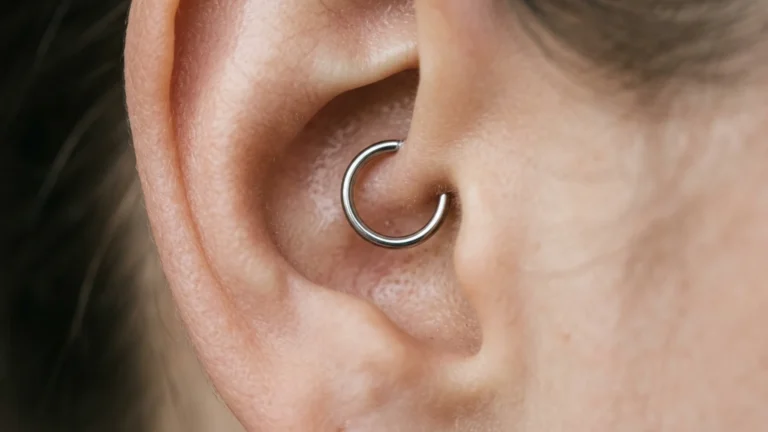
These three sit in the dense inner cartilage near the ear canal, and each takes jewelry differently. The tragus is the small flap of cartilage in front of the canal; it is thick for its size, which is why it heals from the outside in and can feel settled on the surface while the core is still raw. The conch is the large bowl of cartilage in the center of the ear, named for its shell shape, and its thickness is why it sits in the 6-9+ month full-healing band. The daith is the fold of cartilage above the canal, a tight curl that favors a small ring and makes aftercare awkward to reach.
On pain, cartilage sites register higher than a lobe because the tissue is firm and nerve-adjacent rather than fleshy. A lobe is the low baseline most people know; a tragus, conch or daith is a sharper, more pressured sensation and a longer-lasting tenderness afterward. That difference is not a reason to avoid them, but it is a reason to expect a slower settle and to resist an early swap. For reaching the daith with saline, see also: our saline solution for daith guide, and for the tragus specifically, our tragus piercing healing time guide.
Why “looks healed” is the wrong test, and what to check instead
Ear piercings heal from the outside surfaces inward, so the skin at each opening can look closed and dry while the tunnel between them is still an open wound. This is the single most common reason a change goes wrong: the reader checks the two ends, sees no crust or redness, and assumes the interior matches. It does not.
Clean Origin describes healing in phases, with a final maturation phase that starts around 6 months post-piercing and firms the tissue around the site. That remodeling stage, it notes, can last up to 2 years. So even a piercing that feels healed at month six is still structurally settling. The usable test before any change is a set of conditions, met together: no pain on contact, no swelling, no discharge of any kind, and jewelry that moves freely without tugging. If any one of those fails, the piercing is not ready – regardless of how long ago it was done.
The downsize step: an earlier milestone that is not a jewelry change
Generalist pages treat the wait as a single decision – heal, then swap. Studio guidance separates two milestones, and the earlier one is the downsize. STUDS distinguishes a downsize step from full healing and gives separate frames: a lobe downsize at 2-3 months, a helix downsize at 3-4 months. The downsize replaces the longer initial post (left long for swelling) with a shorter one that fits the settled tissue. STUDS is explicit that a downsize does not mean the piercing is fully healed or ready for hoops and fashion jewelry.
Held against the full-healing frames from the same source, the gap is instructive. A lobe downsizes at 2-3 months but reaches full healing at 4-6+ months. A helix downsizes at 3-4 months but reaches full healing at 6-9+ months. The downsize is an interim fitting done by a qualified piercer, not the green light for a DIY swap into decorative jewelry.
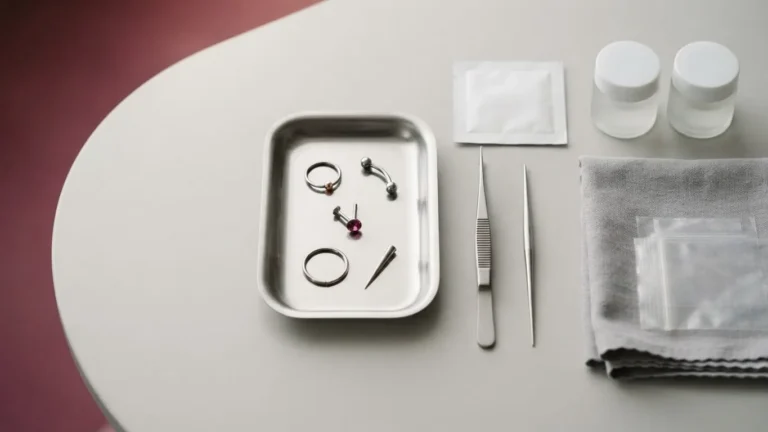
Who should do the change during healing matters too. A professional has sterile tools, correctly sized implant-grade jewelry on hand, and can assess the channel. During the healing period, that is the safer route than a bathroom swap.
What goes wrong when you change jewelry too soon
Three failure modes drive the caution. First, infection: an open channel is a wound, and introducing jewelry (or your hands) before it closes can carry bacteria in. Second, closure: the hole can shrink or close faster than people expect. Third, tearing – forcing a post through tissue that has not healed rips the channel and sets healing back.
The closure risk is sharper than most realize. The Association of Professional Piercers notes that removing jewelry from a healed piercing may cause rapid shrinkage, and that most holes shrink fairly rapidly, with the channel settling smaller or fully closed within a month or two. That applies to healed piercings; a fresh one can narrow in minutes. The practical rule: never force jewelry. If a post will not pass without pressure, stop – the resistance is the tissue telling you it is not ready, and pushing through tears it.
There is also a legacy habit worth dropping. The old advice to twist or rotate jewelry to “keep the hole open” is counterproductive. The APP’s suggested aftercare for body piercings advises against twisting, spinning, or rotating jewelry during healing, as the motion disrupts the forming channel rather than protecting it.
Which metals to switch into, and which to avoid
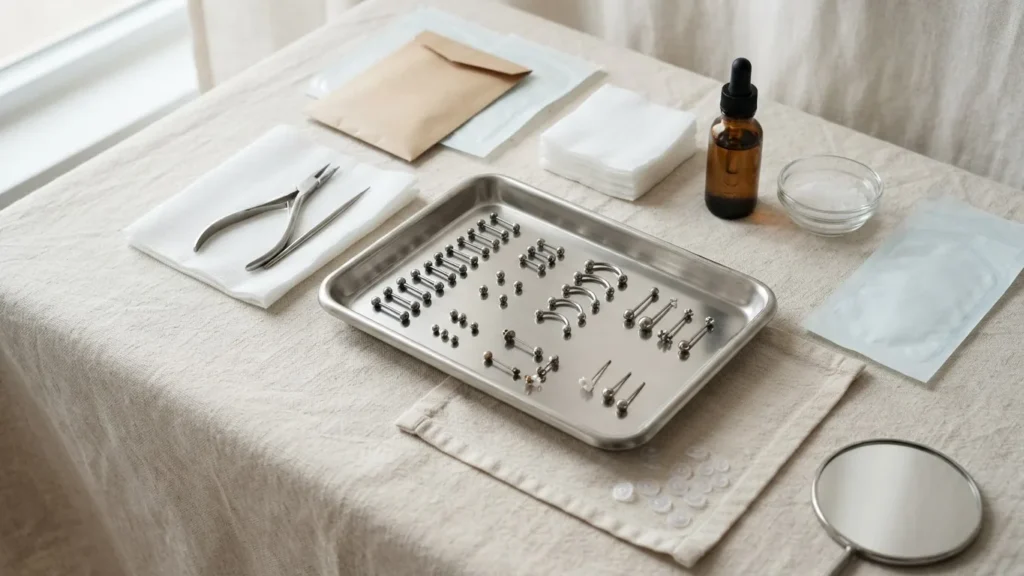
The jewelry you change into carries as much weight as the timing. A healed-but-remodeling channel still reacts to the wrong material. The APP’s guidance on jewelry for healed piercings sets the standard for what belongs in a settled piercing versus a healing one. The safe direction is implant-grade metals – titanium and surgical-grade steel are the common recommendations – and solid gold of appropriate purity, with threadless or internally threaded ends so nothing abrasive drags through the channel.
What to avoid: plated costume pieces, unknown alloys, and anything with external threading on the part that passes through the tissue. For a first change into a cartilage hoop or a fashion piece, the material question and the healing question are separate gates – both must pass. This desk compiles these material standards from the published professional body-modification guidance rather than any single retailer’s catalog, and the wider subject is collected under our ear piercings section.
Children’s ear piercings: a different clock and a 35% complication rate
Adult-oriented studio pages skip the pediatric specifics entirely, so parents often apply the wrong schedule. Riley Children’s Health, with guidance from pediatrician Dr. Alyssa Swick citing the AAP, gives child-specific figures that differ from the adult lobe window.
Per Riley Children’s Health’s ear piercing care for kids, do not remove or change the earrings for at least four to six weeks after piercing. Even once the earrings can first be changed, post (stud) earrings should be worn for about six months after piercing to prevent the holes from closing. The same guidance notes that about 35% of ear piercings result in a complication of some kind, making some medical intervention likely – a figure that argues for patience over an early swap.
On timing of the piercing itself, physicians often recommend waiting until at least two months of age, after the first routine vaccinations, to reduce infection risk. And a clear stop rule from the same source: if you notice an embedded earring back, or pain, redness, pus or swelling that lasts longer than 24 hours after the piercing, contact your physician for an exam and treatment.
When to stop and see your piercer or a clinician
None of the timelines here replace an in-person assessment, and nothing in this article is a diagnosis. A healing piercing produces some clear or pale discharge and mild tenderness early on; that is expected. What is not expected is persistent worsening. The pediatric stop rule applies broadly as a prompt to seek care: an embedded earring back, or pain, redness, pus or swelling lasting longer than 24 hours, warrants a call to a physician.
For the mechanics of a change – whether the channel is truly ready, which jewelry fits, whether to downsize first – a qualified piercer is the right person during the healing period. For anything that looks infected, inflamed, or embedded, a clinician is the right call. When the two questions overlap, see both. The cost of a professional change is modest against the cost of a torn or infected channel: studio jewelry changes commonly run in the low tens of dollars, far below the medical bill a complication can carry.
Reconciling the conflicting cartilage numbers
The published figures for cartilage do not line up, and it is worth knowing why before you pick one. Mantra Tattoo gives around 3 to 6 months with some sites to a year. STUDS gives 6-9+ months for most cartilage and 8-12+ months for the longest group. Clean Origin’s own page carries two different figures: its summary says 6-12 months for cartilage, while its body text elsewhere says to let cartilage heal for up to 12 weeks before changing earrings, and separately lists 2 to 8 months until complete healing for placements such as septum and tragus.
These are not interchangeable. They mix different milestones (first change versus full healing) and different placement groupings. The 12-week figure in particular sits oddly against the same page’s 6-12 month summary and should not be treated as the reliable number for cartilage. The resolution: do not average them. Take the milestone you actually need – a first elective change versus full maturation – and apply the longest credible figure for your specific placement, because cartilage punishes optimism. For helix or tragus, that means planning for the back half of the 3-to-9-month range, not the front, and confirming the condition checks before anything goes in.
Can I take my earring out briefly and put it back?
Risky, and the riskier the newer the piercing. A fresh channel can narrow within minutes of being left empty. Even a fully healed one tends to shrink, and the APP notes it may settle smaller or closed inside a month or two. If a piece must come out, have a replacement ready to insert immediately, and never leave a healing cartilage site bare.
My lobe looks fine at four weeks – can I swap the stud?
Four weeks is short of the 6-8 week earliest-change window for lobes, and surface appearance does not confirm the interior has closed. Wait until the conditions are met together: no tenderness on contact, no swelling, no discharge, and free movement of the current jewelry. If those hold at six to eight weeks, a careful change is reasonable.
Does a downsize mean my piercing is healed?
No. A downsize is an interim fitting, swapping a long swelling-allowance post for a shorter one, done by a qualified piercer. STUDS places it well ahead of full healing – a lobe downsizes at 2-3 months but matures at 4-6+ months. It is not clearance for hoops or decorative fashion jewelry, which wait for full healing.
How soon after piercing can a baby’s earrings be changed?
Not for at least four to six weeks, per pediatric guidance, and stud earrings should stay in for roughly six months afterward so the holes do not close. Given that around 35% of ear piercings run into some complication, the conservative schedule is deliberate. Any pain, redness, pus or swelling past 24 hours means a call to the physician.
The downsize-to-healed gap: how long after your downsize before a real swap
STUDS treats the professional downsize and full healing as two separate milestones, and because both come from the same source with the same definitions, you can subtract one from the other to see how long the piercing is still remodeling after a downsize has already happened. The downsize is not your cue to start changing jewelry yourself – the arithmetic shows how big that gap really is.
- Lobe: downsize at 2-3 months, full healing at 4-6+ months. Even in the fastest case, full healing (4 months) arrives at least 1 month after the latest downsize (3 months), and up to 2 months after the earliest downsize (2 months). The upper end of the full-healing band (6+ months) stretches that gap further still.
- Helix: downsize at 3-4 months, full healing at 6-9+ months. That leaves at least 2 months between the latest downsize (4 months) and the earliest full-healing point (6 months), and as much as 3 months measured from the earliest downsize (3 months).
In short: once a piercer downsizes your jewelry, plan on another one to three months minimum – longer on cartilage – before the channel is actually mature enough for a decorative change. A shorter post that finally fits is a sign of progress, not a finished piercing.