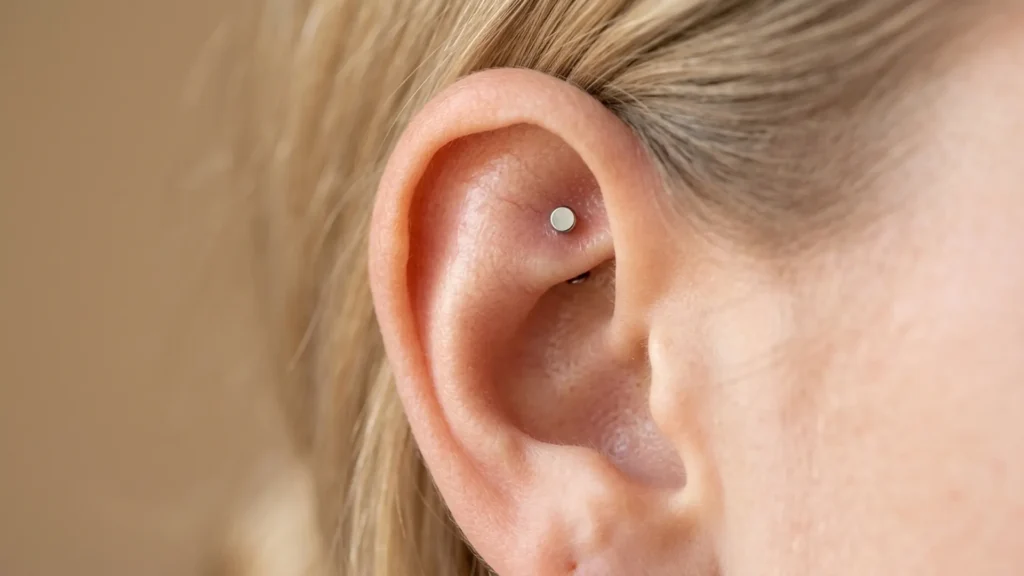
A hidden helix piercing is a cartilage piercing tucked into the inner fold of the upper ear, set back where the rim curls inward so the jewelry peeks out subtly rather than sitting boldly on the outer edge. It is one of my favorite placements to recommend to clients who want the look of a helix without the snag, the catch on hairbrushes, or the constant knocking against pillows that a standard outer helix gives you. The jewelry sits sheltered in the crook of the cartilage, which makes it discreet, a little protected, and genuinely flattering on most ear shapes. In this guide I will walk you through exactly where it goes, how much it hurts, the real healing timeline, what jewelry suits it, the mistakes that cause bumps, and how to tell it apart from the placements people confuse it with.
I want to be straight about one thing up front. The word hidden makes this sound low maintenance, and the discreet placement does protect it from some everyday bumps. But it is still cartilage, which means it heals slowly, it can develop bumps if you mistreat it, and it deserves the same patience as any other helix. Discreet does not mean effortless.
What a Hidden Helix Piercing Actually Is
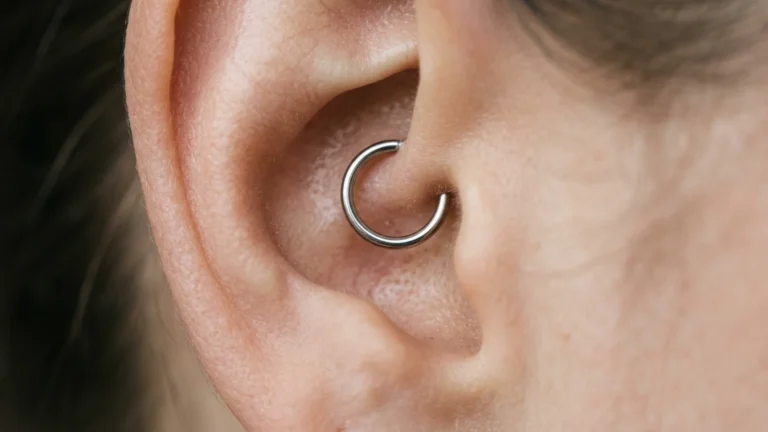
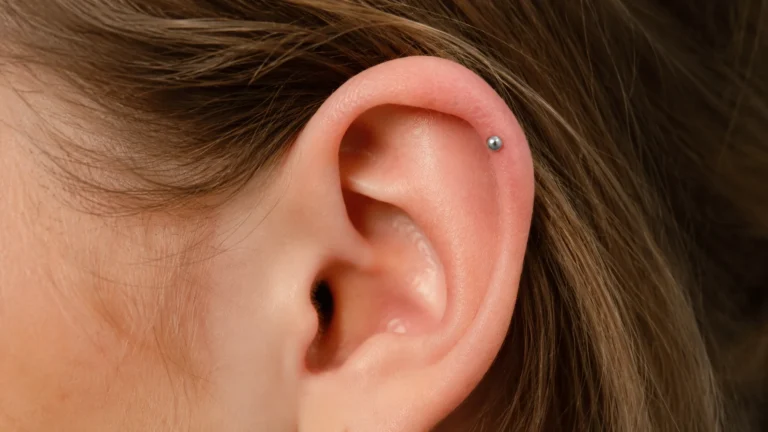
The helix is the curved outer rim of cartilage that runs around the top of your ear. A standard helix piercing sits right on that visible outer edge. A hidden helix moves the placement inward and upward, into the spot where the rim folds back on itself near the top of the ear, so the jewelry rests in that inner curve. From the front, you see a small flash of a stud nestled in the fold rather than a piece sitting on the outer rim. That tucked position is the whole appeal. It reads as understated and intentional, and it sits out of the way of hairbrushes, hats, glasses arms, and the side of your pillow.
Because it is set into the fold, the piercing usually takes a flat-back stud rather than a hoop. A small ball, a tiny disc, a flat gem, or a low-profile cluster sits beautifully there. A ring tends not to work as well because the fold does not give a hoop room to sit cleanly. The placement is a single cartilage piercing, so it is not more complex than a normal helix to perform, but it does ask for a piercer with a good eye, because the exact spot has to follow your ear’s natural fold to look right and heal straight.
Where It Sits Compared to Other Helix Placements
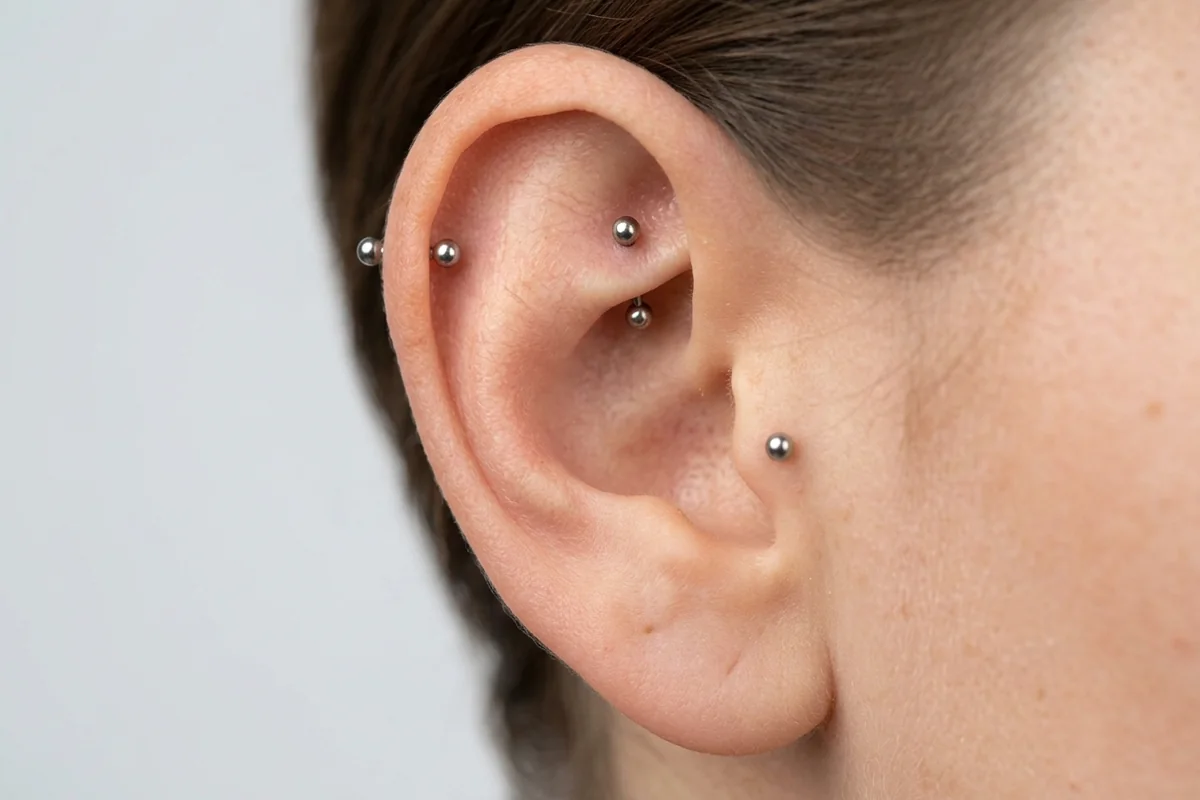
People mix up the helix family constantly, so here is a clean comparison. All of these are cartilage, all take 16 gauge jewelry as a rule, and all heal on a similar timeline. The difference is purely where on the ear they land.
| Placement | Location on ear | Visibility | Usual jewelry |
|---|---|---|---|
| Hidden helix | Inner fold of the upper rim | Subtle, tucked | Flat-back stud |
| Standard helix | Outer upper rim | Prominent | Stud or hoop |
| Forward helix | Front of ear near the face | Visible from the front | Flat-back stud |
| Flat helix | Flat inner cartilage below the rim | Moderate | Flat-back stud |
| Mid / lower helix | Middle or lower outer rim | Prominent | Stud or hoop |
The closest cousin is the flat helix, which sits on the flat panel of inner cartilage rather than in the curled fold. The two get confused often, but a hidden helix specifically uses the fold to conceal the back of the jewelry, while a flat helix sits more openly on the flat cartilage. If you are deciding between placements for a curated ear, our ear piercing guides cover each spot in detail, and the piercing types and charts hub lays the family out side by side.
Does a Hidden Helix Piercing Hurt
It is cartilage, so expect a sharp, brief pinch followed by a dull pressure, not the quick light sting of a lobe. On the kind of one to ten scale piercers use, most people put a helix around a four or five, with a hot flush and watering on the same side for a moment. The needle pass itself takes a second. What lingers is a throb that fades over the first few hours and a tenderness that comes and goes for the first week or two, especially if you bump it or sleep on it.
The hidden placement does not hurt more than a standard helix. If anything, the procedure feels the same, since it is the same cartilage. What differs is the angle the piercer works at, which is slightly more tucked, so a steady professional matters. Eat something beforehand so you are not lightheaded, breathe out as the needle goes through, and do not tense your shoulders up to your ears. For how this placement stacks up against others by discomfort, our ear piercing pain chart ranks every spot.
Healing Timeline and Aftercare
Here is where the hidden helix asks for honesty. Like every cartilage piercing, it heals slowly, from the outer surfaces inward, and the timeline is months, not weeks. Plan on a minimum of three to four months before it feels settled and six to nine months before it is fully healed and ready for a jewelry change. The tucked position can actually help, because it gets bumped less than an exposed rim, but the fold can also trap moisture and product if you are not careful, which works against you. So the placement gives a little and takes a little.
| Stage | Time frame | What to expect |
|---|---|---|
| Fresh | Days 1 to 14 | Swelling, tenderness, some crusting, occasional throb |
| Early healing | Weeks 2 to 12 | Swelling fades, crusting eases, still fragile inside |
| Settling | Months 3 to 6 | Looks calm, may still react to bumps |
| Fully healed | Months 6 to 9+ | No discharge, no tenderness, safe to change jewelry |
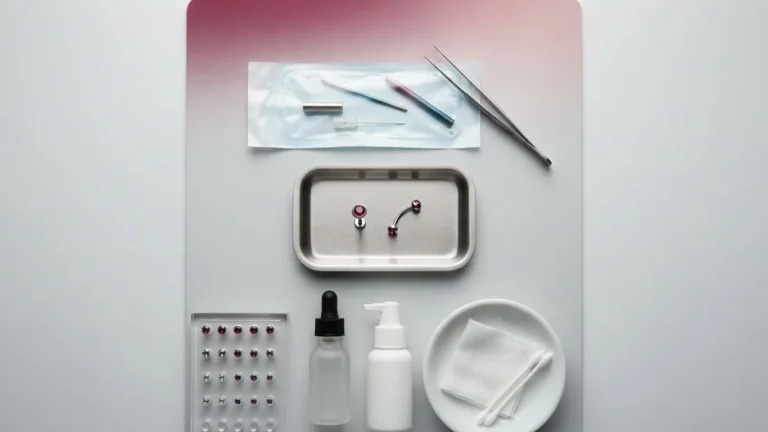
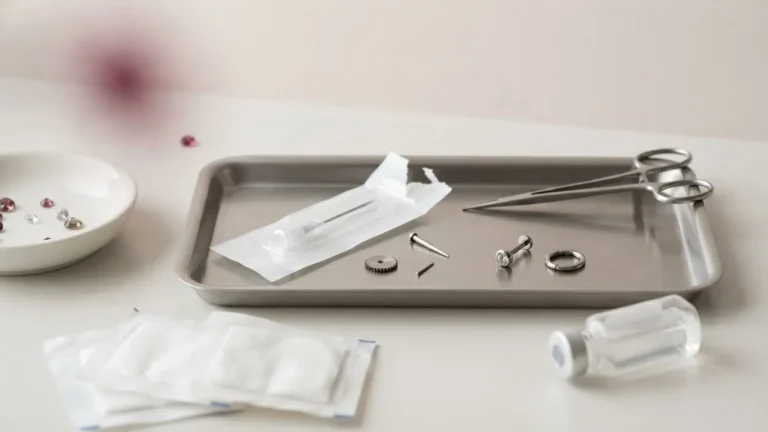
Aftercare is simple and you should resist the urge to do more. Rinse it once or twice a day with sterile saline, getting into the fold gently with a saline-soaked clean gauze or cotton if crust builds up there. Do not touch it with unwashed hands. Do not twist, spin, or rotate the jewelry, ever, since that is the number one cause of irritation and bumps. Keep shampoo, conditioner, dry shampoo, hairspray, and makeup out of the fold while it heals, and rinse the area after washing your hair. Avoid pools, hot tubs, and lakes until it is well along. Skip alcohol, hydrogen peroxide, and tea tree oil, all of which dry out and damage cartilage. The minimalist approach is the one reputable health bodies recommend, and you can read body piercing care guidance from Healthdirect Australia and aftercare standards from the Association of Professional Piercers.
Choosing Jewelry for a Hidden Helix
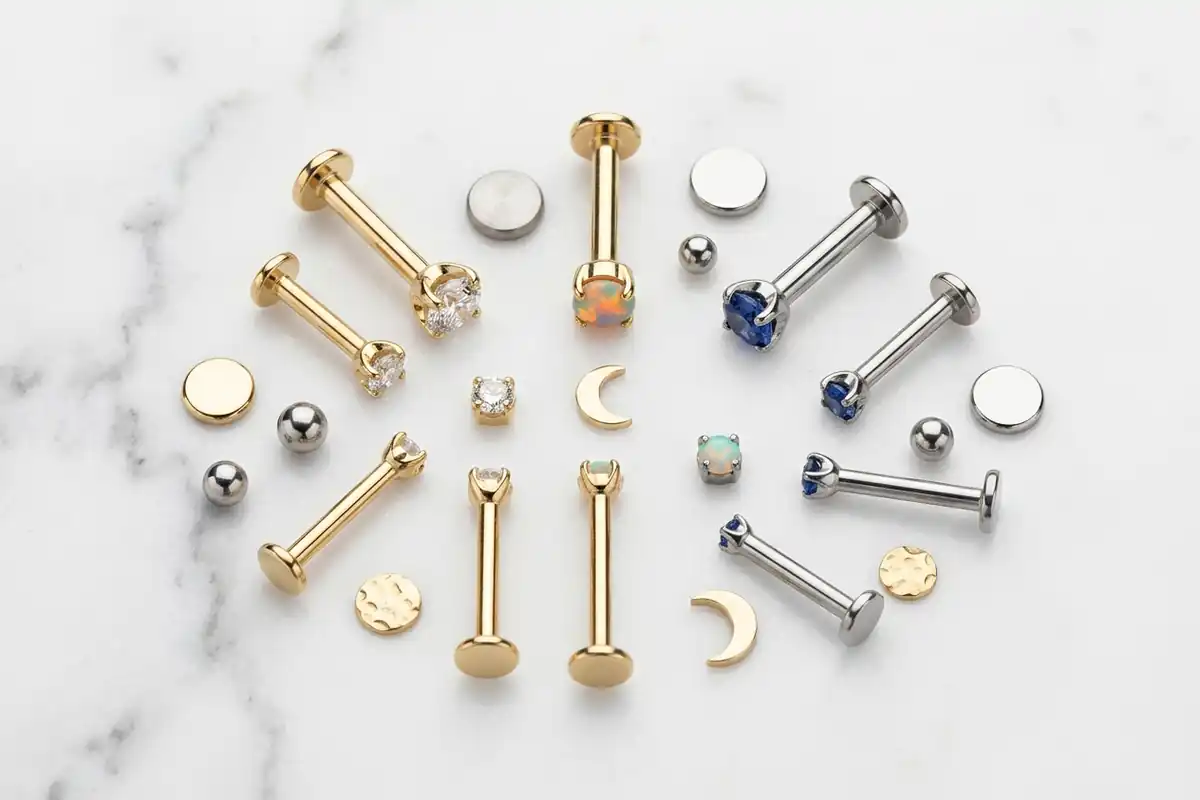
The hidden helix is a flat-back stud placement, full stop, for the healing period. A flat disc backing sits comfortably behind the fold against your ear without a sharp ball digging in, which matters when the jewelry is tucked into a tight curve. The front can be a small ball, a flat gem, a tiny star or disc, or a low cluster, as long as it is proportionate to the fold and does not stick out so far that it catches.
Material is not negotiable for a healing cartilage piercing. Use implant grade titanium labeled ASTM F-136, solid 14k or 18k nickel-safe gold, or niobium. Avoid ungraded surgical steel, gold plating that wears off, and sterling silver that tarnishes in the channel. Threadless or internally threaded jewelry is gentler than externally threaded, because there are no exposed threads to drag across the fresh channel when it goes in. Gauge is almost always 16, and the post length should leave a little room for early swelling, then get downsized to a shorter neat post by your piercer once the swelling fades, usually around the two month mark. Our jewelry materials and sizing guide walks through metals and how to read a flat-back’s measurements.
| Choice | Recommended | Avoid during healing |
|---|---|---|
| Style | Flat-back stud | Hoops and rings |
| Front design | Small ball, flat gem, tiny disc | Large or protruding pieces |
| Material | Titanium F-136, solid gold, niobium | Ungraded steel, plated, silver |
| Threading | Threadless or internal | External threading |
| Gauge | 16g | Mismatched gauges |
Common Mistakes and Bump Prevention
The cartilage bump is the thing people fear, and with a hidden helix it usually comes from a short list of avoidable causes. Sleeping on it is the big one. The tucked placement helps, but pressing your ear into a pillow for hours still distorts the healing channel and traps fluid. Use a travel pillow with a hole in the middle or train onto the other side. Catching it counts too. Even though it is hidden, pulling a tight sweater over your head or yanking out an earbud can knock it, so be deliberate.
Over-cleaning is the second common error. People treat hidden as dirty because product collects in the fold, then they scrub it three times a day or reach for harsh antiseptics, which dries and inflames the cartilage. Once or twice a day with saline is plenty. Changing the jewelry too early is the third. The surface of a cartilage piercing looks healed long before the inside is, and swapping at two or three months almost guarantees a bump. Wait the full six to nine months, and have your piercer do the first change. For more on timing that swap safely, see our guide on how long ear piercings take to heal.
If a bump does appear, do not panic and do not pick at it. A small irritation bump often comes from one of the causes above and settles once you fix the cause, downsize ill-fitting jewelry, and keep up gentle saline rinses. What you should not do is apply random creams, crush it, or change to fancier jewelry hoping to fix it. If a bump grows, the piercing becomes warm and very painful, or you see thick discolored discharge, see your piercer or a doctor, since those can point to an infection or a hypertrophic scar that needs proper assessment.
The Downsize and First Jewelry Change
Two maintenance moments shape how a hidden helix turns out, and people tend to know about neither. The first is the downsize. Your starting flat-back will have a slightly longer post to allow for the swelling that hits in the first week or two. Once that swelling settles, around the two month mark, that extra length becomes slack that lets the jewelry rock inside the tucked fold every time you move, which irritates the channel right when it is trying to stabilize. Because a hidden helix sits in a curve, an oversized post is even more prone to catching and shifting than one on a flat surface. Go back to your piercer for a shorter post of the same gauge. It is a quick swap, it is not a sign the piercing is healed, and it often heads off the bump that an unattended long post would eventually cause.
The second moment is the first real jewelry change, the one where you swap to a piece you actually picked. Wait until the piercing has passed every healing sign, which for a hidden helix means no crust, no discharge, color matching the rest of your ear, and no tenderness when you touch it or sleep on it, all holding steady for several weeks. That usually lands at six to nine months. For a tucked placement especially, have your piercer do that first change, because the angle into the fold is awkward to navigate yourself and the channel can tear if you drag the new post through at the wrong line. After that first professional swap, most people can change their own jewelry easily, since the channel is mature and the fold is no longer fragile.
Styling a Hidden Helix With the Rest of Your Ear
Part of the appeal of this placement is how it plays with others. Because it sits in the inner fold rather than on the rim, a hidden helix adds a second layer of interest to a curated ear without crowding the outer edge, which leaves the rim free for a standard helix, a row of lobes, or a hoop further down. A common pairing I set up is a hidden helix tucked in the fold with a small stud on the outer helix just above or below it, so the eye catches a flash in the fold and a piece on the rim, giving the upper ear depth rather than a single flat line of jewelry.
Keep proportion and metal in mind when you build around it. A hidden helix wants a small, low-profile front so it stays tucked, so it pairs best with similarly delicate pieces rather than a large statement stud right next to it. Match your metals across the ear, sticking with all titanium or all gold rather than mixing tones, and the whole arrangement reads as intentional. If you are planning several pieces, space the appointments out so each cartilage piercing heals unpressured before you add the next, since stacking fresh cartilage piercings on one ear leaves you nowhere comfortable to sleep. Our jewelry guide can help you coordinate sizes and finishes across a full ear.
Is a Hidden Helix Right for You
This placement suits a few specific wants. If you like the helix look but hate snagging jewelry on your hair, glasses, or pillow, the tucked position solves that. If you want something discreet enough for a workplace where bold piercings are frowned on, a small stud nestled in the fold reads as subtle. If you are building a curated ear and want depth and dimension rather than a row of pieces along the rim, the hidden helix adds interest in the inner curve. It also flatters ears where the fold is well-defined, because the jewelry has a natural pocket to sit in.
It is less ideal if your heart is set on a hoop, since the fold does not host rings well, or if your ear’s fold is shallow, in which case a piercer may steer you to a flat helix or standard helix instead. That personal anatomy read is exactly why you bring your ideas to a professional rather than deciding from a photo. A good piercer will look at your fold, mark the spot that follows your ear’s curve, and tell you honestly whether a hidden helix or a neighbor placement will suit you better. Whichever you land on, treat it as the months-long cartilage commitment it is, keep the aftercare simple, and you will have a discreet, well-healed piece you stop thinking about entirely, which is the highest compliment a piercing can earn.
Frequently Asked Questions
How long does a hidden helix piercing take to heal?
Plan on a minimum of three to four months before it feels settled and six to nine months before it is fully healed and ready for a jewelry change. It is cartilage, so it heals slowly and unevenly from the outside in. The surface looks calm long before the inside is finished, so do not rush the timeline.
Does a hidden helix piercing hurt more than a normal helix?
No. It is the same cartilage, so the pain is similar, usually a sharp brief pinch followed by a dull pressure, around a four or five out of ten. The angle is slightly more tucked, so a steady professional piercer matters, but the sensation is not worse than a standard helix.
Can I put a hoop in a hidden helix piercing?
Not really, and not while healing. The placement sits in a fold that does not give a hoop room to sit cleanly, so it is a flat-back stud placement. A small ball, gem, or disc on a flat backing suits it. Stick with a flat-back stud through healing and ask your piercer before trying anything else.
Why does my hidden helix have a bump?
The most common causes are sleeping on it, catching it while dressing, over-cleaning, or changing the jewelry too early. Fix the cause, keep up gentle saline rinses, and many small bumps settle. If the bump grows, the area becomes warm and painful, or you see thick discharge, see a piercer or doctor to rule out infection.