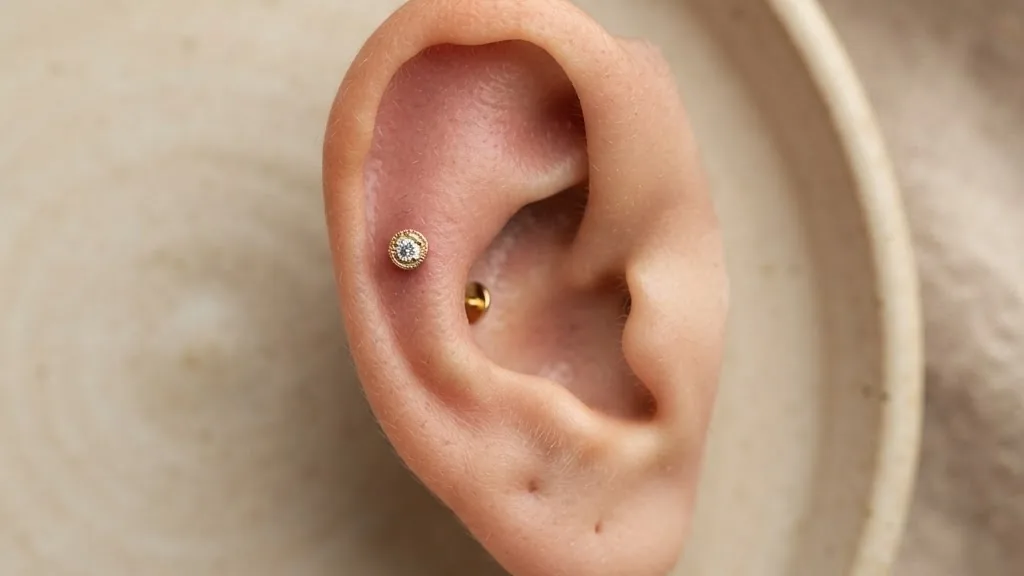
Flat ear piercing sits in a spot most people cannot name until they see it. It goes through the flat, open plate of cartilage in the upper ear, tucked just below the curl of the helix and above the inner ridges. Clients point at a stacked ear on someone else and say “I want that little stud floating in the middle.” That floating stud is almost always a flat. It is one of the most flattering anchor points on the ear, but the cartilage it lives in is thick, slow to heal, and unforgiving of shortcuts. Let me walk you through it the way I would if you were in my chair.
The short version: a flat is a cartilage piercing on the smooth upper-ear plate, done at 16 g with a hollow needle, wearing a flat-back labret stud in implant-grade titanium. Expect about a 7 out of 10 for pain, 2 to 3 months of initial healing, and 6 to 12 months before it is truly settled. Clean it with sterile saline two to three times a day, never twist it, never sleep on it, and plan on one downsize around 6 to 8 weeks. Most bumps are irritation, not infection, and they clear once you fix the cause. Budget roughly $55 to $100 for the piercing plus quality jewelry.
Where a flat piercing actually sits
A flat piercing goes through the flat, paddle-shaped section of cartilage in the upper ear, the smooth area between the outer rim and the inner folds. Think of the ear in three zones: the outer curl is the helix, the deep bowl near the canal is the conch, and the broad flat plate in between is where a flat lives. Because it is not on an edge, the stud reads as a clean dot of metal sitting on open skin rather than hugging a ridge.
That placement is exactly why it pairs so well in a curated ear. You can float a flat between a helix and a forward helix, or set it above a conch, and it fills the gap that otherwise looks empty. If you are still mapping out which holes go where, our breakdown of the common types of ear piercings and placements is a good place to plan the full layout before you commit to any single hole.
The trade-off is the tissue itself. The flat plate is denser and thicker than the thin helix rim, so the same needle meets more resistance. That is not a reason to avoid it. It just means the pain and the healing behave a little differently than they would on a lobe, and you should go in expecting that rather than being surprised by it.
How a flat piercing is actually done
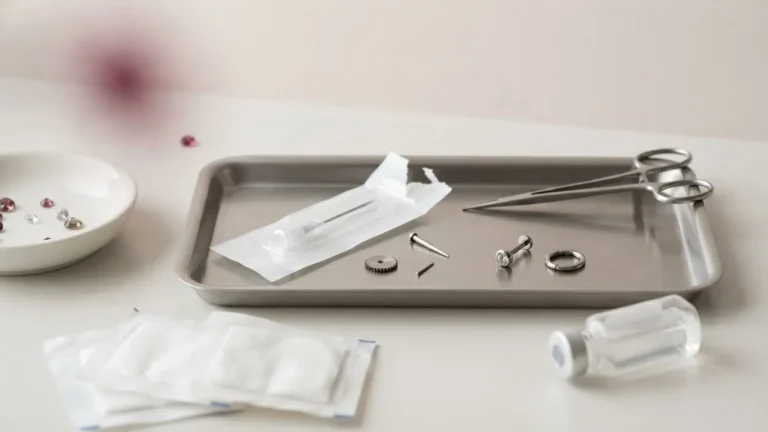
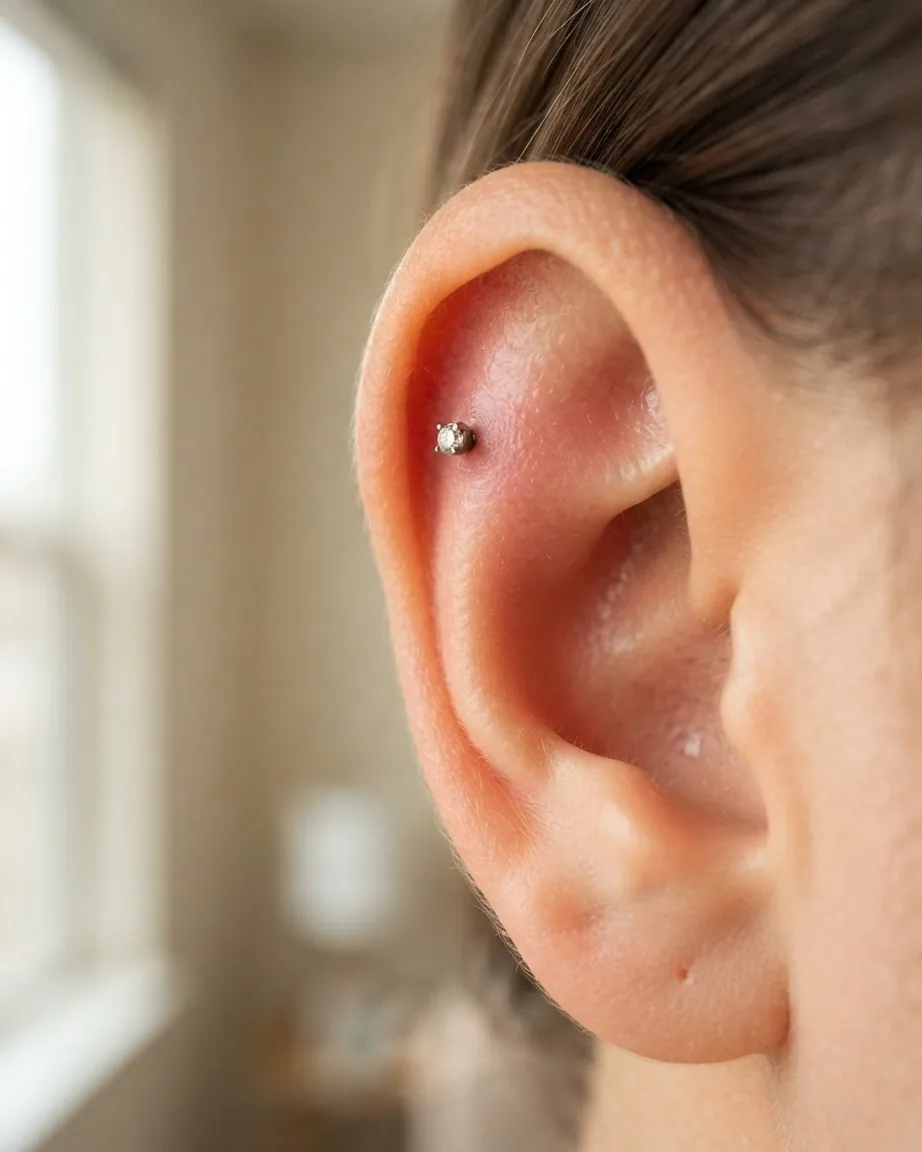
A good piercer marks the spot with you sitting up, checks it against your other placements, and only picks up a needle once you both agree on the dot. The piercing is done with a hollow, single-use needle, not a piercing gun. This matters more than people realize: guns crush cartilage with blunt force instead of cutting a clean channel, and that extra trauma is a direct route to swelling, bumps, and a longer recovery. If a shop offers to gun your cartilage, walk out.
Standard gauge for a flat is 16 g, which is 1.2 mm thick. Some piercers work at 18 g (1.0 mm) if you want a daintier post, but 16 g is the workhorse because the slightly thicker bar resists irritation and holds heavier decorative ends without drooping. The initial jewelry is deliberately longer than what you will end up wearing, usually a 10 to 14 mm bar. That extra length is not a mistake. It leaves room for the swelling that shows up in the first days, so the disc and the top never dig into puffy tissue.
The whole thing takes seconds. You breathe in, the needle passes on the exhale, the jewelry follows, and the piercer seats the back. You will feel a firm pinch and a hot pressure, then it is done and you are looking at a new stud in the mirror.
How much a flat piercing hurts
Most people land a flat piercing around 7 out of 10 on the pain scale. It is more than a lobe and a step above a thin helix, because the needle is passing through a thicker slab of cartilage. The sharp moment lasts a second or two. What surprises people is the aftermath: a dull, hot throb that can hang around for a couple of days, plus tenderness whenever you bump it or roll onto it in your sleep.
Pain is personal, though. Your anatomy, your nerves, your stress level, and how skilled the piercer is all move the number. If you want to see how a flat stacks up against every other spot on the ear before you book, compare placements on our ear piercing pain level chart. For most of my clients the piercing itself is over before they finish bracing, and the “worst” part is the week of tenderness after, not the needle.
The healing timeline nobody wants to hear
Here is the honest part. Cartilage heals slowly because it is avascular, meaning it has very little direct blood supply, so it relies on slow diffusion to deliver what it needs to rebuild. A flat is not a lobe that settles in six weeks. Plan on 2 to 3 months for initial healing, when the outside starts to feel calm, and 6 to 12 months before the channel is genuinely mature all the way through. Plenty of flats take the full year.
Cartilage also heals from the outside in. The surface can look perfect and closed while the tissue deep in the channel is still fragile, which is the exact trap that makes people change jewelry too early and undo months of progress. Swelling and soreness are loudest in the first 2 to 4 weeks, then fade into a long, quiet stretch where the piercing mostly just needs to be left alone.
If you want realistic ranges for every ear placement side by side, our guide to how long ear piercings take to heal lays them out. The single biggest mistake I see is treating a three-month-old flat like it is finished. It is not. Patience is the whole game with cartilage, and rushing it is how bumps are born.
Jewelry that heals cleanly
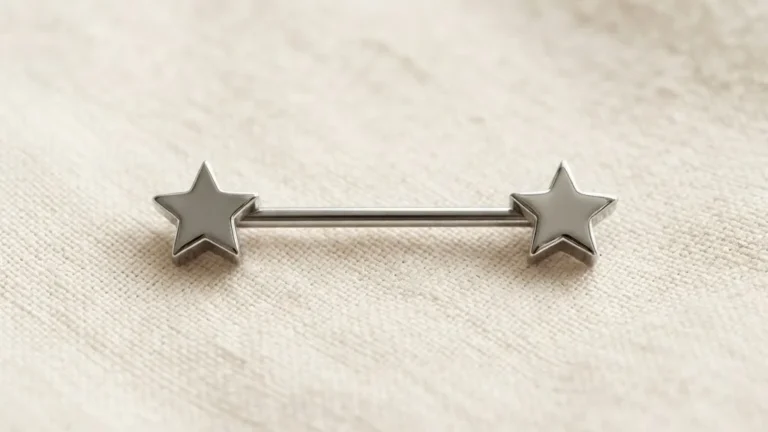
The right piece for a fresh flat is a flat-back labret stud. The back is a smooth flat disc that lies against your head, so there is nothing poking your scalp and nothing to catch when you sleep or brush your hair. The decorative end lives on the front, and the disc does the quiet work of keeping everything stable. A ring is not the move on a fresh flat; a fixed, low-profile stud is.
Just as important is how the top attaches. Choose internally threaded or threadless (push-pin) jewelry, where the smooth post passes through your ear and the threading or pin stays outside the channel. Externally threaded pieces drag tiny screw threads straight through your healing tissue every time they go in or out, and that is a needless source of irritation.
Material is where I refuse to compromise. For a fresh flat, use implant-grade titanium certified to ASTM F136, which is the Ti-6Al-4V ELI alloy. It is nickel-safe, lightweight, and biocompatible, and it is the standard the Association of Professional Piercers points to for new piercings. Solid 14k or 18k gold, niobium, and high-quality glass are also safe initial materials. What you want to hear about the exact standards for initial jewelry is spelled out by the Association of Professional Piercers, and it is worth reading before you let anyone put metal in your ear. Cheap mystery alloys and externally threaded steel do not belong in a healing cartilage piercing.
Once you are fully healed you get to have fun with heavier ends, gold, gems, and clusters. If you are gathering inspiration for what to swap in later, browse ideas in our roundup of cartilage and conch piercing jewelry styles, since the same flat-back studs that suit a conch look great on a flat.
Downsizing: the step most people skip
Remember that long 10 to 14 mm bar you started with? It has one job, which is to give swelling somewhere to go. Once the swelling settles, that extra length becomes a liability. A bar that is too long levers back and forth every time you sleep on it, brush past it, or catch it on a collar, and each of those little movements tears at the delicate tissue trying to knit inside the channel. That is the mechanical reason so many flats look fine at week two and then sprout a bump at week six.
So you downsize. Around 6 to 8 weeks, once swelling is clearly gone, your piercer swaps the long post for a shorter one, usually landing in the 6 to 8 mm range for the finished wear length. Some stubborn flats need a little longer, closer to 3 to 4 months, before they are ready. This is a quick studio visit, not a re-piercing, and it is one of the most protective things you can do for the piercing.
Do not do the downsize yourself in the mirror on a half-healed flat, and do not swap to a decorative end at the same time you are testing whether the channel is ready. For the full logic on timing a jewelry change, read up on when you can safely change a cartilage piercing. Rushing this is the number one self-inflicted wound I see.
Aftercare that actually works
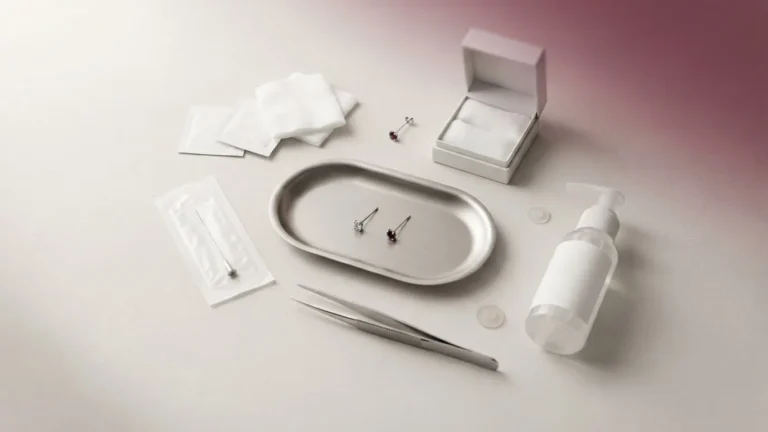
Aftercare for a flat is simple, and the simplicity is the point. Clean it with sterile saline, which is a 0.9% sodium chloride solution, two to three times a day. Spray or briefly soak the piercing, let any crust soften, and gently wipe it away with clean hands or a clean gauze. That is the entire cleaning routine. You are supporting your body, not scrubbing the piercing into submission.
What you leave off matters as much as what you put on. Skip alcohol, hydrogen peroxide, antibacterial soap, tea tree oil, and homemade sea-salt brews. They all dry out and irritate cartilage, and stronger is not better here. Do not twist or rotate the jewelry; the old advice to spin your studs is outdated and just drags crust through the channel. Wash your hands before you touch it and otherwise keep your hands off.
Two habits protect a flat more than any product. First, do not sleep on the pierced side. Pressure through the night causes swelling, bumps, and even migration, where the piercing slowly shifts because it is being pushed. A travel pillow with a hole, or just training yourself to the other side, pays off. Second, keep your world clean around it: fresh pillowcases, a wiped-down phone screen, and hair kept back so it cannot snag the post. General guidance on gentle piercing care and what to avoid is echoed by the American Academy of Dermatology, and it lines up with everything above.
Troubleshooting bumps on a flat
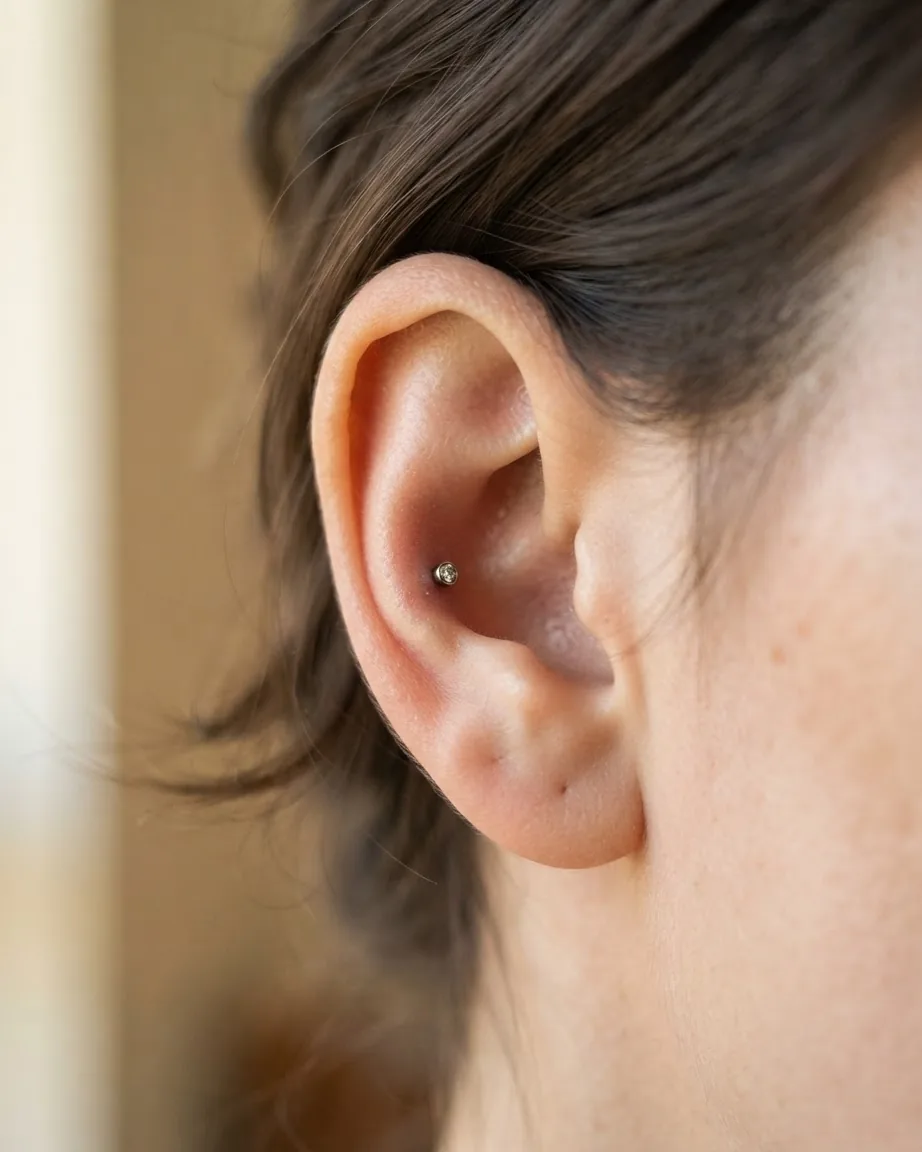
Bumps are the single most common reason people message me about a flat, and the good news is that most of them are irritation, not infection. An irritation bump is usually a small, firm nodule right beside the piercing, sometimes a bit fluid-filled, and it shows up because the piercing is being provoked. The usual culprits are sleeping on it, a bar that is the wrong length, a snag, a knock, or low-quality metal your body dislikes.
The fix is rarely dramatic. Leave the jewelry in, keep up your saline soaks, and hunt down the cause. If the bar is too long, downsize it. If you keep rolling onto it, fix your sleep. If the jewelry is not implant-grade, that alone can be the problem, so verify the material. Then give it time, because a settled bump can take weeks to flatten out. What you should not do is start layering on ointments, essential oils, or peroxide, or pop the bump, because that just adds new trauma.
Know the difference between an angry bump and a real infection. A cranky irritation bump is localized and stable. Warning signs that point to infection include spreading redness, heat radiating from the area, throbbing pain that is getting worse, and yellow or green pus, sometimes with a fever. For a clear read on cartilage bumps versus infection, Healthline breaks down the signs, and if you suspect an infection you should see a professional. Reliable guidance on when a pierced ear needs medical attention is available from the Mayo Clinic. If a firm, growing, shiny bump keeps returning, it may be a keloid or hypertrophic scar, and that is a conversation for a dermatologist rather than something to treat blind.
What a flat piercing costs
Pricing splits into two parts: the piercer’s fee and the jewelry. At a reputable studio the piercing fee usually runs about $35 to $65. Quality jewelry is priced separately, and once you add implant-grade titanium the all-in total commonly lands between $55 and $100. Across the board, most people spend somewhere in the $40 to $80 range, with the jewelry being the main swing factor.
Do not shop this on price alone. A cheap gun piercing with mystery metal is the most expensive option once you count the extra months of irritation, a bump that will not quit, and the eventual re-piercing. Paying for a skilled piercer, a hollow needle, and ASTM F136 titanium up front is the frugal choice in the long run. Also budget a little extra for the downsize appointment and for the nicer decorative end you will want once you are healed.
Flat piercing versus other cartilage placements
A flat rarely gets booked alone. Most people are stacking it into a curated ear next to a helix, a forward helix, a conch, a rook, or a tragus, so it helps to see how the flat actually compares to its neighbors instead of guessing. The table below uses the same scale for every row: gauge at the initial piercing, pain on a plain 1 to 10 scale where 10 is the worst you can imagine, and healing measured from the day of the piercing.
| Placement | Typical gauge | Pain (1 to 10) | Initial healing | Full healing |
|---|---|---|---|---|
| Flat | 16 g | 7 | 2 to 3 months | 6 to 12 months |
| Helix | 16 g to 18 g | 5 | 2 to 3 months | 4 to 6 months |
| Forward helix | 16 g to 18 g | 6 | 2 to 3 months | 6 to 9 months |
| Conch | 14 g to 16 g | 7 | 3 to 4 months | 6 to 12 months |
| Rook | 16 g | 8 | 3 to 4 months | 6 to 12 months |
| Tragus | 16 g | 6 | 2 to 3 months | 4 to 8 months |
Read the pain and healing columns as ranges, not promises. A rook sits highest on this list because the fold it goes through is thick and the piercer often has to work at an angle, while a helix sits lowest because the rim there is thin. The flat lands in the middle of the pack for pain but ties the conch and rook for the longest full healing, which is exactly why it deserves the same patience you would give either of those placements. If a shop quotes you a gauge outside these ranges, ask why before you agree to it.
Tip: Photograph your flat every two weeks during healing, from the same angle and in the same light. A running photo log makes it far easier to tell whether a bump is actually shrinking, holding steady, or growing, which is the difference between waiting it out and calling a professional.
Frequently asked questions
Is a flat piercing on cartilage?
Yes. A flat sits on the thick, flat plate of cartilage in the upper ear, below the helix rim and above the inner ridges. Because it is true cartilage rather than the soft lobe, it hurts a bit more, around 7 out of 10, and it heals on a cartilage timeline of roughly 6 to 12 months rather than a few weeks.
How long does a flat piercing take to heal?
Initial healing is about 2 to 3 months, when the surface calms down, but full healing usually takes 6 to 12 months, and many flats need close to a year. Cartilage heals slowly from the outside in, so the piercing can look done long before the deeper channel is actually mature and ready for jewelry changes.
What gauge and jewelry is used for a flat piercing?
The standard gauge is 16 g (1.2 mm), sometimes 18 g (1.0 mm) for a daintier look. The go-to piece is a flat-back labret stud in implant-grade titanium certified to ASTM F136, internally threaded or threadless. The initial bar runs 10 to 14 mm to allow for swelling, then downsizes to about 6 to 8 mm once healed.
Why does my flat piercing have a bump?
Most flat-piercing bumps are irritation, not infection. Common triggers are sleeping on it, a bar that is too long, snags, knocks, or non-implant-grade metal. Keep the jewelry in, continue saline soaks, and fix the underlying cause, often a downsize. See a professional if you notice spreading redness, heat, worsening pain, or green or yellow pus.
Can I change my flat piercing jewelry after a few months?
Be careful here. A downsize by your piercer around 6 to 8 weeks is expected, but a full swap to a decorative end should wait until the piercing is genuinely healed, often 6 months or more. Cartilage heals from the outside in, so an early change on a channel that still looks fine on the surface can restart swelling and bumps.
Can I sleep on a flat piercing?
Not during healing. Sleeping on a fresh flat presses the jewelry into the tissue, which drives swelling, bumps, and even migration where the piercing shifts. Train yourself onto the other side or use a travel pillow with a hole in the center so the ear floats. Once fully healed, occasional side-sleeping is fine, though comfort still favors staying off it.
The bottom line
A flat is one of the best-looking cartilage placements you can add to a curated ear, but it rewards patience over enthusiasm. Go to a skilled piercer who uses a hollow 16 g needle and implant-grade ASTM F136 titanium, expect about a 7 out of 10 for pain, and settle in for a real 6 to 12 month heal. Clean with plain saline, never twist or sleep on it, plan the downsize around 6 to 8 weeks, and treat most bumps as irritation you can calm. Do those unglamorous things and your flat will sit clean and happy for years. Rush them, and you will spend those months fighting the piercing instead of wearing it.