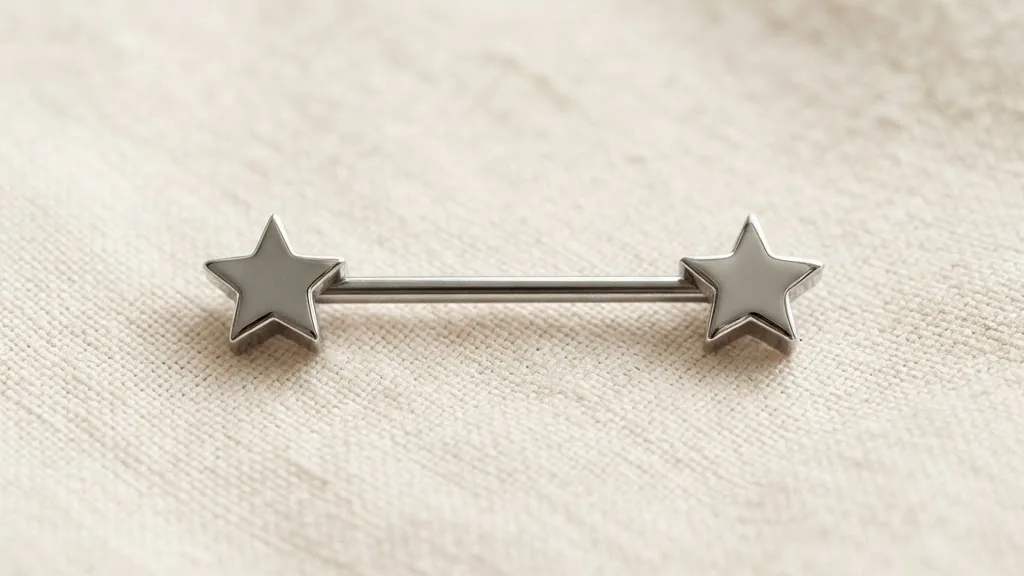
Industrial piercing star jewelry is one of the most requested looks that comes across my bench, and I get why. A little star riding a long straight bar across the top of the ear reads as bold and delicate at the same time. But the star is the easy part. Underneath that charm sits a real cartilage project: two separate holes joined by one barbell, a long heal, and a jewelry choice that can make or break the whole thing. So before we talk stars, let’s be clear about what you are actually asking your ear to do, then build the pretty part on top of it.
The short version: an industrial is two cartilage piercings connected by a single straight barbell, and a star industrial simply means that barbell wears a star-shaped end or a small star charm. The initial bar is almost always 14 gauge (1.6 mm) and about 32 mm to 38 mm long, star versions commonly at 36 mm. Plan on 9 to 12 months of healing, sometimes up to 18, and do not switch to a decorative star until your piercer confirms the channel is settled. Choose implant-grade titanium, keep the star light, and clean with sterile saline twice a day.
What a star industrial piercing actually is
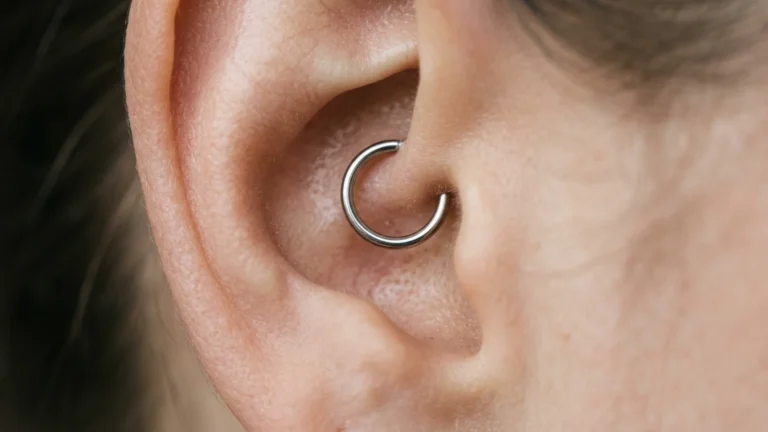
A star industrial is not a special piercing technique. It is a standard industrial fitted with jewelry that ends in a star. The industrial itself is two cartilage holes in the upper ear, most often running from the outer helix down and across to the anti-helix ridge on the other side. One straight barbell threads through both holes, which is why the bar looks so long. In the UK you will hear it called a scaffold piercing. The star lives at one visible end of that bar, so the decorative choice does not change the anatomy, the healing, or the risk. It only changes what people see.
That distinction matters because a lot of shoppers fall in love with a star charm first and think about the piercing second. In the studio I flip that order. If your ear can carry an industrial and you are ready for the heal, then yes, a star is a wonderful finish. If the anatomy or the timeline is wrong, no charm rescues it. For a wider view of how this sits next to other placements, our rundown of the main types of ear piercings is a good map before you commit.
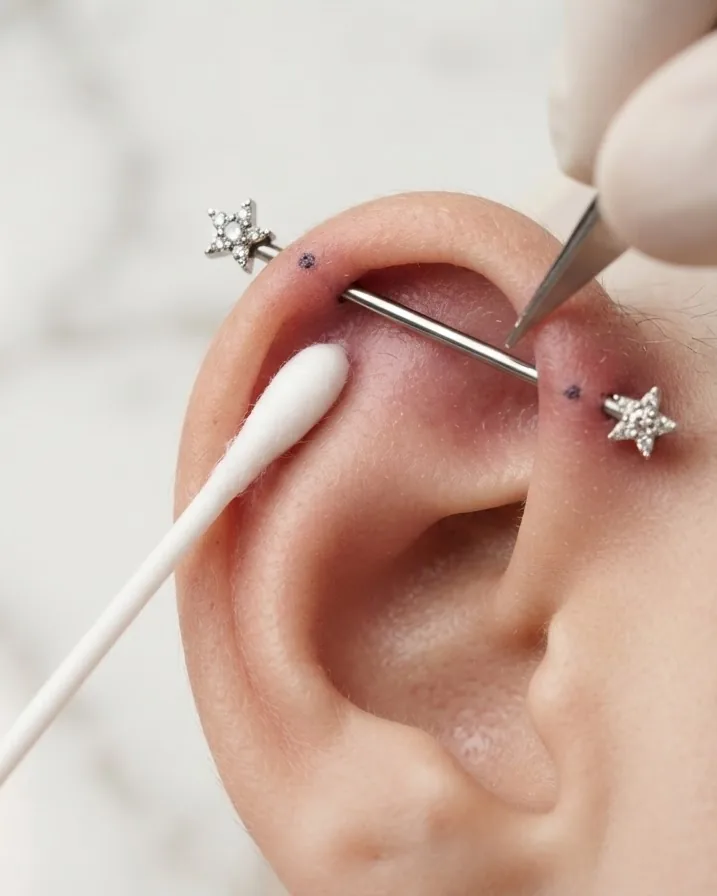
The barbell that carries the star
The jewelry doing the work is a straight barbell, and its two numbers are gauge and length. Gauge is thickness. The standard starter gauge for an industrial is 14 gauge, which equals 1.6 mm. A thicker 14g bar is the norm because it gives that long span real stability and resists flexing every time the ear gets bumped. Some studios pierce at 16 gauge (1.2 mm), but 14g is the workhorse for industrials and the size most star barbells are sold in.
Length is the second number, and it is custom to your ear. Most industrial barbells fall between 32 mm and 38 mm, or roughly 1.25 to 1.5 inches. Your piercer measures the distance between the two entry points and adds a few millimeters of wearable space so the fresh tissue is not choked. Star-charm industrial barbells are very commonly stocked at 36 mm in 14g, which lands right in that typical window. If a shop hands you a star bar without asking about your measurement, that is a small red flag. A star industrial piercing still needs a length matched to your anatomy, not a one-size guess.
One more point on the initial bar. It is fitted deliberately long to leave room for swelling in the first weeks. That extra length is normal and temporary, not a sizing mistake.
When you can actually wear the star
This is where I slow people down. Cartilage heals slowly because it has poor blood supply compared with the soft lobe, and an industrial asks two cartilage wounds to heal while sharing one bar that moves as a unit. The standard healing range is 9 to 12 months. It is completely normal for an industrial to run 12 to 18 months, close to a year and a half, before it is truly settled. That is longer than most people expect, and it is the single biggest reason industrials get angry: owners treat a three-month-old piercing like a healed one.
Downsizing is the milestone that matters for a star. Around the 6 month mark, once the early swelling has gone down, your piercer can swap that long initial bar for a shorter one that fits closer to the ear. Only a piercer should do this on a healing industrial. The downsize is also the natural moment to move from a plain, functional end to a decorative star, assuming the tissue looks calm. If you are unsure whether you are ready to change anything, our guide on when you can change a cartilage piercing walks through the signs. For the broader timeline across placements, see how long ear piercings take to heal.
Trying to force a star charm in at week four to post a photo is how people end up with bumps, prolonged swelling, and a heal that resets. The star is a reward for patience, not a shortcut.
Choosing a safe star barbell
Here is where the decorative choice becomes a health choice. The Association of Professional Piercers recommends implant-grade titanium as the standard material for initial and healing jewelry, and it is what I put in almost every fresh industrial. On a label that means ASTM F136 titanium. It is biocompatible, lightweight, and nickel-safe, which is exactly what a long cartilage heal needs. Solid 14k or 18k nickel-free gold is also body-safe if you want warmth in the metal. What you want to avoid during healing is cheap plated jewelry or mystery-metal star charms from a fashion bin.
Threading is the detail people miss. On a quality star barbell the ends are either threadless, meaning the star presses in on a smooth pin, or internally threaded, meaning the screw threads sit inside the bar so the shaft stays smooth. Both let a clean, unridged bar pass through your channel. Externally threaded bars drag exposed threads through healing tissue and are worth avoiding for any cartilage piercing. Many titanium star ends carry a small clear CZ stone, which is fine as long as the base metal is implant grade.
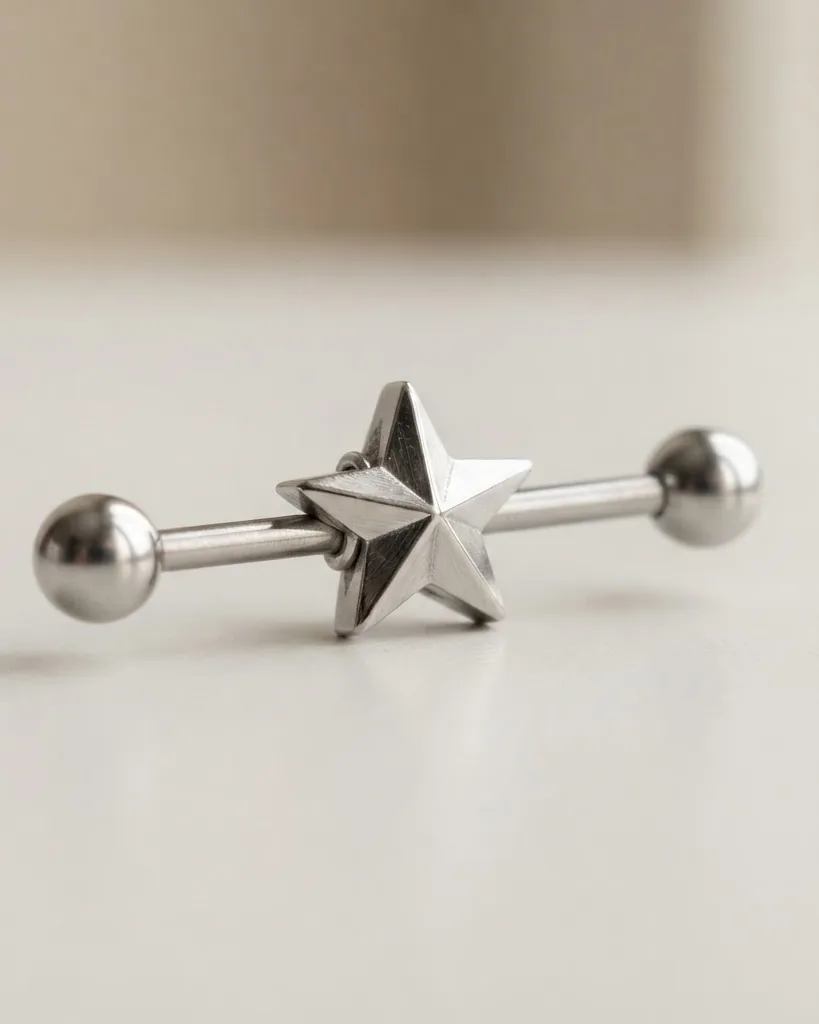
Weight is the quiet factor with stars specifically. A flat, small star end is barely different from a plain ball. A large or dangly star charm adds mass and swing, and on a long industrial bar that extra movement tugs at two healing holes at once. During the heal, keep the star small and flush. Save the bigger statement star for after everything is settled. To read up on quality metals and stone settings in a related placement, our notes on choosing conch piercing jewelry cover the same material logic.
Does your ear fit a star industrial
An industrial is anatomy-dependent, and no charm changes that. For the classic helix to anti-helix bar to sit right, the two ridges of cartilage need to be thick enough to hold the piercing and, just as important, they need to face each other so a single straight bar can span both cleanly. The middle of the ear cannot bulge into the path where the bar will lay. If your ear is small, flat, or shallow, the geometry may simply not work, and a good piercer will tell you so instead of forcing it.
This is why I never sell a star industrial off a photo. Come in, let a piercer look at your actual ear, and hear an honest yes or no. If your anatomy is not built for a standard industrial, there are workarounds like a floating or vertical variation, or a single helix wearing a star instead. Understanding basic helix piercing placement helps here, since the industrial borrows one of its holes from the helix family. A star can live on many parts of the ear, so a no on the industrial is not a no on the look.
Pain and cost, honestly
People want a straight answer on pain, so here it is. Most clients rate an industrial around 6 to 7 out of 10, and some feel it closer to 8 or 9. It is sharper than a lobe because cartilage is denser, and you are getting two passes back to back in the same sitting, so the sensation stacks. It is quick, though, and the star you are picturing has nothing to do with how it feels going in. If you want to compare placements before you book, our ear piercing pain chart lines them up side by side.
On cost, a straightforward industrial usually runs about $40 to $100 for the service, and jewelry may be priced separately. Choosing implant-grade titanium, solid gold, or a decorative star end pushes the total up, and studios in big cities or with a strong reputation charge more. That premium usually buys better metal, better technique, and safer sizing, which on a piercing that heals for the better part of a year is money well spent. Do not chase the cheapest star; chase the cleanest studio.
Aftercare that protects the star channel
Aftercare for an industrial is simple to say and easy to skip. Clean it twice a day with sterile saline, specifically a 0.9 percent sodium chloride wound wash, then let it air dry or pat it with clean non-woven gauze. That is the whole cleaning routine. You do not need harsh soaps, alcohol, tea tree oil, or ointments, all of which tend to irritate cartilage rather than help it.
The other half of aftercare is what you do not do. Do not twist, spin, or slide the bar; the old advice to rotate jewelry is outdated and just re-injures the channel. Keep hair products, headphones, earbuds, and phone screens off the piercing, and be careful pulling shirts over your head. Sleep off it. Because an industrial spans two holes, one snag transmits force to both, so protecting the bar protects double the tissue. When your piercer finally clears you to wear the decorative star, keep applying the same saline habit for a few more weeks while the new end settles into a comfortable spot.
Star layouts and pairings that work
Once you are healed and wearing the star, styling is the fun part. A single star industrial can stand alone as the anchor of the upper ear, and honestly it often looks best with nothing competing next to it. If you want a curated ear, the trick is spacing and repetition. Echo the star with one tiny star stud on a lobe or a helix so the eye reads a deliberate theme rather than clutter. Two or three stars in graduating sizes across the ear feel intentional; five scattered ones feel accidental.
Metals should agree. If your industrial bar is titanium, keep the companion pieces in matching silver-tone titanium or steel rather than mixing warm gold beside cool silver right next to it. A star industrial also pairs cleanly with a plain conch stud below it, letting the star be the single point of interest up top. The goal with any star layout is one clear focal piece and a couple of quiet supporting notes, not a constellation fighting for attention. Because the industrial bar is long and horizontal, it already draws the eye, so the surrounding studs can afford to be small.
Common problems and how to read them
Even a healthy star industrial can throw a scare during the long heal. Some swelling, mild redness, and a bit of crust in the first weeks are normal healing, not infection. A small firm bump beside a hole is often irritation from pressure, sleeping on it, or too heavy a charm, and it usually calms once you remove the source and stay consistent with saline. Do not swap jewelry in a panic; changing an angry piercing yourself tends to make it worse.
Warning signs that need a professional or a doctor are different: spreading heat and redness, thick colored discharge, throbbing pain that ramps up rather than fades, or fever. Those point to infection, and general medical guidance from sources like the Mayo Clinic and the American Academy of Dermatology is worth reading so you know the line between normal and not. When in doubt, see your piercer first for a jewelry or fit issue, and a doctor for a suspected infection. Never remove jewelry from an infected piercing without advice, since that can trap the infection inside.
Star industrial versus a single star helix
If your anatomy does not support an industrial, or if the long heal feels like too much to take on, a single star helix is the practical alternative and it delivers a lot of the same charm. One cartilage hole in the upper ear wearing a star stud gives you the same celestial accent without the two-hole bar spanning the ear. It heals faster too, generally in the range of a few months to about half a year rather than the year-plus an industrial demands, because you are asking one hole to close instead of two that share a bar.
The trade-off is presence. A star industrial makes a strong horizontal statement across the top of the ear that a single stud cannot match, and that architectural line is exactly what draws people to the look in the first place. My usual advice is to be honest about your tolerance for the heal and your daily habits. If you sleep on your side, wear over-ear headphones for work, or run your fingers through your hair constantly, a single star helix forgives those habits far better than a long industrial bar that catches on everything.
You can also start with the helix star now and add the industrial later once you know how your cartilage behaves. Building an ear in stages is smarter than forcing every hole at once and hoping they all heal on schedule.
Star Barbell Material Comparison
Material choice affects comfort, cost, and how the star end catches light once you are past the initial titanium bar. Here is how the common options for a star industrial barbell compare side by side.
| Material | Gauge | Typical Length | Best Use | Notes |
|---|---|---|---|---|
| Implant-grade titanium (ASTM F136) | 14g (1.6mm) | 32-38mm, 36mm common | Initial bar and long-term wear | Nickel-free, lightweight, the default in most studios |
| Solid 14k nickel-free gold | 14g (1.6mm) | 34-36mm | Healed wear, warmer tone | Body-safe only if solid; skip plated versions |
| Solid 18k nickel-free gold | 14g (1.6mm) | 34-36mm | Healed wear, premium finish | Softer metal, more prone to scratching |
| Surgical steel (316LVM) | 14g (1.6mm) | 32-38mm | Budget healed wear | Contains trace nickel; avoid if you react to costume jewelry |
| Niobium | 14g (1.6mm) | 32-38mm | Sensitive skin alternative | Hypoallergenic but star-end styles are harder to find |
Tip: Bring your current barbell to the studio when you upgrade to a decorative star end, so the piercer can match the exact length instead of guessing from a chart.
Frequently asked questions
Can I get a star industrial piercing done fresh?
You can be pierced with a plain, functional straight barbell that happens to have a small star or flat end, but most piercers fit a simple, longer bar first to allow for swelling. The bigger or dangly decorative star usually goes in at your downsize, around the 6 month mark, once your piercer confirms the tissue is calm and ready.
What gauge and length is a star industrial barbell?
Almost always 14 gauge, which is 1.6 mm thick, on a straight barbell. Length is custom to your ear and typically runs 32 mm to 38 mm, with star barbells very commonly stocked at 36 mm. Your piercer measures the span between the two holes and adds a few millimeters of room, so do not buy a length blindly online.
How long before my industrial is fully healed?
Plan on 9 to 12 months at minimum, and do not be surprised if yours takes 12 to 18 months. Cartilage heals slowly because it has limited blood supply, and an industrial asks two holes to heal on one shared bar. Treat it gently the whole time, not just the first month.
What metal should a star barbell be?
Implant-grade titanium, labeled ASTM F136, is the standard the Association of Professional Piercers recommends for healing jewelry. Solid 14k or 18k nickel-free gold is also body-safe. Avoid plated pieces and unmarked fashion metals during the heal. Choose a threadless or internally threaded end so a smooth shaft passes through your channel.
Does a heavy star charm hurt healing?
It can. A large or dangling star adds weight and swing to a long bar, and that extra movement tugs on two healing holes at once, which encourages irritation bumps. Keep the star small and flush against the ear until you are fully healed, then switch to a bigger statement star if you want more drama.
How much does an industrial piercing cost?
The service is usually about $40 to $100, and jewelry may be priced separately. Implant-grade titanium, solid gold, or a decorative star end raises the total, and busy city studios charge more. On a piercing that heals for close to a year, paying for a skilled piercer and quality metal is the better value.
The bottom line
An industrial piercing star is a great look, but it earns its place only when the piercing under it is done right. Get an honest anatomy check, start with a 14 gauge straight barbell sized to your ear at 32 to 38 mm, choose implant-grade titanium, and clean with saline twice a day. Give it 9 to 12 months, downsize around the six-month mark, and let your piercer bring the decorative star in when the tissue is truly ready. Do that, and the star sits on a calm, well-healed bar for years. Rush it, and no charm can hide an irritated piercing. Patience first, star second.