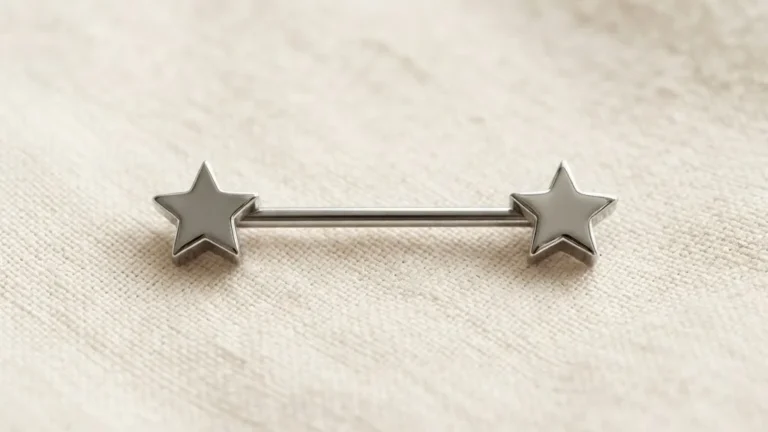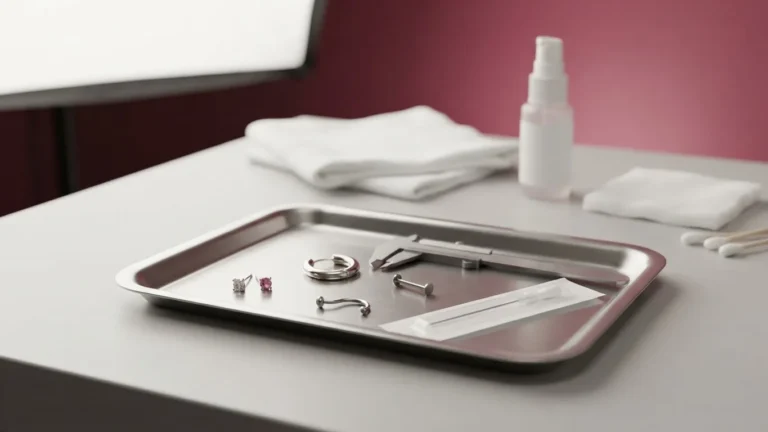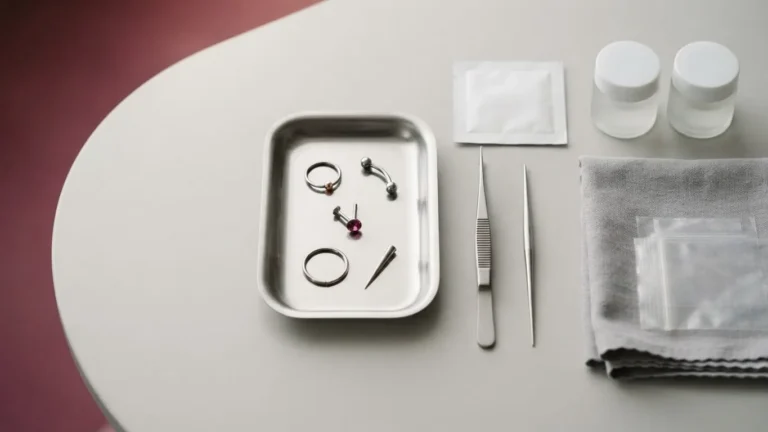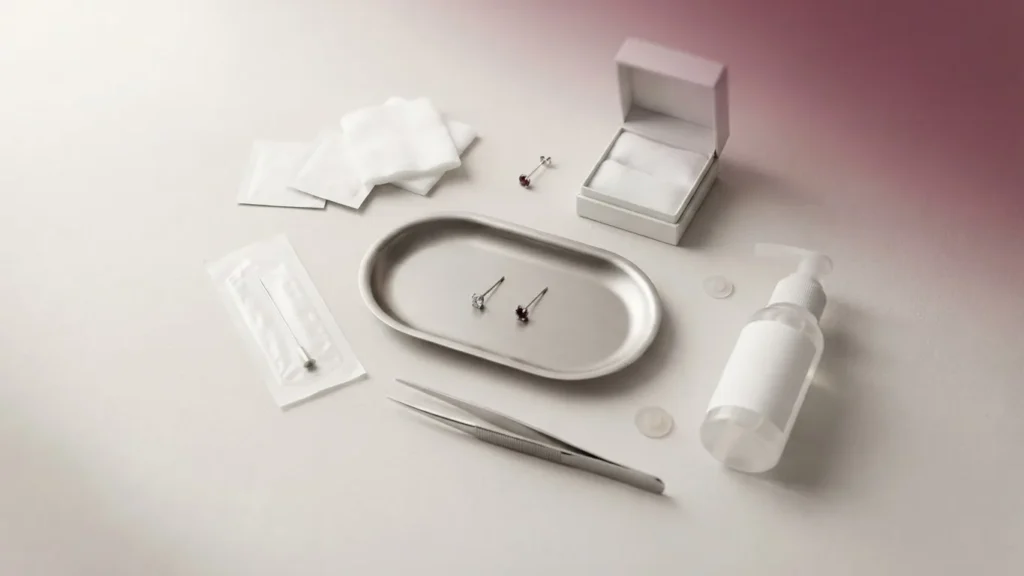
The same healed double earlobe gets quoted three different times – four to six weeks, six to eight weeks, and three to six months – and none of those numbers is wrong. Each one measures a different endpoint: when the surface closes over, when the channel is stable enough to swap jewelry, and when the tissue finishes maturing inside. Piercing double earlobes, the most common form of a two-hole ear piercing, takes a few minutes in the chair. The decisions wrapped around it – both holes at once or spaced out, gun or needle, which healing figure you actually act on – are where people get into trouble.
Piercing double lobes most often means placing two holes in the earlobe, in one session or across two separate visits. Expect mild discomfort – a professional piercer has rated the pain at about 3 out of 10 – and surface healing in roughly six to eight weeks, with full tissue maturation closer to three to six months. Keep flat-back studs in until the channels are stable, clean twice daily with sterile saline, and judge readiness to change jewelry by how the holes look and feel, not the calendar alone.
What Counts as a Double Ear Piercing
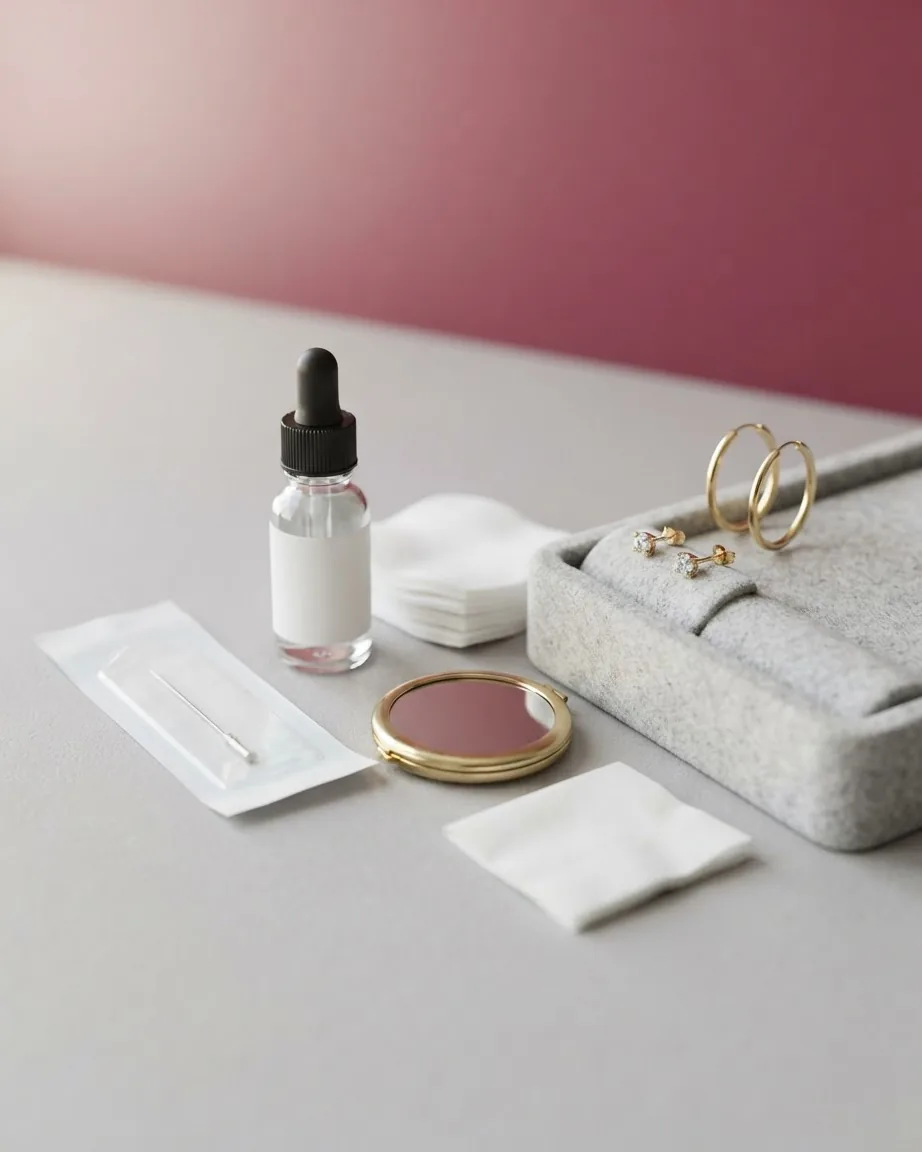
A double ear piercing is two holes in the same ear. In its usual form, both sit in the fleshy earlobe, stacked vertically or set side by side. The lobe is soft tissue with a good blood supply, which is why it heals faster and hurts less than anywhere else on the ear. A dermatologist-reviewed consumer guide from Byrdie, checked by Julia A. Siegel, MD, uses the lobe version as the reference case when people say “double.”
The word stops being simple once a second hole climbs off the lobe. Above it you move into cartilage – the firm, less vascular tissue of the helix and the structures around the ear canal. Cartilage behaves differently in almost every way that matters: slower healing, more prolonged tenderness, and a hard limit on how it can be pierced safely. Double lobes are the entry point to a wider menu of ear piercings, and the moment a pair leaves the lobe, the advice in this guide splits along that lobe-versus-cartilage line.
Does the Second Hole Hurt More Than the First?
On an earlobe, the baseline is low. Piercer Breanna Workman has put double-lobe pain at about 3 out of 10 – a sharp pinch, over in a second. Pain is highly individual, so treat that figure as one experienced rating rather than a measured average; anxiety, placement, and your own sensitivity all move it.
When both holes are done in one sitting, the second can register as sharper than the first. The reason is physiological: the first puncture has already triggered an inflammatory response, so the tissue is reacting by the time the needle comes back. That is a genuine reason some people prefer to space the two piercings out. Cartilage changes the calculus again – a helix or similar placement runs well above a lobe on any pain scale, and it stays tender far longer. For a broader read on where each spot lands, see also our different types of ear piercings guide.
Why Healing Times Disagree, and Which One to Act On
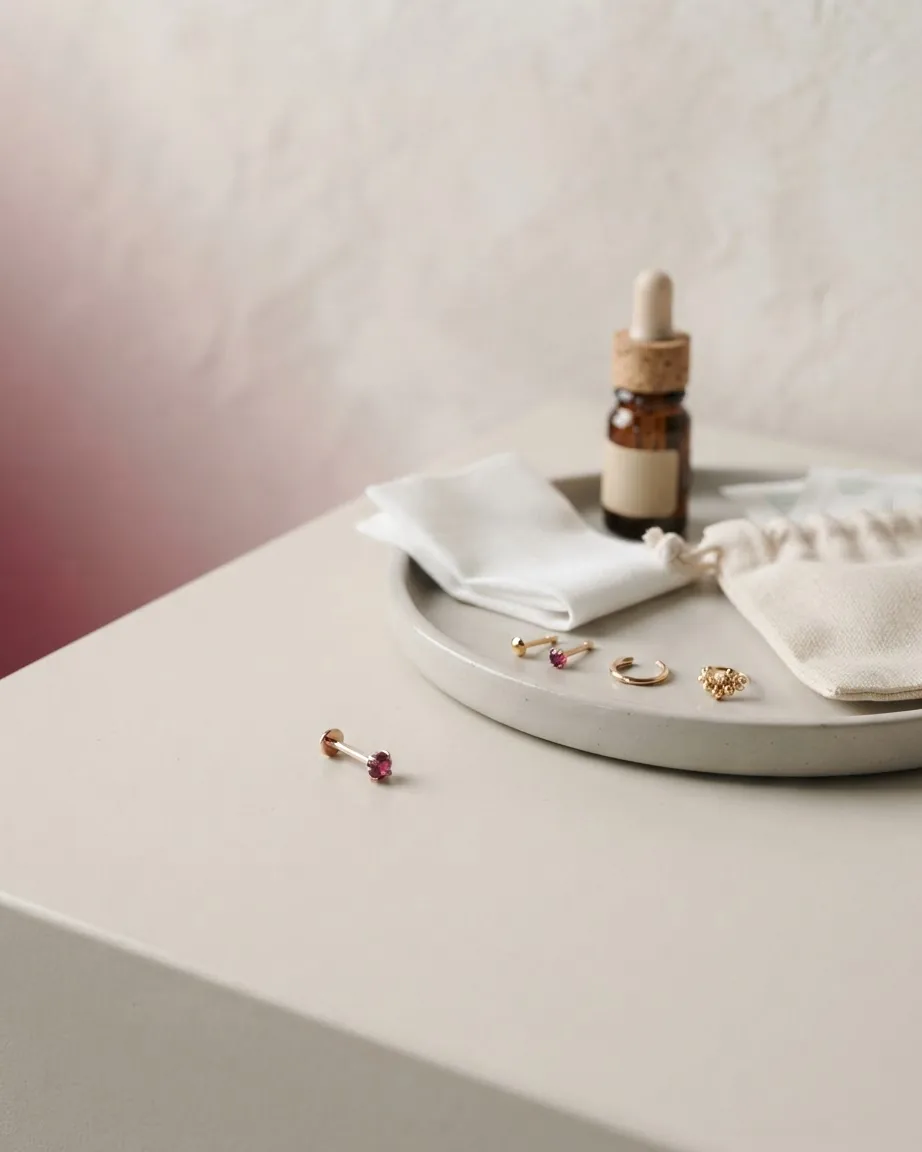
Reputable sources hand you different “healed” numbers for the same double lobe, and the fix is to read each number by what it actually measures. A state body-art aftercare sheet from the Michigan Department of Health and Human Services gives earlobe healing as four to six weeks. Byrdie’s guide puts a double at about six to eight weeks. A lobe-healing explainer from Biology Insights describes surface healing at roughly six to eight weeks but full tissue maturation taking three to six months. Those are not a contradiction. They are three endpoints.
The earliest figure describes surface closure – the outside looks sealed. The middle figure describes a channel stable enough that changing jewelry no longer disturbs it. The longest figure describes the inner wall of the hole, the fistula, finishing its maturation. A clinic aftercare template from Pabau, built to Association of Professional Piercers guidelines, frames earlobe initial healing at four to six weeks with full healing by six to eight weeks, and notes how sharply the clock changes by location.
| Endpoint | What it measures | Earlobe | Cartilage |
|---|---|---|---|
| Surface closure | The outside looks sealed | ~4 – 6 weeks | longer |
| Full healing / jewelry-change readiness | Channel stable enough to swap | ~6 – 8 weeks | 6 – 12 months |
| Internal maturation | The inner channel finishes | 3 – 6 months | longest |
Read this way, the practical rule writes itself: plan the surface timeline for everyday care and the maturation timeline for how long you keep protecting the piercing. Location dominates everything – the same Pabau template puts cartilage at six to twelve months and oral piercings such as tongue and lip at eight to sixteen weeks, even where the surface heals sooner. See also our guide on how lobe piercings take to heal.
Piercing Double Lobes in One Session, or Spacing Them Out
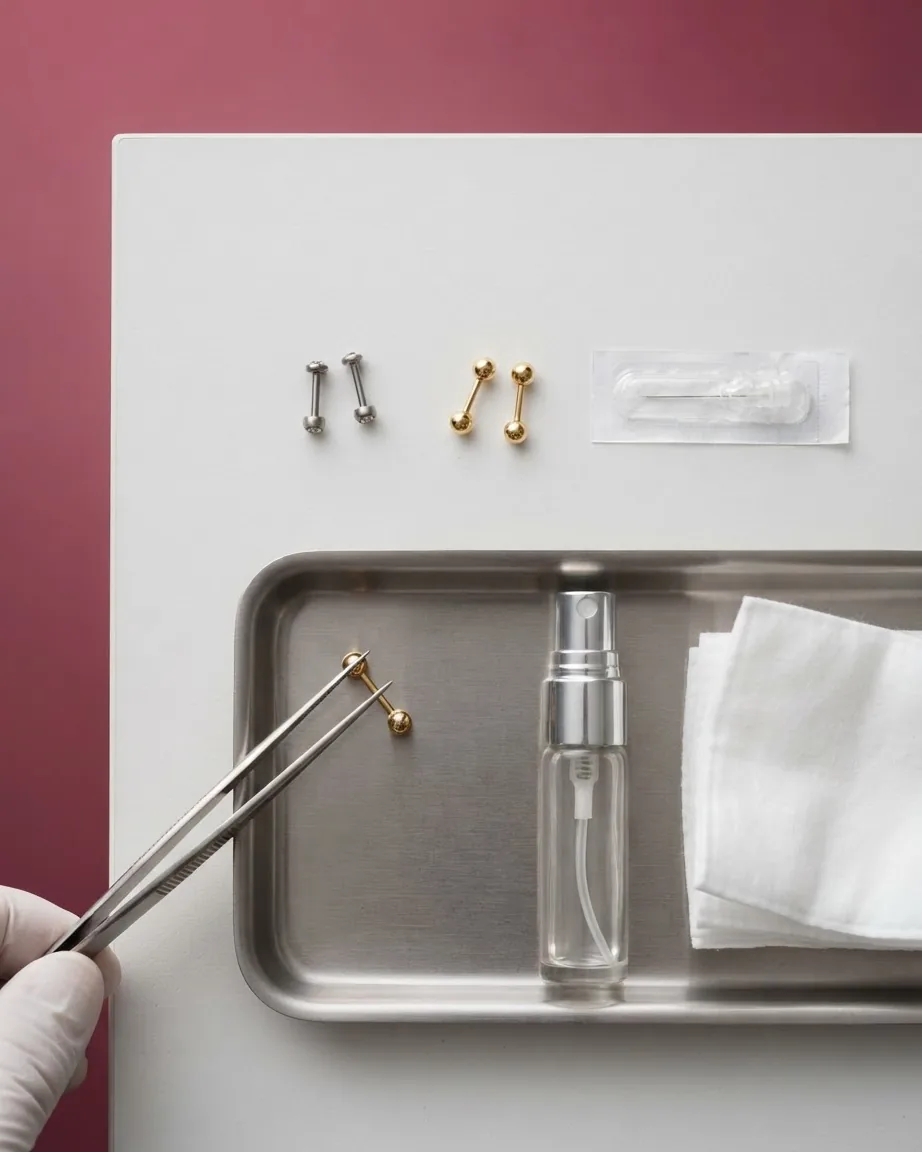
This is a booking decision, not a style one. Both holes in one appointment saves a second visit and gets you to a symmetrical finished look sooner. The trade is that the second puncture lands in tissue that is already swelling, which can make precise, even spacing harder to judge, and – as noted above – the second hole often reads as the sharper of the two.
Spacing them out is the more conservative route. Let the first heal to a stable point, then add the second against a settled, predictable landmark. You pay for that with an extra trip and a longer wait to the full look. There is no single right answer; the choice depends on how much you value symmetry-in-one-sitting versus cleaner spacing and a calmer second piercing. If you lean toward adding the next hole later, the signal to book it is the first one reaching the jewelry-change stage, not an arbitrary date on the calendar.
What a Double Costs, and Why the Needle Quote Runs Higher
Price figures float around because they measure different things.
Method is a separate axis. A comparison from Science Insights puts a needle lobe piercing at roughly $30 to $60 against $15 to $30 at a gun station. The gun looks cheaper on the sticker, and on a lobe it stays within accepted limits. The higher needle quote buys a sterile single-use needle, a trained piercer, and tissue that is displaced rather than crushed. When you compare prices, pin down which figure you are looking at: a per-hole single or a packaged pair, and gun or needle. Do not try to math a “needle double” out of the single-hole numbers – the ranges overlap by method and location, and stacking them invents a figure nobody quoted.
Cleaning Two Fresh Holes Without Doubling the Work
A common worry is that two holes mean twice the aftercare. They do not. Both holes clean in the same pass, so the routine is the same one you would run for a single piercing – you simply cover two sites.
The Pabau template, aligned to Association of Professional Piercers guidance, specifies sterile saline of 0.9 percent sodium chloride for cleaning. If packaged sterile saline is not on hand, the fallback soak is one-eighth to one-quarter teaspoon of non-iodized sea salt dissolved in 8 oz of warm distilled water, with the piercing soaked for five to ten minutes twice daily. Two points carry most of the outcome:
- Clean twice a day, no more – over-cleaning irritates a healing channel as readily as neglect does.
- Do not rotate, twist, or spin the jewelry. The old advice to “turn” an earring is counterproductive and drags bacteria through the wound.
- Wash hands before touching either site, and let the holes dry rather than rubbing them.
The Michigan Department of Health and Human Services sheet frames the same low-interference approach as an official standard rather than a studio preference. Anything that looks genuinely wrong is a reason to see your piercer or a clinician, not to improvise.
When a Gun Stops Being an Option: the Cartilage Line
On an earlobe, a piercing gun remains within limits. On cartilage, it comes off the table. A model regulatory code published by the National Environmental Health Association, drawing on Association of Professional Piercers standards, treats the method difference as a safety line rather than a matter of taste, and the reason is mechanical. A gun does not cut a clean channel; it forces a blunt stud through with spring pressure.
Science Insights frames that as a crush injury. Soft lobe tissue tolerates it; firm cartilage does not, and blunt force there risks shattering the cartilage and triggering chondritis – a painful infection of the cartilage itself. The healing penalty compounds the risk: that same source puts cartilage at six to twelve months when done with a gun versus three to six months with a needle and proper care, against six to eight weeks (gun) and four to six weeks (needle) for a lobe. The rule for a double is simple. As long as both holes stay in the lobe, either method is defensible. The instant a second hole leaves the lobe, needle is the only appropriate route. See also our types of piercings for ears guide.
Jewelry That Goes In, and When You Can Swap It
Fresh holes want plain, secure studs – flat-back posts that sit flush and will not snag – kept in until the channel is stable. Implant-grade steel and titanium are the standard biocompatible choices for the healing phase. For gold, the dermatology-reviewed guidance from Dr. On a lobe, Science Insights describes a post around 8mm with very little extra length beyond the thickness of the lobe, so the jewelry does not shift or catch.
Timing the first change is where the healing endpoints pay off. Biology Insights warns that changing jewelry before the six-to-eight-week mark can cause micro-tears that restart healing. The safer trigger is observational: no soreness when touched, no discharge, no redness, and a hole that moves freely. If any of those are missing, the channel is telling you it is not ready, whatever the week number says. When in doubt, have your piercer make the first change and read the hole for you.
Telling Normal Healing From Infection Across Two Holes
Two holes give you a built-in reference. Early on, some tenderness, light pink coloring, and a little clear or pale crusting are ordinary as the tissue knits. The useful signal is divergence. When one hole of a pair looks and feels noticeably worse than its twin – and both got the same care – that gap is worth taking seriously rather than waiting out.
Signs that point toward a problem rather than ordinary healing include pain that climbs instead of settling, redness that spreads outward from the hole, warmth, swelling that keeps building past the first days, thick yellow or green discharge, or any fever. None of these is something to self-diagnose from a checklist. A single angry hole alongside a calm one is a reason to see your piercer, and anything suggesting a spreading or systemic infection is a reason to see a clinician promptly. A guide can tell you what healthy healing tends to look like; it cannot examine your ear, and it is not a substitute for a professional who can.
Is nickel jewelry a problem for a fresh double?
It can be. Nickel-containing jewelry is a common trigger of contact dermatitis in healing lobe piercings, which can mimic or worsen irritation. For two fresh holes, lean on implant-grade titanium or steel, or gold above 14 karats, and treat persistent itching, redness, or a rash around the studs as a cue to have the metal and the site checked rather than pushing through it.
What if one hole of the pair heals on a different schedule than the other?
Uneven progress between two holes is common, especially when both were done in one session, since the second was pierced into tissue that had already begun reacting. Keep both on the same twice-daily routine and set your jewelry-change timing by the slower, fussier hole. Readiness is judged per hole, not per pair, so the calmer one waiting on its twin is normal.
Can both holes be done on cartilage in one sitting?
It is possible, but two cautions stack. Doing both at once makes clean, even spacing harder to place while the first is already swelling, and cartilage must be pierced with a needle, never a gun. Plan for a far longer timeline than a lobe – on the order of six to twelve months to full healing – and expect more day-to-day tenderness throughout.
Combien de nettoyages pour sortir de la cicatrisation de surface
On te dit « nettoie deux fois par jour » et « la surface se referme en 6 à 8 semaines », mais personne ne te donne le total. Le voici, calculé sur la fenêtre de cicatrisation de surface, pour les deux trous à la fois (ils se nettoient dans le même passage).
- 84 à 112 nettoyages à faire avant que la surface soit refermée : 2 × 7 × 6 = 84 (à 6 semaines), 2 × 7 × 8 = 112 (à 8 semaines).
- Si tu utilises le trempage maison en secours (5 à 10 min par passage faute de saline stérile en flacon), ça représente 7 h à 18 h 40 de trempage cumulé : 5 × 2 × 7 × 6 = 420 min au minimum, 10 × 2 × 7 × 8 = 1120 min au maximum.
Concrètement : prévois un flacon de saline qui tient ~100 passages, et garde en tête que le gros du temps de soin se joue sur ces deux premiers mois, pas après.