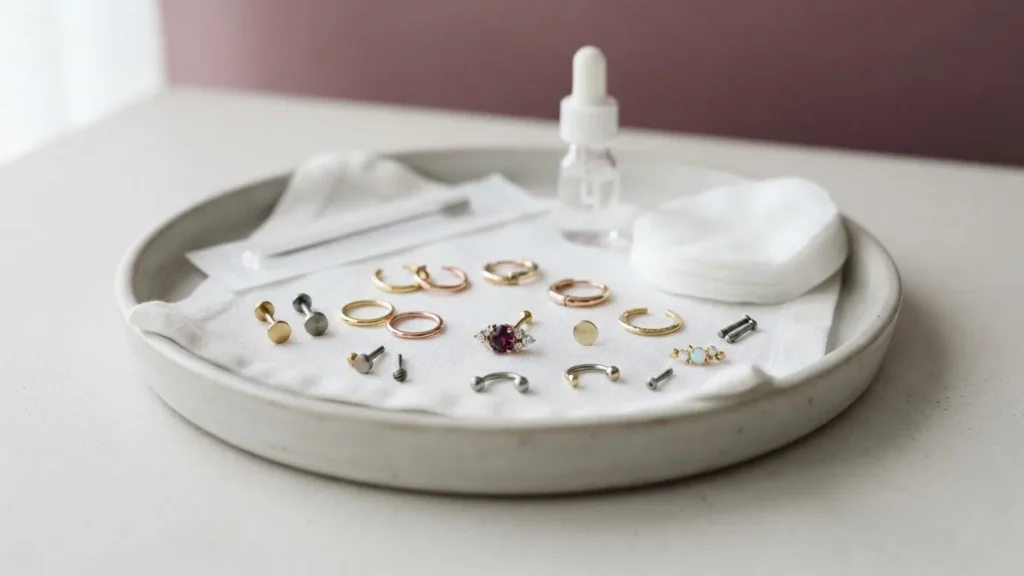
Cartilage piercings run into trouble more often than lobe piercings. In one comparison published in The Laryngoscope via PubMed, complications were reported in 40.2 percent of cartilage piercings against 25.4 percent of lobule piercings. That gap is why the first fork among the types of piercings for ears turns on tissue rather than looks: a soft lobe behaves nothing like a firm cartilage fold once the needle is through. Placement names come from the anatomy underneath, and so do healing time, the pain you feel, and the jewelry that will sit well.
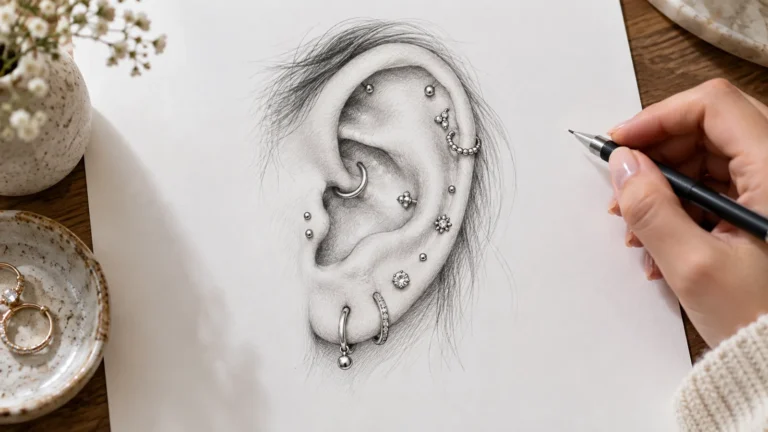
The outer ear carries a handful of structures that piercing names borrow directly: the lobule (the fleshy lobe), the helix (the curved outer rim), the antihelix (the inner ridge running parallel to it), the concha (the central shell-shaped bowl), and the tragus (the small flap in front of the ear canal). Almost every named ear piercing sits in one of these.
The types of piercings for ears fall into two tissue groups. Lobe piercings pass through soft tissue and settle fastest, roughly 6 to 8 weeks. Cartilage placements, including conch, tragus, rook, daith, snug, helix, and industrial, pass through firm tissue and take much longer, commonly 6 to 9 months and sometimes up to a year. The lobe carries the lowest pain and the fewest reported problems; cartilage sites report more. Match the jewelry to the spot: studs or small rings for lobes, flat-back studs or curved barbells for most cartilage. For anything red, swollen, or leaking pus, stop and see a professional.
Lobe versus cartilage: the split that sets your timeline
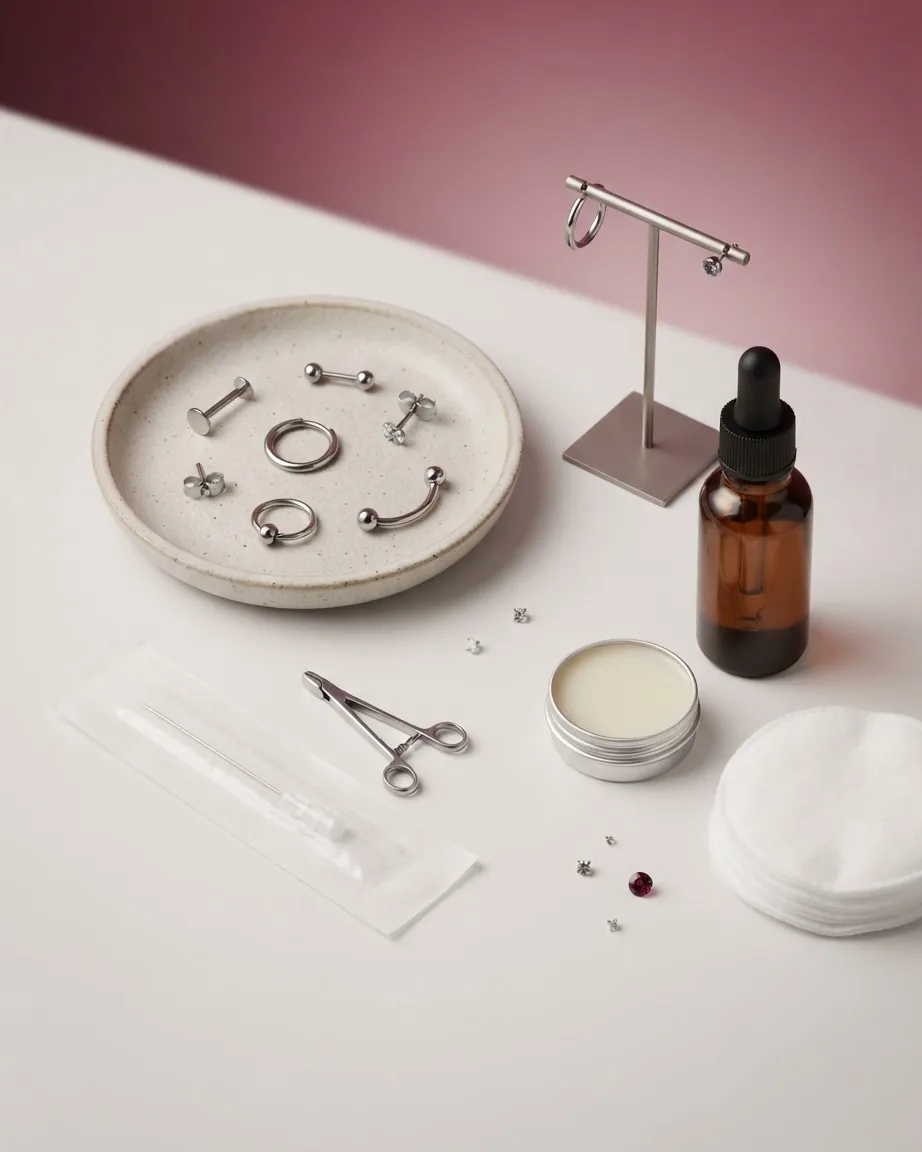
A lobe piercing goes through soft, well-supplied tissue, which is why it closes the wound quickly and hurts least of any ear placement. Cartilage has a thinner blood supply and a stiffer structure, so it takes far longer to rebuild the channel and reacts more to pressure, sleeping on it, and knocks.
The timing difference is wide. Cleveland Clinic puts lobe healing at about six to eight weeks, with cartilage running up to six months or a full year. The Association of Professional Piercers procedure manual lists the earlobe at 6 to 8 weeks or longer and ear cartilage, all variations, at 6 to 9 months or longer. These are ranges with open upper ends, so individual ears land anywhere inside them.
Pain is harder to pin to a number, because it depends on the spot and the person. As a rough order of orientation, the lobe is the gentlest, and the denser cartilage folds higher up the ear feel sharper and carry more pressure during and after the piercing.
An ear piercing chart: each spot and its healing window
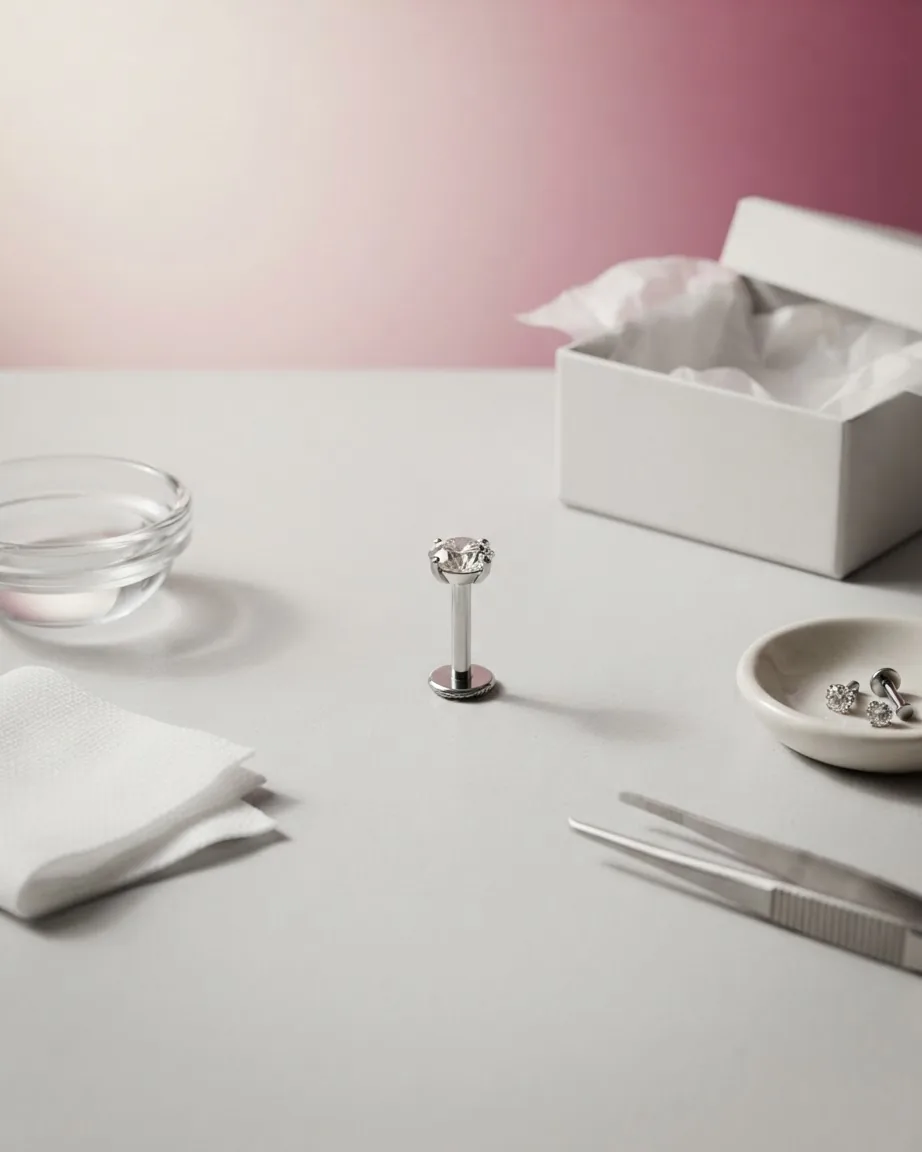
This chart matches each common placement to the tissue it sits in, a rough healing window, and a starter jewelry style. Healing figures follow the Association of Professional Piercers manual and Cleveland Clinic; the conch note reflects a separate range from WebMD, covered below. For the wider set of placement maps, see our types charts.
| Placement | Anatomy / tissue | Rough healing | Starter jewelry style |
|---|---|---|---|
| Lobe | Lobule, soft tissue | 6 to 8 weeks | Stud or small ring |
| Helix | Upper outer rim, cartilage | 6 to 9 months | Flat-back stud; ring once healed |
| Conch | Central bowl (concha), cartilage | 6 to 9 months (some sources: 4 months to a year) | Flat-back stud; ring once healed |
| Tragus | Flap at ear canal, cartilage | 6 to 9 months | Small flat-back stud |
| Rook | Antihelix fold, cartilage | 6 to 9 months | Curved barbell |
| Daith | Crus of the helix, cartilage | 6 to 9 months | Small ring or curved barbell |
| Snug | Antihelix ridge, cartilage | 6 to 9 months | Curved barbell |
| Industrial | Two upper-ear holes, cartilage | 6 to 9 months | One straight barbell |
A chart shows where a piercing can go, not whether your ear can hold it. The jewelry styles above are general starting points; a piercer picks the exact length, gauge, and material in person so the piece clears swelling without pressing on the fresh channel.
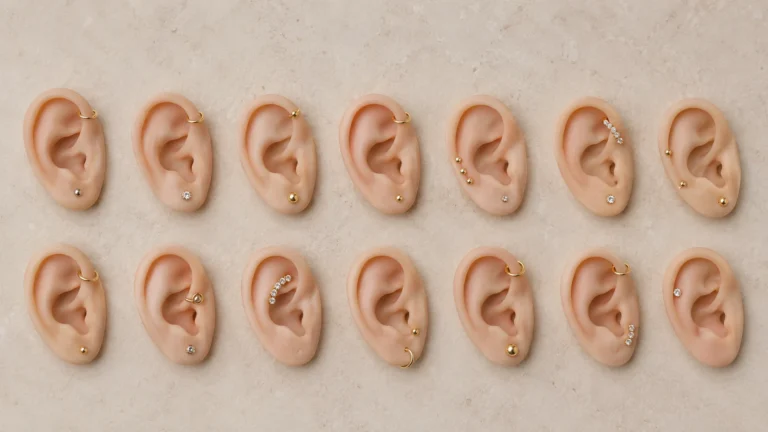
Named placements and the fold each one passes through
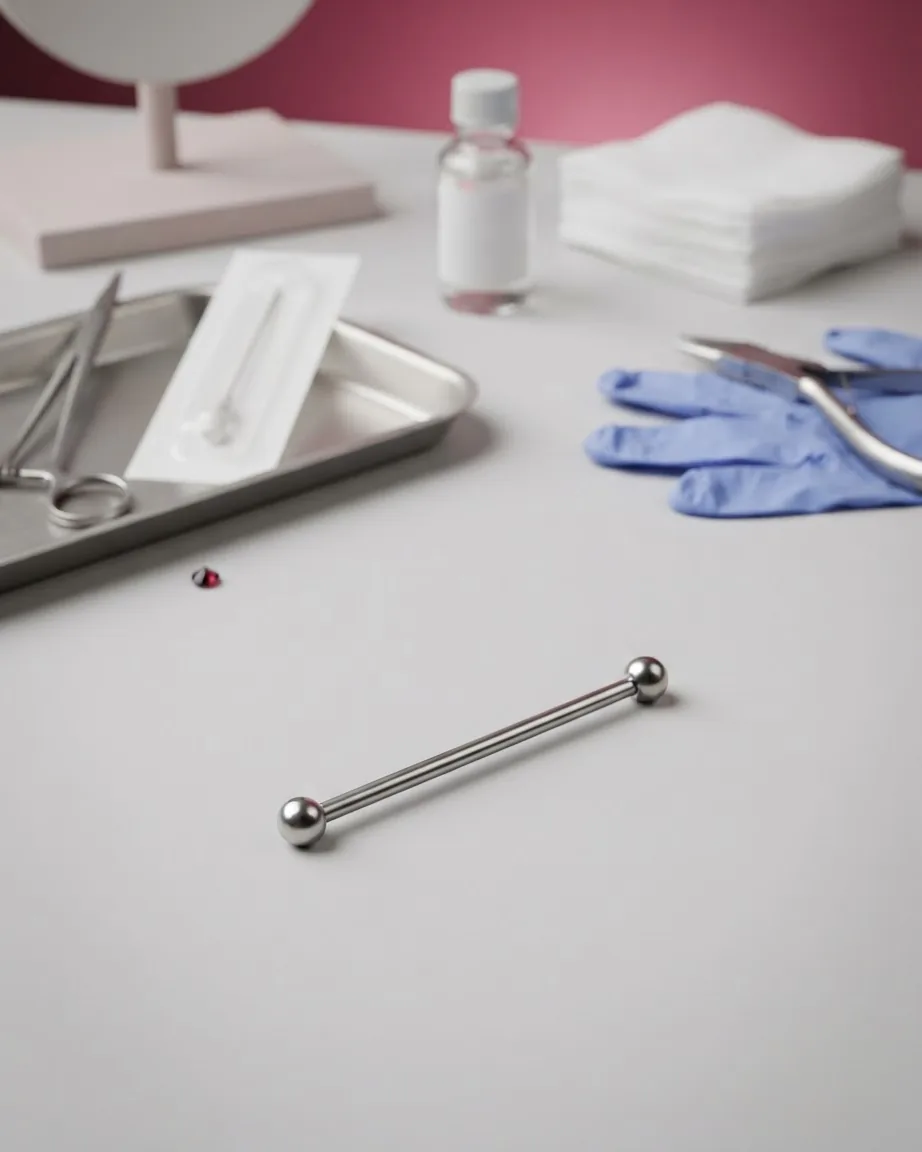
These names are tied to anatomy, so they are not interchangeable style labels. Each one describes a specific structure, and a piercing in one spot heals and behaves on its own terms.
- Helix: the upper curve of the outer rim. The most common cartilage placement, with room for several points along the arc.
- Conch: the shell-shaped bowl of cartilage in the center of the ear. WebMD notes conch and other side-of-ear piercings can take 4 months to a year to heal fully, which widens the lower end seen in the APP range.
- Tragus: the small flap of cartilage in front of the ear canal. It is thinner than it looks and takes short, low-profile jewelry.
- Rook: the antihelix fold near the top of the inner ear, pierced through a ridge of cartilage rather than a flat surface.
- Daith: the crus of the helix, the small ridge just above the ear canal. It passes through cartilage like any other point there. Claims that a daith piercing eases migraines are not supported by solid clinical evidence, so choose it on fit and looks, and raise any headache treatment with a clinician.
- Snug: the antihelix, the inner ridge running parallel to the outer rim. One of the shallower folds, so it depends heavily on having the ridge to support it.
- Industrial: two separate cartilage holes across the upper ear linked by a single straight barbell. It is really two piercings healing at once, which is part of why it is demanding.
Why “cartilage” is not one risk category
Grouping every cartilage piercing together hides real differences between sites. The comparison in The Laryngoscope found infection in 30.3 percent of cartilage piercings against 23.8 percent of lobule piercings. Those numbers are self-reported from one surveyed cohort, so they describe that group rather than a fixed probability for any individual ear.
Site matters once an infection does set in. A systematic review indexed on PubMed looked at patients who had already developed infection after a piercing through cartilage and found ear deformity in 100 percent of scapha cases against 43 percent of helix cases, with Pseudomonas aeruginosa behind 87.2 percent of infections. Because that review studied only people who were already infected, it maps which spots fare worse once infection takes hold, not the odds that a fresh piercing becomes infected. The practical read: higher, denser cartilage carries more at stake than the lobe, and the aftercare window is counted in months. See also our cartilage piercing to heal guide.
Starter jewelry by placement and material
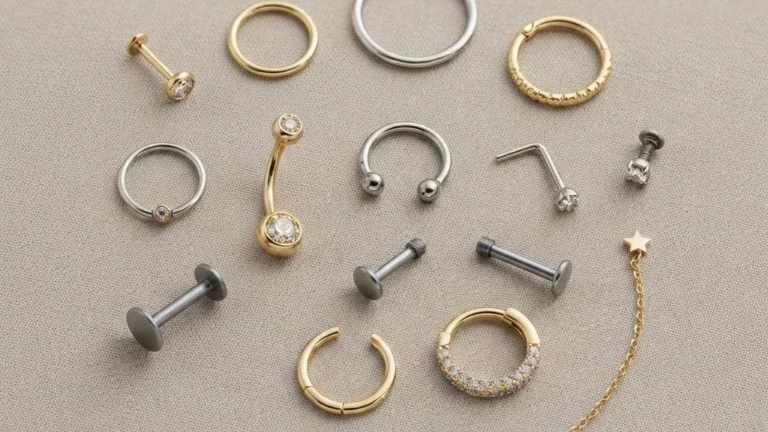
Starter jewelry is chosen to clear swelling and avoid snagging while the channel forms, which is why the style follows the anatomy. Flat-back labret studs suit most cartilage points because the flat disc sits flush behind the ear and gives nothing to catch. Curved barbells fit the folds, the rook and snug, where a straight bar would fight the ridge. Rings and hoops tend to come later, once a conch or daith has settled, since movement on a fresh cartilage channel slows healing.
Material choice follows the specifications piercing standards and manufacturers set for pieces worn in a healing wound, with implant-grade titanium and surgical steel the usual starting metals. If you are weighing a coated or colored stud, know what the finish is before it goes in a fresh ear; our note on black ear piercing studs covers that. See also our tragus piercing jewelry guide.
Aftercare across ear piercings and when to see a professional
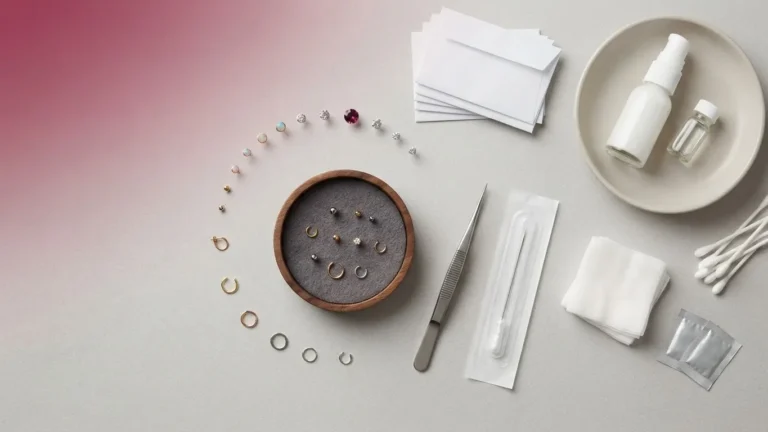
Aftercare here follows the protocols published by the Association of Professional Piercers. Their aftercare guidance points to a saline rinse whose only listed ingredient is 0.9 percent sodium chloride, with purified water sometimes also listed. Anything stronger, or scented, is not aftercare for a fresh piercing.
One point of care is genuinely disputed. The APP states that moving or rotating jewelry “is not necessary during cleaning/rinsing and may actually irritate the piercing.” The UK’s National Health Service guidance on infected piercings instead says to gently turn the jewellery while cleaning. These disagree, and neither is wrong for every case. The workable resolution: do not twist a dry or crusted piercing, and follow the aftercare your own piercer gives for the specific placement rather than a general rule from either direction.
Keloids are a slower risk worth planning for. WebMD notes a keloid may not form until 3 to 12 months after a conch piercing, so a bump that appears long after the surface looks calm is not automatically a new infection. Watch instead for spreading redness, swelling, warmth, pain that climbs rather than fades, pus, or fever. The NHS guidance on infected piercings is the sign to stop self-treating and get the ear assessed. None of this is a diagnosis; a piercer or a clinician decides what a specific ear needs, and anything that looks or feels wrong is their call, not a chart’s.
How to choose among the types of piercings for ears
Work from your own ear outward. Start with tissue: if you want the fastest, lowest-pain route with the shortest care window, a lobe at 6 to 8 weeks is the clear entry point. If you want a cartilage placement, accept the 6-to-9-month commitment before you book, because the care runs the length of the healing, not the length of the soreness.
Then check whether the anatomy is even there. Folds like the rook, snug, and industrial depend on having the ridge or the geometry to support them; a chart cannot tell you that, and a piercer assessing your ear in person can. Bring the placement you want and let them confirm the fit, the jewelry, and the order to add pieces if you are planning more than one. For the full map of where each point lands, our ear piercing diagram lays out the named spots alongside honest timelines.
Does a daith piercing treat migraines?
There is no solid clinical evidence that a daith piercing reduces migraines. It sits in the crus of the helix and heals as an ordinary cartilage piercing, with the same months-long window and the same infection considerations as other cartilage spots. If headaches are the reason you are considering one, raise treatment with a clinician first and judge the piercing on fit and appearance.
When is it safe to swap my starter jewelry?
Not when it stops hurting. A cartilage channel keeps forming for months after the surface feels fine, so soreness fading is a poor signal on its own. Changing a piece too early can reopen or irritate the forming tract. Have your piercer confirm the placement is settled and fit the next piece, especially before moving a conch or daith from a stud to a ring.
Can every ear take a rook or an industrial?
No. Both depend on anatomy you may or may not have: a rook needs enough of the antihelix fold, and an industrial needs two points that line up for a single straight bar. Some ears lack the ridge or the geometry, and forcing the placement risks poor healing or migration. A piercer assessing your ear in person is the only reliable way to know.
How much riskier is cartilage, in the study’s own numbers
“Cartilage is riskier” is easy to say and hard to size. The Laryngoscope survey gives two pairs of rates, and dividing them turns the vague claim into something you can weigh. These are self-reported figures from one surveyed cohort, so they describe that group, not the odds for your ear, but the relative gap is what the arithmetic makes visible:
- Complications: 40.2% of cartilage piercings vs 25.4% of lobe piercings. That is 40.2 / 25.4 = 1.58x the rate, a gap of 40.2 – 25.4 = 14.8 percentage points.
- Infection specifically: 30.3% vs 23.8%. That is 30.3 / 23.8 = 1.27x the rate, a gap of 30.3 – 23.8 = 6.5 percentage points.
The useful read is the comparison between the two ratios: the cartilage penalty is much larger for complications overall (1.58x) than for infection alone (1.27x). Most of what pushes cartilage ahead is non-infection trouble, pressure, slow closing, irritation, not just bugs. And once infection does take hold, site matters: among already-infected cases, ear deformity hit 100% of scapha vs 43% of helix, which is 100 / 43 = 2.33x as often. Higher, denser cartilage has more at stake than the rim, which has more at stake than the lobe.