Cartilage piercing carries measurably higher infection odds than a lobe, and the sharpest evidence comes from a single outbreak documented in JAMA: among ear piercings tracked in that report, the relative risk of a suspected infection was 3.6 (95% CI, 1.5 – 8.5) for cartilage compared with the lobe, and every confirmed case involved a spring-loaded piercing gun. That one detail decides more about a safe inner conch piercing than any jewelry choice. This guide compiles the gauge, post length, healing windows, saline routine, cost, and infection signs from published professional standards and medical sources, and flags where those sources disagree so the decision stays yours.
Quick answer: An inner conch piercing passes through the flat plate of cartilage in the middle of the ear bowl. A piercer uses a sterile 14-gauge or 16-gauge needle, never a gun. Needle healing runs about 6 to 12 months because cartilage regenerates slowly; it may look settled at 3 to 4 months while the inner channel is still fragile. Start with implant-grade titanium or 14k-or-higher gold, clean twice daily with sterile 0.9% sodium chloride saline, and expect to pay roughly $30 to $90. Do not switch to a hoop until a piercer confirms full healing.
Where the inner conch sits and who the anatomy rules out

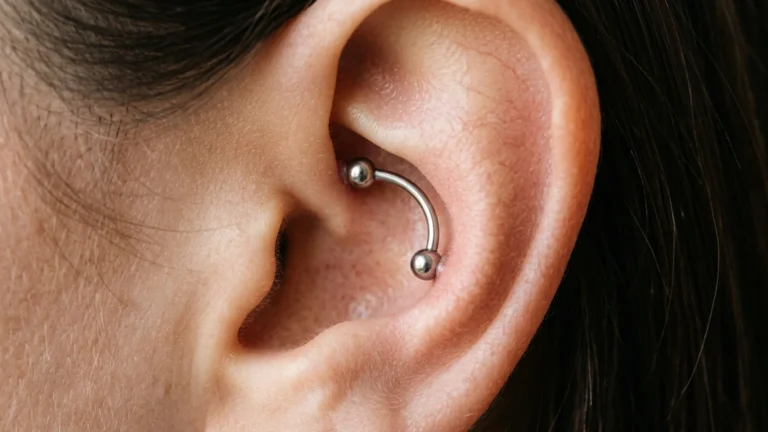
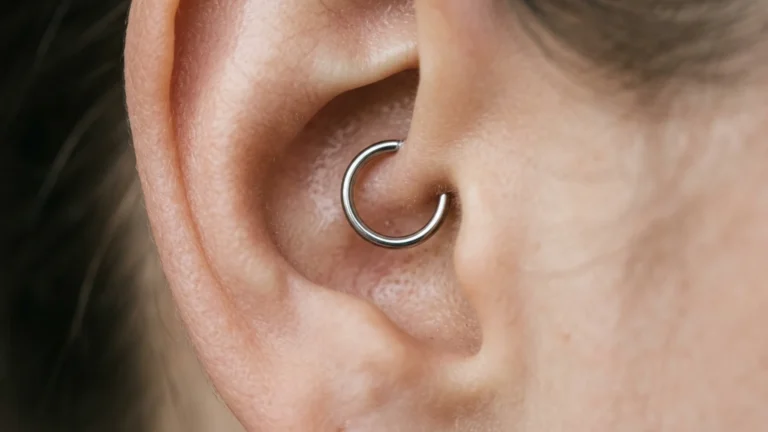
The conch is the shell-shaped bowl of the ear, named for its resemblance to a conch shell. An inner conch piercing goes through the flat central plate of that bowl, below the helix rim and behind the ear canal opening. An outer conch sits higher, in the band of cartilage running up toward the antihelix. The inner placement faces outward and holds a flat-back stud cleanly, which is part of why it has stayed popular for decades.
Almost everyone qualifies. Pierced Addiction notes that nearly every ear has the anatomy an inner conch piercing requires, and Urban Body Jewelry describes it as anatomy-dependent but says it is rare for someone to lack the structure for one. The honest screen is not whether the bowl exists but whether the cartilage plate is thick and flat enough for your piercer to seat a stud without the disc pressing against the rim. That is a judgment made in the chair, with the ear in hand, not from a photo.
Thin, shallow, or sharply curved conch anatomy is the realistic disqualifier. If a piercer tells you the geometry will not hold a flat-back comfortably, that is anatomy talking, not caution for its own sake. For how this placement sits beside the rest of the ear, see our wider ear piercings section.
Needle, gauge, and the one tool to walk out on

A reputable studio pierces the conch with a single-use hollow needle. FreshTrends states the conch is typically pierced with a 14G needle. The jewelry gauge that follows is close but not identical across sources, and the spread is worth knowing before you book.
- FreshTrends: a 14G needle is typical.
- Urban Body Jewelry: conch piercings are typically performed at 16 or 14-gauge.
- Pierced Addiction: 16G is standard, though some piercers use 14G depending on anatomy and client preference.
So the defensible range is 16G to 14G, and which end you land on depends on your cartilage and the piercer’s preference, not on a universal rule. A thicker 14G channel is marginally more robust; a 16G sits a touch less heavily. If the piece is a ring from day one, a heavier gauge such as 12G or 10G may be used, which is one reason most piercers start the conch with a stud rather than a hoop. For the mechanics of why a hollow needle leaves a clean channel, see our piercing needle guide.
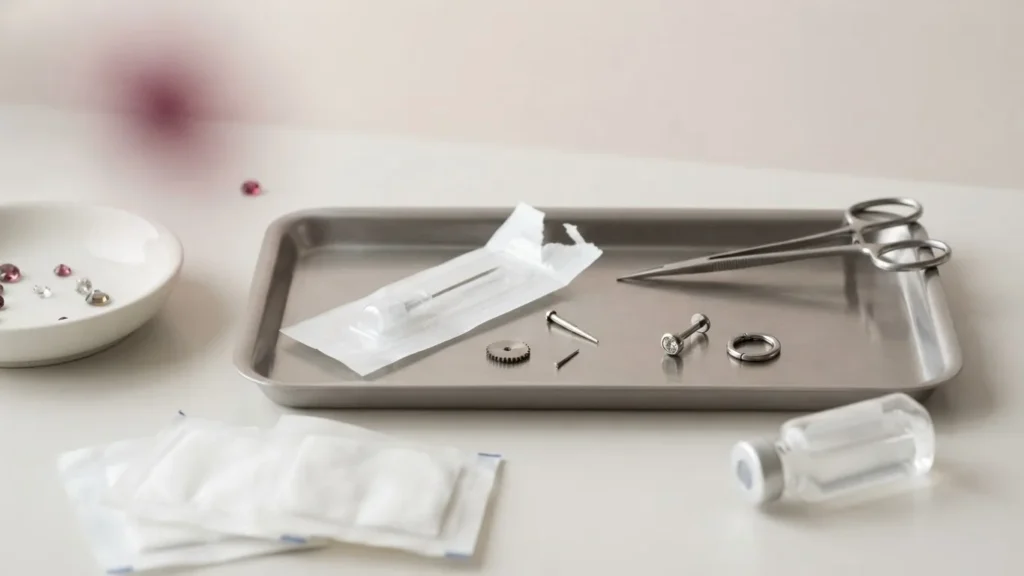
The non-negotiable is the tool. FreshTrends is blunt that you should never choose a piercer who uses a piercing gun, noting it can damage the ear. The JAMA report gives that the force of clinical data: in its outbreak, all persons with confirmed infections had their ear cartilage pierced with an open, spring-loaded piercing gun, and the authors state plainly that ear cartilage piercing is inherently more risky than lobe piercing. A gun cannot be fully sterilized and crushes rather than cuts cartilage. If a studio reaches for one, leave.
How much an inner conch piercing hurts next to a lobe
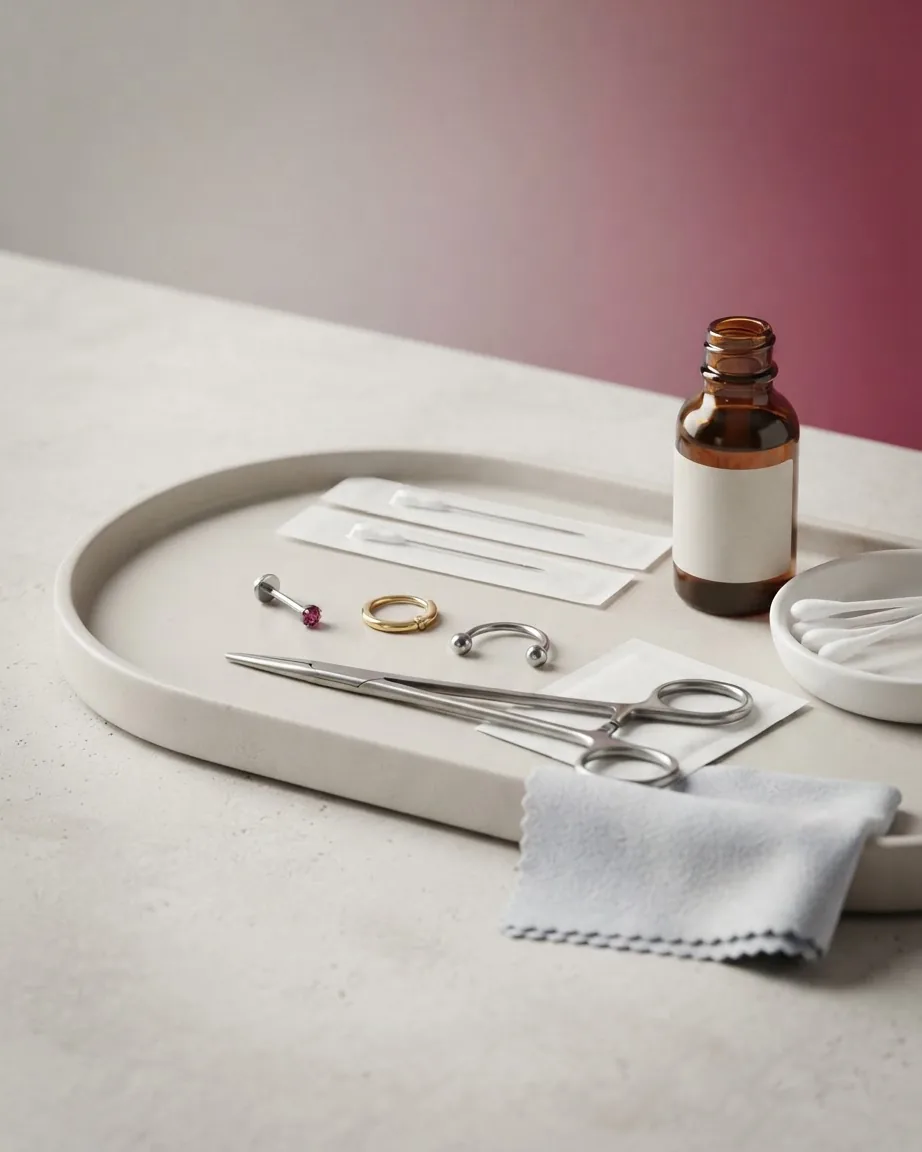
The conch runs through a thick, dense area of cartilage, thicker than the helix or tragus per Vital Piercing, so it ranks above a lobe on every scale that compares placements. A lobe is soft tissue and barely registers; the conch is firm cartilage, and the sensation is a deep, hot pressure rather than a quick pinch. Vital Piercing rates it around 6 to 7 out of 10, with the actual piercing lasting only a few seconds.
Translate that honestly: it hurts more than a standard lobe and more than most people expect from a single ear piercing, but it is brief, and the ache that follows for the first day or two is the bigger story than the needle itself. If you want placements ranked against each other before you decide, our piercing pain chart plots the conch against softer and firmer sites.
Healing time: why “looks healed” is the dangerous number
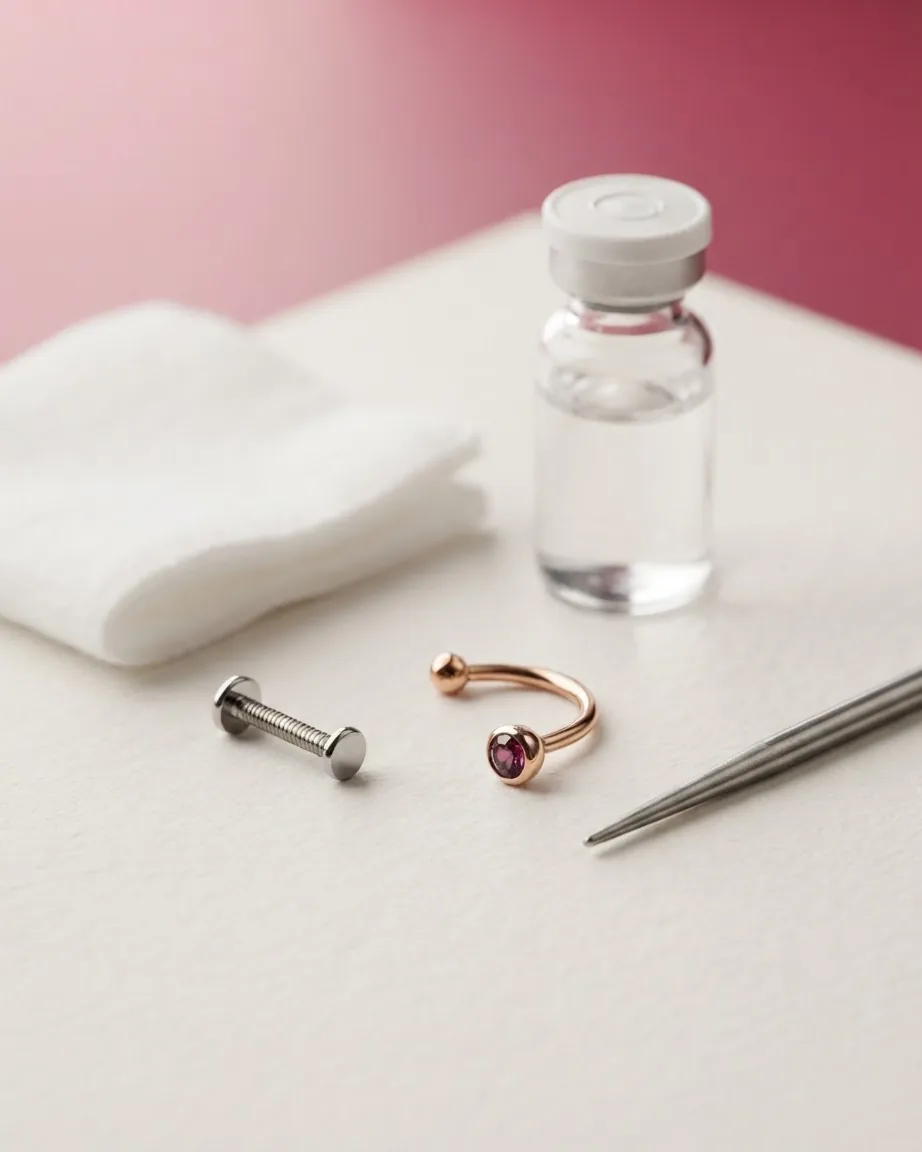
This is where sources diverge, and the disagreement is the useful part. Cartilage has little direct blood supply, so it closes slowly and from the outside inward. Here is what each source reports for full healing of a needled conch:
| Item | Value |
|---|---|
| FreshTrends | 3 months to one year. |
| Urban Body Jewelry | an average of 4 to 6 months, up to a year with poor aftercare or if you sleep on it. |
| Healthline | 6 to 9 months by needle; a dermal punch can take a year or more. |
| Pierced Addiction | 6 months to 12 months, because cartilage regenerates more slowly than soft tissue. |
| Vital Piercing | 6 to 12 months, with some people needing the full 12 months. |
These do not contradict so much as define “healed” differently. The lower figures describe the surface settling; the higher ones describe the internal channel. Plan for the upper end, roughly 6 to 12 months, and treat anything earlier as a bonus a piercer confirms, not an assumption you make.
The clinical distinction matters more than the spread. The Association of Professional Piercers notes that this type of wound heals from the outside to the inside, so although it may feel fine on the outside, the interior could still be fragile. Vital Piercing puts the same point in numbers: the piercing may look and feel healed after 3 to 4 months, but the internal channel takes much longer. The practical consequence is that the moment it feels done is precisely when a careless jewelry change does the most damage. Pierced Addiction adds that this is why the cartilage requires 6 to 12 months of contact with the initial jewelry.
Starter jewelry: material, threading, and post length that heals
Two decisions drive whether an inner conch piercing heals clean: what the jewelry is made of, and how long the post is.
On material, follow the APP’s initial-jewelry standard. The Association of Professional Piercers specifies implant certified titanium (Ti6Al4V ELI) that is ASTM F-136 compliant, or ASTM F1295 / ISO 5832-3 compliant, or commercially pure titanium meeting ASTM F-67. As for gold, the APP only clears it for a fresh piercing when it reaches 14k or above, is free of both nickel and cadmium, and has been alloyed so it stays biocompatible. Threading is the quiet detail: a smooth internally-threaded or threadless post will not drag the healing channel the way external threading can.
Post length carries swelling. Pierced Addiction describes an initial post of 6 to 8mm to accommodate swelling, settling to a 5 to 6mm post after downsizing. That initial extra length is deliberate headroom, not a sizing error, and it is why the first piece looks slightly loose.
For the conch, piercers nearly always start with a flat-back labret stud rather than a hoop, because a stud holds the cartilage still while a ring levers on it with every movement. If you are eyeing a ring as the eventual look, it is the second piece, not the first.
Downsizing versus switching to a hoop: two different milestones
People collapse these into one event and get hurt doing it. They are separate, and they happen months apart.
The first is downsizing: swapping the long swelling-accommodation post for a shorter one once the initial swelling drops. The timing differs by source. Urban Body Jewelry says to downsize after about 4 to 6 weeks. Pierced Addiction puts downsizing at 8 to 12 weeks, moving to a 5 to 6mm post. These are not a true contradiction so much as different read-outs of how fast a given ear settles; the trigger is swelling going down, confirmed by your piercer, not the calendar. A post left too long catches on things and drives irritation bumps.
The second is switching the jewelry type, stud to ring, which waits for full healing. Here the sources split on the number: Urban Body Jewelry says wait until fully healed, typically four to six months, before changing a stud to a ring; Pierced Addiction says jewelry should not be changed, including switching to a hoop, until full healing has been confirmed, typically after 6 to 12 months. Given the outside-in healing problem above, the cautious read is the later one, and the real gate is a piercer confirming the channel, not a date on a calendar.
When you do move to a hoop, Vital Piercing notes most conch hoops run 10mm to 14mm in diameter depending on ear size. If a ring was the plan from the start and the piercer worked at a heavier gauge, that influences the sizing too.
The saline routine, and the products that set healing back
Aftercare for cartilage is mostly about doing less, correctly. The Association of Professional Piercers sets the standard most studios teach from.
- What to use: sterile saline. Per the APP aftercare standard, your saline ingredients should list 0.9% sodium chloride as the only ingredient, nothing else.
- How often: Healthline advises cleaning the piercing at least twice per day for at least 3 months.
- Leave it still: the APP points out that you gain nothing by twisting or turning jewelry as you clean or rinse, and the handling can inflame the site instead. That familiar “turn your earrings” habit works against a fresh channel.
- What to avoid: the APP says to avoid cleaning with alcohol, hydrogen peroxide, antibacterial soaps, iodine, or any harsh products, as these can damage cells.
- Dry carefully: cloth towels should be avoided, the APP notes, as they can harbor bacteria and snag on jewelry. A clean paper product or air-drying is the safer call.
The theme is restraint. Harsh antiseptics and constant fiddling do more harm than the bacteria they are meant to fight, because they kill the cells rebuilding the channel.
Cartilage infection risk, the warning signs, and the instinct to resist
The infection story for cartilage is real and worth stating precisely. Cleveland Clinic warns that this part of your ear has a greater risk of infection than the earlobe, in the context of perichondritis, an infection of the tissue around the cartilage. JAMA frames the same point as a rule: ear cartilage piercing is inherently more risky than lobe piercing.
The hardest numbers come from one outbreak, and their scope matters. In the JAMA report covering 186 ear piercings, 7 (4%) resulted in confirmed Pseudomonas aeruginosa infection and 18 (10%) led to suspected infections; the cartilage-versus-lobe relative risk for suspected infection was 3.6 (95% CI, 1.5 – 8.5). The patients were aged 10 to 19, and four were hospitalized, three for incision and drainage surgery and one for intravenous therapy. Read this correctly: those figures come from a single piercing-gun outbreak, not from routine needled conch piercings. The 4% and 10% describe what a gun and a bad environment produced, which is exactly the setup a good studio avoids.
Know the signs. Healthline lists yellow or green discharge coming from the piercing among the markers of infection. Persistent heat, spreading redness, swelling, and worsening pain after the first few days belong in the same category.
The counterintuitive part is what not to do. Healthline warns that removing your jewelry could cause an infected abscess to grow, because the jewelry keeps the channel open to drain. If you suspect an infection, leave the piece in and see your piercer or a clinician. The aftercare here is compiled from published standards, not a diagnosis; anything that looks wrong is a question for a professional, not a web page.
Scarring and keloids: the screen to do before you book
Cartilage scars more readily than soft tissue, and the conch is no exception. FreshTrends notes that hypertrophic scarring is very common in cartilage piercings, and that if you have keloids, a rare genetic condition, they are likely to appear in cartilage piercings.
The distinction is worth holding. A hypertrophic scar or an irritation bump stays within the piercing area and often settles with corrected aftercare, downsizing, or time. A keloid grows beyond the original wound and reflects an individual tendency. If you or close relatives have formed keloids from previous piercings or injuries, that is a conversation to have with your piercer and, if there is doubt, a clinician, before a needle touches the cartilage. Pre-screening is cheaper and kinder than treating a keloid after the fact.
What an inner conch piercing costs
Price depends on the studio, the region, and the jewelry included. Two sources bracket it:
- FreshTrends: conch piercings cost anywhere between $30 and $90.
- Vital Piercing: typically $40 to $70 at a reputable studio, including basic jewelry.
So roughly $30 to $90 covers the field, with $40 to $70 the common middle when basic jewelry is bundled. The variable that moves the number most is the jewelry. Implant-grade titanium or 14k-and-up gold costs more than mystery metal, and it is the part you should not economize on, because the material directly affects whether the channel heals. A cheap piece that irritates the cartilage can cost far more in prolonged healing or a bump than the saving was worth.
Headphones, swimming, and the migraine claim that is not proven
Two everyday habits set conch healing back. Urban Body Jewelry warns that in-ear headphones and earbuds add pressure on the piercing that can irritate it and prolong healing, which makes the conch an awkward placement for anyone who lives in earbuds; over-ear headphones that clear the bowl are the safer swap during healing. The same source warns that swimming exposes the healing fistula to water that can carry bacteria and cause an infection, so pools, lakes, and hot tubs are off-limits until a piercer confirms the channel.
Then there is the claim that sends people to the conch in the first place: that it relieves migraines or anxiety. The evidence does not support it. Medical News Today states that some people report an improvement in migraine severity and frequency following a conch piercing, but there is insufficient scientific evidence to support such claims. Reported improvements may reflect a placebo effect.
Keep a separate, narrower claim distinct from that one. Healthline reports a 2017 review suggesting that auricular acupuncture, acupuncture focused on the ear, may offer some pain relief when administered within 48 hours of pain onset. That is a finding about acupuncture, not about wearing a piece of jewelry in the conch, and the two should not be merged. Get a conch piercing because you want the piercing, not as a treatment for a medical condition.
The ‘looks healed’ danger window, in months
An inner conch piercing can look and feel healed after 3 to 4 months, yet full healing of the internal channel runs 6 to 12 months. The arithmetic turns that disagreement into the single number that protects you: the stretch of time when the piercing feels done but a careless jewelry change does the most damage.
- At best, 2 more months of care: if yours looks settled at 4 months and heals fully at the 6-month low end, that is still 6 − 4 = 2 months when the channel is fragile.
- At worst, 9 more months of care: if it looks healed at 3 months but needs the full 12, that is 12 − 3 = 9 months of continued fragility.
- Only a quarter of the way done when it ‘looks healed’: 3 ÷ 12 = 25%, so feeling healed at the 3-month mark can mean just 25% of the maximum healing time has actually passed.
Treat the moment it feels healed as the start of the risky window, not the end – and let a piercer, not the calendar, confirm the first jewelry change.
FAQ
Can I start with a hoop instead of a stud?
It is possible but not ideal. A ring moves against the cartilage constantly, which slows healing, so most piercers fit a flat-back stud first. If a hoop is placed from the outset it may be done at a heavier 12G or 10G. The cleaner route is a stud now, hoop later, once a piercer confirms the channel is fully closed.
Why does my conch look healed but my piercer says it isn’t?
Cartilage closes from the surface down, so the outside seals while the inner tunnel stays fragile. One source notes the site can look and feel settled at 3 to 4 months while the deeper channel needs far longer. Trusting the surface is what causes bumps and setbacks when people change jewelry too soon.
Is a dermal punch worth it over a needle?
A dermal punch removes a small core of cartilage rather than displacing it, and Healthline notes that version can take a year or more to fully heal, against roughly 6 to 9 months for a needled conch. Punches suit larger-gauge jewelry and specific looks. For a standard inner placement, the longer healing is a real trade-off to weigh with your piercer.
What should I do the moment I suspect an infection?
Leave the jewelry in. Pulling it can trap an infected abscess and let it enlarge rather than drain. Watch for yellow or green discharge, spreading warmth, and pain that worsens past the first days, then contact your piercer or a clinician promptly. Cartilage infections are treated medically, and early attention keeps a minor problem from reaching the point of drainage surgery.
How long before I can sleep on that side?
Pressure from sleeping on the piercing is one reason Urban Body Jewelry says healing can stretch to a full year instead of its 4 to 6 month average. There is no fixed clearance date; the cartilage tolerates side pressure only once a piercer confirms full healing, which for the conch generally lands in the 6 to 12 month window. A travel pillow with a hole keeps weight off in the meantime.