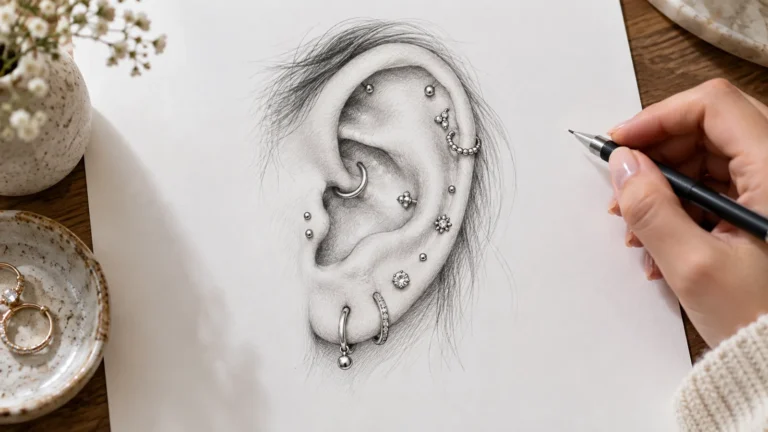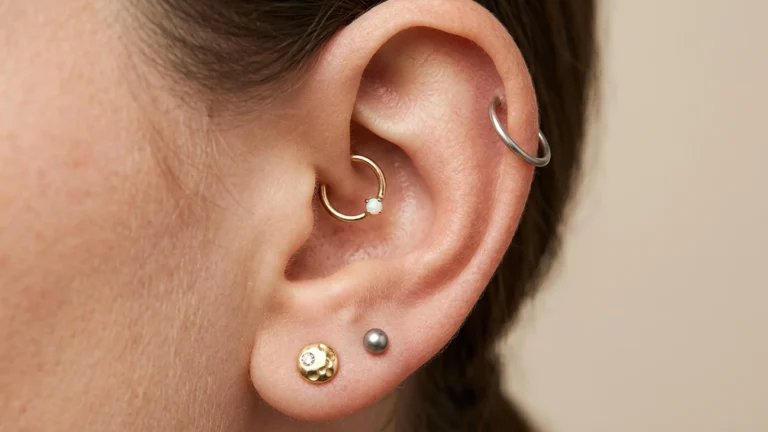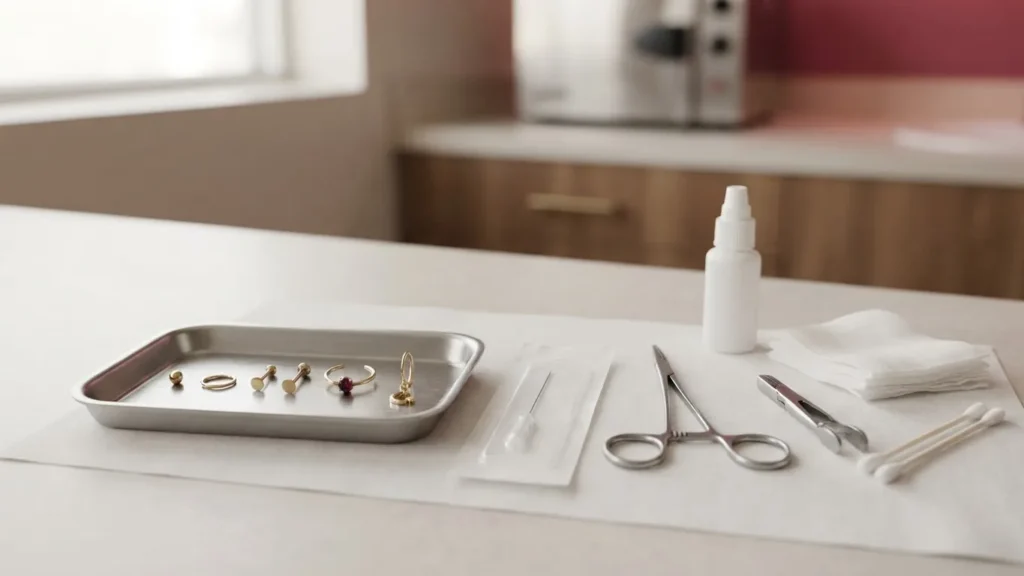
Earlobes are the most-pierced body part in the United States: Cleveland Clinic reports that 84% of women and 64% of men have pierced lobes, with cartilage piercings next in line. That split matters before you book anything, because the different kinds of ear piercings do not heal, hurt, or accept jewelry the same way. A lobe runs through soft, fatty tissue; most of the others run through cartilage, which has a low blood supply and repairs slowly. The placement you pick decides your pain, your healing window, and whether earbuds or a side-sleeping habit will fight you for months.
Quick answer. The named types of ear piercings fall into families by the tissue they sit in: the lobe family (standard, stacked, high, transverse) through soft tissue, and the cartilage group (helix, forward helix, tragus, anti-tragus, inner and outer conch, daith, rook, snug, industrial, orbital). Lobes heal fastest, roughly six to eight weeks, and hurt the least because fatty tissue has few nerves. Cartilage placements can take six months to a year and hurt more. For any fresh piercing, request a sterile needle rather than a gun, and implant-grade jewelry.
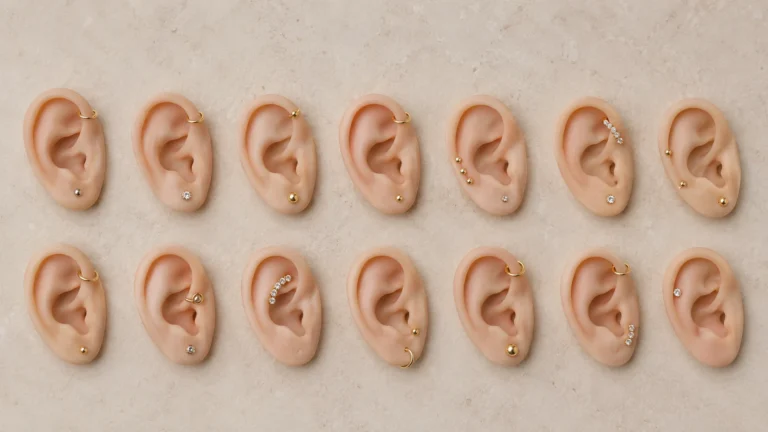
An ear-piercing chart: where each placement sits and roughly how long it heals
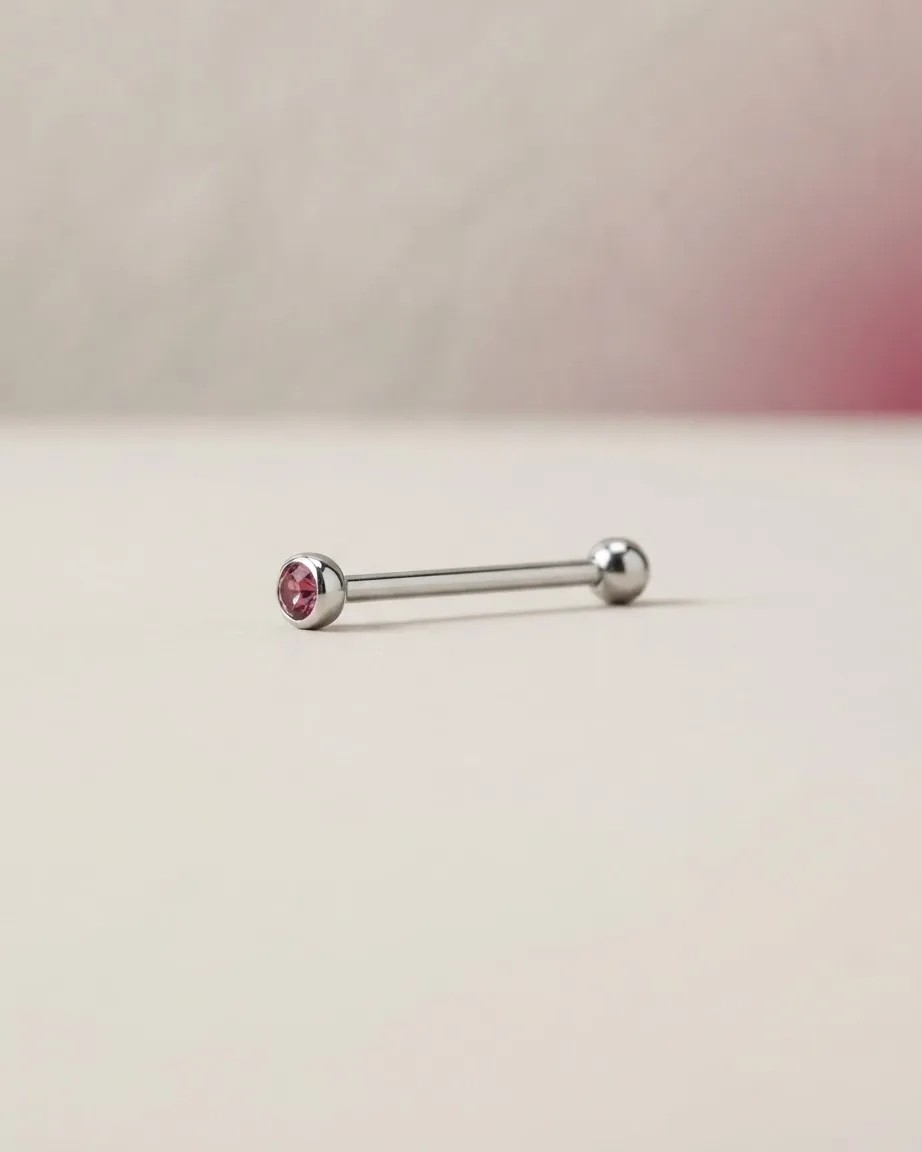
The fastest way to read your own ear is by tissue, not by trend. Soft-tissue lobes sit at the fleshy bottom. Everything above them threads through cartilage, the firm ridge and folds that make up the rest of the ear. That single distinction predicts most of the healing math: Cleveland Clinic notes that cartilage does not get as much blood supply as soft tissue, so it repairs itself slowly.
Here is the orientation chart. Treat healing figures as ranges, not deadlines, and see the detail on endpoints further down.
- Standard lobe – soft tissue, lower lobe. Lowest pain. Heals in about six to eight weeks (Cleveland Clinic).
- Stacked / high lobe – soft tissue, upper lobe. Low pain. A studio timeline puts lobe and stacked lobe at roughly 2 – 3 months.
- Transverse lobe – soft tissue, threaded side-to-side through the lobe rather than front-to-back, usually on a barbell.
- Helix – upper outer cartilage rim. Moderate pain, slow healing.
- Forward helix – cartilage at the front of the rim, near the face.
- Tragus – the small cartilage nub in front of the ear canal. Prone to irritation (see earbuds, below).
- Anti-tragus – cartilage ridge opposite the tragus, above the lobe.
- Conch (inner / outer) – the large cartilage bowl in the center of the ear.
- Daith – the innermost cartilage fold above the canal.
- Rook – a thick fold of cartilage in the antihelix ridge.
- Snug (anti-helix) – cartilage ridge running down the mid-ear.
- Industrial – two cartilage holes on the upper ear joined by one straight barbell.
- Orbital – two holes joined by a single ring.
For the fuller view across the category, see our types charts.
Will a daith piercing actually help my migraines?
This is the highest-stakes claim in the whole category, and the popular version of it is wrong. The daith sits in the innermost cartilage fold, and it circulates online as a migraine treatment. The headache specialists disagree. The American Migraine Foundation states plainly that the only evidence supporting the idea is anecdotal and that there is no research backing the theory; it adds that any reported results are widely believed to be placebo, while the piercing still carries real risks like infection and pain.
The peer-reviewed literature lands in the same place. A case report published in Frontiers in Neurology concludes that daith piercing cannot be recommended as a migraine treatment, citing the lack of scientific evidence, an unquantified failure rate, and the risks tied to insertion.
What about the survey people quote back? That same report describes an online survey of 380 people with a daith piercing, in which 47.2% reported a reduction in migraine frequency. Read it carefully: it is self-selected and self-reported, and the share reporting no further attacks fell over the months that followed. A number that erodes over time and comes from people who chose to answer is not evidence of a treatment effect. If migraine relief is your goal, that is a medical question for a clinician, not a reason to get pierced.
Gun or needle: does it matter for cartilage?

It matters more than almost any other choice you make at the counter, and it is a question you can ask before you ever sit down. Cleveland Clinic recommends needles over guns and specifically advises needles for piercing children, because piercing guns aren’t always sterilized between uses.
On cartilage the stakes climb. The Association of Professional Piercers prohibits its members from using reusable ear piercing guns for any piercing procedure. The reason is mechanical: most studs fired from a gun are dull and forced through under spring pressure, so the effect on the body is more like a crush injury than a clean piercing. On structural tissue, the APP documents that gun use can cause auricular chondritis, shattered cartilage, and excessive scarring.
The screening test is simple. Before booking a helix, tragus, conch, rook, or any cartilage placement, confirm the studio uses a single-use sterile needle. If the answer is a gun, walk.
How to tell safe metal from “surgical steel” marketing

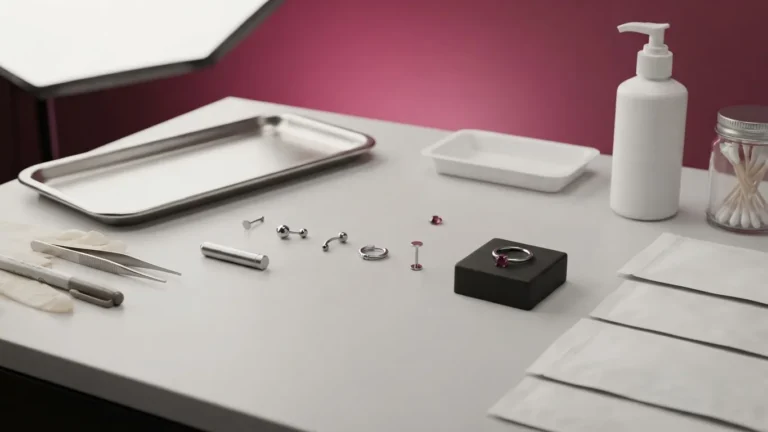
“Hypoallergenic” and “surgical steel” are marketing phrases, not specifications. For a fresh wound you want checkable grades, and the standard for initial-piercing jewelry gives them.
Request one of these, by name:
- Implant-grade titanium – implant-certified Ti6Al4V ELI that is ASTM F-136 compliant, or ASTM F1295 / ISO 5832-3, or commercially pure titanium ASTM F-67.
- Gold – 14k or higher, nickel- and cadmium-free, and alloyed for biocompatibility. Gold above 18k is too soft, and gold-plated, gold-filled, and vermeil do not qualify for a fresh piercing.
- Internally threaded or threadless ends – so the part that passes through your skin is smooth, with no exposed threading dragging across the wound.
Those are acceptance criteria you can say out loud. If a shop cannot name the grade, that is your answer. Cleveland Clinic lists 14K gold, medical-grade steel, and titanium among the safest options too; the APP standard simply pins down the exact grades behind those words.
Why you shouldn’t twist a new piercing or swap jewelry once it “looks healed”
Two old habits cause more self-inflicted trouble than almost anything else. The first is rotating the jewelry. Cleveland Clinic is explicit that the old advice to rotate a piercing regularly is no longer recommended, because a piercing is a puncture wound and disturbing it complicates healing.
The second is changing jewelry the moment the surface looks fine. The APP aftercare guidance explains why that fails: this kind of wound heals from the outside inward, so it can feel fine on the surface while the interior is still fragile. “Looks healed” and “fully matured” are not the same stage. A jewelry retailer’s placement guide puts it bluntly – a piercing may look and feel healed months before the fistula has fully formed, and changing jewelry too early is one of the leading causes of irritation, migration, and infection.
Practical read: leave the original jewelry in, hands off, and confirm timing with your piercer before any swap. If you are planning a specific upgrade, our conch piercing hoop guide addresses when a conch is ready for a ring.
Placements to avoid if you use earbuds, sleep on your side, or want fast healing
Match the piercing to your habits, not just your mirror. Three lifestyle factors quietly decide whether a placement heals clean.
Earbuds. A tragus sits right where an earbud goes. Byrdie notes that the post blocks where earbuds sit, so each time you take them in and out it irritates the piercing. An inner conch runs into the same conflict. If you wear in-ear headphones for hours a day, these two placements will fight your routine for months.
Side sleeping. Any cartilage piercing on the upper ear takes direct pressure when you sleep on that side. Because cartilage heals slowly on its low blood supply, that repeated pressure prolongs an already long healing window.
Speed. If you want the quickest path, stay in soft tissue. Cleveland Clinic gives lobes about six to eight weeks, and a studio timeline rates lobe and stacked lobe at roughly 2 – 3 months – the fastest of any ear placement. Cartilage, by contrast, can run six months to a year. For a second soft-tissue hole specifically, see our second lobe piercing guide.
Ask your piercer which endpoint a quoted number refers to.
Industrial vs orbital: two holes, two very different outcomes
These get confused because both connect two holes, but the hardware and the healing profile diverge. An industrial is a single straight barbell rigidly joining two separate cartilage piercings on the upper ear. Byrdie notes they are difficult to heal precisely because you are healing two cartilage piercings instead of one, and the rigid bar means the pair must heal in tandem – so they irritate easily.
An orbital uses a ring instead of a barbell to loop two holes, such as two lobe holes or two cartilage holes. Same two-hole concept, different mechanics. The decision comes down to your tolerance for a slow, irritation-prone heal: if that worries you, the orbital’s lighter hardware and the option to place it in soft tissue is the gentler route.
Rook, snug, and what “most painful” really means
Pain scales in this category are subjective, and the sources do not fully agree, so treat “most painful” as a cluster rather than a single winner. The rook passes through a fold of inner-ear cartilage; because that cartilage is thick, Byrdie notes it may hurt more than a helix or tragus. The snug, also called the anti-helix piercing, is described by the same publication as the most painful of cartilage piercings. A jewelry retailer’s guide instead rates the industrial highest overall, since it is two cartilage points in one sitting.
The honest summary: the snug, rook, and industrial are all widely rated among the most painful ear placements, and ranking them precisely against one another is guesswork. Anatomy varies, and a thick fold on one person is a thin one on another. If you are weighing a rook specifically, our rook jewelry guide gets into the fit.
How many piercings you can safely get in one session
Curated-ear plans tempt people into doing everything at once. The constraint is physiological, not aesthetic. A placement guide advises limiting yourself to 2 to 3 lobe piercings at a time because your body’s healing resources are finite, and a jewelry retailer’s FAQ lands on the same 2 – 3 figure. Multiple cartilage points at once stack the slow-healing problem and the pressure problem together. Build a curated ear in stages, letting each round settle before the next.
Cleaning a new piercing, and when to stop guessing and see a pro
Aftercare is where the type of piercing stops mattering and the wound-care basics take over. The APP no longer suggests mixing your own sea salt solution; it recommends a sterile saline wound wash whose label lists 0.9% sodium chloride as the only ingredient (purified water may also appear). The American Academy of Dermatology adds a daily step: gently wash the piercing with a mild, fragrance-free cleanser and water at least once a day, and wash your hands before touching it.
None of this is a diagnosis. This guide compiles published professional standards; it is not individual medical advice, and it cannot tell you whether your ear is infected. Spreading redness, warmth, swelling, pus, or persistent pain are reasons to stop self-treating and contact your piercer or a clinician. Cartilage infections in particular are not something to wait out.
Choosing your placement: a short decision path
Put the pieces together into a sequence you can actually run. Start with your tissue tolerance: if you want low pain and a fast heal, stay in the lobe family, where six to eight weeks is realistic. If you are set on cartilage, accept a six-month-to-a-year window and the slow repair that comes with low blood supply.
Then layer your habits on top. Heavy earbud use argues against the tragus and inner conch. Committed side-sleeping argues against upper-ear cartilage until you can manage the pressure. Want two connected holes without the tandem-healing headache of an industrial? The orbital is the softer call.
Finally, lock the two non-negotiables regardless of placement: a single-use sterile needle, and implant-grade titanium or 14k-plus gold with smooth, internally threaded or threadless ends. Nail those, and the main thing left is patience while the inside catches up to the outside.
The real time cost of cartilage: 3x to 9x a lobe
The healing ranges get quoted in different units – weeks for lobes, months for cartilage – which hides how big the gap actually is.
- In plain weeks: that’s 20 to 44 extra weeks of healing (26 − 6 and 52 − 8) versus a lobe before the piercing is mature.
Translation for the decision at the counter: a cartilage placement is a 3-to-9-times-longer commitment of careful handling, side-sleeping compromises, and no early jewelry swaps. If you want something healed in weeks rather than most of a year, that math points straight at the lobe family.
FAQ
Is numbing cream worth using before a cartilage piercing?
The sources here don’t evaluate topical numbing products, so there’s no sourced figure to offer. What the evidence does establish is that cartilage hurts more than fatty lobe tissue because it is thicker and more nerve-dense. Ask your piercer what they permit; some decline numbing agents because they can affect skin texture during the procedure.
Can I switch from a stud to a hoop on a brand-new piercing?
No. A fresh channel heals outside-in, so the interior stays fragile long after the surface settles, and an early change is a documented cause of migration and infection. Hoops also move more than studs, adding irritation. Wait until your piercer confirms the fistula has matured, which for cartilage can mean many months rather than weeks.
If 47.2% of surveyed people reported fewer migraines after a daith, isn’t that something?
Not reliable evidence. That figure comes from a self-selected online survey where respondents chose to participate, and the share reporting no attacks declined over following months. Headache specialists attribute reported relief largely to placebo and note no research supports the mechanism. For migraine care, consult a clinician rather than booking a piercing.
How do I check a studio before a cartilage appointment?
Confirm two things by phone. First, that they pierce with a single-use sterile needle, never a reusable gun, which is barred from professional practice and can crush cartilage. Second, that the initial jewelry meets a named grade – implant-grade titanium or 14k-plus gold – not just “surgical steel.” A shop that can answer both specifically is screening well.