The three most complete charts on the ear piercing pain scale cannot agree on the same hole. MADAJ Piercings rates the conch a 7/10. Piercepective puts cartilage placements including the conch at 4 – 5/10. Statement Collective calls the snug the most painful ear piercing at 9/10, while Piercepective caps the whole ear at 6 – 7/10. Every one of them uses a self-described 1 – 10 scale, and none of them anchors that scale to anything shared. A “7” on one page does not measure the same thing as a “7” on another. So the honest starting point is this: the score is an opinion aggregate, not a measurement, and the tissue type under the needle tells you more than any single digit.
Quick answer. On the ear piercing pain scale, the earlobe sits at the bottom – soft tissue, a fast jab, roughly 2/10 on MADAJ’s chart. Cartilage ranks higher because the needle pushes through dense tissue and presses on the perichondrium around it. Commercial charts place the hardest spots (snug, industrial, conch) anywhere from 6/10 to 9/10, and they openly disagree. Treat the number as a rough ranking, not a precise score. The lobe heals in about six to eight weeks; cartilage can take up to a year. Two pains are involved: a few seconds of sharp jab, then a dull ache for 20 to 60 minutes after.
Lobe at 2/10, industrial at 8/10: how the charts rank each placement
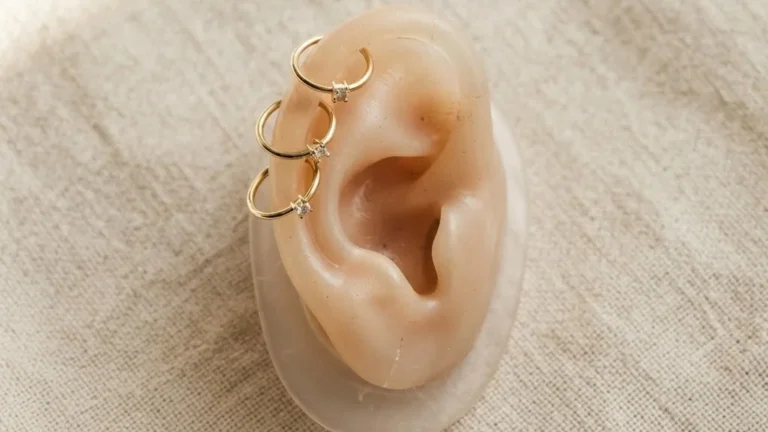
Start with the two ends everyone roughly agrees on. MADAJ Piercings describes ear piercings running “from about 2/10 for the lobe to 8/10 for the industrial,” which makes the lobe the floor and the industrial near the ceiling on its pain-levels chart. The lobe is fatty, nerve-sparse tissue with no cartilage to resist the needle, so the jab is quick and shallow. The industrial threads a single barbell through two cartilage points at once – two punctures, dense tissue, more force.
The middle is where the agreement collapses. The table below lays the three fullest charts side by side so the gaps are visible rather than averaged away.
- Conch – MADAJ: 7/10. Piercepective: grouped with cartilage at 4 – 5/10. A two-point spread on the same hole.
- Industrial – MADAJ: 8/10. Piercepective: 6/10. Statement Collective: 8/10.
- Snug – MADAJ: 7/10. Piercepective: highest ear placement at 6 – 7/10. Statement Collective: “usually the most painful ear piercing, rated around 9/10.”
- Rook vs. daith – Statement Collective rates the rook around 7/10 versus the daith’s 6/10. MADAJ’s table orders them the other way in the lower range.
Piercepective publishes these figures on a chart it describes as ranked by real data, and Statement Collective assigns the snug its 9/10 on its own chart. Here is the decision this unlocks: do not pick a placement because a chart promised it was a “5.” The snug swings from 7 to 9 across two pages. If a specific score is driving your choice, you are trusting a number that another reputable chart contradicts by two or three points. Rank the options by tissue and by how long you are willing to care for them instead. For the broader picture of how a single studio scores every spot, our piercing pain chart guide holds one consistent 0 – 10 reading.
Why cartilage outranks the lobe when it has no nerves inside

Cartilage itself is largely insensate – it carries no significant internal nerve supply. So why does every chart rank it above the lobe? The pain comes from the surrounding structures, not the cartilage core. A needle driven through the ear presses against the perichondrium, the nerve-rich membrane wrapping the cartilage, and through the skin on both faces. Piercepective attributes the sharper, more pressing sensation of cartilage placements to exactly this perichondrial involvement. Add the simple mechanics: forcing a needle through dense, springy cartilage takes more sustained force than slipping it through the lobe’s soft fat, and that force registers as a longer, firmer push rather than a clean pop.
Placement geography matters as much as tissue. HowStuffWorks (Health) notes the tragus – the flap of cartilage in front of the ear canal – looks intimidating but carries relatively few nerve endings, so it tends to rank only moderate. The inner conch, by contrast, sits deep near the ear canal, and the sensation there is often described as a loud internal crunch rather than a sharp sting. The lesson for choosing: “near the face and scary-looking” does not equal “most painful.” The tragus you flinch at may hurt less than the flat helix spot you assumed was easy.
Six to eight weeks for a lobe, up to a year for cartilage
The jab is the part people fear, and it is the shortest part. Two separate timescales decide how an ear piercing actually feels over its life. First, the acute pain: a few seconds of sharp sensation as the needle passes, then a dull ache. Piercepective reports that afterpain lasting 20 to 60 minutes once the needle is out. That window is the throb, not the healing.
Second, and far longer, is the healing commitment. The Cleveland Clinic states that earlobe piercings “tend to heal in about six to eight weeks,” and that cartilage piercings can take anywhere up to six months to a year on its guide to what to expect when getting your ears pierced. That difference reframes the whole pain question. A lobe hurts for seconds and settles in roughly 8 weeks. The number on the pain chart tells you about one afternoon. The healing timeline tells you about the next year.
During that long cartilage window, snags and knocks reintroduce pain and can disturb the forming channel. This is why starter jewelry sizing and metal choice matter well past the first week – a point that applies whether you are healing a first hole or adding to a stack. If you are planning more than one spot, our multiple ear piercings guide and the gentler double ear piercing route are worth reading before you book.
See a piercer or a clinician promptly if a healing piercing shows spreading redness, increasing rather than fading pain after the first days, warmth, pus, or fever. Normal healing trends toward less discomfort over time; pain that escalates is a signal, not a stage.
Why a needle beats a gun, and never a gun on cartilage
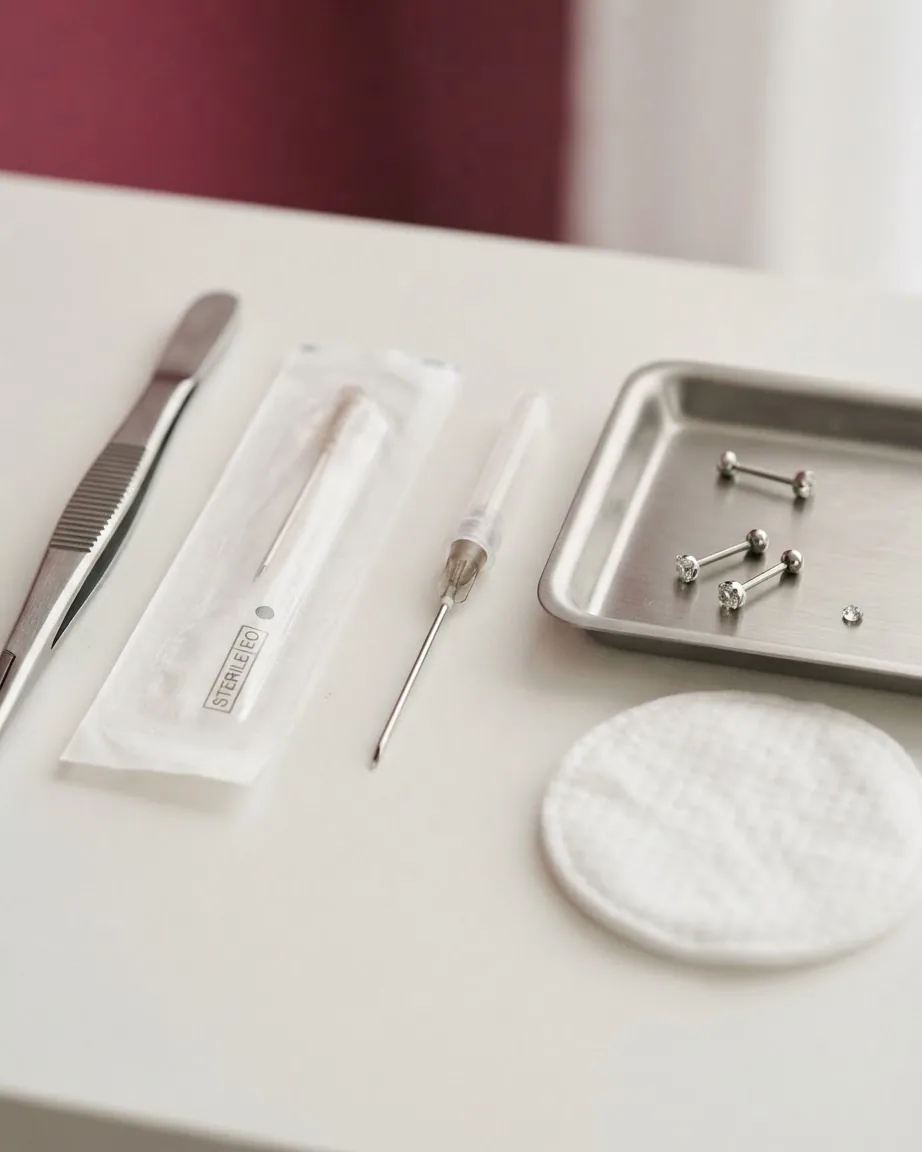
The method changes the safety math more than it changes the pain. A piercing needle is hollow and sharp; it removes a clean core of tissue and leaves a channel that can drain and heal. A spring-loaded gun does not cut – it forces a blunt stud through the ear by pressure. That is crush trauma, and on cartilage it carries specific, documented risks the Association of Professional Piercers has long warned about: the blunt force can shatter the cartilage, and the resulting damage can lead to auricular chondritis, an inflammation of the cartilage. The APP’s position is a hard rule, not a preference: guns do not belong anywhere on cartilage.
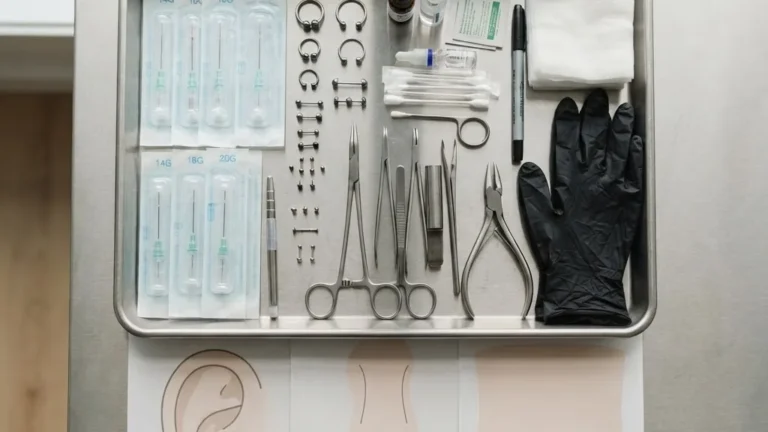
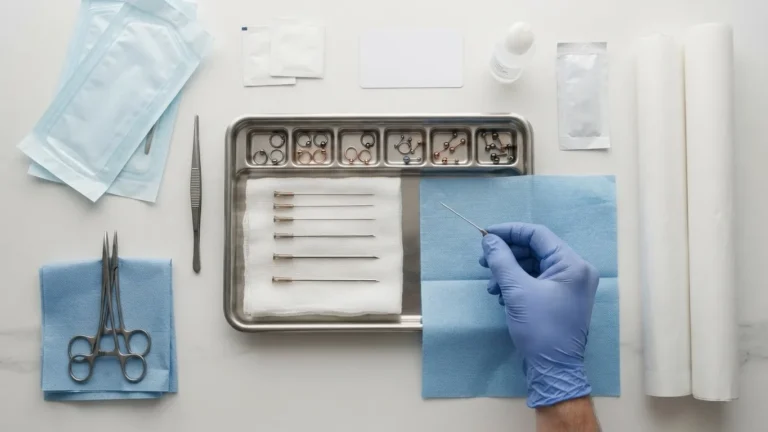
Sterilization is the other half. A single-use piercing needle is sterile and discarded. Most piercing guns are plastic, and plastic cannot be run through an autoclave – the steam-sterilization standard – which means the mechanism contacting your ear cannot be fully sterilized between clients. The APP’s sterilization guidance is published on its professional standards site. Combine blunt trauma with an un-autoclavable instrument and the reasoning behind “needle over gun” stops being about comfort and becomes about infection and tissue survival. For how the instrument itself is built and sized, our piercing needle guide goes deeper.
What an ear piercing costs, and why jewelry is a separate line
Price splits into two parts that studios bill separately: the service fee for the procedure, and the jewelry you leave wearing. Conflating them is how people get surprised at the counter. The service fee covers the piercer’s time, the sterile needle, and the setup. The jewelry is priced on its own – metal, size, and quality drive it, and implant-grade titanium or solid gold costs more than entry-level steel because it is less likely to irritate a fresh wound.
Published fees vary by city and studio, so treat any single figure as indicative rather than universal. For a concrete, sourced breakdown of how a service fee and starting jewelry stack into a real total, see our septum piercing cost breakdown, and the wider pain cost section for how placement and jewelry together shape the bill. The practical rule: ask for the service fee and the jewelry price as two separate numbers before you commit, and ask what metal the starter piece is. A low service fee attached to low-grade jewelry can cost more in the end if the metal provokes irritation during a months-long cartilage heal.
The pre-piercing ibuprofen myth: what the medical source actually says
This is the one piece of advice where getting it wrong can mean more bleeding, not less. The charts split on it directly. Piercepective recommends taking an over-the-counter anti-inflammatory – ibuprofen – 30 minutes before the appointment to reduce swelling and afterpain. The Cleveland Clinic and MADAJ Piercings say the opposite.
The medical and professional sources win this one, and here is the reasoning. Aspirin and ibuprofen thin the blood. MADAJ advises avoiding alcohol, aspirin, and ibuprofen for at least 24 hours before the appointment because they increase bleeding and swelling. The Cleveland Clinic instead recommends an extra-strength acetaminophen (Tylenol) about an hour before the procedure, which can lessen pain without the blood-thinning effect. So the resolution is clear: for pre-procedure pain relief, reach for acetaminophen roughly 60 minutes ahead, not ibuprofen 30 minutes ahead. The anti-inflammatory that Piercepective recommends is the one the medical guidance tells you to skip before a puncture.
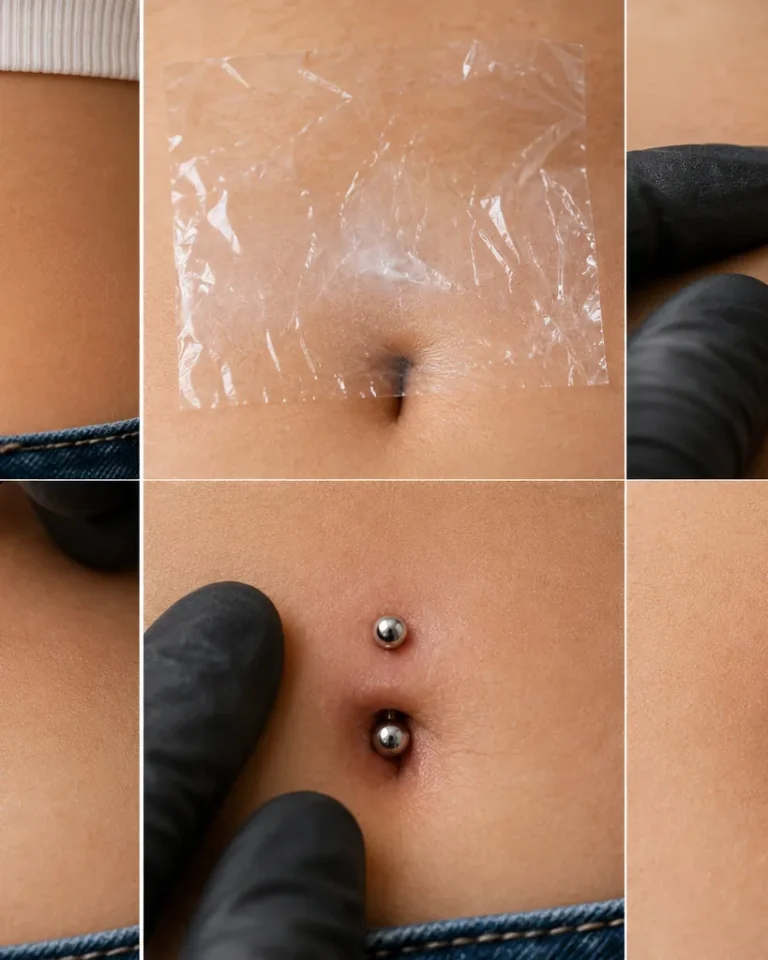
On topical numbing, MADAJ describes applying a lidocaine-based cream such as EMLA to the area 30 minutes to one hour before the appointment and covering it with plastic wrap to hold it in place. Numbing cream dulls the skin’s surface; it does little for the deep cartilage push, so set expectations accordingly. None of this is a substitute for your piercer’s own pre-appointment instructions – follow theirs first, and raise any medication you take with them.
The daith-migraine and period-pain claims, checked against the evidence
Two popular beliefs attach to ear piercing pain, and both deserve a correction grounded in sources rather than repetition.
The first is that a daith piercing relieves migraines. The American Migraine Foundation’s position is that no research supports the daith as a migraine treatment, and that any reported relief is widely attributed to placebo. If migraine relief is the only reason you are considering a daith, the evidence does not back the claim – choose the placement on its own merits instead.
The second is that getting pierced “during your period” hurts more. A commercial page lists the days around menstruation as one of several factors that increase pain sensitivity. The peer-reviewed physiology literature does not support that certainty. The Frontiers in Physiology review by Tan et al. (2020) notes that the menstrual cycle, which lasts for an average of 28 days, divides broadly into follicular and luteal phases, and that the better-controlled studies mostly did not find any effect of menstrual-cycle phase on experimental pain sensitivity. You can read the review on frontiersin.org. The same review frames chronic pain as pain persisting for more than 3 months – a reminder that the research here studies lasting pain conditions, not the one-second jab of a piercing. The takeaway: do not reschedule your appointment around your cycle in the belief that it changes how much the needle hurts. The physiology does not establish that effect.
When it is safe to change the jewelry
Changing the starter piece too early is a common way to reintroduce pain and disturb a channel that only looks healed from the outside. The timeline follows the tissue, not the calendar comfort of wanting a new look. Because a lobe takes about 6 to 8 weeks to heal and cartilage can take up to a year, the safe window to swap jewelry differs sharply between them.
For the lobe, the surface may feel settled near the end of the 8 weeks, but confirming readiness with the piercer who did the work is the cautious move – a tract can be fragile under a seam that looks closed. For cartilage, patience is not optional. Swapping during the months-long heal can traumatize the forming channel, restart swelling, and invite irritation bumps. When in doubt, the person to decide is the piercer, who can inspect the channel; a clinician should see anything that looks infected rather than simply unhealed. For the geometry of why the right starter shape matters through that long window, see our curved barbell for rook guide and the rook jewelry sizing notes.
The rule that ties pain, cost, method and healing together: the number on any ear piercing pain scale describes a few seconds. The placement you choose commits you to weeks or months of care, a needle rather than a gun, jewelry you should not rush to change, and acetaminophen rather than ibuprofen on the way in. Those decisions outlast the jab by a wide margin.
How Far Apart the Charts Are: the Disagreement in Points
Because all three charts use the same 1 – 10 scale, you can subtract one chart’s score from another’s on the same hole and read the disagreement directly. Doing that arithmetic shows the gaps are not rounding noise – on the snug, the two charts are a full 30% of the entire scale apart, which means the single most-cited “most painful” piercing has no agreed number at all.
- Snug – 3 points apart. Statement Collective’s 9/10 minus Piercepective’s 6/10 leaves a 3-point gap, or 30% of the whole 10-point scale, on the placement most often called the worst.
- Conch – 2 points apart. MADAJ’s 7/10 minus Piercepective’s 5/10 gives a 2-point spread on the same hole.
- Industrial – 2 points apart. MADAJ’s 8/10 minus Piercepective’s 6/10 is another 2-point gap, even though Statement Collective lands back at 8/10.
The takeaway from the subtraction: if a chart’s exact score is driving your choice, a 2-to-3-point swing between equally reputable charts is swallowing that decision whole. Rank by tissue type and healing time instead of the digit.
Frequently asked questions
Which ear piercing is objectively the least painful?
The earlobe, consistently. It is the one spot the major charts broadly agree on, with MADAJ placing it at roughly 2/10 – fatty tissue, no cartilage resistance, and a fast puncture. Because it carries the shortest healing commitment too, it is the gentlest entry point for anyone nervous about either the jab or the months of aftercare that cartilage demands.
Can I use numbing cream for a cartilage piercing like the conch?
A lidocaine-based cream numbs the skin surface but reaches poorly into dense cartilage, so a deep conch or industrial still delivers a firm internal push despite the cream. MADAJ describes applying it 30 to 60 minutes beforehand under plastic wrap. Treat it as partial help for the surface sting, not a full block, and clear its use with your piercer first.
If two charts disagree on a placement, which number should I trust?
Neither as a precise figure. Every chart uses an unanchored 1 – 10 opinion scale, so a conch marked 5 on one page and 7 on another is not a measurement error – the scales do not share a reference point. Use the ranking to separate lobe-tier from cartilage-tier placements, then let tissue type and healing length drive the actual choice.
Does a piercing hurt more if I take ibuprofen first to relax?
The concern is bleeding, not relaxation. Ibuprofen and aspirin thin the blood, which can raise bleeding and swelling during the puncture; MADAJ advises avoiding them for 24 hours beforehand. The Cleveland Clinic suggests extra-strength acetaminophen about an hour ahead instead, since it eases pain without that blood-thinning effect.