A cartilage piercing can still be mid-healing a full year after the appointment. Ask how long does an ear piercing take to heal, and the useful answer starts with a counter-question: which part of the ear? An earlobe and a cartilage spot run on different clocks, and treating them as one schedule is where most aftercare mistakes start.
Placement sets the timeline. An earlobe piercing generally heals in six to eight weeks. A cartilage piercing – helix, tragus, conch and similar spots – can take four to 12 months. The six-week figure that circulates everywhere refers to keeping starter jewelry in place, not to full healing. Early soreness, itching and faint color change are common in the first weeks. Pronounced swelling, heat, spreading redness or darkening, bleeding, pus or feeling unwell point toward infection and warrant a clinician. And cartilage carries a higher-consequence complication profile than the lobe, which changes the decision before you ever book it.
Six weeks keeps the jewelry in, not proof of healing
The six-week number is real, but it answers a different question than most people think. The American Academy of Dermatology advises keeping starter jewelry in a new piercing for six weeks or more, including at night, so the channel does not close or get disturbed. That is a minimum for jewelry retention – a don’t-take-it-out-yet instruction – not a certificate that the wound has closed. You can read the American Academy of Dermatology Association’s guidance on caring for new piercings.
The gap matters most on cartilage. A helix can be well past six weeks and still forming tissue inside the channel. Reading the retention minimum as a healing deadline is exactly how a piercing gets jewelry swapped, bumped or neglected months before it is ready.
How long does an ear piercing take to heal by placement?
Cleveland Clinic gives the two windows directly: earlobe piercings take six to eight weeks to heal, and cartilage piercings may take four to 12 months. Their patient material on an ear keloid states those figures. The spread is wide because dense, slow-perfusing cartilage rebuilds far more slowly than soft lobe tissue.
| Placement | Typical healing window |
|---|---|
| Earlobe | Six to eight weeks |
| Cartilage (helix, tragus, conch and similar) | Four to 12 months |
So two sources can both be right while sounding contradictory: the six-weeks-or-more retention figure and the four-to-12-month cartilage window describe different things. For the lobe case specifically, see our lobe piercing healing guide, and for placement-by-placement differences, our types of ear piercings guide.
Cartilage piercings and the perichondritis risk
Longer healing is only part of what sets cartilage apart. MedlinePlus, the patient reference from the U.S. National Library of Medicine, identifies cartilage piercing as a leading cause of perichondritis, an infection of the tissue around the cartilage. In its wording, “Ear piercing through the cartilage is probably the major risk factor today.”
Left unchecked, perichondritis can advance to chondritis – infection of the cartilage itself – which can cause severe, lasting damage to the structure of the ear. That shifts the choice beyond the calendar. A slower heal is one problem; a complication that can distort the shape of the ear is a different order of problem, and it is the reason cartilage warning signs are not something to watch and wait on.
Normal early soreness versus infection warning signs
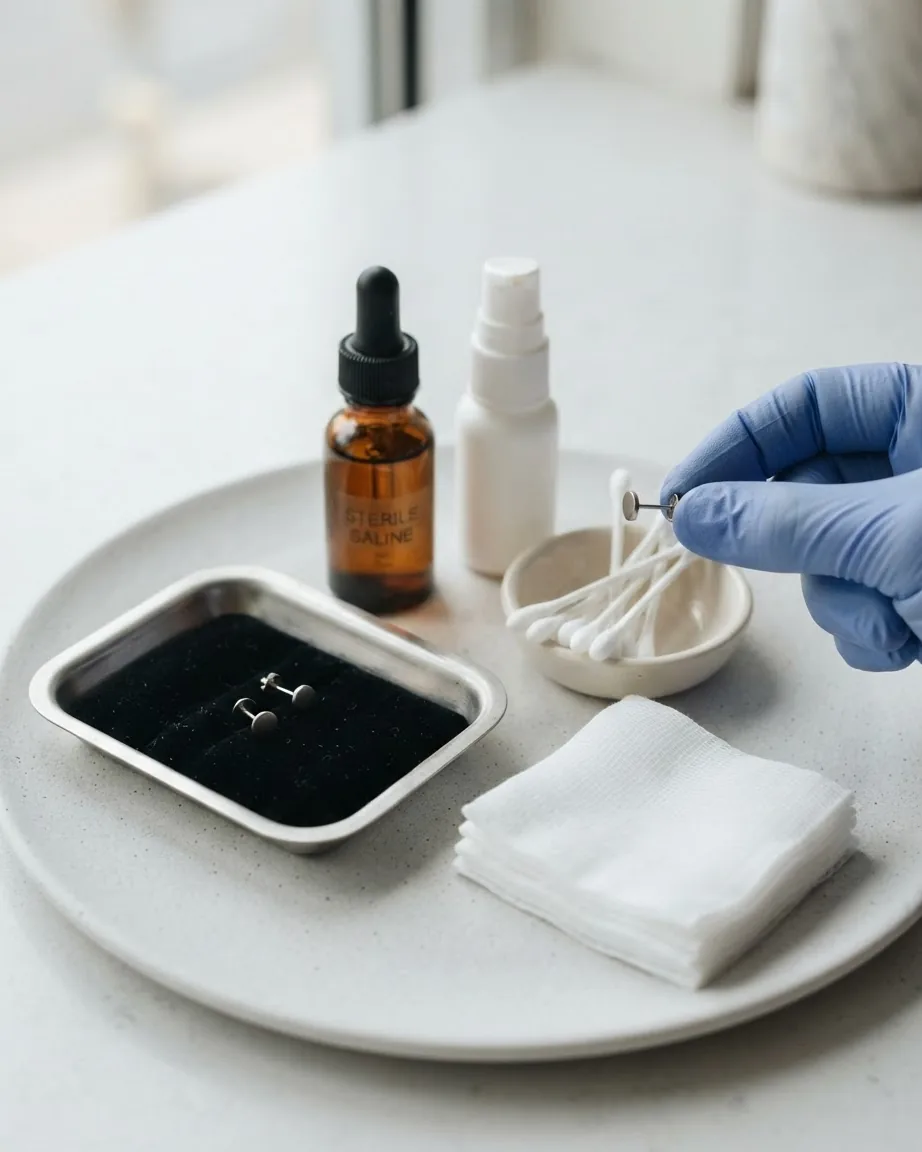
The hard part for most people is telling routine healing from trouble. The NHS draws the line by symptom. In the first weeks, a new piercing can be tender and itchy, and the skin around it may look slightly red on lighter skin or a little darker than usual on darker skin. That cluster, on its own, fits ordinary early healing.
What does not fit is a louder set of signs. The National Health Service guidance on infected piercings flags these as reasons to act:
- Swelling, pain or heat around the piercing
- Skin that is very red, or markedly darker depending on your skin tone
- Blood or pus coming from the site
- Feeling generally unwell, which can signal the infection is spreading
Mild itching and faint color change sit in one group; swelling, heat, pus and feeling ill sit in another. They are not interchangeable, and the second group is your threshold for getting it looked at.
Cleaning a fresh piercing without overcleaning
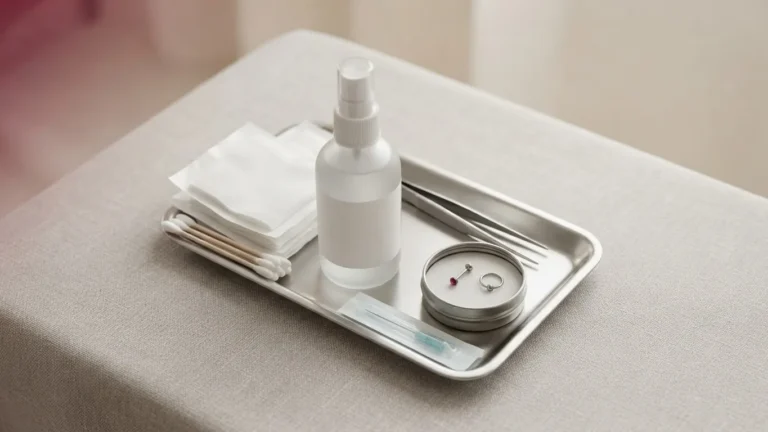
Day-to-day care is mostly restraint. Keep the starter jewelry in for the retention period above, leave the piercing alone between cleanings, and follow the aftercare instructions your piercer gives you for that specific placement. Harsh products and constant handling irritate a healing channel and can stall it; more cleaning is not better cleaning. If you are unsure what a given spot needs, ask the studio that did it rather than improvising – jewelry length, gauge and material all factor in, and a tragus or conch does not behave like a lobe. For the broader picture, our aftercare healing material sits alongside this one.
Infected-looking piercing? Why the jewelry usually stays in
An infected-looking piercing triggers an obvious instinct: pull the jewelry out. NHS guidance points the other way – leave your jewelry in unless a doctor tells you to take it out. Removing it can let the opening close over and seal infection inside, where it is harder to treat.
So the sequence is: keep the jewelry in, and get the piercing assessed by a clinician if the warning signs appear. Do not sit on a cartilage piercing that looks wrong, given how perichondritis can progress. If anything about a healing piercing reads as infected – spreading redness or darkening, heat, pus, or feeling unwell – that is a reason to see a professional, not to self-treat by taking it apart.
The timeline you plan around depends on where you pierce
Put it together and the honest answer to how long an ear piercing takes to heal is a range with a decision attached. An earlobe is the short, forgiving case. Cartilage asks for patience measured in months, steady jewelry retention, and a lower tolerance for ignoring warning signs, because the complication it can run into reaches the structure of the ear itself. Match your expectations to the placement, keep the starter jewelry in through the retention period, watch for the infection signs rather than the calendar alone, and bring anything that looks wrong to a professional with the jewelry still in. That is the whole of it.
Cartilage versus lobe: the real size of the gap
Both healing windows come straight from Cleveland Clinic, but they’re quoted in different units – weeks for the lobe, months for cartilage – which hides how far apart they actually are. The lobe window and the cartilage window do not even touch: the earlobe wraps up in a month or two, while cartilage is still rebuilding deep into the following seasons, and nothing in the middle bridges the two.
- Earlobe: 6 to 8 weeks.
- Cartilage: 4 to 12 months.
This is the part that catches people out. A cartilage piercing, even running as fast as it possibly can, is still working on itself long after a lobe pierced the same day would have fully settled. The practical upshot is simple: a six-week mental model, borrowed from the lobe or from the jewelry-retention minimum, is wrong for cartilage by a wide margin, and planning your aftercare around that borrowed number sets you up to swap jewelry or drop your guard while the channel is nowhere near done. Treat the cartilage clock as its own thing, running in months, and judge readiness by how the piercing behaves rather than by the week on the calendar.