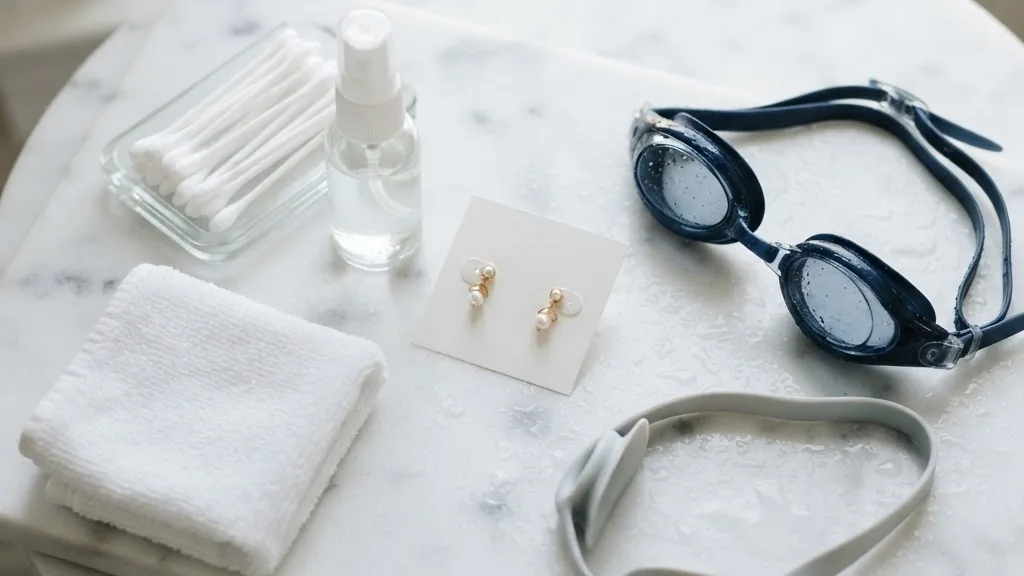
Can you swim after getting ears pierced? The short, honest answer is no – not until the piercing has fully healed, which for a standard earlobe means roughly 6 to 8 weeks of initial healing and up to 6 months to close completely on the inside. A fresh piercing is an open wound, and pools, lakes, oceans, and hot tubs are full of bacteria that can turn a simple new earring into an infection.
It is a frustrating answer, especially if you got your ears done at the start of summer with a beach trip or a pool party already on the calendar. But the piercing channel that runs through your ear is a small tunnel of raw tissue, and submerging it in water that is not sterile is one of the fastest ways to invite trouble. The good news is that the rules are simple, the timeline is predictable, and there are ways to handle the water you cannot avoid.
The guidance below reflects current aftercare recommendations from the Association of Professional Piercers, infection guidance from the Mayo Clinic, and waterborne-illness data from the CDC. When your own piercing looks or feels off, your studio piercer and, if needed, a clinician are the right people to call.
Quick answer: Wait until the piercing is fully healed before swimming. Earlobe piercings need about 6 to 8 weeks of initial healing and up to 6 months to fully mature; cartilage piercings such as a helix or conch take 3 to 12 months. While healing, the Association of Professional Piercers recommends avoiding submersion in pools, lakes, oceans, and hot tubs, because waterborne bacteria such as Pseudomonas aeruginosa can infect an open piercing. If you truly cannot avoid the water, a waterproof film dressing reduces risk but does not remove it.
The short answer, and the honest timeline
Piercers and dermatologists agree on the core rule: keep a healing piercing out of standing or shared water. The reason people get tripped up is that a piercing can look and feel healed long before it actually is. Skin heals from the outside inward, so the surface can seal and calm down while the tissue deep in the channel is still raw. The Association of Professional Piercers makes this point directly, noting that a piercing may seem healed before the healing process is truly complete.
That gap between “looks fine” and “is fine” is exactly where swimmers get into trouble. A lobe that has stopped being sore at week three is not a lobe that is ready for a lake. The initial healing window for an earlobe is commonly cited at 6 to 8 weeks, but full internal healing can run to about 6 months, and cartilage takes far longer. Many studios give a practical minimum of at least 4 to 6 weeks before any water exposure, but the honest gate is full healing, not a fixed date. If you want the complete breakdown by placement, our guide on how long ear piercings take to heal lays out every ear location.
Here is the uncomfortable truth for summer piercings: if you get your ears done in June, a properly healed lobe may not be swim-ready until late summer, and a cartilage piercing done in June may not be swim-ready until the following year. Planning the piercing around the calendar, rather than the calendar around the piercing, saves a lot of grief.
Why water and a fresh piercing do not mix
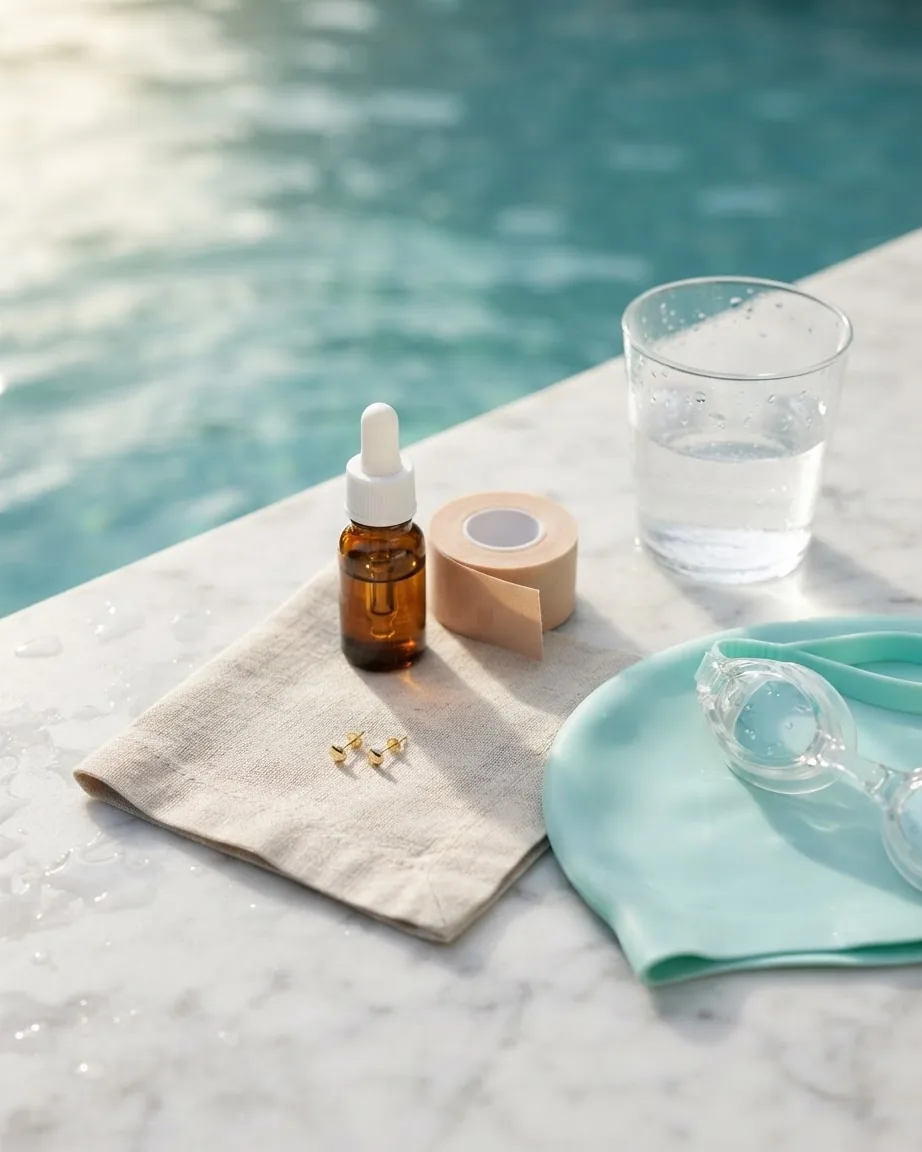
A new piercing is not a decoration sitting on top of your skin. It is a puncture wound with a channel, called a fistula, running straight through living tissue. Until that channel lines itself with skin, anything in the water has a direct route inside. Pool water, lake water, ocean water, and hot tub water all carry microorganisms, and some of them specialize in exactly this kind of warm, moist opening.
The bacterium piercers and public-health agencies worry about most here is Pseudomonas aeruginosa. It thrives in warm water and is the organism behind “hot tub rash” (folliculitis) and swimmer’s ear (otitis externa). The CDC tracks recreational water illnesses tied to it; in one Maine hotel-pool outbreak in March 2023, 23 people developed rashes and ear or limb symptoms after swimming. Pseudomonas is normally knocked down by proper chlorine or bromine, which is why the CDC recommends a minimum free-chlorine level of at least 1 part per million in public pools. But an under-treated pool, and especially a hot tub where heat burns off disinfectant fast, can let the bug flourish.
Bacteria are only half the problem. Chlorine and salt are harsh on a raw wound. Chlorinated water dries and irritates healing tissue, which can slow the process and leave the piercing angry and inflamed even if no infection takes hold. Saltwater stings and is far from sterile. On top of that, sunscreen, body oils, sand, and other swimmers’ contributions all end up in the same water. For all of these reasons, the Association of Professional Piercers advises avoiding submerging a healing piercing in bodies of water such as lakes, pools, oceans, and hot tubs, and you can read the full aftercare guidance on the Association of Professional Piercers site.
How long to wait: a healing-time chart
Not all ear piercings heal at the same pace, and this is where a lot of confusion starts. Lobes are soft tissue with good blood flow, so they heal fastest. Cartilage has far less blood supply, so a helix, tragus, or conch can take many months and is more prone to complications. The chart below shows typical healing windows and the point at which swimming becomes reasonable. Treat these as ranges, not guarantees, because everyone heals differently.
| Piercing type | Initial healing | Full healing | Swim-safe when |
|---|---|---|---|
| Earlobe (standard) | 6-8 weeks | Up to ~6 months | Fully healed, no tenderness or discharge |
| Helix / upper cartilage | 3-6 months | Up to ~12 months | Fully healed and confirmed by your piercer |
| Tragus | 3-6 months | 6-12 months | Fully healed, no soreness |
| Conch | 4-6 months | 6-12 months | Fully healed and stable |
| Industrial (two cartilage holes) | 4-6 months | Up to ~12 months | Both holes fully healed |
The pattern is clear: cartilage buys you a long wait. If you are deciding between placements and want something swim-season friendly, a lobe heals in a fraction of the time a helix piercing needs. Cartilage also punishes mistakes more harshly, since a cartilage infection is more serious and harder to treat than a lobe infection. Whatever the placement, the swim-safe column is the one that matters: not a date on the calendar, but the moment the piercing is genuinely healed, with no tenderness, crusting, or discharge, ideally confirmed by the professional who did it.
What to do if you absolutely must get in the water
Sometimes life does not wait for a piercing. A pre-booked vacation, a swim class you cannot skip, or a job that involves water can all collide with a healing timeline. The safest choice is still to stay out of the water, but if that is genuinely impossible, the Association of Professional Piercers describes one fallback: protecting the piercing with a waterproof, transparent film dressing of the kind sold at pharmacies. This is a harm-reduction step, not a green light, and it comes with real limits.
- The contours of an ear are hard to seal completely, so water can still wick in under the edges of a dressing.
- A dressing that traps moisture against the piercing can create its own warm, damp pocket where bacteria grow.
- Adhesive films can tug on the jewelry when you peel them off, irritating the very wound you are protecting.
- A film dressing does nothing about chlorine or salt that reaches the piercing anyway.
- No dressing makes lake, ocean, or hot tub water safe for an open wound; it only shortens the exposure.
If you do end up in the water, treat the piercing carefully before and after. A short, careful routine reduces the odds of a problem:
- Step 1 – Apply a fresh waterproof film dressing over a clean, dry piercing right before you get in, and keep the time in the water as short as you can.
- Step 2 – Get out, remove the dressing, and rinse the piercing with clean running water to flush off pool or lake water.
- Step 3 – Spray the area with sterile saline wound wash (0.9 percent sodium chloride as the only ingredient) to clean it the way the APP recommends.
- Step 4 – Pat it dry gently with disposable gauze, never a shared cloth towel that can harbor bacteria.
- Step 5 – Watch the piercing closely for the next few days for any redness, swelling, or discharge.
Skip the harsh stuff entirely. The APP specifically advises against alcohol, hydrogen peroxide, antibacterial soaps, iodine, and thick ointments, all of which can dry, irritate, or trap bacteria against a healing piercing rather than help it.
Saltwater versus chlorine versus a lake: which is riskiest
People often assume the ocean is the “natural” and therefore safe option, or that a chlorinated pool is sterile. Neither is true, and it helps to rank the water you might meet. None of these are safe for an unhealed piercing, but they are not equally risky either.
A well-maintained public pool is the most controlled environment, because chlorine or bromine actively kills most bacteria when it is dosed correctly to that 1 part per million minimum. Even then, chlorine irritates a raw wound and dosing is never guaranteed at a busy pool. The ocean is next: saltwater is not sterile, it carries marine bacteria including Vibrio species, and sand grinding against a piercing adds mechanical irritation. Lakes, ponds, rivers, and hot tubs sit at the high-risk end. Still or slow-moving fresh water can be warm and full of organic matter and runoff, and hot tubs combine heat, aeration, and heavy bather loads in a way that breaks down disinfectant quickly, which is exactly why Pseudomonas outbreaks cluster around them.
So the practical ranking, from least to most risky for an open piercing, runs roughly: a properly chlorinated pool, then the ocean, then a lake or hot tub. Chlorine versus saltwater is not really a contest of safe options; it is a contest of which irritant and which bacterial mix you would rather keep away from your ear. The honest takeaway is that all of them belong on the “wait until healed” list.
Signs your piercing is infected
Even careful people run into problems, so it helps to know the difference between normal healing and a genuine infection. In the first weeks, some tenderness, light pink color, a little clear or whitish crust, and mild swelling are all part of ordinary healing. A piercing that is infected looks and feels worse, not better, as the days pass.
The Mayo Clinic describes the warning signs of an infected ear piercing as redness, pain, and swelling around the site, along with fluid that looks like pus draining from the hole. Additional red flags are worth watching for:
- Redness or dark discoloration that spreads outward rather than fading.
- Increasing pain, throbbing, or heat radiating from the piercing.
- Yellow or green pus, or foul-smelling discharge.
- Swelling that grows instead of settling after the first few days.
- Fever or feeling generally unwell, which can signal a spreading infection.
Cartilage deserves extra caution. Because it has little blood supply, a cartilage infection is harder to clear and can lead to lasting damage or deformity of the ear, so a hot, very red, swollen cartilage piercing is never something to sit on. If you are unsure whether what you are seeing is irritation or infection, the safest move is to have it looked at rather than guess.
When to see a professional piercer or a doctor
For a minor irritation, your studio piercer is often the fastest source of good advice, since they can tell inflammation from infection and check that the jewelry and fit are not part of the problem. For anything that looks like a true infection, medical guidance matters. The Mayo Clinic suggests that for a minor soft-tissue piercing infection you can wash your hands, apply a clean, warm, damp compress to the site for about 15 minutes, and repeat that roughly four times within 24 hours to encourage drainage and ease discomfort.
Escalate to a healthcare professional if the redness and swelling do not improve, if the site keeps oozing blood or pus, or if you develop a fever. Seek care promptly for any cartilage piercing that is painful, itchy, swollen, and very red or dark, because cartilage infections can move fast. You can read the full self-care and when-to-seek-help guidance from the Mayo Clinic. One important caution: do not remove the jewelry on your own if you suspect an infection, because taking it out can let the surface close and trap the infection inside. Ask your piercer or clinician first.
Getting back in the pool safely
Once the piercing is genuinely healed, swimming goes back to being ordinary. “Healed” means no tenderness, no crusting, no discharge, and a channel that has fully lined itself with skin, which for cartilage is best confirmed by the piercer who did it. Even then, a few habits keep a healed piercing happy: rinse your ears with clean water after a pool or lake, dry them gently, and give sensitive skin a spray of saline if chlorine leaves it feeling tight.
If you swim often and want to protect newer jewelry or a piercing that still feels a little sensitive, low-profile piercing retainers can be a practical swap for elaborate earrings, since they are smoother and less likely to snag. They do not make an unhealed piercing safe to submerge, but for a healed one they cut down on irritation and lost jewelry. When in doubt about whether your particular placement is ready, ask the professional who pierced you rather than testing it in a lake.
Frequently asked questions
How long after ear piercing can I swim?
Wait until the piercing is fully healed, not just until it stops hurting. For a standard earlobe that means roughly 6 to 8 weeks of initial healing and up to about 6 months for full internal healing; many studios set a practical minimum of at least 4 to 6 weeks before any water. Cartilage piercings such as a helix or conch take 3 to 12 months, so plan on a much longer wait before submerging them.
Can I swim if I cover my piercing with a waterproof bandage?
A waterproof, transparent film dressing can reduce exposure for a short, unavoidable dip, and the Association of Professional Piercers lists it as a fallback. It is not a green light. The ear’s shape makes a full seal hard, water can wick in, and trapped moisture can breed bacteria of its own. If you use one, keep the swim short, then remove it, rinse, and spray with sterile saline afterward.
Is saltwater or chlorine safer for a new piercing?
Neither is safe for an unhealed piercing. A properly chlorinated pool kills most bacteria but still irritates a raw wound, while ocean saltwater is not sterile and carries marine bacteria and sand. Between the two, a well-maintained pool is the more controlled environment, but the real answer is to keep both away from the piercing until it is fully healed.
What happens if I already went swimming with a fresh piercing?
Do not panic, but do act. Rinse the piercing with clean water, spray it with sterile saline wound wash, and dry it gently with disposable gauze. Then watch it closely for a few days. If you see spreading redness, increasing pain, swelling, or pus, treat it as a possible infection and contact your piercer or a clinician rather than waiting it out.
Are hot tubs worse than pools?
Generally yes. Hot tubs combine warm water, heavy aeration, and many bathers, which breaks down chlorine or bromine quickly and creates ideal conditions for Pseudomonas aeruginosa, the bacterium behind hot tub rash. Public-health outbreaks tied to recreational water often trace back to hot tubs, so they are among the riskiest places to submerge a healing piercing.
Can I shower or bathe with a new ear piercing?
Showering is fine and even helpful, since clean running water and a quick saline spray are part of normal aftercare. The concern is submersion in shared or standing water, so avoid soaking in a bathtub, and let shampoo and soap rinse off rather than sit on the piercing. A brief shower is very different from sitting in a pool, lake, or hot tub.
The bottom line
Can you swim after getting your ears pierced? Not until it is truly healed. Give an earlobe its 6 to 8 weeks of initial healing and up to 6 months to finish, and give cartilage the 3 to 12 months it needs, then confirm with your piercer that the channel is genuinely closed before you submerge it. While you wait, keep pools, lakes, oceans, and hot tubs off the list, because waterborne bacteria like Pseudomonas and the drying sting of chlorine and salt are exactly what an open wound does not need. If you cannot avoid the water, treat a waterproof dressing as damage control, not permission, and clean the piercing with sterile saline afterward. Learn the difference between ordinary healing and the redness, swelling, and pus of an infection, and lean on a professional piercer or a doctor the moment something looks wrong. Patience is not the exciting answer, but it is the one that keeps your new piercing, and your ear, healthy.